
Introduction: Why Understanding the Accounts Director Role Is Critical for Your Career Growth
You’ve crushed your quota for three years straight as an Account Executive. You’ve mastered the pitch, closed the deals, and built solid client relationships. Yet somehow, you’re still stuck in the same role while watching less experienced colleagues leapfrog into leadership positions.
Here’s what nobody tells you: the jump from AE to accounts director isn’t about working harder—it’s about working differently.
The financial stakes are significant. Account directors earn 40-60% more than account executives on average, with total compensation packages often exceeding $150K in major markets. But that’s just the beginning.
This role represents a fundamental shift from tactical execution to strategic leadership. You’ll stop chasing individual deals and start architecting entire account portfolios. You’ll transform from a solo performer into a force multiplier who drives revenue through others.
Throughout this guide, you’ll discover exactly what an accounts director does, the specific responsibilities that define success, and the proven path to get there. We’ll break down salary benchmarks, required skills, and the leadership framework that separates managers from directors. Plus, you’ll learn how building your personal brand accelerates your transition into senior roles.
Let’s map your roadmap to leadership.
What Is an Accounts Director? Role Definition and Core Purpose
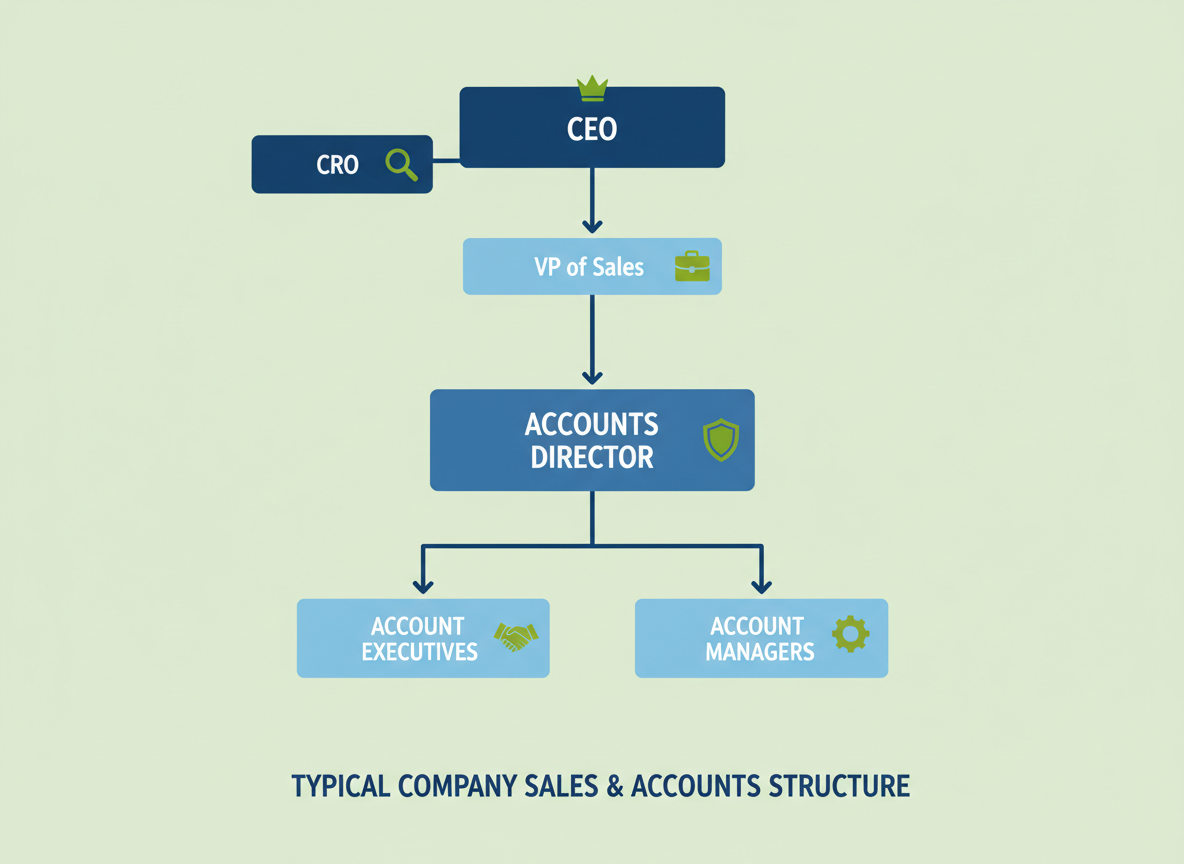
An Accounts Director is a senior leadership position responsible for managing a portfolio of key client accounts, overseeing account teams, and driving revenue growth across their assigned book of business. Think of them as the strategic quarterback who ensures clients stay happy, contracts get renewed, and revenue keeps flowing.
Here’s where titles get confusing. While “Accounts Director” and “Account Director” sound similar, they’re different roles. An Account Director typically manages specific accounts or smaller client segments, whereas an Accounts Director oversees multiple account managers and the entire accounts department’s strategy. The “Director of Accounts” title? That’s essentially the same as Accounts Director—just a different naming convention some companies prefer.
The core purpose centers on three pillars: strategic oversight of client relationships, leading and developing account management teams, and protecting revenue through retention and expansion. You’ll typically report to a VP of Sales, Chief Revenue Officer, or CMO, depending on your organization’s structure.
This isn’t a mid-level manager role—you’re carrying P&L responsibility, meaning the financial success of your accounts sits squarely on your shoulders. According to recent industry data, companies with $50M+ in revenue are 73% more likely to have dedicated Accounts Directors compared to smaller organizations.
The position has grown increasingly prevalent across professional services, SaaS, digital agencies, and B2B technology sectors. If you’re curious about how this role differs from similar positions, check out our breakdown of Account Directors to understand the career progression path.
Key Responsibilities: What Accounts Directors Actually Do Day-to-Day
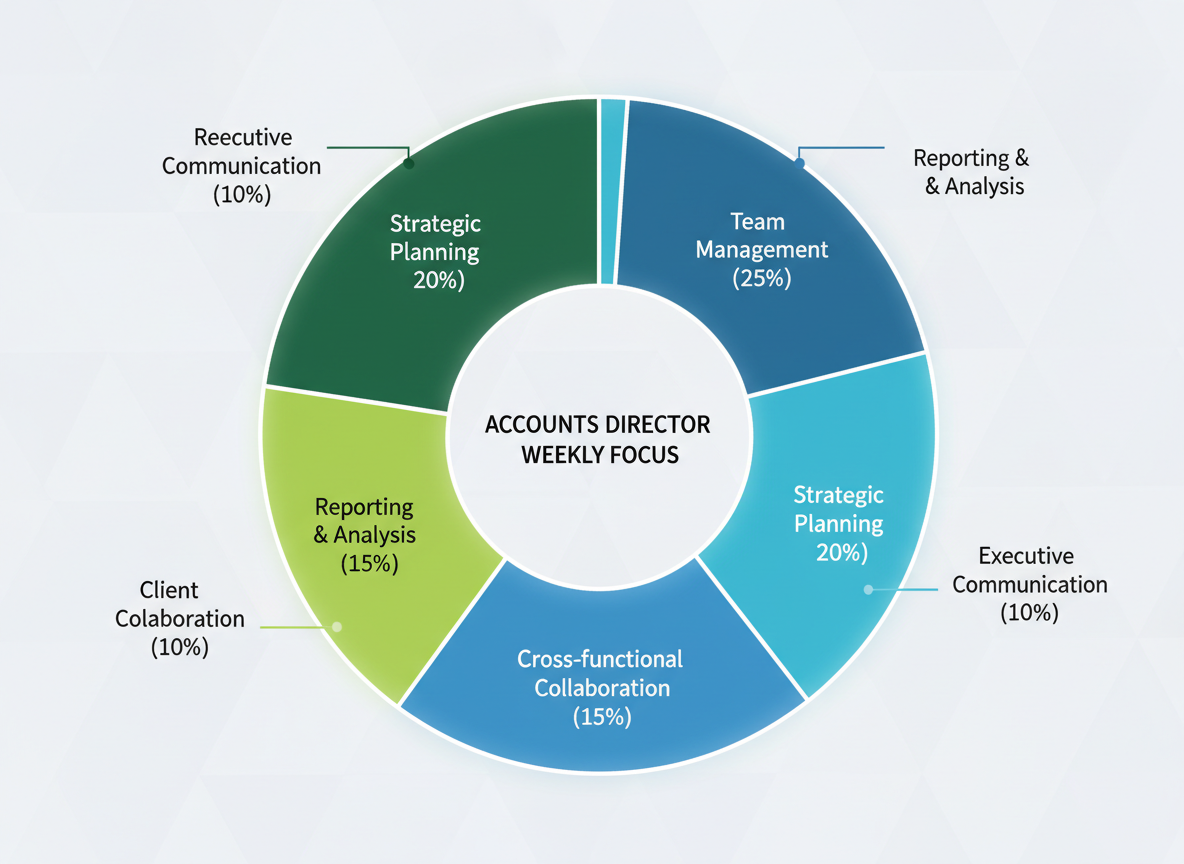
Here’s the truth: an accounts director’s role looks nothing like the tidy job description you’ll find on LinkedIn. It’s part strategist, part firefighter, part mentor—and it changes hourly.
Strategic Account Planning
You’ll own the big picture for your highest-value clients. That means mapping out 12-18 month growth strategies, identifying upsell opportunities, and making sure your portfolio doesn’t just maintain—it expands. Most accounts directors manage between $2-10 million in annual revenue across 8-15 enterprise accounts.
Team Leadership
Your Account Executives and Managers need more than task assignments. You’re coaching them through tough negotiations, reviewing their client presentations, and turning them into future leaders. Expect to spend 30-40% of your week on people development.
Revenue Accountability
You own the numbers. Forecasting, budgeting, P&L analysis—finance becomes your second language. When a deal slips or a client churns, you’re explaining why to the C-suite.
Cross-Functional Quarterback
You’ll coordinate with marketing on campaign alignment, push product teams for client-requested features, and work with customer success to prevent churn. It’s diplomacy with deadlines.
Executive Relationship Management
When a CEO-level client has concerns, they’re calling you—not your team. You handle escalations, renew contracts, and sometimes salvage relationships that seemed dead.
Typical Week Breakdown:
- Client meetings and strategy sessions: 35%
- Team management and mentoring: 30%
- Internal coordination and reporting: 20%
- Contract negotiations and renewals: 15%
The best accounts directors also leverage modern copywriting tools to help their teams craft compelling proposals and client communications faster.
Accounts Director vs. Account Executive: Understanding the Critical Differences
Here’s the truth: these roles couldn’t be more different, even though they’re often confused.
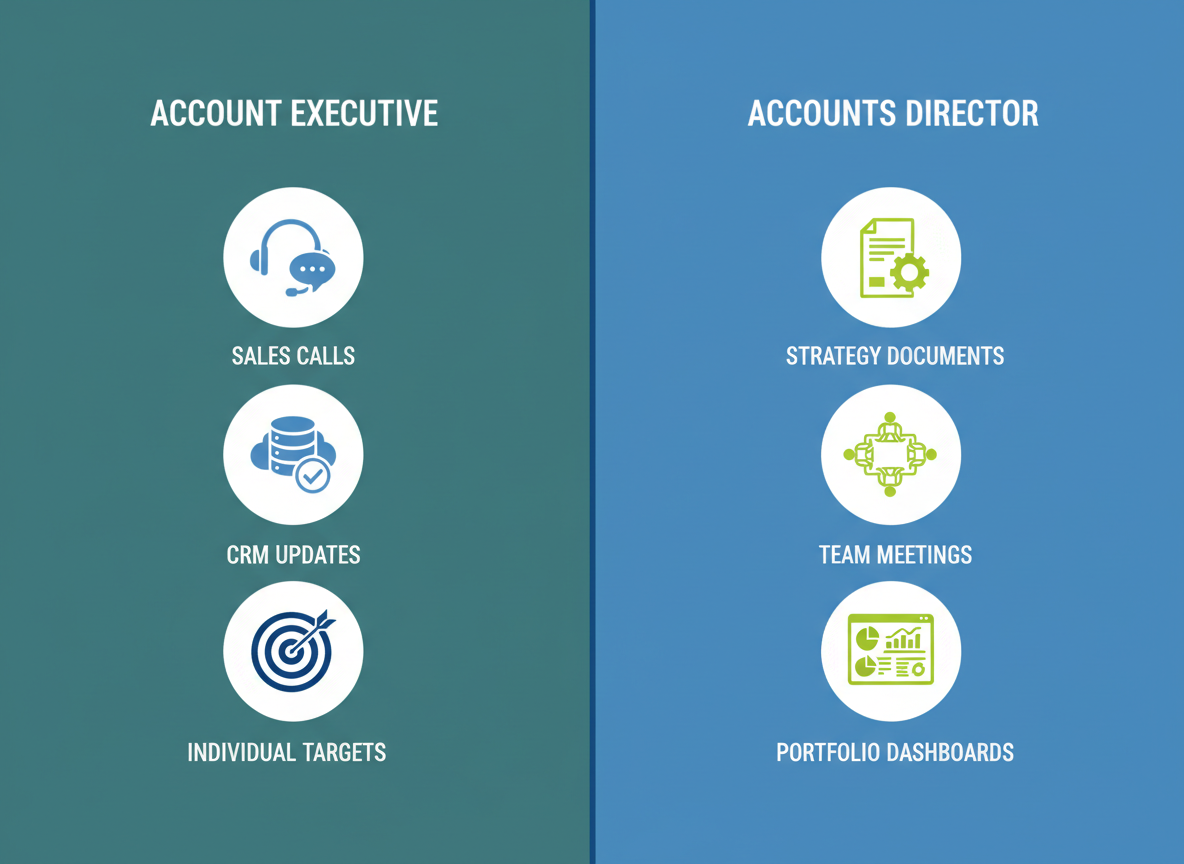
An Account Executive lives in the trenches. They’re closing deals, hitting personal quotas, and managing client relationships on a day-to-day basis. Their world revolves around monthly and quarterly targets. They’re asking: “How do I get this prospect to sign?” or “How can I upsell this client?”
An accounts director operates from 30,000 feet. They’re not chasing individual deals—they’re building strategies that impact entire portfolios and teams. Their focus? Annual revenue goals, team development, and C-suite stakeholder relationships. While an AE might meet with a marketing manager weekly, the director’s having quarterly business reviews with the CMO or CEO.
The scope difference is massive. AEs own their numbers. Directors own their team’s numbers, client retention rates, and sometimes regional or departmental revenue targets that can stretch into millions.
Decision-making authority shifts dramatically too. An AE needs approval for discounts or contract changes. A director has the autonomy to restructure accounts, reallocate resources, and make strategic pivots without seeking permission at every turn.
Common myth: AEs can’t think strategically. False. But their strategy serves immediate execution. Directors think in multi-year roadmaps and ecosystem health.
Another misconception? That directors don’t touch clients. They absolutely do—just at the executive level where relationships shape entire partnerships, not individual projects.
Essential Skills & Competencies: What You Need to Excel as an Accounts Director
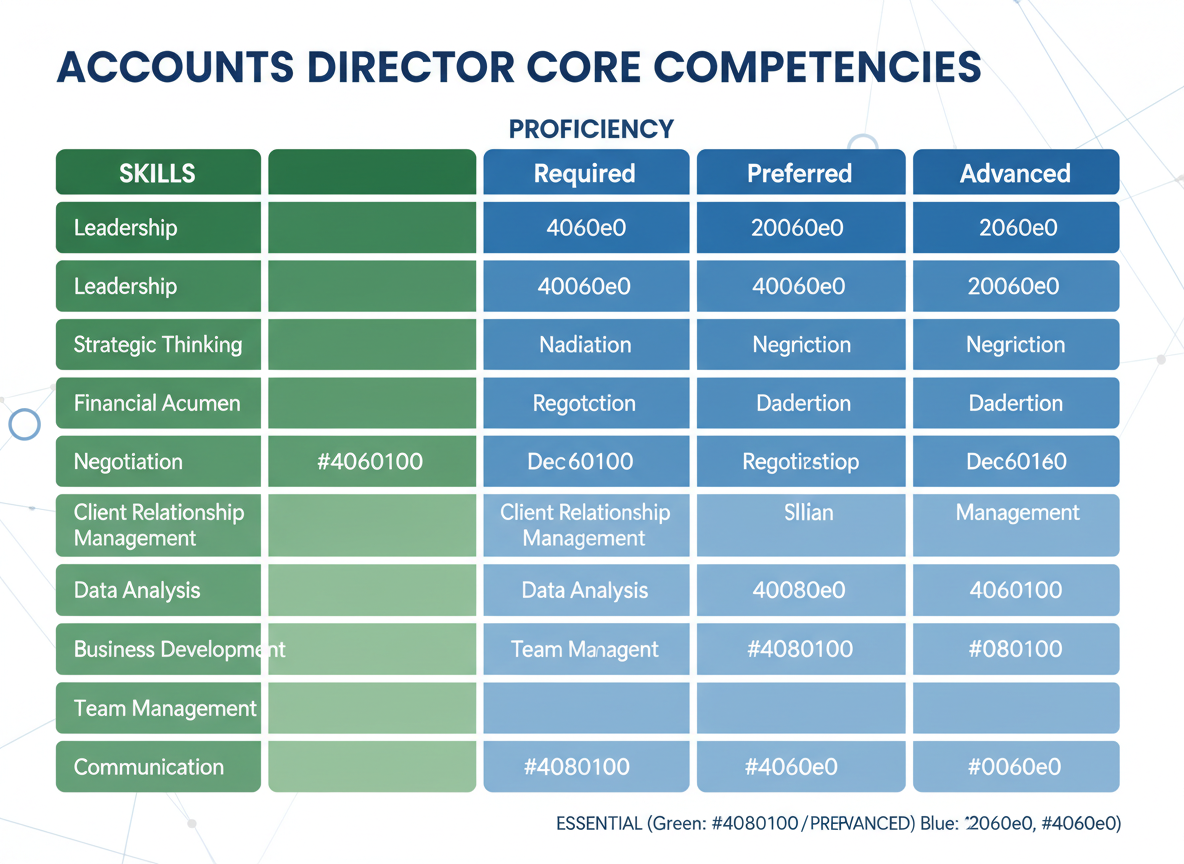
Here’s what separates great accounts directors from those who merely hold the title: they’ve mastered a blend of hard and soft skills that most people overlook.
Leadership and people management form your foundation. You’ll coach team members through client crises at 4 PM on Friday, deliver feedback that actually improves performance, and resolve conflicts between your team and demanding clients. This isn’t theoretical—you’re doing it daily.
Strategic thinking and business acumen mean you understand why your client’s competitor just launched that campaign and what it means for market positioning. You’re connecting dots others miss, translating market dynamics into actionable account strategies.
Financial literacy goes beyond reading spreadsheets. You’re managing P&L statements, forecasting revenue with accuracy that makes your CFO nod in approval, and optimizing budgets that directly impact company growth.
Advanced negotiation skills become essential when you’re sitting across from C-suite executives who’ve heard every pitch. You’ll need to influence without authority, persuade with data, and close deals that others walk away from.
But here’s what catches people off guard: the soft skills matter just as much. Emotional intelligence helps you read the room during tense client meetings. Resilience keeps you steady when you lose a major account. Adaptability lets you pivot strategies mid-quarter without losing your team’s confidence.
You don’t need perfection in every area—but you can’t afford major gaps either.
Salary & Compensation: What Accounts Directors Earn in 2026
The money’s real. Accounts directors in the United States typically earn between $120,000 and $165,000 in base salary, but that’s just the starting point. When you factor in commissions, bonuses, and equity packages, total compensation jumps to $180,000-$280,000 or more.
Location matters more than you’d think. Coastal markets like New York, San Francisco, and Seattle push the upper end of these ranges, while midwest positions might settle 15-20% lower. Remote roles? They’re landing somewhere in between, though top performers still command premium rates regardless of zip code.
Industry selection can make or break your earning potential. SaaAs companies typically offer the highest compensation packages, especially when stock options are included. Financial services and enterprise tech follow closely behind. Agency accounts directors generally earn less (averaging $135,000-$195,000 total comp), while manufacturing roles hover around similar figures but with fewer performance bonuses.
Company size creates distinct compensation structures. Startups might offer $110,000-$140,000 base with significant equity upside. Mid-market firms typically provide $130,000-$160,000 with predictable bonus structures. Enterprise organizations often exceed $170,000 base but with more conservative equity grants.
Here’s what progression looks like: entry-level directors start around $120,000, senior directors push past $180,000, and those on the VP track can hit $250,000+ in total comp.
Compared to your account executive days, you’re looking at a 40-60% increase in total earnings. Most packages include comprehensive health benefits, 401(k) matching, car allowances, and annual professional development budgets exceeding $5,000.
Career Progression Roadmap: From Account Executive to Accounts Director
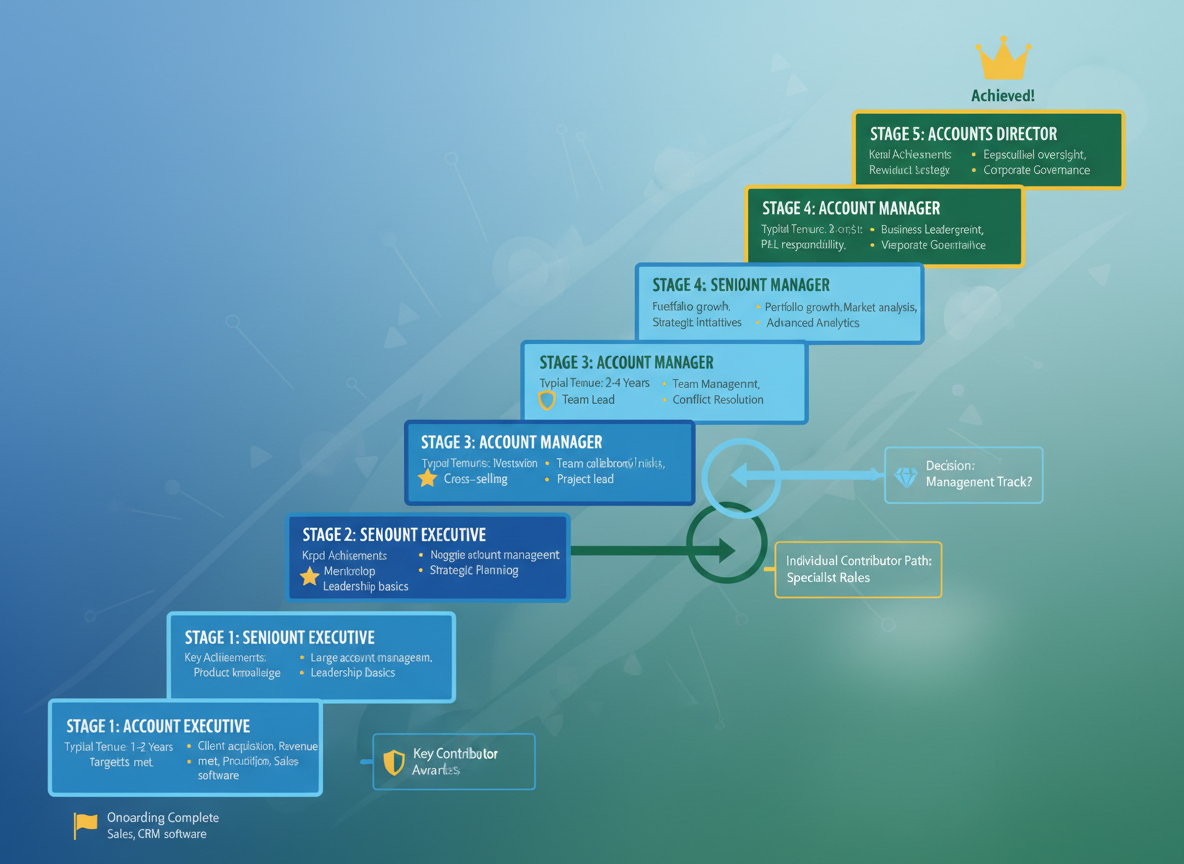
The path to becoming an accounts director isn’t a straight line, but there’s a proven roadmap most professionals follow over 5-7 years.
Years 1-2: High-Performing Account Executive
Start by mastering the fundamentals. You’ll need consistent quota attainment—aim for 100-120% of target for at least four consecutive quarters. This phase is about building credibility through results and developing deep product knowledge.
Years 3-4: Senior Account Executive or Team Lead
Now you’re taking on leadership exposure. You might mentor junior reps, lead cross-functional projects, or manage smaller strategic accounts. The goal here? Demonstrate you can influence outcomes beyond your individual contributions.
Years 4-5: Account Manager or Strategic Account Manager
Here’s where things shift. You’re managing key accounts worth $500K+ annually and thinking strategically about long-term relationships rather than just closing deals. You’ll typically oversee 8-15 major accounts and coordinate internal resources.
Years 5-7: Transition to Accounts Director
Readiness indicators include: managing accounts generating $2M+ in revenue, proven experience developing junior team members, and strategic input on department initiatives. This is also when building your professional brand and visibility becomes essential.
Alternative Pathways
Some professionals take lateral moves into customer success or sales operations before moving up. Others jump industries for director titles earlier—though you’ll sacrifice institutional knowledge for title advancement.
Common Obstacles
Getting stuck at the senior level happens when you’re great at execution but haven’t demonstrated strategic thinking. The fix? Volunteer for cross-departmental projects and speak up in planning meetings.
Consider external moves when internal promotion timelines exceed 18 months or your company lacks growth trajectory.
Education, Certifications & Professional Development Requirements
Most accounts directors hold at least a bachelor’s degree in business, marketing, communications, or related fields. Honestly? Your major matters less than many think. I’ve seen English majors and engineers excel in this role because they brought critical thinking and communication skills.
An MBA can accelerate your climb to director level, especially at Fortune 500 companies. But here’s the reality: ten years of proven client retention beats an MBA every time at mid-market firms. The degree opens doors at traditional corporations; experience opens doors everywhere else.
Certifications do carry weight. The Certified Strategic Account Manager (CSAM) from SAMA shows you’re serious about strategic relationships. Sales methodology certifications like Sandler, Challenger Sale, or SPIN Selling demonstrate mastery of consultative selling—which matters when you’re managing six-figure accounts.
Leadership development programs and executive coaching deliver tangible ROI. They’ll sharpen your skills in conflict resolution, team motivation, and executive presence. I’ve watched directors invest $5,000 in coaching and land promotions worth $30,000 more in compensation.
Don’t sleep on continuous learning. Industry conferences connect you with peers facing identical challenges. Strategic account management associations offer workshops that’ll transform your approach.
Self-directed education matters too. Books like “The Challenger Sale” and podcasts covering B2B strategy keep you sharp. Planning your professional development content? Tools like a free outline generator help structure your learning roadmap efficiently.
Bottom line: certifications enhance credibility, but results drive careers.
Performance Metrics & KPIs: How Accounts Directors Are Evaluated
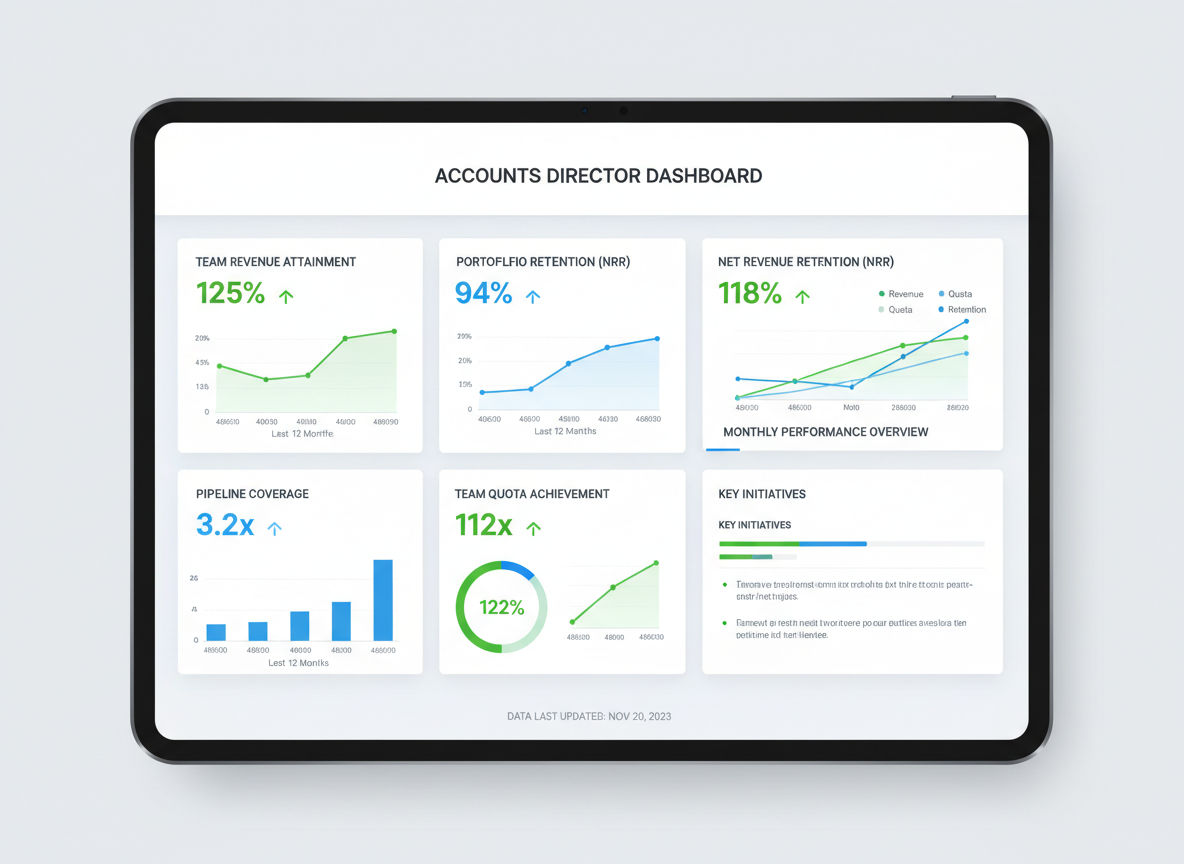
Unlike individual contributors who focus on personal quota, accounts directors get evaluated on team-level outcomes and strategic portfolio health.
Primary KPIs that make or break your review:
Team revenue attainment sits at the top. Most organizations expect 95-110% of quota across your entire team. Your portfolio retention rate matters just as much—anything below 85% raises red flags. Net revenue retention (NRR) reveals whether you’re growing existing accounts, with top performers hitting 120%+ in SaaS environments.
Secondary metrics paint a fuller picture. Account expansion rate (typically 15-25% annually), customer lifetime value growth, and competitive win/loss ratios show your strategic impact.
Team performance indicators include:
- Quota attainment percentage across all reps
- Pipeline coverage (3x-4x is standard)
- Forecast accuracy within 10% variance
Operational excellence gets measured through client satisfaction scores (NPS above 50 is solid), team turnover rate (under 15% annually), and time-to-productivity for new hires (90-120 days typically).
Strategic indicators matter more as you climb. How deeply have you penetrated strategic accounts? Can you demonstrate C-level relationships beyond just your champion?
Evaluations happen quarterly for tactical adjustments, with annual reviews determining compensation. The shift from individual contributor metrics? You’re judged on building systems that scale, not closing deals yourself. Strong accounts directors hit 100%+ team attainment while maintaining 90%+ retention—that’s the benchmark that earns promotions.
Common Challenges Faced by Accounts Directors (And How to Overcome Them)
Every accounts director hits familiar roadblocks. Here’s how to navigate them without burning out.
Balancing strategic work with team management tops the list. Block dedicated time for high-level thinking—mornings work best for most people. Use the “manager schedule vs. maker schedule” approach: reserve mornings for strategy, afternoons for team interactions.
Managing underperforming team members requires direct conversations, not avoidance. Use the SBI framework (Situation-Behavior-Impact) to address issues objectively. Document performance gaps, create 30-day improvement plans, and follow through consistently.
Cross-functional politics drain energy fast. Map stakeholders quarterly, understand their priorities, and find mutual wins. When priorities clash, escalate with proposed solutions—never just problems.
Maintaining executive relationships while empowering your team means mastering delegation. Hand off client work you’ve historically owned. Yes, it’s uncomfortable. Your value now comes from multiplying results through others, not personal execution.
Forecasting accuracy under pressure improves with discipline. Use rolling 90-day forecasts updated weekly. Track variance between projections and actuals to refine your methodology over time.
Transitioning from doing to leading requires a mental shift. You’re no longer the best individual contributor—you’re building the best team. That’s harder and more valuable.
Customer escalations need clear protocols. Respond within two hours, acknowledge the problem, provide a timeline, and follow up personally. Speed matters more than perfection.
When problems arise, ask three questions: What’s the root cause? What’s within my control? What’s the smallest action that creates the biggest impact?
Industry Variations: How the Accounts Director Role Differs Across Sectors
Your effectiveness as an accounts director depends heavily on understanding your industry’s unique dynamics.
SaaS and technology companies emphasize subscription models and product adoption metrics. You’ll track monthly recurring revenue, churn rates, and expansion opportunities. Technical acumen matters here—you need to speak confidently about APIs, integrations, and platform capabilities. Creating compelling content around technical products becomes essential, which is why many tech-focused accounts directors leverage modern AI product description tools to maintain consistency across client communications.
Financial services demands rigorous regulatory compliance knowledge. You’re managing longer sales cycles (often 12-18 months) and relationship banking principles where trust trumps speed.
Agency environments require creative collaboration skills. You’re balancing project profitability against client satisfaction while managing retention dynamics that make or break your year.
Manufacturing and distribution shifts your focus to supply chain considerations and strategic volume versus margin decisions. You’ll analyze order patterns and logistics impacts.
Professional services firms expect you to monitor utilization rates, oversee project delivery, and allocate talent efficiently across engagements.
Healthcare and pharmaceuticals add compliance complexities requiring clinical understanding and navigating FDA or similar regulatory frameworks.
Geographically, US roles typically emphasize aggressive growth targets, UK positions focus more on relationship depth, and APAC markets balance both with cultural sensitivity. Startup accounts directors wear multiple hats with scrappy resourcefulness, while enterprise roles offer structured processes and specialized teams.
Hiring an Accounts Director: Interview Questions & Selection Criteria
Finding the right accounts director isn’t about checking boxes—it’s about uncovering how they think, lead, and recover from setbacks.
Strategic Thinking Questions
Ask candidates to walk you through a time they repositioned an underperforming account. Listen for specifics: What metrics signaled trouble? How did they rally their team? What was the outcome? Strong candidates quantify everything and acknowledge mistakes they’d avoid next time.
Behavioral Deep-Dives
“Tell me about a conflict between your team and a client’s C-suite.” Watch how they navigate blame versus ownership. Follow up with coaching examples—how they’ve developed struggling account managers reveals their leadership philosophy.
Situational Scenarios
Present real challenges: “Your team’s forecasting is consistently off by 20%. What’s your 90-day plan?” Or “A $500K client threatens to leave because your account manager dropped the ball.” Their responses show problem-solving under pressure.
What Candidates Should Ask
Red flag if they don’t inquire about team structure, success metrics, or growth trajectory. Sharp directors want to understand what they’re stepping into.
Selection Red Flags
Be wary of candidates who speak vaguely about results, dominate conversations without listening, or have thin management experience relative to their proposed level. Check references specifically about coaching ability and crisis management—not just client satisfaction.
When building your job description, separate must-haves (5+ years leading accounts teams, proven retention rates) from nice-to-haves (specific industry experience). During compensation negotiations, directors expect equity discussions and performance incentives tied to team outcomes—not just individual billings.
Accounts Director Success Stories: Real-World Case Studies
The SaaS Turnaround: Marcus Chen inherited a struggling SaaS team generating $2.3M annually. Within 18 months, he pushed revenue to $6.4M—a 180% jump. His approach? He restructured territories based on customer lifetime value rather than geography, implemented weekly pipeline reviews with predictive analytics, and created a mentorship system pairing top performers with newer reps. “I stopped managing accounts and started building account managers,” Marcus explains.
Slashing Client Churn: Agency Accounts Director Sarah Patel faced a brutal reality—28% annual churn was bleeding profits. She built a retention framework around quarterly business reviews, proactive check-ins tied to client KPIs, and a red-flag system that triggered immediate intervention. The result? Churn dropped to 9% within 14 months. Her team also cross-sold services that complemented their content strategy efforts, deepening client relationships.
The Fast Track: Jake Morrison made Director in four years by volunteering for high-stakes accounts others avoided, earning certifications in his industry vertical, and documenting his processes obsessively. “I became the person leadership couldn’t afford to lose,” he says.
Partnership Power: When Account Executive Priya Sharma and Accounts Director Tom Reynolds collaborated on a $1.8M account, they expanded it to $6.8M in two years through aligned planning, transparent communication, and shared commission incentives.
Common Thread: Each story shares pattern recognition—they identified problems before clients did, invested in their people, and measured what mattered.
Tools & Technologies Every Accounts Director Should Master
The modern accounts director needs a tech stack that transforms client management from reactive firefighting into strategic relationship building.
CRM platforms form your foundation. You’re not just logging calls in Salesforce—you’re building custom dashboards, automating workflows, and leveraging Einstein Analytics for predictive insights. HubSpot’s sequences and Microsoft Dynamics’ integration with the Microsoft ecosystem can streamline your team’s entire client journey.
Revenue intelligence tools like Gong and Chorus record client conversations and surface coaching opportunities you’d otherwise miss. Clari takes your pipeline data and turns it into accurate forecasts that keep your leadership team happy.
For strategic planning, account management software (Kapta, Prolifiq, Altify) helps you visualize account hierarchies, track relationship maps, and identify expansion opportunities that spreadsheets simply can’t handle.
Your executives want data they can understand quickly. That’s where Tableau, Looker, or Power BI shine—transforming raw numbers into visual stories that drive decisions.
Don’t overlook AI-powered content tools for proposal development and client communications. Modern copywriting software speeds up everything from pitch decks to follow-up emails without sacrificing personalization.
The real advantage? Integrating these tools into cohesive workflows that eliminate context-switching and free your team to focus on relationship building.
Is the Accounts Director Role Right for You? Decision Framework
Before you chase this leadership position, let’s get brutally honest about fit.
The Self-Assessment Reality Check
Ask yourself: Do you genuinely light up when developing others, or do you prefer crushing deals solo? Accounts director roles demand 60-70% of your time managing people, not accounts. If you’d rather perfect your pitch deck than mediate team conflicts, that’s valuable self-knowledge.
Here’s what separates successful directors from struggling ones:
Strategic thinking over tactical execution. You’ll set direction, not execute every detail. If spreadsheets energize you more than quarterly planning sessions, senior account executive roles might suit you better.
Comfort with conflict. Budget pushbacks, underperforming team members, difficult clients—you’ll handle them all. Introverts absolutely can excel here, but you can’t hide from tough conversations.
Financial motivation clarity. Yes, compensation jumps 35-50%, but you’ll earn it through longer hours and weekend fire-drills. Is that trade-off worth it for your lifestyle goals?
Alternative paths exist. Customer success leadership, solution architecture, or principal account executive roles offer advancement without full people management. Some professionals find these trajectories more fulfilling.
Consider building your Personal Brand Statement Generator: 7 Best Free Tools + Templates to Stand Out in 2026 to clarify your unique value proposition before making this career pivot.
Frequently Asked Questions (FAQ)
How long does it take to become an Accounts Director?
Most professionals reach this level in 7-12 years, but it varies. If you’re crushing quotas and demonstrating leadership early, you might get there in 5-6 years. Others take 15+ years depending on industry complexity, company growth, and available opportunities.
What’s the difference between an Accounts Director and a Sales Director?
Sales Directors focus purely on revenue generation and hitting numbers. Accounts Directors own the full client relationship—retention, expansion, satisfaction, and strategic planning. You’re managing relationships, not just transactions.
Do I need an MBA to become an Accounts Director?
Not necessarily. While an MBA can accelerate your path and boost earning potential, most companies value proven track records over credentials. Strong performance, client retention metrics, and leadership skills matter more than degrees.
How many people does an Accounts Director typically manage?
Expect to manage 3-8 direct reports at smaller companies, 10-15 at mid-sized firms, and 20+ at enterprise organizations. The structure depends heavily on company size and client portfolio complexity.
Can I become an Accounts Director without being an Account Executive first?
Yes, though it’s uncommon. Some people transition from project management, consulting, or client success roles. You’ll need demonstrable client management experience and business acumen, regardless of your previous title. For more on related career paths, check out Account Directors Explained: Role Breakdown, Career Path & How to Advance in 2026.
What’s the work-life balance like for Accounts Directors?
Be honest with yourself—it’s demanding. Expect 50-60 hour weeks during critical periods, client emergencies on weekends, and after-hours calls. That said, you’ll have more control over your schedule than earlier career stages.
How much travel is required for an Accounts Director role?
It depends on your industry. Tech and SaaS roles might require 20-30% travel, while agency or consulting positions could push 40-50%. Remote-first companies have reduced this significantly since 2024.
What’s the next step after Accounts Director?
VP of Client Services, VP of Account Management, or Chief Client Officer are common progressions. Some transition into General Manager roles or start their own agencies.
Are Accounts Director positions remote-friendly in 2026?
Increasingly, yes. About 60% of positions now offer hybrid or fully remote options, though client-facing roles still benefit from occasional in-person meetings.
How do I negotiate salary as an Accounts Director?
Lead with your retention rates, revenue impact, and team performance metrics. Research market rates thoroughly, and don’t forget to negotiate equity, bonuses, and commission structures—not just base salary.
Conclusion: Your Path Forward as an Accounts Director
The accounts director role represents more than just a job title—it’s your gateway to strategic leadership and substantial earning potential. You’ve seen the numbers: six-figure salaries, C-suite pathways, and the power to shape business outcomes across major client portfolios.
Your next move depends on where you stand today. If you’re in account management, start leading one strategic initiative this quarter. Already directing accounts? Focus on building your executive presence and expanding your network with decision-makers.
Here’s what separates good accounts directors from exceptional ones: they leverage technology to amplify their impact. Modern tools streamline client reporting, pitch preparation, and content planning—giving you more time for strategic thinking. Consider using AI-powered outline generators to accelerate your client presentation development, or explore Testing CG to enhance your content creation workflow as you scale your responsibilities.
The path won’t always be smooth, but mastery of this role delivers both professional fulfillment and financial rewards. Your leadership journey starts with one strategic decision—make today that moment.

I am a full-time online marketer, for over a decade now. Helped over 100,000+ people & generated well over $12M in online sales.