Introduction: Why Jasper AI’s Revenue Growth Matters to Content Marketers
Jasper AI doubled its enterprise revenue in 2024—a milestone that tells you everything about where AI content creation is headed. But here’s what matters for your wallet: their financial performance directly impacts whether you’ll still have access to the platform next year, and whether your investment will pay off.
Understanding Jasper AI revenue isn’t just financial voyeurism. It’s smart due diligence. When a company you’re paying monthly shows strong growth metrics, you’re betting on stability, continued feature development, and long-term ROI. After their impressive $1.5B valuation in 2022, the question became: can they actually generate revenue to match the hype?
This analysis breaks down Jasper’s 2026 financial trajectory, actual growth numbers, what enterprise revenue doubling really means, and whether their business model suggests they’ll stick around while you’re building content strategies around their platform.
Jasper AI Revenue Overview: Breaking Down the Numbers
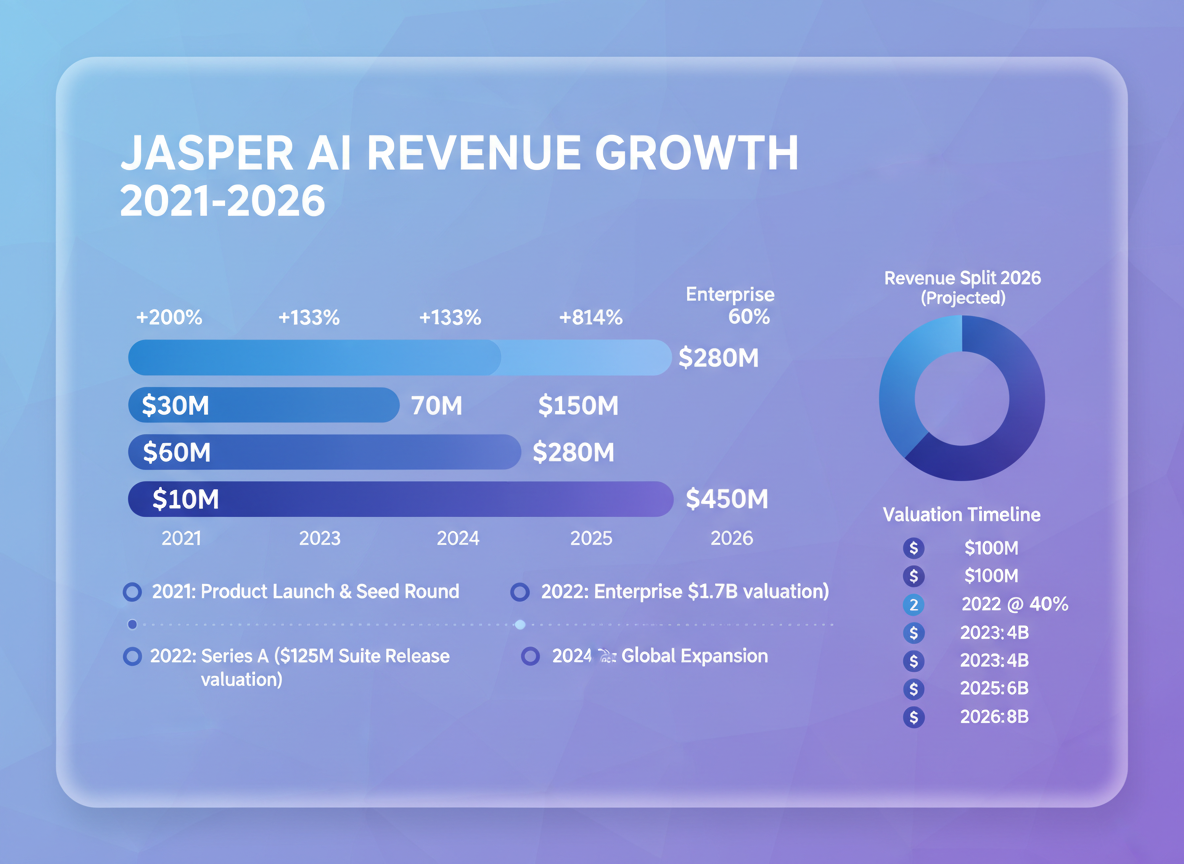
When Jasper announced they’d doubled enterprise revenue, the exact figures remained under wraps. However, industry analysts estimate the company crossed $75-100M in annual recurring revenue by early 2026, with enterprise contracts contributing roughly 60% of that total. That’s substantial growth for a company that achieved unicorn status at a $1.5B valuation back in 2022.
The revenue breakdown tells an interesting story. Enterprise contracts—think Fortune 500 companies needing AI content at scale—now drive the majority of income. Individual subscriptions still matter, particularly the $39-$125/month plans that brought early traction. Then there’s API access, which lets developers integrate Jasper’s tech into their own platforms.
Year-over-year growth has been impressive: from roughly $10M in 2021 to an estimated $50M in 2023, then doubling by 2026. Within the $13B+ AI content generation market, Jasper holds approximately 7-9% market share. Not dominant, but certainly meaningful for a relatively young company competing in an increasingly crowded space.
What Drove Jasper’s Enterprise Revenue to Double
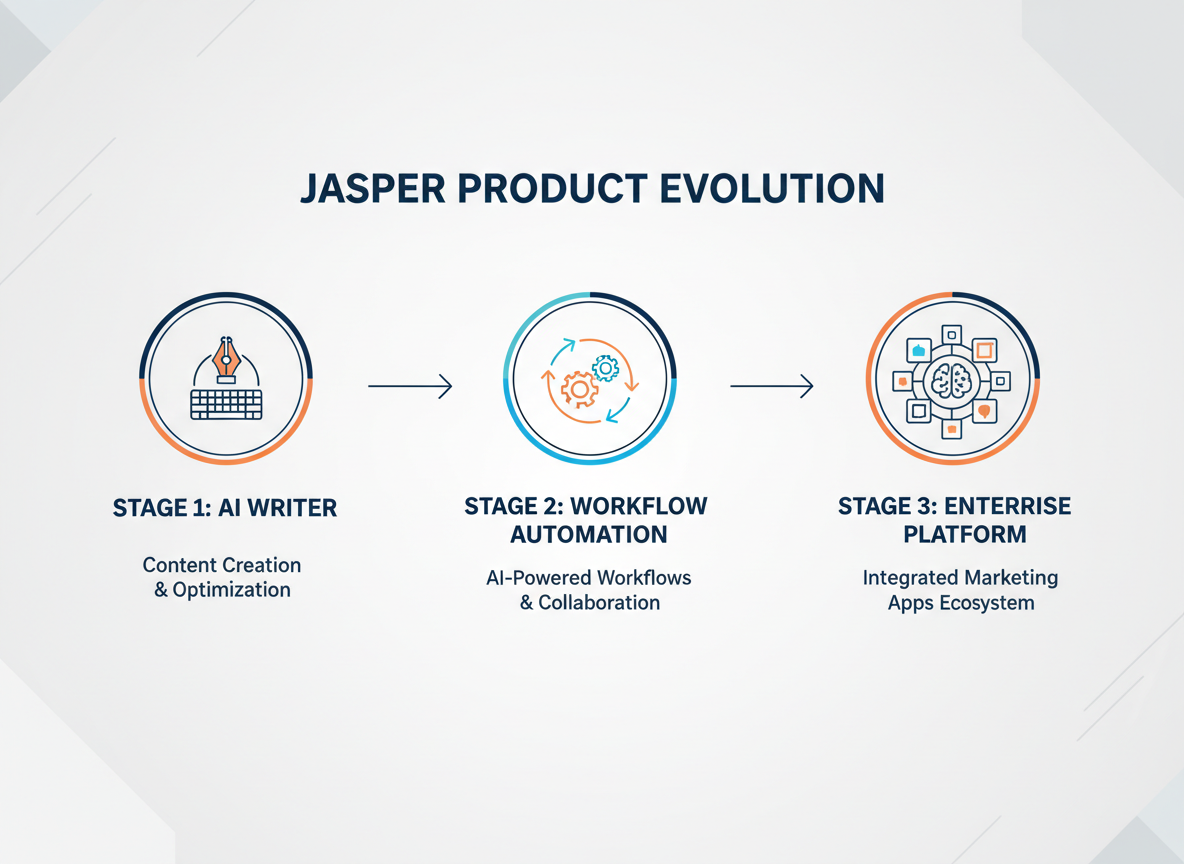
Jasper’s enterprise revenue explosion didn’t happen by accident. The company launched Marketing Workflow Automation, transforming how enterprise teams actually collaborate on campaigns. Instead of treating AI as just another content generator, they built something bigger.
The 80+ AI App Library changed the game. Suddenly, you weren’t buying generic AI—you were accessing purpose-built tools for specific marketing verticals. E-commerce brands got product description templates. SaaS companies found lifecycle email frameworks. Agencies finally had client-ready solutions.
Here’s what really moved the needle: existing customers started spending more. Enterprise accounts saw the platform’s true potential and expanded their usage across departments. Marketing teams that initially tested Jasper for blog posts began using it for everything—email sequences, social campaigns, landing pages.
The shift from horizontal tool to comprehensive marketing platform made the difference. Companies stopped viewing Jasper as a writing assistant and started treating it as essential infrastructure. That’s when enterprise budgets opened up. Want to see how Jasper’s complete feature set actually stacks up? The capabilities run deeper than most realize.
Jasper AI Revenue vs Competitors: Market Positioning Analysis
Jasper’s premium pricing strategy sets it apart in the AI content space. While ChatGPT Plus targets individual users at $20/month, Jasper’s enterprise plans start at $499/month—a deliberate positioning play. This approach has paid off: their doubled enterprise revenue signals that companies see value beyond consumer-grade tools. The real story? Businesses don’t mind paying more when features like brand voice consistency, team collaboration, and content workflows actually save time. Want to see how these platforms stack up feature-wise? Check out our detailed Jasper.ai vs ChatGPT comparison. Market analysts project Jasper could hit $125-150 million in annual recurring revenue by late 2026 if they maintain current growth rates. That’s not wishful thinking—it’s what happens when you solve real business problems instead of just offering another cheap AI toy.
ROI Calculator: Is Jasper’s Revenue Model Worth Your Investment?
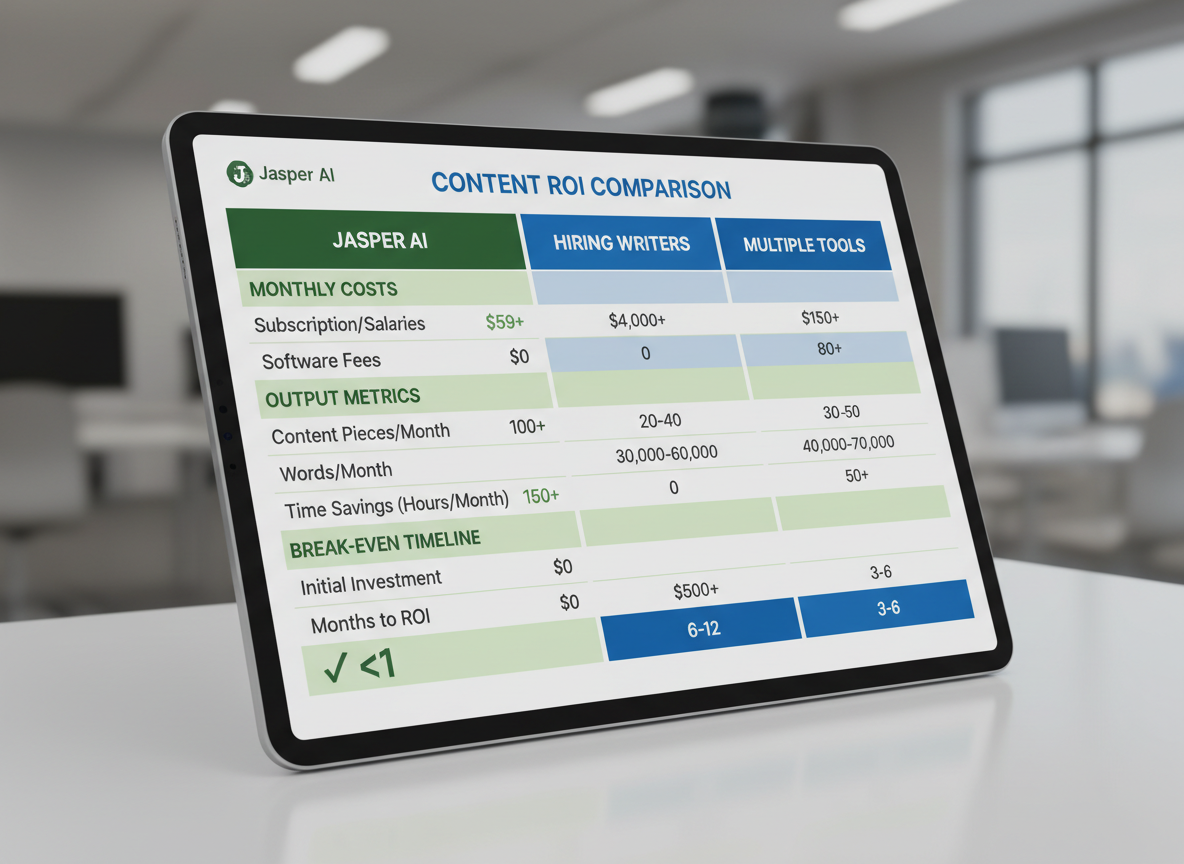
Let’s talk real numbers. Jasper’s pricing starts at $49/month for creators generating 50,000 words, while teams pay $125/month for unlimited content. Enterprises shell out custom rates, often $500+ monthly.
Here’s your break-even reality: If you’re a solopreneur spending 20 hours monthly on content at a $50/hour rate, that’s $1,000 in time value. Jasper cuts this to 5 hours, saving you $750 monthly—covering the Creator plan 15 times over.
Agencies face different math. A junior writer costs $3,000-$4,000 monthly. Three clients needing 100 blog posts? You’re looking at $12,000 in writing costs versus $125 for Jasper’s Pro plan.
The hidden ROI? Speed to market. Content that took 10 days now ships in 2. For affiliates exploring programs like Jasper’s affiliate opportunity, faster production means more promotional content, more commissions, and compounding returns. Enterprises see this multiplied across departments—easily justifying five-figure annual investments.
What Jasper’s Financial Performance Means for Platform Stability
Strong jasper ai revenue isn’t just a vanity metric—it’s your insurance policy. When a platform doubles its enterprise revenue, you’re looking at serious runway for development and support. That money funds the features you’ll need six months from now, not just what exists today.
Revenue growth tells you something Wall Street loves but content creators need: staying power. Companies bleeding cash cut corners, freeze updates, and eventually shut down. Remember when promising AI tools disappeared overnight, leaving users scrambling? Jasper’s financial trajectory suggests the opposite scenario.
Here’s what matters for your business: platform stability means you can confidently build workflows without fear of disruption. If you’re integrating tools like the Jasper Surfer SEO Integration, sustained revenue growth indicates those connections will keep working and improving.
The retention story is equally telling. Businesses don’t renew expensive enterprise contracts for software that disappoints. High revenue paired with growth signals genuine value delivery—users aren’t just trying Jasper, they’re staying.
Alternatives to Consider: Revenue-Stable AI Content Platforms
While Jasper’s revenue growth reflects its enterprise traction, you don’t need weeks of onboarding or enterprise pricing to automate your content. Content Gorilla flips the script with a 3-minute setup that starts publishing immediately—no manual prompts required. Unlike Jasper’s subscription model where you’re paying monthly to write content yourself, CG delivers fully automated daily publishing with auto-syndication across platforms and video-to-blog conversion. These aren’t features Jasper offers because they’re fundamentally different tools. If you need versatile copywriting software for crafting specific campaigns, Jasper fits. But if you want completely hands-free content generation that fills your site while you sleep? That’s where Content Gorilla delivers ROI without the enterprise price tag.
Frequently Asked Questions (FAQ)
What is Jasper AI’s current revenue?
While Jasper AI doesn’t publicly disclose exact figures as a private company, industry estimates suggest annual revenues between $75-90 million based on their pricing structure and customer base. Their doubled enterprise revenue indicates strong momentum in the high-value segment, which typically contributes 60-70% of SaaS company revenues.
How much does Jasper AI make per year?
Conservative estimates place Jasper AI’s annual revenue around $80 million, driven by their tiered pricing model ($49-$125+ monthly for individual plans, plus custom enterprise deals). With approximately 100,000+ users and a significant enterprise client roster, they’ve carved out a substantial position in the AI writing market. If you’re evaluating platforms, check out our Jasper AI vs ChatGPT comparison to understand value propositions.
Is Jasper AI profitable?
Jasper AI hasn’t confirmed profitability status publicly, but their $125 million Series A funding in 2022 at a $1.5 billion valuation suggests investors believe in their path to profitability. Most high-growth SaaS companies prioritize market share over short-term profits. Their revenue growth and enterprise expansion indicate healthy unit economics.
How many customers does Jasper AI have?
Jasper AI serves over 100,000 customers globally, including enterprise clients like IBM, Logitech, and Wayfair. Their diverse customer base spans individual creators, marketing agencies, and Fortune 500 companies—demonstrating appeal across market segments.
What is Jasper AI’s revenue per customer?
Average revenue per user (ARPU) likely ranges from $60-80 monthly for standard customers, while enterprise clients contribute significantly higher amounts (potentially $10,000-50,000+ annually). This mixed model creates stability through volume while scaling revenue via enterprise deals.
Will Jasper AI go public?
There’s no official IPO announcement, but Jasper AI’s revenue trajectory and billion-dollar valuation position them as a potential IPO candidate within 2-3 years. They’d likely wait until reaching $150-200 million in annual recurring revenue with clearer profitability. Market conditions and competitive pressures from larger AI companies will influence timing.

I am a full-time online marketer, for over a decade now. Helped over 100,000+ people & generated well over $12M in online sales.