

Introduction: Understanding the Account Director Role in Modern Business
Here’s a startling reality: companies lose 10-30% of their customer base annually, and most of those losses trace back to weak client relationships. That’s where account directors become irreplaceable.
If you’ve ever wondered what separates someone managing accounts from someone who drives six-figure client relationships and shapes business strategy, you’re not alone. The titles “account director,” “account manager,” and “account executive” get tossed around interchangeably, creating massive confusion for professionals trying to map their career trajectory.
An account director isn’t just someone who keeps clients happy. They’re strategic architects who transform relationships into revenue engines, leading teams while influencing C-suite decisions. They’re the difference between a client who stays for years and one who jumps ship after the first contract.
This guide cuts through the noise. We’ll unpack exactly what an account director does, the responsibilities that set them apart, what you can expect to earn in 2026, and the proven path from entry-level roles to this strategic position. Whether you’re stuck in tactical work and hungry for advancement, or you’re hiring for this role and need clarity, you’ll walk away knowing precisely what this position demands and delivers.
What Is an Account Director? Complete Definition and Core Responsibilities
An Account Director is a strategic leadership position responsible for managing high-value client relationships and overseeing teams of account executives. Unlike account managers who handle day-to-day client needs, Account Directors operate at the 30,000-foot level—crafting long-term strategies, identifying growth opportunities, and serving as the primary executive contact for key accounts.
Here’s what sets this role apart: while an account executive might manage $200K in annual contracts, an Account Director typically oversees portfolios worth $2-5 million or more. They’re not fielding daily emails about campaign tweaks. Instead, they’re in boardrooms presenting quarterly business reviews, negotiating six-figure renewals, and aligning agency capabilities with evolving client objectives.
The core responsibilities break down into four pillars:
Portfolio Management – Overseeing multiple client accounts simultaneously, balancing resource allocation, and maximizing revenue across the entire book of business.
Team Leadership – Managing and mentoring account executives, coordinating cross-functional teams, and ensuring consistent service delivery that meets or exceeds client expectations.
Strategic Planning – Developing account strategies that drive retention and expansion, identifying upsell opportunities, and forecasting revenue growth across their portfolio.
Executive-Level Communication – Building C-suite relationships with clients, presenting strategic recommendations, and negotiating contract renewals that typically range from $500K to multi-million dollar agreements.
Most Account Directors report directly to a VP of Sales or Client Services Director. Success gets measured through tangible metrics: client retention rates (industry benchmarks hover around 85-90%), portfolio revenue growth (typically 15-25% year-over-year), team performance, and client satisfaction scores. It’s a results-driven position where your impact shows up directly on the company’s bottom line.
Account Director vs Account Executive: Key Differences Explained
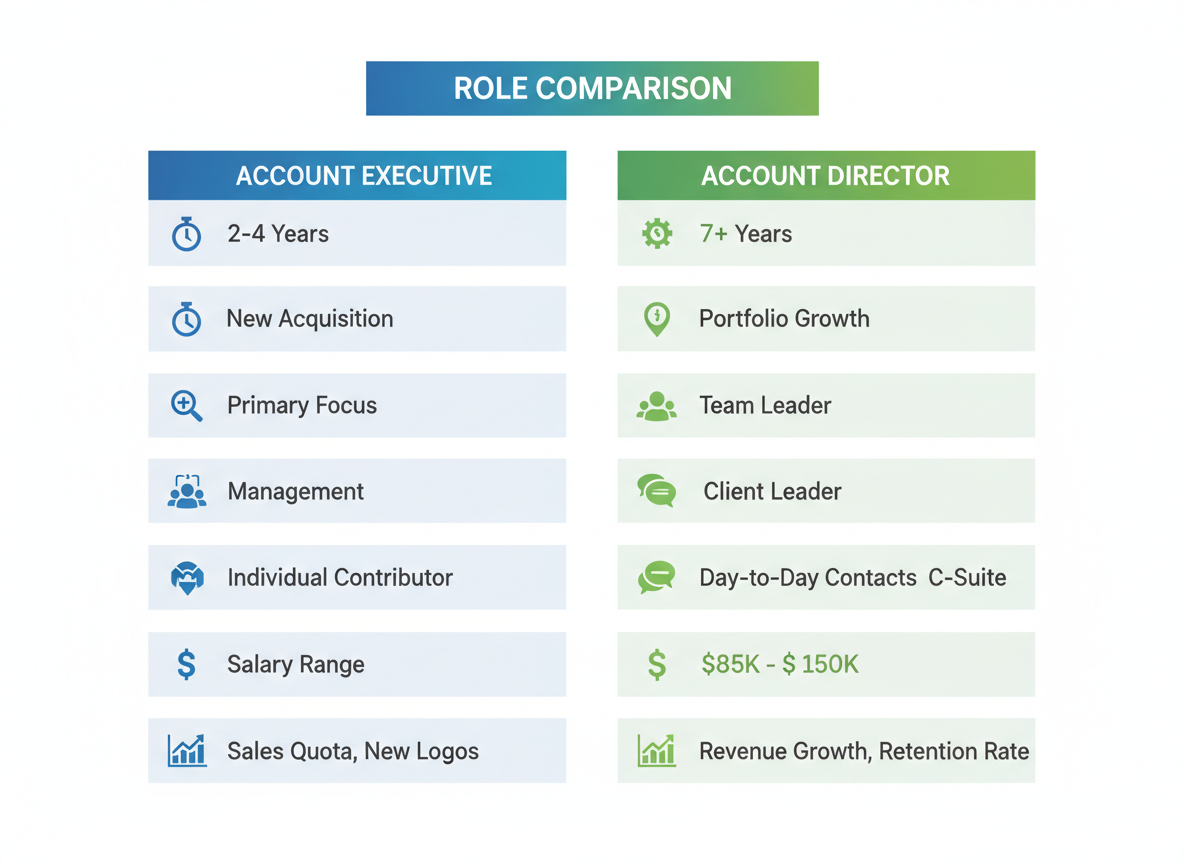
The gap between an Account Executive and an Account Director is wider than you’d think. It’s not just a title change—it’s a complete shift in how you approach client relationships and business growth.
An
Account Directors, on the other hand, operate at 30,000 feet. They oversee entire client portfolios, manage teams of AEs, and develop long-term strategic roadmaps. Instead of chasing the next sale, they’re building relationships with C-suite executives and identifying expansion opportunities across multiple accounts.
The decision-making authority tells the whole story. AEs typically need approval for significant budget changes or strategic pivots. Account Directors have the autonomy to make these calls independently, often managing six-figure (or seven-figure) client relationships without constant oversight.
Experience matters here. Most AEs have 2-4 years in sales or client services. Account Directors? They’ve usually logged 7-10+ years, proving they can handle complex negotiations and team leadership.
Compensation reflects this divide. While AEs might earn $60,000-$90,000 with commission, Account Directors command $100,000-$150,000+ base salaries, with performance bonuses tied to portfolio growth rather than individual deals. The financial upside mirrors the responsibility.
Day-to-Day Responsibilities: What Does an Account Director Actually Do?
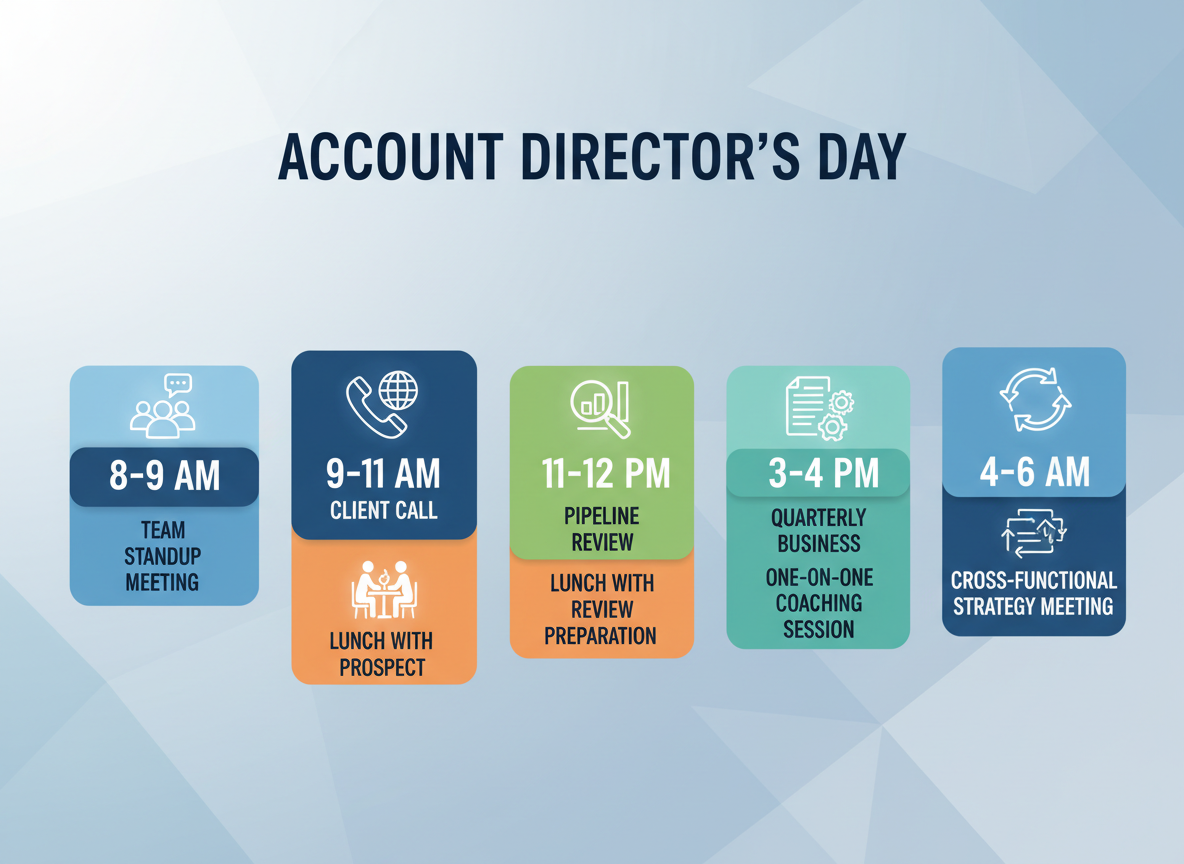
The reality of an Account Director’s day? It’s rarely the same twice.
Your mornings typically start with a quick scan of client updates and team check-ins. You’ll review your pipeline, flag urgent issues, and set priorities before meetings dominate your calendar. Unlike account managers who focus on execution, you’re constantly thinking three steps ahead—identifying expansion opportunities, addressing potential churn risks, and connecting dots between client needs and your company’s capabilities.
Client-facing work fills a significant chunk of your week. You’ll lead quarterly business reviews where you present performance metrics and strategic recommendations. These aren’t just “here’s what we did” presentations—you’re demonstrating ROI and plotting the next phase of growth together.
Team management demands daily attention. You’re coaching account managers through complex negotiations, conducting performance reviews, and sometimes stepping in to resolve conflicts. It’s part mentor, part mediator, part motivator.
Cross-functional collaboration keeps you connected across departments. You’ll brief the marketing team on campaign needs, work with product on feature requests, and coordinate with operations on delivery timelines. When things go sideways—and they will—you’re the one managing the crisis and communicating transparently with both clients and leadership.
You’ll also spend time each week preparing forecasts and strategic reports for executives. They’re counting on your insights to drive business decisions.
Essential Skills and Qualifications for Account Directors
The gap between a decent account director and an exceptional one? It’s wider than you’d think.
Hard skills form your foundation. You’ll need strategic planning abilities that let you map out multi-year client roadmaps, financial analysis skills to interpret budgets and forecast revenue, and mastery of CRM platforms like Salesforce or HubSpot. Data interpretation isn’t optional anymore—you’re expected to translate analytics into actionable insights. Contract negotiation rounds out the technical toolkit, especially when you’re managing six or seven-figure accounts.
Soft skills separate the good from the great. Leadership goes beyond managing teams; it’s about inspiring confidence during budget cuts or campaign pivots. Emotional intelligence helps you read the room when a client’s CFO pushes back on your proposal. Conflict resolution becomes your daily currency, and executive presence? That’s what earns you a seat at the C-suite table.
Most account directors hold degrees in business, marketing, or communications. You’ll typically need 7-10+ years climbing through account management or sales roles—there’s no shortcut here.
Technical proficiencies matter too: Microsoft Suite for presentations, analytics platforms like Google Analytics or Tableau for reporting, and whatever industry-specific tools your clients use.
Here’s the reality check: clients can smell inexperience. They want someone who’s already navigated their specific challenges.
Account Director Salary: Compensation Breakdown for 2026
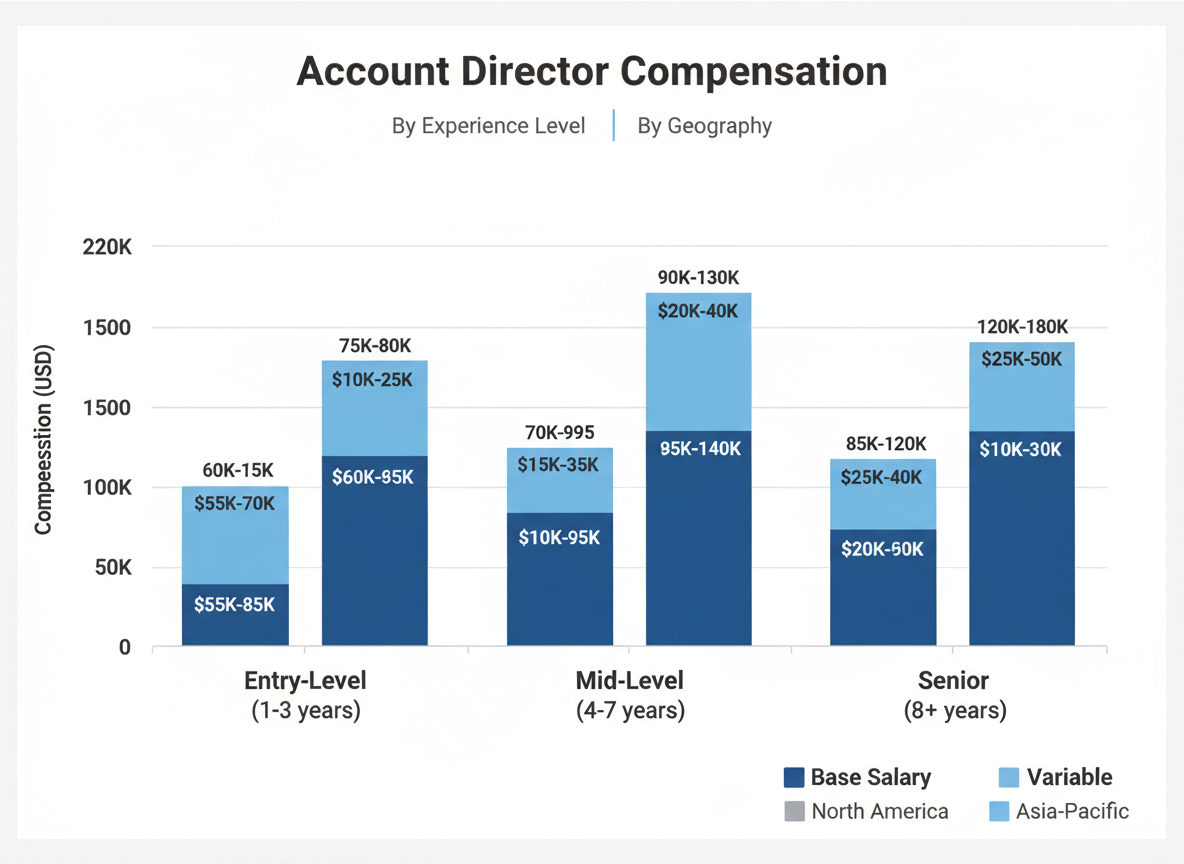
Let’s talk money. The average Account Director pulls in a base salary of $85,694 nationally in 2026, though this number tells only part of the story. The actual range spans from $70K to $120K depending on several factors you’ll want to consider.
Here’s where it gets interesting: total compensation—including commissions, performance bonuses, and profit-sharing—typically lands between $100K and $180K annually. Top performers in high-value accounts often exceed these figures significantly.
Geography matters more than you’d think. Account Directors in San Francisco, New York, and Boston command premium rates, often 30-40% higher than those in smaller markets like Austin or Charlotte. Similarly, industry choice impacts your paycheck. Tech companies and digital agencies typically offer the most competitive packages, while healthcare and traditional manufacturing sectors trend more conservative.
Experience level creates substantial gaps too. Entry-level Account Directors might start around $75K base, while senior ADs managing multiple strategic accounts can command $140K or more. Company size plays a parallel role—enterprise organizations generally offer higher base salaries, whereas startups might sweeten deals with equity and stock options that could be worth considerably more long-term.
Don’t overlook benefits packages. Most companies include health insurance, 401(k) matching, remote work allowances, professional development budgets, and performance incentives. The best packages also feature unlimited PTO, wellness stipends, and client entertainment budgets that make the total compensation even more attractive.
Career Progression: The Complete Path from Account Executive to Account Director
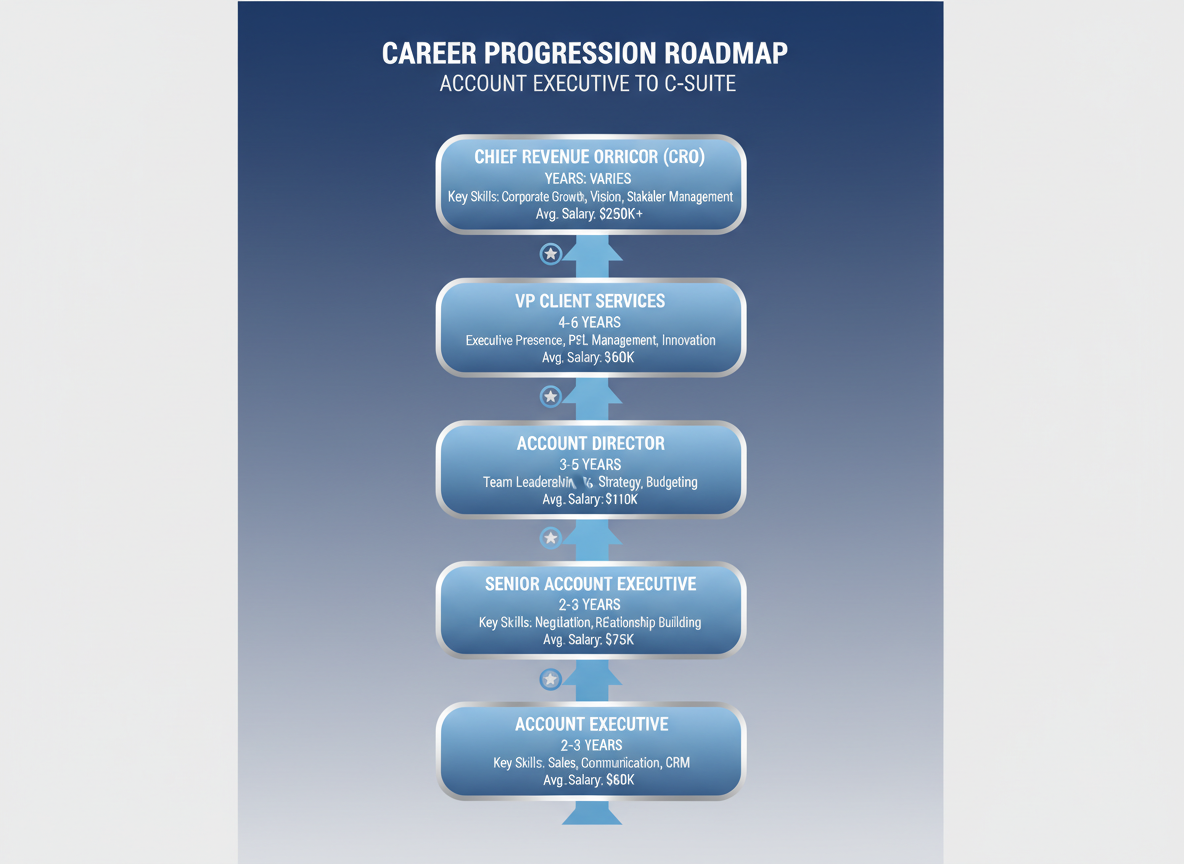
The journey to becoming an account director isn’t overnight, but it follows a predictable pattern. Most professionals spend 2-3 years as an Account Executive, learning client management fundamentals and proving they can close deals. From there, expect another 2-3 years as a Senior Account Executive, where you’ll handle bigger accounts and mentor junior team members.
Here’s what readiness looks like at each stage: As an AE, you’re hitting quota consistently (90%+ quarterly). Senior AEs demonstrate they can manage accounts worth $500K+ annually while maintaining 95% retention rates. When you’re ready for promotion to Account Director, you’ll typically oversee portfolios exceeding $2M with multiple direct reports.
Skills development shifts dramatically. Early career? Focus on CRM mastery, presentation skills, and basic project management. Mid-career AEs need strategic thinking, cross-functional collaboration, and the ability to identify upsell opportunities. Director-level demands executive presence, P&L management, and team leadership capabilities.
Not everyone follows the traditional path. Lateral moves into specialized industries (healthcare, tech, finance) can fast-track advancement. Some switch from agency to in-house roles for better work-life balance and equity opportunities.
Beyond Account Director, you’ve got options: VP of Client Services, SVP of Sales, or even Chief Revenue Officer. Certifications like Strategic Account Management from SAMA or executive leadership programs accelerate this trajectory.
The biggest pitfall? Staying too comfortable in one role. If you’re hitting year four without a promotion or new responsibilities, that’s your signal. Seek mentorship aggressively, network across departments, and don’t wait for opportunities—create them.
Industry Variations: How the Account Director Role Differs Across Sectors
The account director role shifts dramatically depending on your industry. Here’s what that looks like in practice.
Technology/SaaS account directors live in a fast-paced world where product adoption metrics matter more than anything. You’ll need genuine technical knowledge—clients won’t tolerate surface-level understanding when they’re implementing complex software. Managing rapid growth while preventing churn becomes your daily challenge.
Advertising and marketing agencies demand creative collaboration skills. You’re overseeing campaigns, juggling multiple clients simultaneously (often 5-10 accounts), and translating creative vision into results clients can understand. Campaign deadlines and pitches define your calendar.
Healthcare sectors require navigating strict compliance requirements and much longer sales cycles—sometimes 12-18 months. Specialized knowledge of regulations like HIPAA isn’t optional.
Manufacturing and B2B roles emphasize supply chain coordination and technical specifications. Relationships here can span decades, not quarters. You’re managing contracts worth millions with clients who value consistency over flash.
Financial services account directors carry regulatory awareness and fiduciary responsibilities. Risk management becomes part of every client conversation.
Retail and e-commerce bring seasonal fluctuations and inventory coordination challenges. You’re developing omnichannel strategies while managing the holiday rush crunch.
Team sizes vary wildly too—from managing 2-person pods in startups to overseeing 15+ account managers in large agencies. Revenue responsibilities can range from $500K to $20M+ annually, depending on your sector.
Success Metrics and KPIs: How Account Directors Are Measured
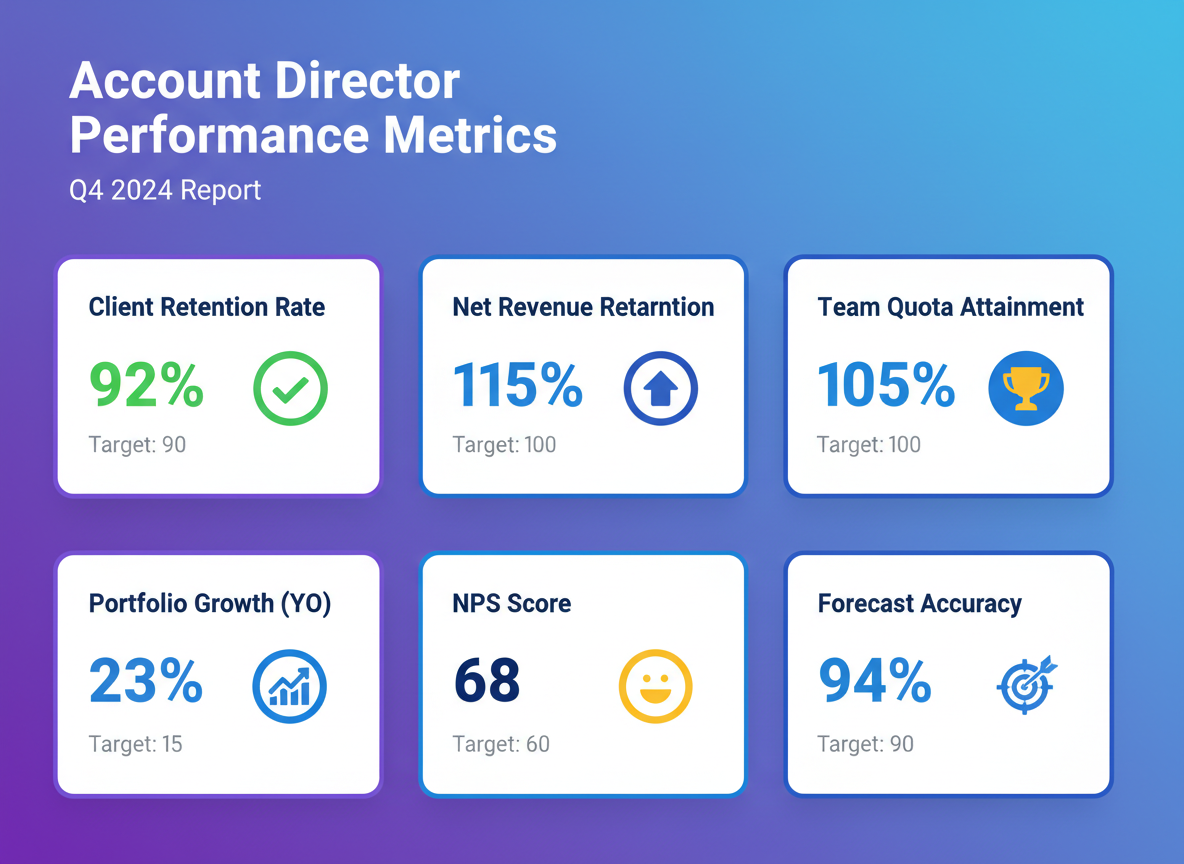
Account Directors face scrutiny through metrics that reflect their strategic impact rather than just sales volume. The primary indicator? Client retention rate, where top performers consistently hit 90% or above. You’ll also be measured on net revenue retention—ideally exceeding 100% through expansion—and overall portfolio growth.
Your team’s success becomes your success. Expect evaluation on collective quota attainment, how well you’re developing individual account executives, and whether you’re keeping talented people on board. High employee turnover signals leadership problems.
Client satisfaction gets tracked through NPS scores, feedback from quarterly business reviews, and renewal rates. These aren’t vanity metrics—they predict revenue stability.
Revenue metrics matter too: upsell and cross-sell conversion rates, contract value expansion, and profitability per account. You’re not just maintaining relationships; you’re growing them strategically.
Strategic measurements include how deeply you’ve penetrated key accounts, the quality of your executive relationships, and competitive win rates when defending or expanding territory. Activity-based KPIs like QBR completion rates and forecast accuracy demonstrate operational excellence.
Here’s the key difference from account executives: AEs get measured on new business and individual deals. You’re judged on long-term account health, team performance, and strategic vision. It’s not about closing one big deal—it’s about orchestrating sustainable growth across multiple accounts simultaneously.
Challenges and Pain Points Faced by Account Directors
Account directors walk a tightrope daily. You’re expected to think strategically while simultaneously putting out fires—and honestly, the fires usually win. One minute you’re crafting quarterly growth plans, the next you’re explaining why a campaign underperformed or mediating a clash between your creative team and a demanding client.
Managing personalities adds another layer. You’ve got high performers who need minimal oversight, chronic underperformers who drain your energy, and everyone in between. Performance conversations? They’re never fun, especially when you genuinely like the person struggling.
Scope creep becomes your constant battle. Clients always want more without paying more, and saying “no” risks the relationship. Meanwhile, internal teams resent being asked to do extra work outside the original agreement.
Resource allocation turns into political warfare. Marketing needs designers yesterday, but so does every other account. You’re stuck fighting for bandwidth while trying not to burn bridges with department heads.
The pressure’s relentless from both sides. Clients demand better results, leadership demands bigger retainers, and you’re sandwiched in the middle wondering when you last took a proper lunch break.
Remote team management compounds everything. Reading tone through Slack messages, keeping distributed teams aligned, maintaining culture across time zones—it’s exhausting.
The solution? Set ruthless boundaries, document everything (seriously, everything), invest in project management tools, and build relationships before you need favors.
The Modern Account Director: Remote Work and Digital Transformation
The account director role has shifted dramatically since 2020. Remote and hybrid work isn’t just changing where the job happens—it’s redefining how relationships form and deals close.
Today’s account directors master a completely different toolkit. Zoom handles client presentations and team check-ins. Slack keeps conversations flowing across time zones. Platforms like Asana, Monday.com, and Trello coordinate campaigns with distributed teams spanning continents. The challenge? Building genuine rapport through a screen requires intentional effort.
Smart account directors schedule virtual coffee chats, send personalized video messages, and create moments of human connection between business talks. They’ve learned that team culture doesn’t need an office—it needs consistency, transparency, and celebration of wins (even small ones).
Technology’s getting smarter too. CRM automation tracks client touchpoints without manual logging. AI-powered content creation handles routine communication drafts, freeing directors for strategic thinking. Predictive analytics flag at-risk accounts before problems escalate.
Here’s what matters: AI augments your capabilities—it doesn’t replace your judgment. You’ll still make the critical calls, navigate complex negotiations, and provide the emotional intelligence machines can’t replicate.
Looking ahead? Expect virtual reality client meetings and AI copilots surfacing insights during live calls. The directors who embrace these tools while maintaining authentic relationships will dominate the next decade.
Your 30-60-90 Day Plan as a New Account Director
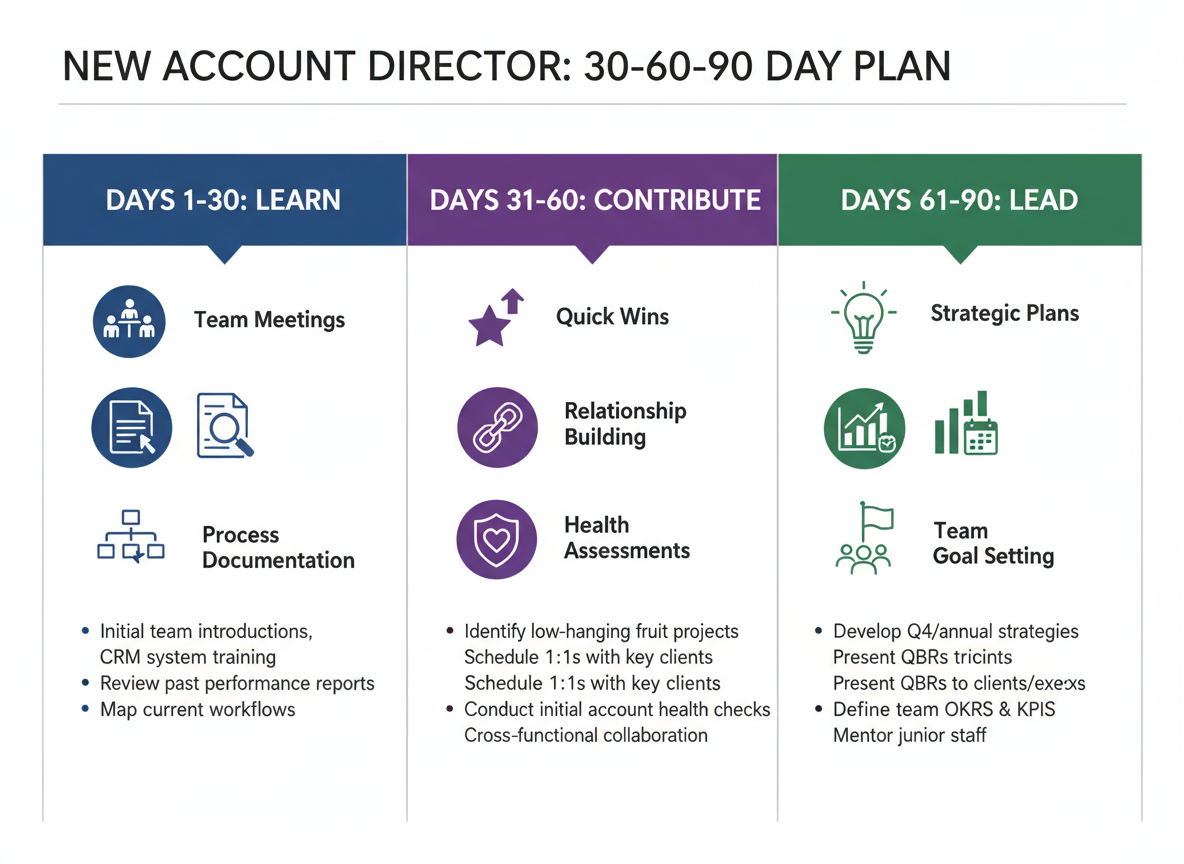
Landing your first Account Director role? Here’s how to hit the ground running without burning out.
Days 1-30: Learn the Landscape
Your main job right now? Listen more than you talk. Schedule one-on-ones with every team member, dive into account histories, and map out existing workflows. Identify two or three quick wins you can deliver fast—maybe it’s streamlining a reporting process or solving a client pain point that’s been ignored. These early victories build credibility.
Days 31-60: Contribute Meaningfully
Now you’re rolling up your sleeves. Implement those improvements you spotted, establish regular team check-ins, and conduct thorough account health assessments. Start building real relationships with key stakeholders—both internally and at your client companies. Don’t skip the finance team; they’ll save you headaches later.
Days 61-90: Lead with Confidence
Time to step into your leadership role fully. Launch your first strategic initiatives, set clear team goals with measurable KPIs, and execute those all-important QBRs. Present your strategic account plans to leadership—this is your moment to show you understand the bigger picture.
Common Mistakes to Avoid
Don’t try changing everything immediately. Resist the urge to criticize “how things used to be done.” That’ll alienate your team fast. Also, skipping client face-time in your first 90 days is career suicide—they need to see you’re invested.
Hiring an Account Director: Interview Questions and What to Look For
Finding the right account director can make or break your client relationships. Here’s how to separate genuine strategic talent from smooth talkers.
Strategic Interview Questions That Reveal Real Experience
Start with outcome-focused questions: “Walk me through how you’ve grown a strategic account by 50% or more.” Listen for specifics—actual tactics, timelines, and measurable results. Vague answers about “relationship building” are red flags. You want concrete examples with numbers.
“How do you handle underperforming team members?” reveals their leadership style. Great candidates discuss clear communication, structured improvement plans, and knowing when to make tough calls. Wishy-washy responses suggest they’ll avoid conflict.
Behavioral and Situational Questions
Present real scenarios: “Your biggest client threatens to leave because of a project delay. You’re down two team members and over budget. What’s your approach?” Strong candidates outline immediate damage control, transparent communication, and strategic resource reallocation.
Ask: “Describe a time you had to choose between client demands and what was best for your company.” This reveals their judgment and integrity.
Green Flags to Watch For
Candidates who ask about your client retention rates, team structure, and growth strategy show strategic thinking. They’re interviewing you too.
Request an account planning presentation or case study analysis. This reveals their strategic framework and communication skills far better than hypothetical questions.
Reference Check Essentials
Ask former clients directly: “Would you hire them again?” And probe former team members about their leadership during pressure situations.
Tools and Resources Every Account Director Needs
Your tech stack can make or break your effectiveness. Salesforce, HubSpot, and Microsoft Dynamics serve as your command centers, tracking client interactions, revenue forecasts, and relationship health scores. You’ll live in these platforms daily.
For strategic planning, invest in QBR templates and account planning frameworks. They’ll transform scattered notes into executive-ready presentations. Team management requires structure too—one-on-one templates, coaching models, and performance review frameworks keep your people growing.
Analytics tools give you real-time portfolio health metrics. You need to spot trouble before clients do.
Here’s where things get interesting: AI-powered automation can reclaim 10+ hours weekly. Testing CG’s platform handles the repetitive stuff—client reports, content scheduling, and automated daily publishing—so you can focus on strategy and relationship building. That’s not a small win; that’s transformational.
Communication platforms like Slack and Teams keep distributed teams aligned, while professional development never stops. Follow industry podcasts, join account management communities, and pursue certifications that expand your strategic thinking.
Download the templates mentioned throughout this guide—they’re proven frameworks, not theory.
Frequently Asked Questions About Account Directors
What’s the difference between an account director and account manager?
Account directors operate at a strategic level, managing multiple accounts and overseeing account managers. They focus on revenue growth, long-term client relationships, and team leadership. Account managers handle day-to-day client needs and individual campaigns. Think of it this way: account managers execute, while account directors orchestrate.
How long does it take to become an account director?
Most professionals spend 5-8 years working up from entry-level roles. You’ll typically progress from coordinator to executive, then to account manager or senior account manager before reaching director level. However, exceptional performers in high-growth companies sometimes make the jump in 4-5 years.
Can you become an account director without sales experience?
It’s challenging but possible. While direct sales experience helps tremendously, you can transition from client-facing roles like customer success, project management, or consulting. You’ll need to demonstrate revenue impact and relationship-building skills.
What is the typical team size an account director manages?
Most account directors oversee 3-10 account managers or executives, depending on company size and structure. In agencies, you might manage smaller teams but handle larger client portfolios.
Do account directors still close deals or is it purely management?
Yes, they absolutely close deals—especially high-value contracts and renewals. Account directors typically handle strategic negotiations while coaching their teams on smaller opportunities.
What certifications help advance to account director level?
Consider pursuing PMP, Salesforce certifications, Strategic Account Management Association (SAMA) training, or industry-specific credentials. However, proven results matter more than certificates.
How does commission structure work for account directors?
Most earn 60-70% base salary with 30-40% variable compensation tied to team performance and individual book-of-business growth. Total OTE typically ranges from $120K-$200K+.
What industries pay account directors the most?
Tech, SaaS, pharmaceuticals, and financial services lead the pack, with compensation packages often exceeding $180K annually.
Is an MBA required to become an account director?
No. While an MBA can accelerate your path, relevant experience and demonstrated results carry more weight. Many successful account directors have bachelor’s degrees or even learned through hands-on experience.
How is work-life balance for account directors?
It varies widely. Expect busy periods during quarter-end, client crises, and major pitches. Remote work has improved flexibility, but you’re ultimately responsible for client satisfaction—which doesn’t always respect boundaries.
What’s the job outlook for account directors in 2026 and beyond?
Strong demand continues, particularly in digital marketing, SaaS, and professional services. Companies increasingly value relationship-driven revenue over transactional sales.
How do account directors work with marketing teams?
They collaborate on campaign strategy, share client insights for targeting, align on messaging, and coordinate on content development. The strongest account directors bridge the gap between marketing capabilities and client needs.

I am a full-time online marketer, for over a decade now. Helped over 100,000+ people & generated well over $12M in online sales.