Why Your Personal Biography Is Costing You Opportunities (And How to Fix It in 2026)
Here’s something that’ll make you uncomfortable: 73% of hiring managers admit they skip right over candidates with generic or missing bios. That’s not a maybe—that’s three out of four decision-makers who won’t even consider you.
Think about the last opportunity you missed. The speaking gig that went to someone else. The client who ghosted after checking your LinkedIn. The job interview you never got. There’s a good chance your biography—or lack of one—was the silent killer.
You might have impressive credentials and years of experience, but if your bio reads like everyone else’s (“results-driven professional with a passion for excellence”), you’re invisible. Worse, you’re forgettable.
Here’s what’s different in 2026: we’re drowning in AI-generated content. Everyone sounds the same because they’re all using the same tools with the same prompts. But hiring managers, event organizers, and clients? They’re desperately searching for something real. Something human. Your personal biography is where that connection happens—or doesn’t.
The numbers back this up. Professionals with compelling bios see 3.5x more profile views and 67% higher response rates to outreach. That’s not luck. That’s the power of words that actually represent who you are.
This guide will show you exactly how to write a bio that opens doors instead of closing them. You’ll get proven templates, real-world examples from people who landed dream opportunities, and a step-by-step framework you can use today.
Your next opportunity won’t wait. Let’s make sure your bio doesn’t cost you another one.
What Is a Personal Biography? (And Why It’s Different From Your Resume)
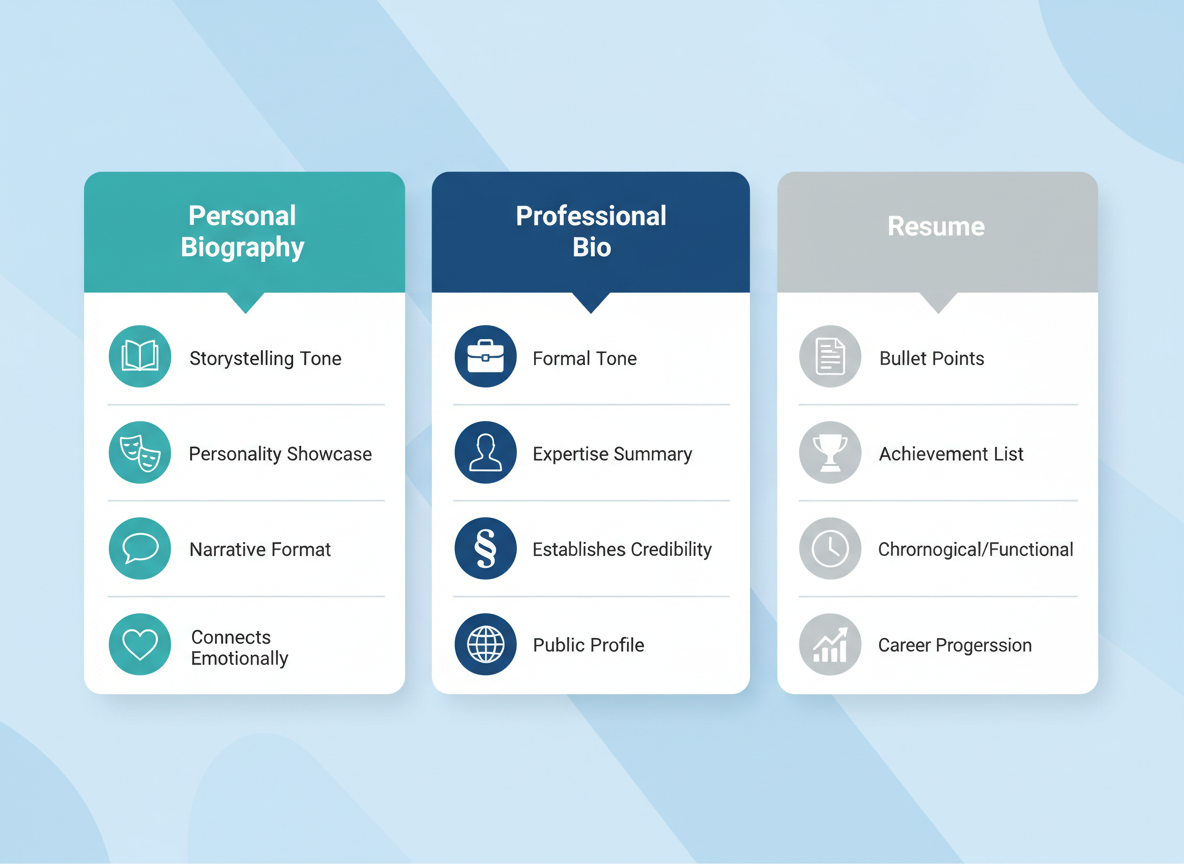
A personal biography is your story distilled into a compelling narrative that shows who you are, what you’ve accomplished, and why people should care. Unlike your resume—which lists dates, job titles, and responsibilities—a personal bio brings personality and context to your achievements.
Here’s the breakdown: A personal bio highlights your human side alongside professional wins. It can include your values, interests, and the journey that shaped you. A professional bio sticks to career accomplishments and expertise, typically used for LinkedIn or conference materials. An executive bio focuses on leadership achievements and strategic vision, written in third person for C-suite positioning.
You’ll need personal biographies for your website’s About page, social media profiles, speaking events, award nominations, podcasts, portfolios, and yes—even dating apps if you want to stand out.
The psychology here matters. Effective personal bios leverage storytelling to create emotional connections, relatability to build trust, and credibility through specific achievements. People remember stories, not job descriptions.
In 2026, authenticity trumps polish. Your audience sees through overly curated personas. They’re also consuming content faster than ever, which means you’ll need both comprehensive bios and micro-bios tailored for different platforms. A 500-word bio works for your website; a 150-character version hooks people scrolling through X (formerly Twitter).
The 5-Part Framework for Writing Personal Biographies That Convert
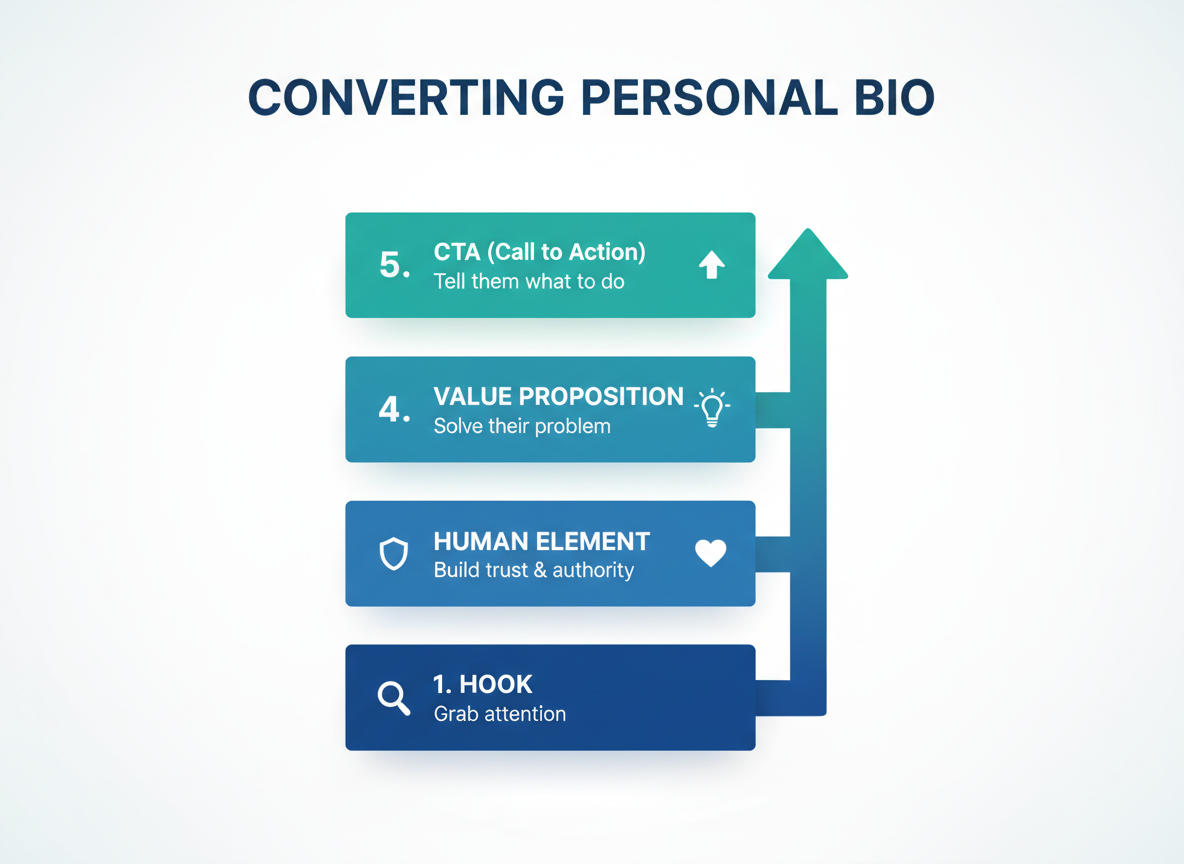
Most personal biographies fail because they sound like everyone else’s. Let’s fix that with a framework that works across every platform and industry.
Part 1: The Hook – Grab Attention Immediately
Your opening line determines whether someone keeps reading or scrolls past. Skip the “I’m a passionate [job title]” cliché. Instead, try these formulas:
The Bold Statement: “I’ve helped 200+ startups raise $50M in funding through better storytelling.”
The Unexpected Angle: “After burning through $100K on failed marketing campaigns, I discovered what actually works.”
The Transformation: “From struggling freelancer to leading a six-figure agency in 18 months.”
Part 2: The Credentials – Prove Your Worth
Now that you’ve got their attention, establish credibility without sounding arrogant. Lead with results, not titles. “Featured in Forbes and Entrepreneur” beats “Award-winning marketer” every time. Mention specific achievements: “Generated $2M in client revenue” or “Built an audience of 50K in 90 days.”
Part 3: The Human Element – Make Them Care
Here’s where you become memorable. Share something real: you’re a coffee addict who writes best at 5 AM, a former teacher turned entrepreneur, or someone who learned English through YouTube. These details create connection. People hire humans, not resumes.
Part 4: The Value Proposition – Show What’s In It For Them
Answer the silent question: “So what?” Explain who you help and how. “I help content creators turn their expertise into profitable digital products” tells your reader exactly what you do for them.
If you’re still struggling to define your unique angle, check out our Personal Brand Statement Generator: 7 Best Free Tools + Templates to Stand Out in 2026 for clarity.
Part 5: The Call-to-Action – Direct the Next Step
Never end with nothing. Tell readers what to do next: “Book a free consultation,” “Download my content calendar template,” or “Connect with me on LinkedIn.” Make it specific and easy.
Bonus: Adjusting Your Tone
Formal contexts (corporate sites, speaking engagements): Keep it professional but not stiff. Use full sentences and industry terminology.
Casual settings (social media, creative portfolios): Relax the language. Contractions are your friend. One-sentence paragraphs work great.
Creative fields: Take risks. Use metaphors. Break grammar rules intentionally. Let your personality shine through every word.
10 Fill-in-the-Blank Personal Biography Templates for Every Situation
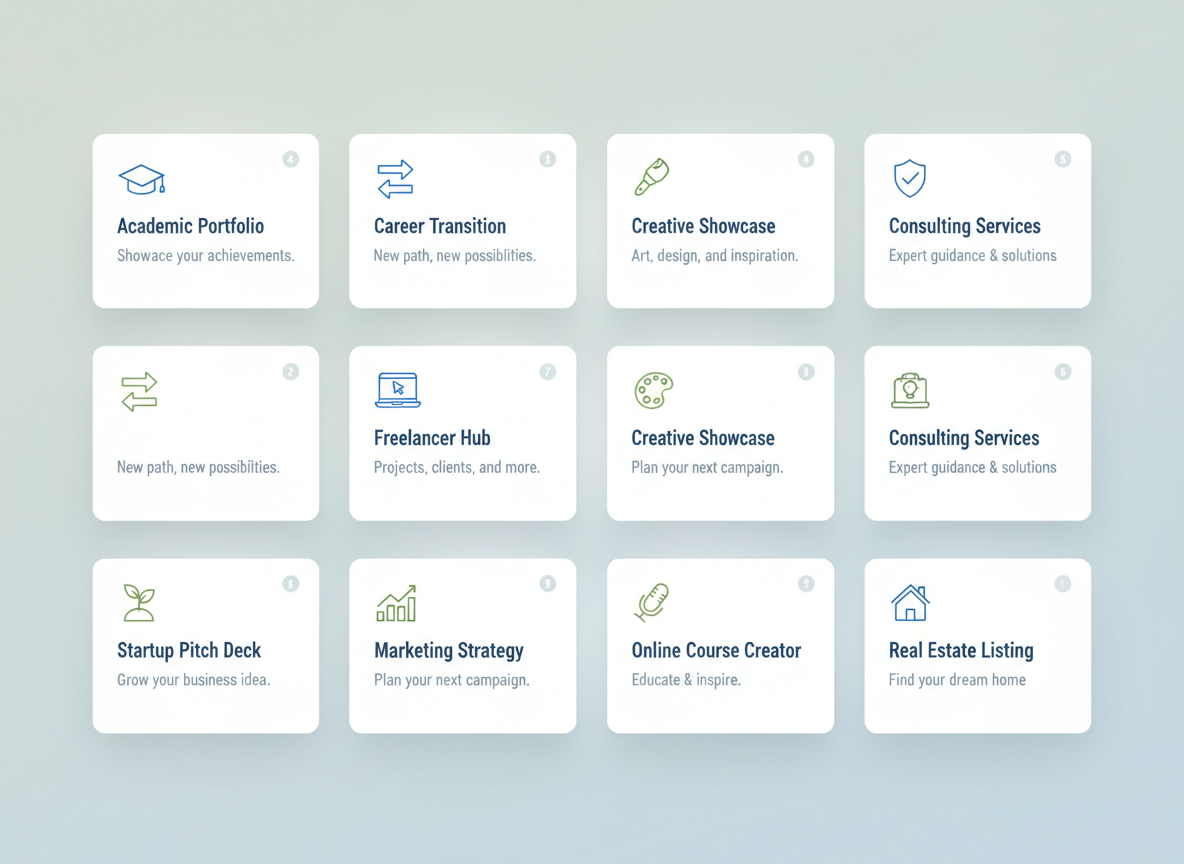
You don’t need to reinvent the wheel. These templates give you the exact structure you need—just fill in your details and adjust the tone to match your personality.
Template 1: Entry-Level Professional
“I’m [Name], a recent [degree] graduate from [University] with a passion for [industry/field]. During my time at [University/Company], I [specific achievement or project]. I’m currently seeking opportunities in [specific role] where I can apply my skills in [2-3 relevant skills]. When I’m not [professional activity], you’ll find me [personal interest that shows personality].”
Example: “I’m Sarah Chen, a recent Marketing graduate from UCLA with a passion for social media strategy. During my internship at a local tech startup, I increased Instagram engagement by 240% in three months. I’m currently seeking opportunities in digital marketing where I can apply my skills in content creation, analytics, and community building. When I’m not crafting campaigns, you’ll find me hiking California trails with my rescue dog.”
Template 2: Career Changer
“After [X years] in [previous industry], I’m bringing my expertise in [transferable skills] to [new field]. My background in [previous role] taught me [valuable lesson/skill], which I’m now applying to [new focus]. I’ve recently [certification, training, or project], and I’m excited to help [target audience] achieve [specific outcome].”
Example: “After 8 years in corporate finance, I’m bringing my analytical mindset to UX design. My background in data analysis taught me how to spot patterns and solve complex problems—skills that translate perfectly to creating intuitive user experiences. I’ve recently completed Google’s UX Design Certificate, and I’m excited to help businesses create digital products that users actually love.”
Template 3: Freelancer/Consultant
“I help [target audience] [achieve specific result] through [your method/service]. With [X years] of experience in [industry], I’ve worked with [types of clients or notable names if possible] to [measurable outcome]. My approach focuses on [unique methodology or philosophy]. [Call to action or contact information].”
Example: “I help e-commerce brands boost their email revenue by 30-50% through conversion-focused copywriting. With 6 years of experience in direct response marketing, I’ve worked with over 100 online stores to craft campaigns that actually sell. My approach focuses on psychology-driven storytelling that turns browsers into buyers. Let’s talk about your next campaign.”
Template 4: Creative Professional
“I’m a [job title] who [unique creative perspective or specialty]. My work has been featured in [publications, platforms, or exhibitions], and I’ve collaborated with [types of clients or projects]. I believe [creative philosophy], which you can see in [portfolio piece or project]. Currently, I’m [current project or focus].”
Example: “I’m a brand designer who believes your visual identity should make you unforgettable, not just presentable. My work has been featured in Design Milk and The Dieline, and I’ve collaborated with sustainable fashion brands and wellness startups. I believe design should tell a story before anyone reads a word, which you can see in my rebrand of Bloom Tea Company. Currently, I’m accepting select projects for Q2 2026.”
Template 5: Entrepreneur/Business Owner
“I founded [Company] to [solve specific problem] for [target market]. What started as [origin story] has grown into [current status—revenue, customers, team size]. We’ve helped [X number] of [customers] [achieve specific results]. Before entrepreneurship, I [relevant background], which gave me insight into [industry problem you’re solving].”
Example: “I founded ContentFlow to eliminate the content bottleneck that suffocates growing businesses. What started as a side project helping three local clients has grown into a 15-person agency serving SaaS companies worldwide. We’ve helped 200+ businesses publish consistently without burning out their teams. Before entrepreneurship, I spent 5 years as a content director at a scaling startup, which gave me firsthand insight into the chaos of managing content at scale.”
Template 6: Speaker/Thought Leader
“I’m a [your expertise] specialist who speaks on [topics]. I’ve presented at [conferences, companies, or platforms], reaching [number] professionals across [industries or regions]. My signature talk, ‘[Talk Title],’ explores [key theme], and I’ve been featured in [media or podcasts]. My mission is to [impact you want to make].”
Example: “I’m a remote work specialist who speaks on building high-performing distributed teams. I’ve presented at SXSW, Web Summit, and Fortune 500 companies, reaching 50,000+ professionals across tech and finance. My signature talk, ‘The Async Advantage,’ explores how companies can ditch meetings without losing momentum. My mission is to prove that flexibility and productivity aren’t enemies—they’re partners.”
Template 7: Academic/Researcher
“I’m a [title] at [Institution], specializing in [research area]. My research focuses on [specific focus], with [X] peer-reviewed publications in journals including [notable publications]. I earned my [degree] from [University], where I [notable achievement]. My work has been cited [number] times and has contributed to [real-world application or impact].”
Example: “I’m an Associate Professor of Environmental Science at Stanford, specializing in urban sustainability. My research focuses on green infrastructure in megacities, with 23 peer-reviewed publications in journals including Nature Sustainability and Urban Studies. I earned my PhD from MIT, where I developed a new model for predicting urban heat island effects. My work has influenced policy decisions in five major U.S. cities.”
Template 8: Social Media Influencer/Content Creator
“I create [type of content] for [audience size] [platform] followers who want to [transformation or value you provide]. I started [platform name] in [year] because [personal reason or gap you saw], and now I [current status—partnerships, reach, community]. I’ve partnered with [types of brands] and specialize in [niche or content style]. Join me at [@handle].”
Example: “I create realistic meal prep content for 450K Instagram followers who want to eat well without living in their kitchen. I started @RealWorldMeals in 2021 because every recipe I found required 30 ingredients I’d never heard of, and now I’m helping working parents reclaim their weeknights. I’ve partnered with kitchenware brands and grocery chains, specializing in 5-ingredient dinners that actually taste good. Join me at @RealWorldMeals.”
Template 9: Job Seeker (LinkedIn/Company Website)
“[Job title] with [X years] of experience in [industry], specializing in [2-3 key skills]. At [Current/Previous Company], I [specific achievement with numbers]. I’m passionate about [professional interest] and have a proven track record of [another achievement or strength]. [Degree] from [University]. Open to [types of opportunities].”
Example: “Marketing Manager with 7 years of experience in B2B SaaS, specializing in demand generation, content strategy, and marketing automation. At CloudTech Solutions, I built a content program from scratch that generated 1,200 qualified leads in year one. I’m passionate about data-driven storytelling and have a proven track record of turning complex technical products into compelling narratives. MBA from Northwestern. Open to senior marketing roles in tech.”
Template 10: Personal Brand Builder
“I’m [Name], a [profession] based in [location]. I believe [core value or philosophy] and spend my time [professional activities] and [personal activities that show character]. I’ve [notable achievement], and I’m always looking to connect with people who [shared interest or value]. You can usually find me [where you spend time or what you’re working on].”
Example: “I’m Marcus Williams, a product designer based in Austin. I believe the best solutions come from understanding people, not just problems, and I spend my time designing apps for healthcare startups and mentoring aspiring designers. I’ve helped launch three apps that collectively serve 2 million users, and I’m always looking to connect with people who geek out over great user experiences. You can usually find me at local design meetups or testing new coffee shops with my sketchbook.”
—
Pro tip: These templates are starting points, not straitjackets. The best personal biographies blend structure with personality. For more examples across different platforms and industries, check out our guide: 57 Example of Bio About Yourself.
The template that works for you depends on where you’re posting and who you’re trying to reach. LinkedIn demands a different approach than your Instagram bio, and a conference speaker bio shouldn’t read like your dating profile (we hope).
Platform-Specific Personal Biography Requirements and Best Practices
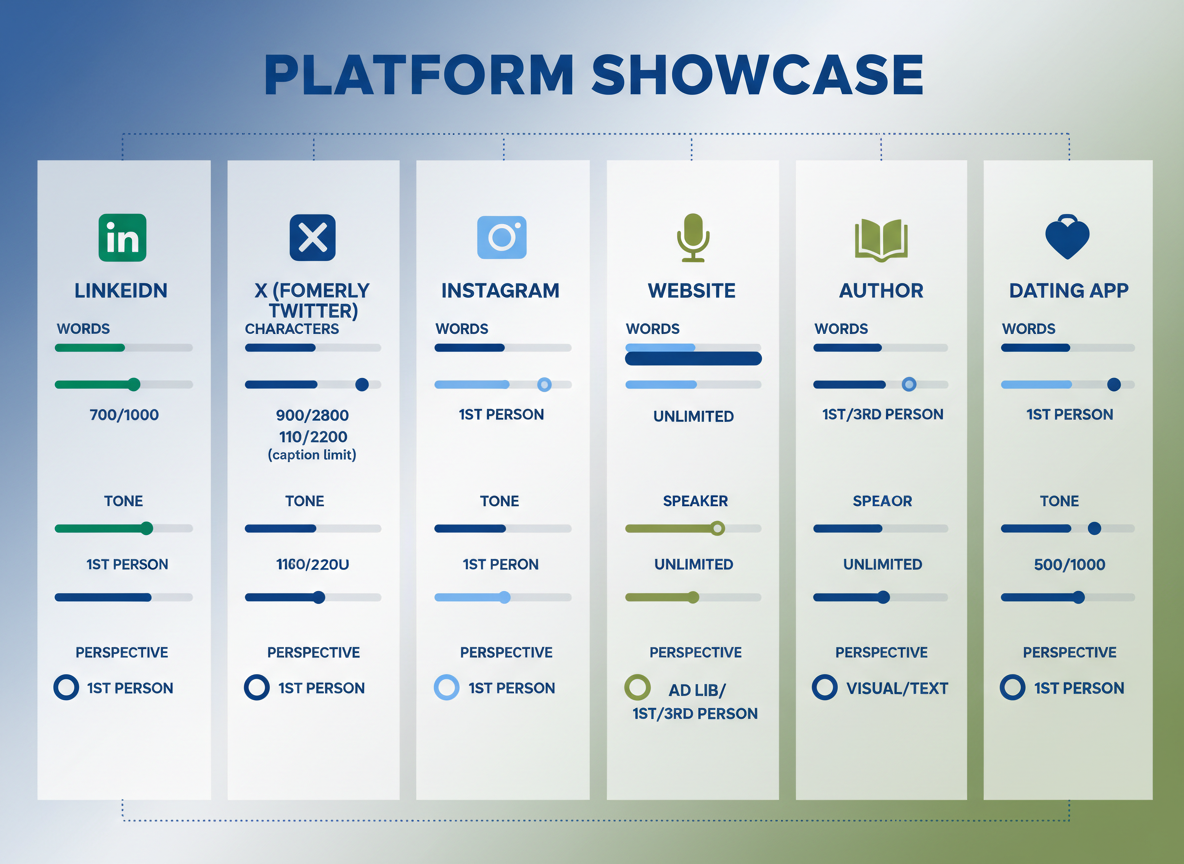
Your personal biography isn’t one-size-fits-all. Each platform has different character limits, audience expectations, and strategic goals. Here’s what actually works in 2026.
LinkedIn: The Professional Powerhouse
You’ve got 2,600 characters to work with—use them. This isn’t the place for humble understatement. Front-load your first two lines with keywords your ideal client or employer would search for. Mention your role, industry expertise, and biggest achievement right away. LinkedIn’s algorithm rewards specificity, so “SaaS marketing strategist specializing in B2B tech companies” beats “marketing professional” every time.
Twitter/X: Personality in 160 Characters
You’re competing for attention in milliseconds. Your bio should answer “why should I follow you?” in one breath. Try this formula: [What you do] + [What makes you different] + [Proof point or personality]. Emojis work here—they break up text and add visual interest. Just don’t overdo it.
Instagram: The Link Is Everything
With only 150 characters, every word matters. Most successful creators use a simple structure: who you help, how you help them, and a call-to-action. Your link in bio becomes prime real estate—update it based on current campaigns or promotions.
Company Website: SEO Meets Credibility
Aim for 150-300 words that balance keywords with readability. Include expertise signals that Google’s E-E-A-T guidelines favor: credentials, years of experience, media mentions, and specific results you’ve delivered. This is where you build authority that converts casual browsers into believers.
Speaker & Conference Bios
Keep these tight at 50-100 words, written in third person. Lead with your most impressive credential, add 2-3 relevant achievements, and end with a credential that establishes expertise. Event organizers want copy-paste ready content that makes you sound credible without editing.
Need platform-specific templates for different bio lengths? Check out our guide on how to write short bios that convert with ready-to-use formulas.
The takeaway? Write your master bio once, then adapt strategically for each platform’s unique requirements and audience expectations.
Before & After: 7 Personal Biography Transformations That Landed Dream Opportunities
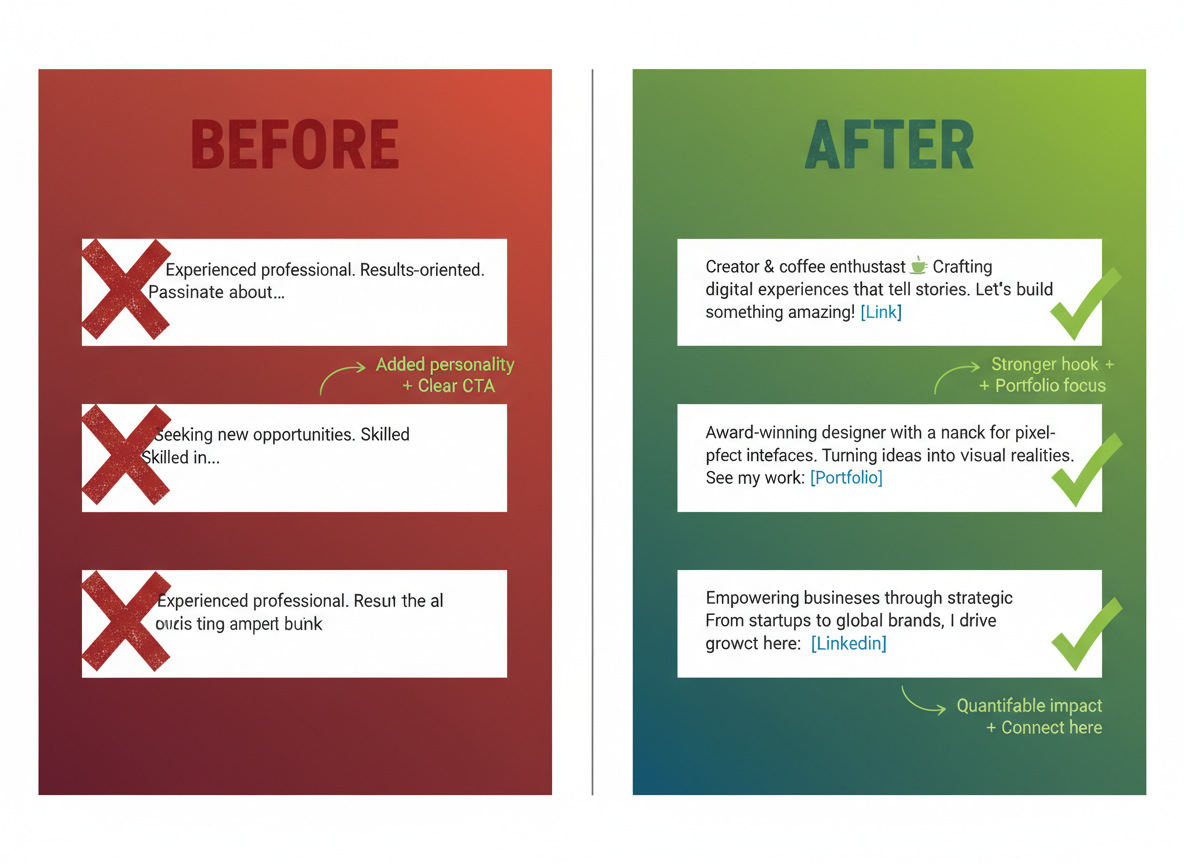
Real transformations speak louder than theory. Here’s what happened when seven professionals rewrote their personal biographies with intention.
Example 1: Marketing Manager Attracts Multiple Recruiters
Before: “Marketing manager with 8 years of experience. Skilled in digital marketing, SEO, and content creation. Looking for new opportunities.”
After: “I help B2B SaaS companies triple their qualified leads without increasing ad spend. After growing ConvertX from $2M to $18M ARR as Marketing Director, I now consult with growth-stage startups struggling to scale past the $5M mark.”
What changed: She replaced vague skills with specific results and positioned herself as a solution to a real problem. Her LinkedIn profile views jumped 340% within two weeks.
Example 2: Entrepreneur Books 15 Speaking Gigs
Before: “Entrepreneur and business consultant. Passionate about helping others succeed.”
After: “I bootstrapped three failed businesses before building a $4M company from my garage. Now I teach other founders the expensive lessons I learned so they don’t have to.”
Why it worked: Vulnerability paired with success created an irresistible story. Conference organizers wanted that authentic journey on their stage.
Example 3: Copywriter Wins High-Value Clients
Before: “Freelance copywriter with experience in various industries. Available for projects.”
After: “The email sequence I wrote for ThriveCo generated $847K in 90 days. I specialize in conversion copy for health and wellness brands ready to scale their email revenue.”
Key difference: Proof and specificity. One concrete win beat a dozen vague claims.
Example 4: Student Secures Competitive Internship
Before: “Business student at State University. Seeking internship opportunities.”
After: “Finance major who increased my campus club’s fundraising by 215% through data-driven strategy. Seeking summer analyst role to apply quantitative skills to real market problems.”
Why it landed: She demonstrated capability through achievement, not just aspiration.
Example 5: Author Boosts Book Sales
Before: “Fiction author and teacher. Published two novels.”
After: “I write thrillers for people who think they hate thrillers. Readers who ‘never finish books’ have binge-read my novels in single sittings.”
What changed: She identified her unique reader and their transformation.
Example 6: Coach Builds Authentic Brand
Before: “Certified life coach dedicated to facilitating personal transformation through evidence-based methodologies.”
After: “I’m the coach who’ll call you out (lovingly) when you’re making excuses. Former corporate burnout who rebuilt her life teaches ambitious women to do the same without the breakdown.”
Why it connected: Real voice replaced corporate speak.
Example 7: Career Changer Balances Past and Future
Before: “Former accountant passionate about graphic design. Love creating beautiful things.”
After: “After a decade crunching numbers, I now design brand identities for financial firms who need someone who speaks both languages—spreadsheets and creativity.”
The magic: She turned her seeming disadvantage into a unique positioning.
Notice the pattern? Each transformation moved from generic to specific, from credentials to results, from features to benefits. For more personal biography examples across different industries, you’ll find even more inspiration to craft your own winning bio.
9 Fatal Mistakes That Make Your Personal Biography Forgettable (And How to Fix Them)
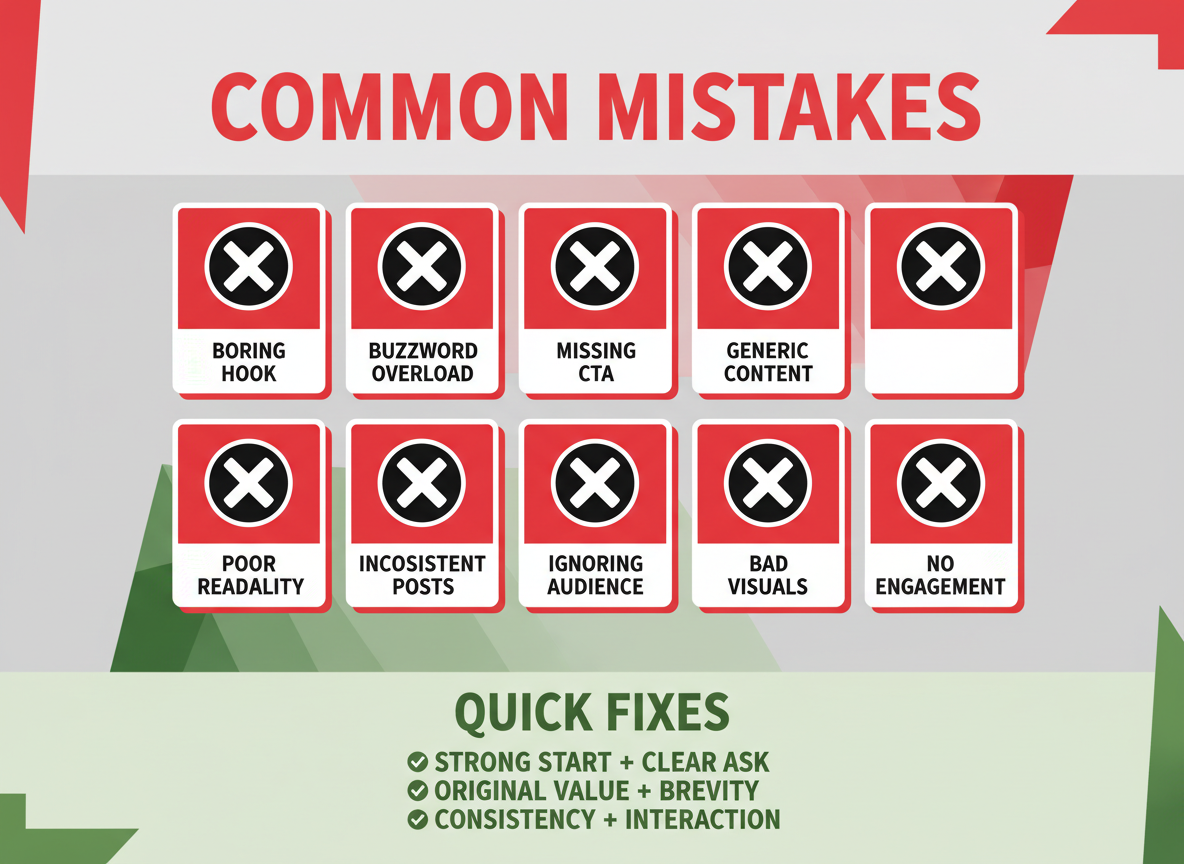
Your personal biography isn’t landing opportunities because you’re making at least three of these mistakes right now.
Mistake 1: Starting with “I am a…”
Nobody reads past the second line when you open like everyone else. Instead, lead with a surprising achievement or bold statement.
Before: “I am a marketing consultant who helps businesses grow.”
After: “I’ve helped 47 startups triple their conversion rates in under 90 days.”
Mistake 2: Listing Job Duties Instead of Achievements
Your audience doesn’t care that you “managed social media accounts.” They want to know you increased engagement by 340% and generated $120K in revenue.
Mistake 3: Using Jargon That Means Nothing
“Synergistic thought leader leveraging disruptive solutions” tells readers absolutely nothing. Replace buzzwords with specific skills and measurable results.
Mistake 4: Being Too Humble or Too Arrogant
Balance confidence with relatability. Share impressive wins, but acknowledge the journey. “After 200+ failed campaigns, I discovered the formula that now drives $2M annually for clients.”
Mistake 5: Including Irrelevant Personal Details
Unless you’re a lifestyle coach, readers don’t need to know about your three cats. Every sentence should support your professional credibility.
Mistake 6: Forgetting Your Target Audience
A personal biography works when it speaks directly to the person reading it. Are you writing for clients, employers, or collaborators? Each needs different information.
Mistake 7: Using Passive Voice
Before: “Results were achieved through strategic planning.”
After: “I achieved 215% ROI through strategic planning.”
Mistake 8: Missing a Clear Call-to-Action
Tell readers exactly what to do next. “Book a consultation,” “Download my framework,” or “Connect on LinkedIn.”
Mistake 9: One-Size-Fits-All Approach
Your LinkedIn bio shouldn’t match your Instagram bio word-for-word. Each platform serves different audiences with different expectations. For more platform-specific strategies and personal biography examples that convert, tailor your approach to each channel’s unique context.
How to Balance Personal and Professional Information in Your Biography
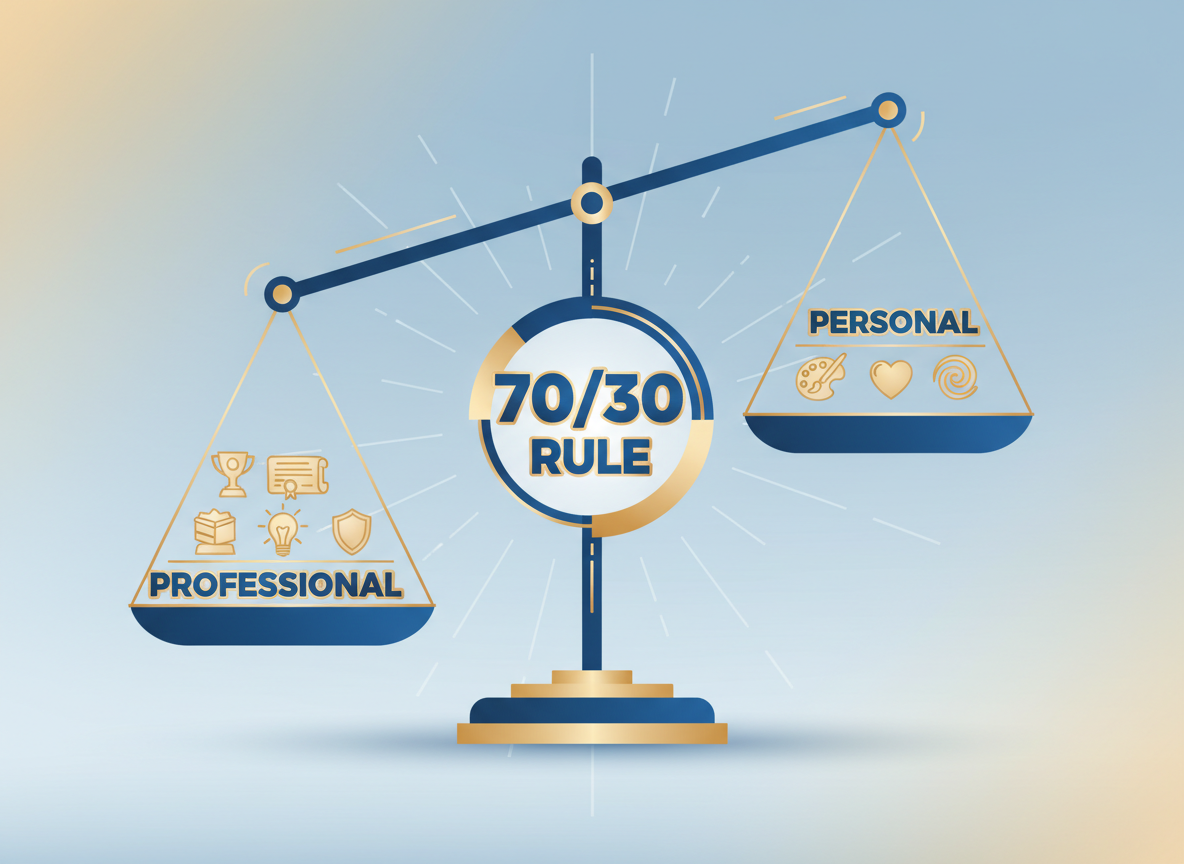
Think of your personal biography as a 70/30 split. About 70% should spotlight your professional wins—credentials, experience, results you’ve delivered. The remaining 30% brings you to life as a human being.
This balance matters because people hire people, not résumés. You want readers thinking “I can work with this person” alongside “this person can do the job.”
When personal details work: Mentioning you’re a parent of three who built a six-figure business from home shows resilience. Sharing that you’re an avid rock climber signals problem-solving and determination. These details create connection points without undermining your expertise.
When they don’t: Nobody needs to know your political views, religious beliefs, or relationship drama. If it’s not something you’d mention in a job interview, it probably doesn’t belong in your professional bio.
Industry context shifts this balance slightly. Creative professionals—designers, writers, content creators—can lean more personal. You’ve got room for quirks and personality that humanize your brand. Corporate executives and consultants? Keep it tighter. Entrepreneurial bios fall somewhere in between, especially when you’re building a personal brand statement that differentiates you.
The sniff test: Read your bio out loud. Does that personal detail make readers nod and think “interesting,” or does it make them wonder why you’re telling them? If it’s the latter, cut it.
SEO and E-E-A-T Optimization for Personal Biographies in 2026
Google’s E-E-A-T framework has transformed personal biographies from simple introductions into powerful credibility engines. Your personal biography now directly influences whether your content ranks—especially in YMYL (Your Money or Your Life) niches like health, finance, and legal services.
Start with strategic keyword placement. If you’re a financial advisor, weave “certified financial planner” and “retirement planning expert” naturally throughout your bio—but don’t force it. Google’s algorithms detect keyword stuffing instantly.
Schema markup matters more than ever. Add structured data using Person or ProfilePage schema to help search engines understand your credentials. Include properties like jobTitle, worksFor, award, and knowsAbout. This structured approach feeds AI-powered search engines that now influence 40% of online discovery.
Your credibility signals should be specific and verifiable. Instead of “award-winning writer,” say “2024 Content Marketing Awards finalist.” Link to your certifications, published articles, and media mentions. These external validation points build topical authority that E-E-A-T rewards.
For GEO (Generative Engine Optimization), structure your bio to answer AI queries directly. List concrete achievements with dates, numbers, and outcomes. When you’re creating content around your expertise, tools for AI paragraph writing can help maintain consistency across your digital presence.
Think of your personal biography as your digital reputation’s foundation—because in 2026, that’s exactly what it is.
Personal Biography Checklist: 15-Point Quality Assurance Before Publishing
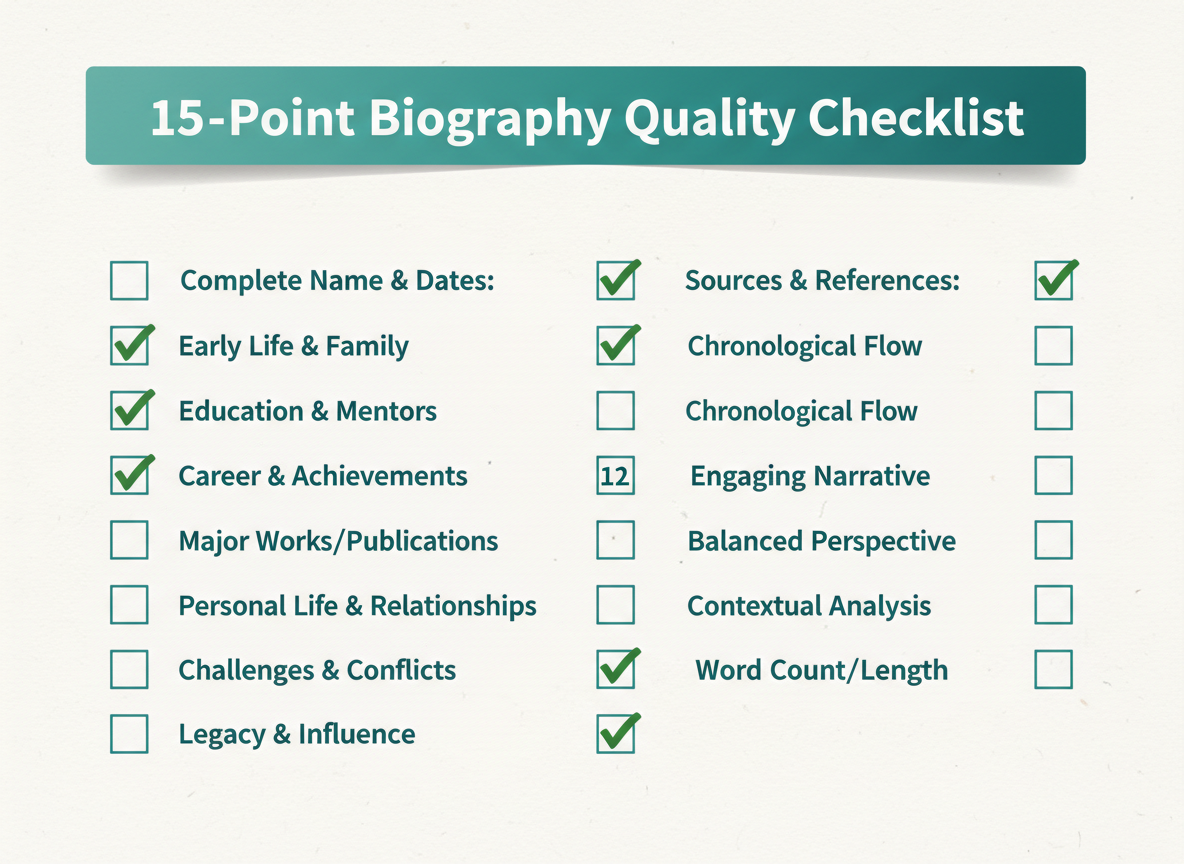
You’ve written your personal biography. Now comes the part most people skip—and regret later. Running through a final quality check separates mediocre bios from ones that actually convert.
Print this checklist (or bookmark it) and review every point before you hit publish:
☑ Compelling opening – First 5 words grab attention immediately
☑ Clear value proposition – Readers know what you offer within 2 sentences
☑ Quantifiable achievements – Include numbers, percentages, or specific outcomes
☑ Target audience alignment – Speaks directly to the people you want to reach
☑ Personality woven in – You sound human, not like a corporate press release
☑ Active voice throughout – Strong action verbs, no passive construction
☑ Zero errors – Grammar, spelling, and awkward phrasing eliminated
☑ Appropriate length – Fits the platform (50 words for Twitter, 300+ for website)
☑ Voice consistency – Third-person or first-person maintained from start to finish
☑ Current information – All roles, achievements, and credentials up-to-date
☑ Clear call-to-action – Readers know what to do next
☑ Contact details included – Email, link, or booking info where relevant
☑ Professional tone – Matches your industry standards and personal brand
☑ Natural keyword integration – SEO-friendly without sounding forced
☑ Peer-tested – At least two people from your target audience reviewed it
For platform-specific formatting tips, check out these 57 example of bio about yourself templates that show exactly how top professionals structure their bios across different channels.
How AI Tools Can Help You Write (But Not Replace) Your Personal Biography
Let’s be clear: AI won’t write your personal biography for you, but it’ll make the process much less painful.
Think of AI as your writing assistant, not your ghostwriter. It excels at breaking through that intimidating blank page, generating structural frameworks, and refining awkward phrasing. What it can’t do? Capture the story about how your grandmother’s cookbook inspired your catering business or why you pivoted from law to graphic design after a backpacking trip through Southeast Asia.
The 80/20 approach works best here. Use AI for the heavy lifting—creating outlines, drafting initial versions, and polishing grammar. Then add the 20% that actually matters: your authentic voice, specific achievements, and memorable details that make readers think, “I need to work with this person.”
When you’re using AI to draft your personal biography, be specific in your prompts. Instead of “write my bio,” try “create a 150-word professional biography for a freelance UX designer with 8 years of experience, focusing on accessibility and healthcare projects.” For more advanced techniques, check out our guide on AI paragraph writing to master the art of AI-assisted content creation.
Red flags that scream “AI-generated”? Watch for vague phrases like “results-driven professional” or “passionate about excellence” without concrete examples. If your bio could describe anyone in your field, it’s too generic.
Content Gorilla’s AI automation helps content creators maintain consistent personal branding across multiple platforms without sounding robotic. You input your unique stories and achievements once, and the system adapts them for different contexts while preserving your authentic voice.
The editing phase matters most. Take that AI-generated draft and inject yourself into it—replace generic statements with quantifiable results, swap bland adjectives for specific anecdotes, and ensure every sentence sounds like something you’d actually say at a networking event.
Your Personal Biography Action Plan: What to Do Right Now
You’ve got the frameworks. Now let’s put them to work.
Here’s your 30-minute action plan to transform your personal biography:
First 10 minutes: Audit your current bio across all platforms. Does it follow the 5-part structure? Does it maintain the 70/30 balance between credibility and humanity? If you’re cringing at what you wrote three years ago, that’s your sign.
Next 15 minutes: Choose the template that fits your industry and draft your new version. Start with LinkedIn (that’s where hiring managers look first), then adapt it for your website, Twitter, and speaker pages. Need help defining your unique positioning? Check out our Personal Brand Statement Generator for additional frameworks.
Final 5 minutes: Test different versions. Change your headline on LinkedIn and track profile views over two weeks. Swap your opening line and monitor which gets more meeting requests.
Set a quarterly reminder to update your bio with fresh achievements. Every closed deal, published article, or speaking engagement deserves a spot.
Here’s what you’re missing right now with that outdated bio: speaking opportunities going to someone with a more compelling story, clients choosing competitors who seem more credible, and collaborations that could’ve been yours.
While you’re building your personal brand, let Content Gorilla handle your content publishing across platforms. More automation means more time for the strategic work that actually moves the needle.
Your story matters. Tell it like you mean it.
Frequently Asked Questions About Personal Biographies
How long should a personal biography be?
It depends where you’re using it. Twitter/X bios max out at 160 characters, so you’ll need the elevator pitch version. LinkedIn gives you 2,600 characters—use around 300-500 words to showcase your expertise without losing readers. Website bios work best at 150-300 words, while speaker bios can stretch to 500 words if you’ve got the credentials to back it up. Short-form bios (50-100 words) work for conference programs and guest posts.
Should I write my personal biography in first person or third person?
Third person (“Sarah helps brands grow their online presence”) sounds more professional for formal contexts like speaking engagements, conference materials, and corporate websites. First person (“I help brands grow their online presence”) creates connection and works better for personal websites, social media, and anywhere you’re building relationships directly with your audience.
What’s the difference between a personal biography and a professional bio?
A professional bio focuses exclusively on your work credentials, achievements, and expertise. A personal biography weaves in elements of who you are beyond work—your values, interests, maybe even hobbies that make you memorable. You’re still professional, but you’re letting people see the human behind the title.
How often should I update my personal biography?
Review it quarterly, update it when something significant happens. New certification? Major client win? Career pivot? Update immediately. Even without big changes, refresh it every 3-6 months to keep the language current and relevant.
Can I use the same biography on all platforms?
Don’t copy-paste everywhere. Each platform has different character limits, audience expectations, and purposes. Your LinkedIn bio should emphasize professional depth, while Instagram needs punchy personality. Twitter requires ruthless brevity. Adapt the core message to fit each platform’s culture. Check out these 47 personal biography examples to see how top professionals customize for different platforms.
What personal information should I include in my biography?
Stick to details that build credibility or connection. Your location (city-level is fine), relevant experience, measurable results, and maybe one humanizing detail that makes you memorable. Skip your age, full address, or anything you wouldn’t share in a first networking conversation.
How do I write a personal biography if I’m just starting my career?
Focus on passion, skills, and potential rather than decades of experience. Highlight relevant education, projects you’ve completed (even unpaid ones), transferable skills from other fields, and what you’re actively learning. Your enthusiasm and fresh perspective are assets—own them.
Should I hire someone to write my personal biography?
Write it yourself first. You know your story best. If you’re struggling with phrasing or structure after several attempts, a professional writer can polish your draft or conduct an interview to capture your voice. Budget $200-$1,000 for professional bio writing, depending on length and complexity. Most people can create effective bios themselves with good examples and feedback.
How do I make my personal biography stand out from competitors?
Be specific. Instead of “marketing expert,” try “I’ve helped 47 SaaS companies double their email open rates.” Replace generic descriptors with concrete results, unique methodologies, or unexpected background details. Your combination of experiences is unique—highlight what makes your approach different.
What tone should I use in my personal biography?
Match your industry’s expectations while letting personality peek through. Tech startups embrace casual language and humor. Legal and financial services need more formal approaches. Creative fields reward distinctive voices. When in doubt, aim for “professionally personable”—competent but approachable.
How can I add personality to my biography without being unprofessional?
Use active verbs that show energy: “build,” “create,” “transform” instead of passive “responsible for.” Include one specific interest or value that reveals character: “When I’m not optimizing campaigns, you’ll find me training for ultramarathons” or “I believe transparency beats clever marketing tactics every time.” Small touches create connection without crossing into TMI territory.
Do personal biographies help with SEO and online visibility?
Absolutely. Search engines increasingly prioritize E-E-A-T (Experience, Expertise, Authoritativeness, Trustworthiness). A well-crafted personal biography with relevant keywords, your actual credentials, and links to your work signals you’re a real expert, not just content filler. Include your bio on your website, author pages, and guest posts—it helps search engines connect your content across platforms and builds your digital authority.
I am a full-time online marketer, for over a decade now. Helped over 100,000+ people & generated well over $12M in online sales.