Introduction: Why Your Short Bio Is Your Most Powerful Marketing Asset
You’ve spent three hours staring at that blank text box, trying to summarize your entire professional existence in 150 characters. Or worse—you’ve recycled the same tired bio from 2019 across every platform, watching engagement flatline while wondering why nobody’s reaching out.
Here’s the uncomfortable truth: most professionals sabotage their opportunities before they even begin. That speaker application? Rejected because your bio read like a LinkedIn summary written by a committee. That potential client who landed on your profile? They bounced in four seconds because they couldn’t figure out what you actually do.
Your short bio isn’t just an afterthought tucked into your social profiles. It’s the gatekeeper to every opportunity that matters. It appears on conference programs, guest post bylines, podcast introductions, Instagram profiles, Twitter headers, email signatures, and networking event badges. Each appearance is a micro-moment where someone decides whether you’re worth their time.
In 2026’s brutal attention economy, you’ve got 3-5 seconds max. That’s it. Not enough time for humble-bragging or industry jargon. Definitely not enough time for that paragraph about your passion for “leveraging synergies.”
This guide hands you the exact formulas that convert. You’ll get platform-specific templates with character counts, before-and-after transformations, and strategic frameworks for different contexts—whether you’re pitching yourself as a speaker, closing freelance clients, or building authority as a creator. We’ve analyzed bios that actually work, including examples across every major platform, to show you what separates forgettable from unforgettable.
Let’s fix your bio problem once and for all.
What Makes a Short Bio Different (And Why Length Matters)
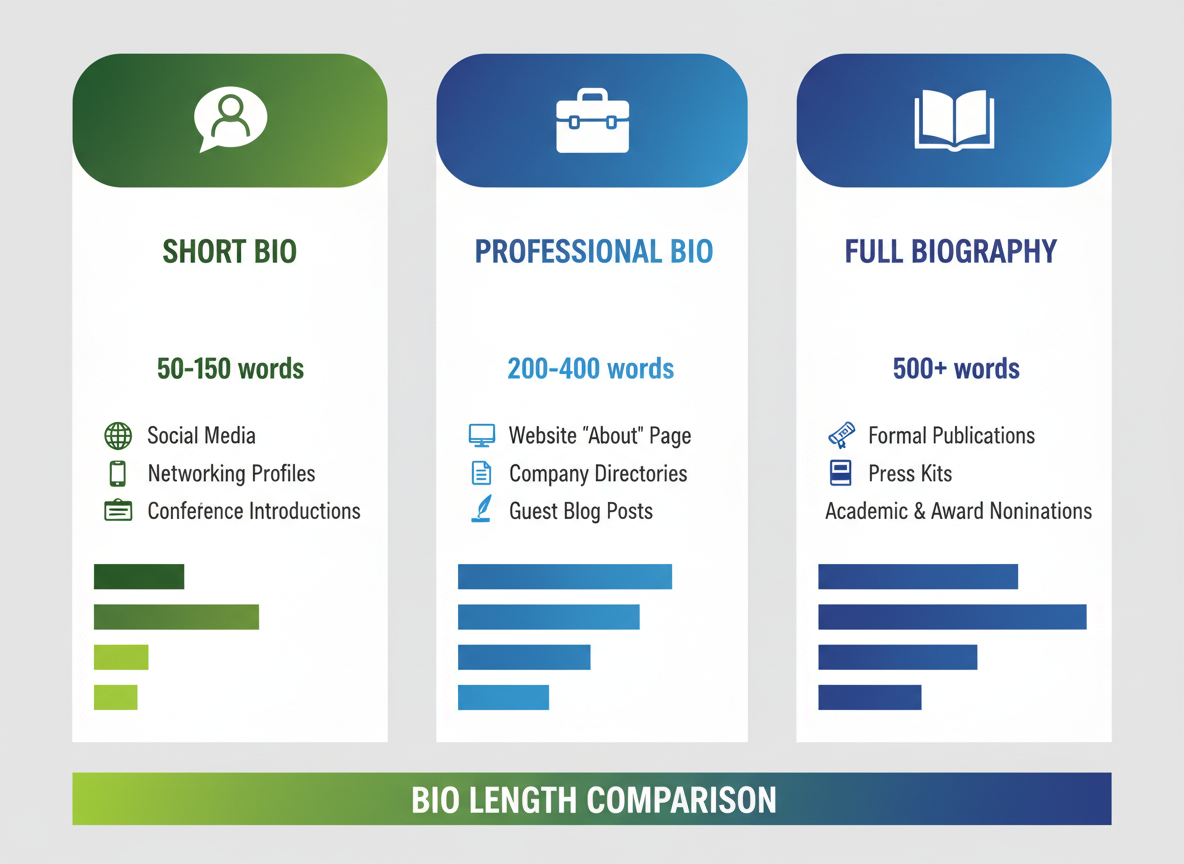
Here’s the truth: a short bio isn’t just a trimmed-down version of your full biography. It’s a completely different beast.
Short bios typically run 50-150 words or 300-600 characters, depending on where they’ll live. Twitter gives you roughly 160 characters. Instagram caps you at 150. LinkedIn’s headline? Just 120 characters to make your mark. Speaker bios for conferences usually demand 75-100 words, tops.
Compare that to full-length professional biographies, which can stretch into several paragraphs—and you’ll see why the short format requires a fundamentally different approach.
The challenge? You’re packing credibility, personality, and your value proposition into the space most people use for a couple of tweets. Research on cognitive load shows readers make snap judgments within 2-3 seconds when scanning bios. That’s barely enough time to read 30 words.
Studies on attention spans reveal that 55% of visitors spend fewer than 15 seconds on a page. Your bio needs to work instantly.
This isn’t about being concise for the sake of it. Platform constraints force you to distill your professional identity down to its essence—which, ironically, often makes your message sharper and more memorable than longer versions ever could.
The 4-Part Formula for Writing Any Short Bio in Under 5 Minutes
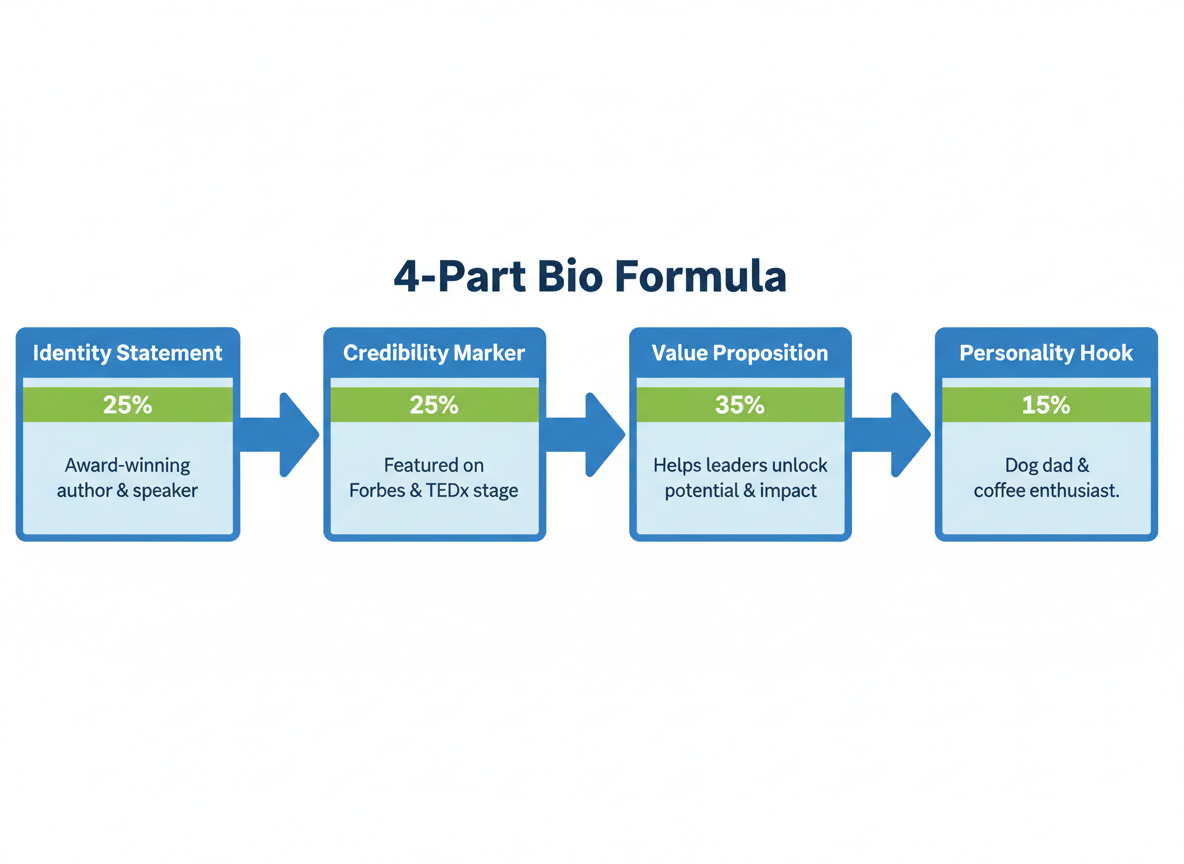
Here’s the straightforward formula that’ll transform bio-writing from a dreaded task into a five-minute process:
Part 1: Identity Statement (25%)
Open with who you are and what you do. One clear sentence. No fluff.
Template: “I’m a [role] who [primary activity].”
Part 2: Credibility Marker (25%)
Add a quick hit of proof—an achievement, credential, or specific expertise that makes people think, “Okay, they know their stuff.”
Template: “[Notable achievement/credential/years of experience].”
Part 3: Value Proposition (35%)
This is your heaviest lift. Explain who you help and what transformation you deliver. When crafting this part, tools like a personal brand statement generator can help clarify your unique positioning.
Template: “I help [target audience] [achieve specific result] without [common pain point].”
Part 4: Personality Hook (15%)
End with something human—a quirky detail, hobby, or simple call-to-action that makes you memorable.
Template: “[Humanizing detail] or [When I’m not [working], I’m [personal interest]].”
The Complete Fill-in-the-Blank:
“I’m a [role] who [primary activity]. [Credibility marker]. I help [target audience] [achieve result] without [pain point]. [Personality hook or CTA].”
Adjusting for Word Count:
Need 50 words? Keep one sentence per part.
Got 150 words? Expand Part 3 with specific methods or results.
Maxing out at 300? Add context to your credibility and include multiple value propositions.
This formula works because it mirrors how people naturally evaluate expertise: identity, trust, relevance, relatability. You’re not reinventing the wheel—you’re filling in proven blanks.
Platform-Specific Short Bio Guidelines: Character Limits & Best Practices
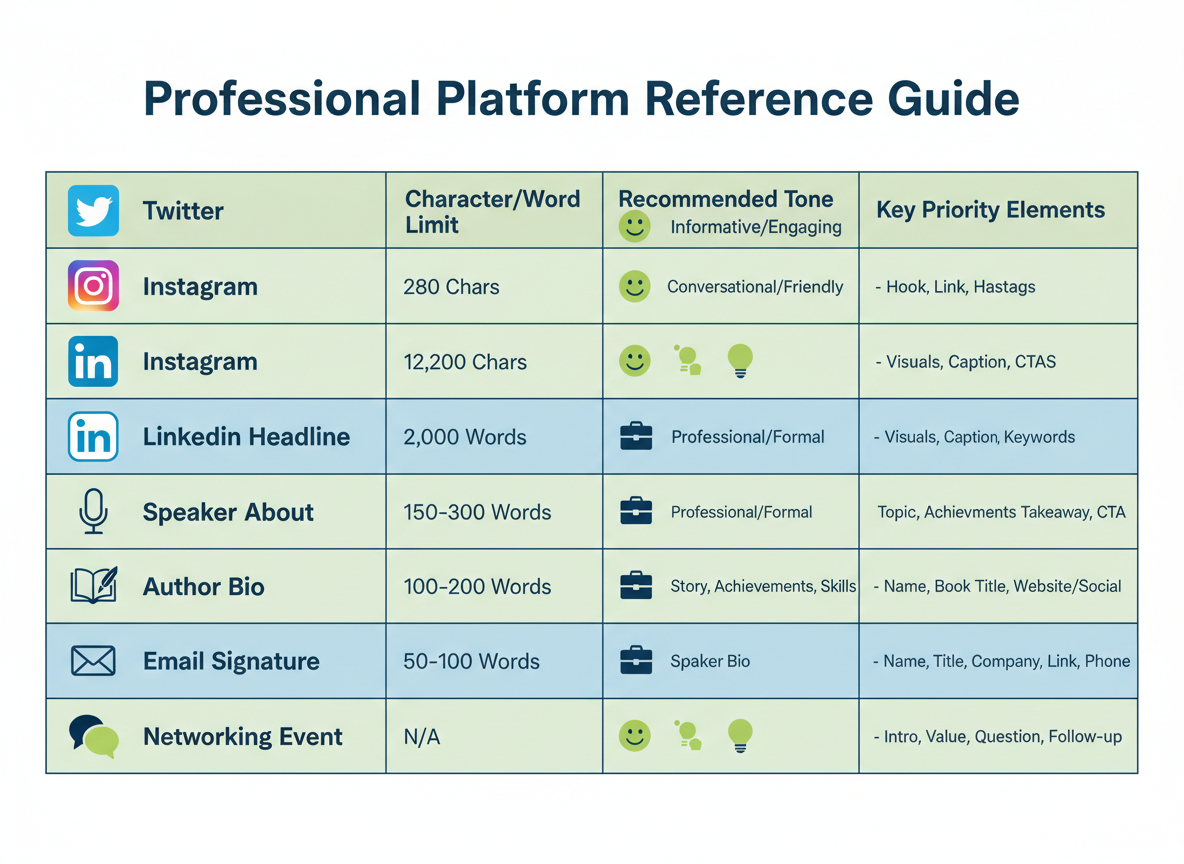
Every platform has its own rules, and cramming a LinkedIn bio into Twitter won’t work. Here’s what actually matters for each major platform where your short bio needs to perform.
Twitter/X gives you 160 characters to make an impression. Pack in keywords that signal your expertise, add a dash of personality, and include a clear CTA. Something like: “Content strategist helping SaaS brands convert. Ex-HubSpot. 🎯 DM me about your content audit → Free template.” You’re searchable, memorable, and actionable.
Instagram’s 150-character limit demands visual thinking. Emojis aren’t just decoration—they’re scannable markers that break up text. Your link is precious real estate, so make it count. Consider: “📈 Growth marketer | Built 6-figure launches | Coffee snob ☕ | Free course ↓” The emojis create rhythm, and you’ve told people exactly what they’ll get.
Your LinkedIn headline (120 characters) needs to work like an SEO magnet while staying professional. Think “Content Marketing Strategist | B2B SaaS Growth | Helping Companies Scale from $1M to $10M” rather than “Passionate storyteller and creative thinker.”
The LinkedIn About section shows only the first 300 characters before forcing readers to click “see more.” Treat this preview like a movie trailer—your best stuff goes upfront. Answer “What do you do?” and “Who do you help?” immediately.
Speaker and conference bios (75-100 words) need third-person formatting and achievement-focused language. Program committees want credentials, media mentions, and relevant expertise—fast. Skip the fluff about being passionate.
Author bylines (50-75 words) establish your authority on the topic at hand. You’re building trust with readers who’ve never heard of you. For platform-specific examples that work across different contexts, check out templates tailored to your exact needs.
Email signature bios (40-60 words) should integrate your value proposition with your contact details seamlessly. You’re not writing a resume—you’re reminding people what you do and why they saved your email.
Networking event bios (60-80 words) need to spark conversations. Give people a hook to remember you by and a reason to follow up.
| Platform | Character/Word Limit | Tone | Priority Elements |
|———-|———————|——|——————-|
| Twitter/X | 160 characters | Punchy, keyword-rich | Expertise, CTA, searchability |
| Instagram | 150 characters | Visual, personality-driven | Emojis, link strategy, niche clarity |
| LinkedIn Headline | 120 characters | Professional, SEO-focused | Keywords, value proposition, positioning |
| LinkedIn About (preview) | 300 characters | Solution-oriented | Problem solved, credibility, hook |
| Speaker Bio | 75-100 words | Achievement-focused | Credentials, third-person, relevance |
| Author Byline | 50-75 words | Authority-building | Expertise, trust signals, topical fit |
| Email Signature | 40-60 words | Concise, professional | Value prop, contact integration |
| Networking Event | 60-80 words | Memorable, conversational | Conversation starter, differentiator |
11 Copy-Paste Short Bio Templates for Different Professions
Ready to write your bio in the next five minutes? These templates work because they follow proven conversion principles—the same ones we cover in our complete guide to personal biography examples. Just fill in the blanks with your details.
Template 1: Freelance Writer/Content Creator
“[Name] helps [target audience] achieve [specific result] through [unique approach]. With [X years] in [niche], I’ve worked with brands like [client examples] to [quantifiable achievement]. When I’m not writing, you’ll find me [personal touch].”
Example: “Sarah Chen helps B2B SaaS companies triple their organic traffic through SEO-driven content. With 7 years in tech marketing, I’ve worked with brands like Slack and HubSpot to generate over 50M page views. When I’m not writing, you’ll find me hiking with my rescue dog.”
Template 2: Marketing Professional/Digital Marketer
“I turn [service/skill] into [measurable results] for [ideal client]. Currently [role] at [company], specializing in [specific focus]. Previously scaled [achievement] at [former company].”
Template 3: Entrepreneur/Business Owner
“Founder of [Company] – we help [audience] solve [pain point]. Since [year], we’ve [impressive metric]. Featured in [publications/achievements]. Building [mission] one [product/service] at a time.”
Template 4: Coach/Consultant
“I partner with [client type] to [transformation] in [timeframe]. Certified [credentials], [X] years experience, and [number] clients served. My approach: [unique methodology]. Results speak: [specific outcome].”
Template 5: Tech Professional/Developer
“[Role] specializing in [tech stack/focus area]. Built [notable project] used by [impressive number]. Passionate about [specific interest]. Open source contributor to [projects].”
Template 6: Creative Professional
“[Role] crafting [type of work] that [emotional result]. Clients include [recognizable names]. My work has [achievement]. Currently exploring [current focus].”
Template 7: Sales Professional
“Top [X%] performer helping [company type] achieve [goal]. Generated [$X] in revenue through [method]. Specialize in [niche]. Let’s connect about [CTA].”
Template 8: Speaker/Thought Leader
“Keynote speaker on [topics]. Spoken at [events]. Author of [book/articles]. Helping [audience] navigate [challenge]. Book me: [contact].”
Template 9: Entry-Level Professional/Career Changer
“Transitioning from [old field] to [new field]. Recently completed [certification/program]. Bringing [transferable skills] to solve [industry problem]. Always learning.”
Template 10: Academic/Researcher
“[Degree] researcher focused on [specific area]. Published in [journals]. Investigating [current research]. Making [complex topic] accessible to [audience].”
Template 11: Non-Profit Professional
“Dedicated to [cause] through [role] at [organization]. Led initiatives that [impact metric]. Believe everyone deserves [mission]. Previously [relevant background].”
Pro tip: Personal branding bios can be casual and show personality. Company-representing bios should maintain professionalism while still sounding human.
Before & After: Transforming Bloated Bios Into Powerful Short Versions
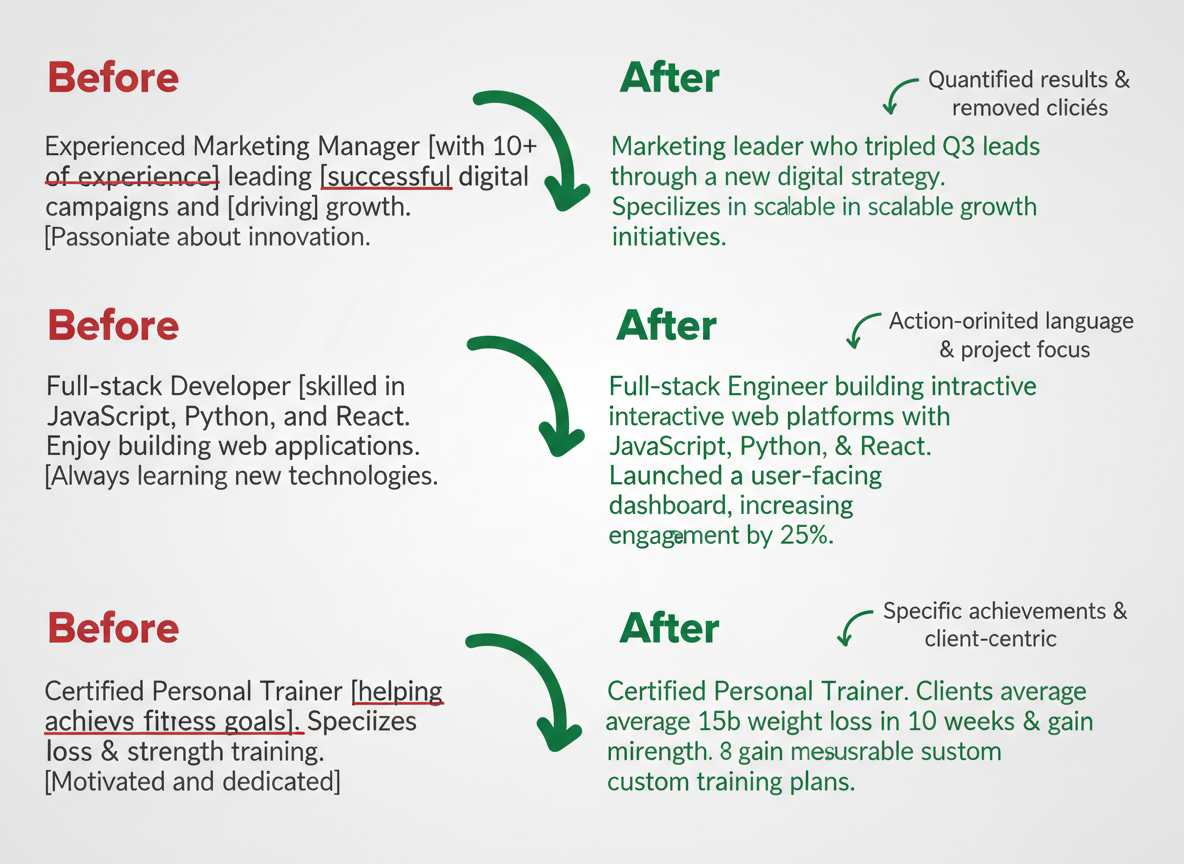
Let’s get real—most bios fail because they’re trying too hard. Here are five actual transformations that show you exactly what to cut, what to keep, and why it works.
Example 1: The ‘Everything But The Kitchen Sink’ Bio
Before (87 words): “I’m a passionate marketing professional with over 15 years of experience in digital strategy, content creation, SEO optimization, email marketing, social media management, and brand development. I’ve worked with companies of all sizes across various industries. I’m also a certified project manager, have a degree in Business Administration, and I’m constantly learning new skills. In my free time, I enjoy hiking, reading mystery novels, and spending time with my two dogs, Max and Charlie.”
After (29 words): “Marketing strategist who’s helped 200+ brands triple their organic traffic. I turn complex SEO into revenue. Currently scaling e-commerce businesses through data-driven content strategies.”
What changed: Removed hobbies, generic descriptors, and laundry-list credentials. Added specific results (200+ brands, triple traffic) and clear positioning. Word count reduced by 67%.
Example 2: The Jargon-Heavy Bio
Before (64 words): “Synergistic thought leader leveraging blockchain-enabled solutions to facilitate paradigm shifts in enterprise ecosystems. My innovative frameworks optimize cross-functional deliverables while maintaining stakeholder alignment through agile methodologies. I architect scalable solutions that drive transformational outcomes.”
After (31 words): “I help tech startups explain complex products in plain English. Former engineer turned copywriter. My clients’ conversion rates increased by 43% on average after rewriting their websites.”
What changed: Stripped buzzword soup. Added concrete profession, relatable backstory, and measurable outcome. Word count reduced by 52%.
Example 3: The Credential-Only Bio
Before (48 words): “MBA from Stanford. Certified Financial Planner (CFP). Licensed Securities Broker. Member of the National Association of Personal Financial Advisors. Published in Forbes, WSJ, and Bloomberg. 20+ years in wealth management.”
After (36 words): “I protect wealth for tech executives navigating IPOs and acquisitions. CFP with 20 years managing $500M+ in assets. Featured in Forbes and WSJ for retirement strategies that actually work.”
What changed: Led with benefit, not credentials. Kept relevant credentials but wove them into value proposition. Word count reduced by 25%.
Example 4: The Vague Bio
Before (52 words): “Experienced designer creating beautiful, functional work for clients worldwide. I focus on user experience and making sure every project exceeds expectations. My approach combines creativity with strategic thinking to deliver results that matter.”
After (35 words): “UX designer specializing in SaaS dashboards that reduce user churn. Redesigned interfaces for 47 startups, cutting support tickets by 60% on average. I make complicated software feel intuitive.”
What changed: Replaced vague claims with specific niche, quantifiable results, and clear expertise. Word count reduced by 33%.
Example 5: The Passive Bio
Before (58 words): “Content has been created for major brands including Nike, Apple, and Microsoft. Campaigns have been developed that resulted in significant engagement increases. Recognition has been received from industry publications. Content marketing strategies have been implemented that have been successful across multiple platforms.”
After (32 words): “I write content that sells. Built campaigns for Nike, Apple, and Microsoft that generated 15M+ impressions. My email sequences convert 3x higher than industry benchmarks.”
What changed: Switched to active voice with strong verbs (write, built, convert). Added specificity (15M impressions, 3x benchmarks). Word count reduced by 45%.
The Master Bio Method: Write Once, Adapt for Every Platform
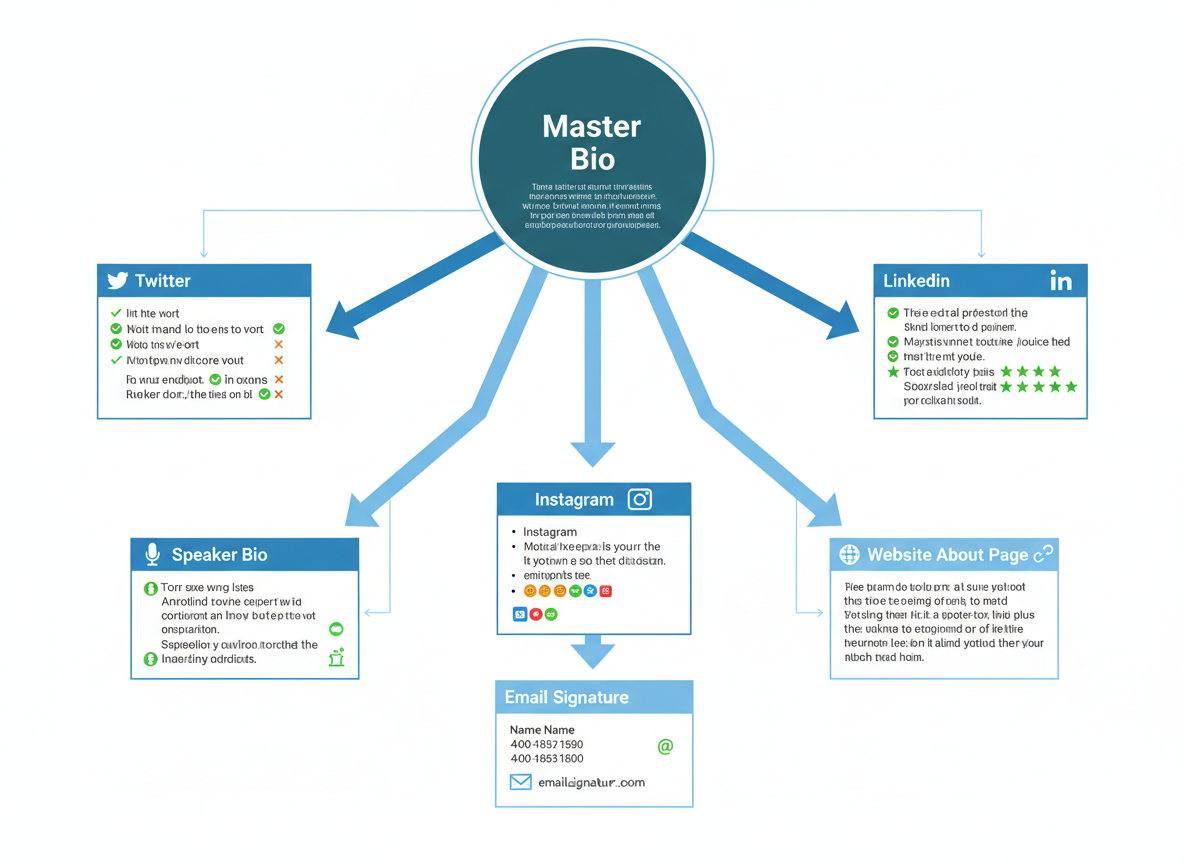
Here’s the secret most people miss: you shouldn’t write a new bio from scratch for every platform. That’s exhausting and inefficient.
Instead, create one comprehensive master bio—about 150 words—that serves as your source document. Think of it as your bio blueprint that you’ll adapt, not rewrite, for each platform.
Step 1: Write Your Master Bio
Use the 4-part formula we covered earlier with all your essential elements. Include your expertise, credentials, personality, and call-to-action. This becomes your complete story.
Step 2: Build Modular Components
Break your master bio into interchangeable modules: core credentials, specific achievements, personality statements, and CTAs. Label each module so you can mix and match based on the platform.
Step 3: Create Adaptation Rules
Document which modules work best on each platform. LinkedIn gets credentials and achievements. Instagram gets personality and relatability. Twitter gets wit and brevity.
Step 4: Build Your Bio Library
Pre-write variations for your main platforms. Store them in a simple document or spreadsheet with clear labels.
This approach mirrors the systematic content creation methods used by content engineers—breaking complex tasks into repeatable systems.
Set quarterly reminders to review and update your master bio when you land new achievements or shift your focus. You’ll spend 30 minutes once instead of starting from scratch every time you need a bio.
7 Common Short Bio Mistakes That Kill Your Credibility (And How to Fix Them)
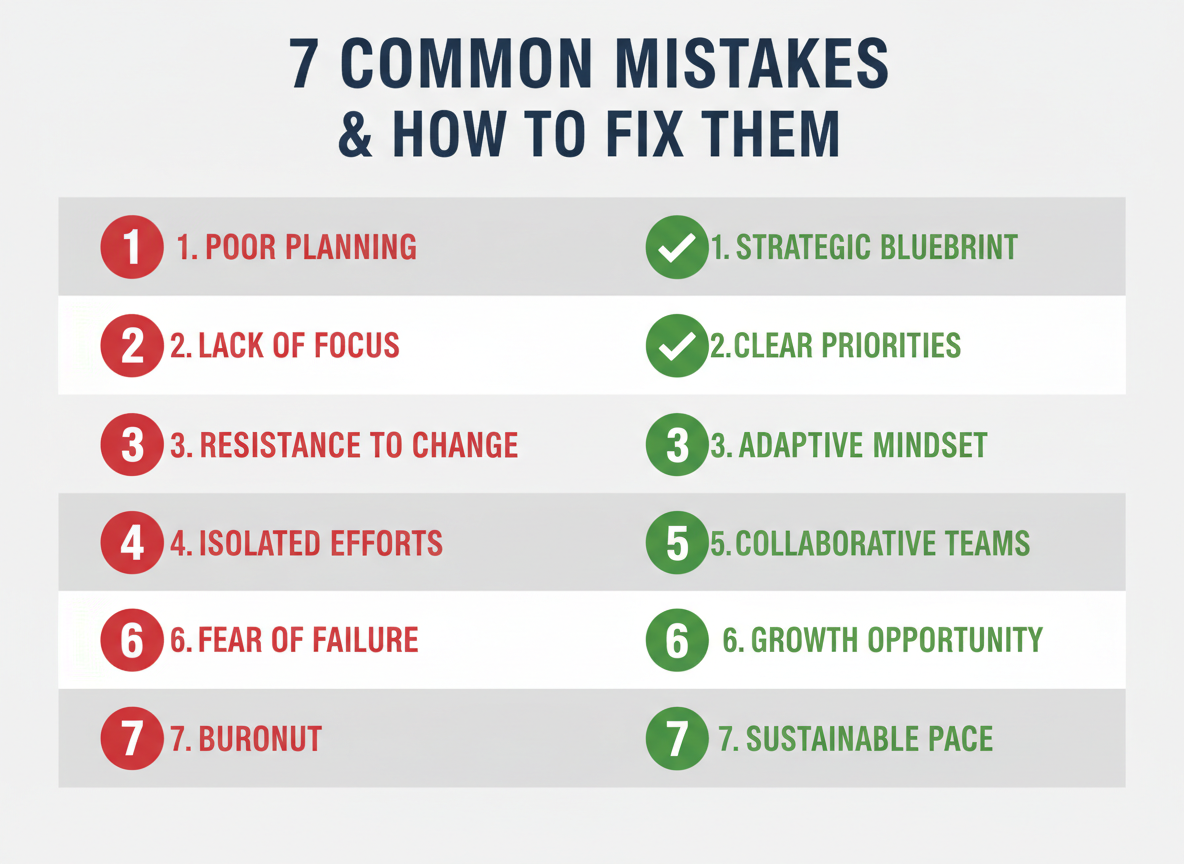
Let’s talk about what’s sabotaging your short bio—and how to fix it fast.
Mistake 1: Over-Cramming Everything
You’ve got 15 years of experience, six certifications, three businesses, and a podcast. But shoving it all into 150 words makes you sound unfocused.
Fix: Match your bio to the context. LinkedIn? Lead with your current role and biggest win. Instagram? Share what you’re passionate about right now. Pick three strong points instead of cramming twelve weak ones.
Mistake 2: Buzzword Overload
“Innovative thought leader leveraging synergies to optimize vertical solutions” tells me absolutely nothing about what you actually do.
Fix: Read your bio out loud. If you wouldn’t say it to someone at a coffee shop, rewrite it. Replace “driving transformational change” with “helped 50 companies triple their revenue.”
Mistake 3: Wrong Person, Wrong Platform
Third person (“Sarah is a marketing consultant…”) feels stuffy on Twitter but works great for speaker submissions.
Fix: First person for social profiles. Third person for professional directories and conference bios. Simple.
Mistake 4: The Dead-End Bio
You’ve hooked them—now what? They scroll away because you didn’t tell them what to do next.
Fix: Always include a call-to-action. “Book a free consultation at [link]” or “Download my content checklist below.”
Mistake 5: Too Humble or Too Cocky
Either you downplay achievements (“I dabble in marketing”) or oversell yourself (“World’s #1 guru”).
Fix: State facts with personality. “Built three 7-figure brands” beats both humble bragging and empty superlatives. For more examples of striking this balance, check out these personal biography examples.
Mistake 6: Stale Information
That award from 2019? It’s aging like milk.
Fix: Set a quarterly reminder to refresh your bio. Update recent wins, current projects, and relevant credentials.
Mistake 7: Ignoring Keywords
If you’re a “content strategist” but never use that phrase, potential clients won’t find you.
Fix: Weave 2-3 industry keywords naturally into your bio. “I help SaaS companies scale their content marketing” beats vague descriptions every time.
Personal Branding vs. Professional Context: When to Use Which Approach
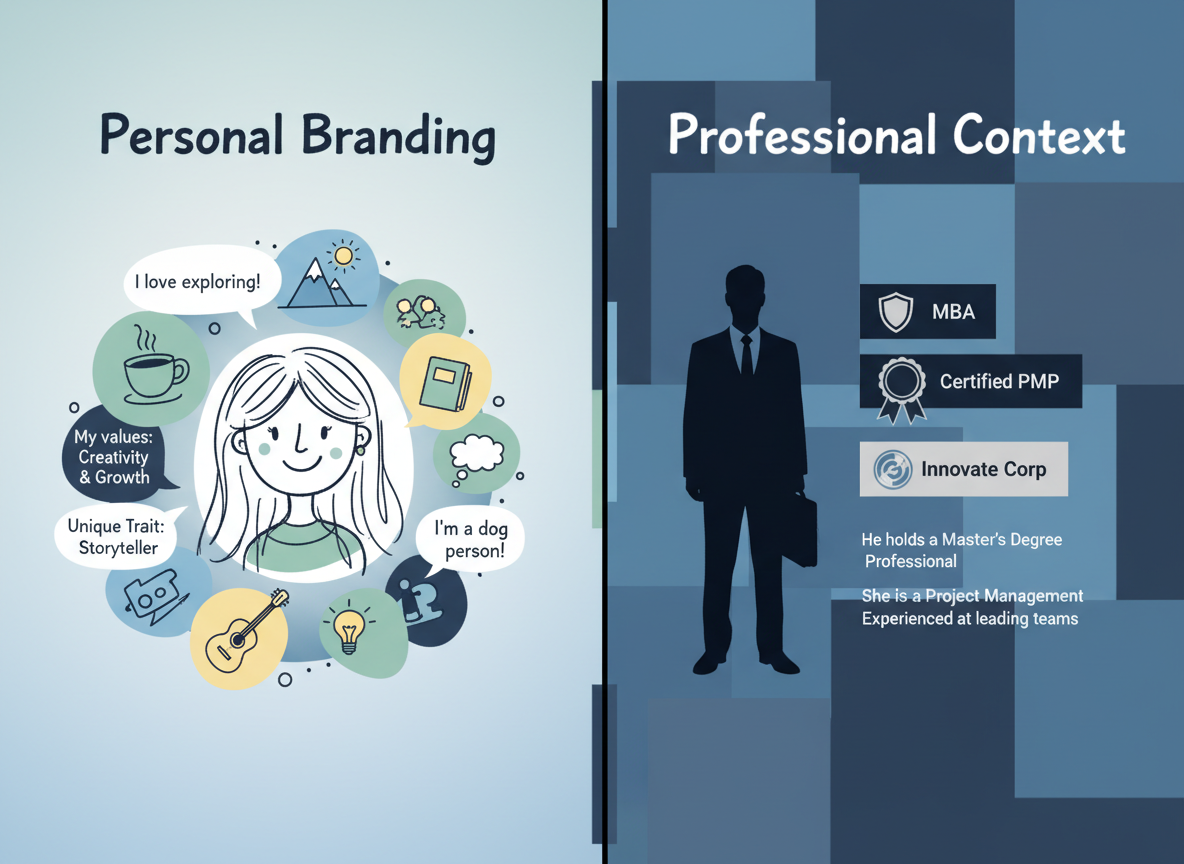
Here’s the truth: the same person needs different bios for different situations. And mixing up personal branding with professional representation can cost you opportunities.
Personal branding positions you as the asset. It’s about building your reputation, showcasing your personality, and attracting opportunities directly to you. You’ll use this approach on personal social media, your own website, freelance platforms like Upwork, networking events, and when establishing thought leadership. The voice? First person, conversational, and personality-forward. Tools like a personal brand statement generator can help refine this approach.
Professional representation emphasizes your role within a larger organization. Think company author bios, corporate LinkedIn profiles, team pages, industry publications, and formal speaking engagements. Here, you’ll typically use third person with credential-heavy language that reinforces organizational authority.
Decision framework:
- Who benefits from the connection? (You = personal; Company = professional)
- What’s the platform’s culture? (Casual = personal; Formal = professional)
- What action do you want readers to take? (Hire/follow you = personal; Trust organization = professional)
Sometimes you’ll blend both approaches—like when you’re a founder representing your company. Lead with organizational credentials, then weave in personal elements that humanize your authority.
Example contrast:
- Personal: “I help overwhelmed marketers automate their content so they can finally stop working weekends.”
- Professional: “Sarah Martinez serves as Director of Marketing Strategy at Testing CG, where she oversees content automation solutions for enterprise clients.”
SEO and Discoverability: Optimizing Your Short Bio for Search and AI
Your bio isn’t just for human readers anymore. AI assistants, search engines, and content platforms now parse your bio to determine where and how you appear in results.
Start with strategic keyword placement. When you’re figuring out how to write short bios that rank, weave relevant terms naturally into your description. Instead of “I help businesses grow,” try “I help SaaS companies increase conversion rates through data-driven content strategy.” See the difference? You’ve included searchable terms without sounding robotic.
E-E-A-T signals matter even in 150 characters. Drop specific credentials early: “7-year SEO strategist” beats “experienced marketer.” Mention recognizable brands you’ve worked with or publications that’ve featured you. These authority markers tell both humans and algorithms you’re legit.
For platform-specific optimization, content engineers understand how structured data affects visibility. If you’re embedding bios on your website, implement author schema markup—it helps Google connect your content to your expertise.
Generative Engine Optimization changes everything. ChatGPT and similar tools pull bio information to answer queries about experts in specific fields. Write in clear, factual statements rather than flowery language. “Built a $2M agency specializing in e-commerce content” gets indexed better than “passionate about helping brands tell their story.”
Voice search matters too. People ask, “Who’s a good freelance writer in Austin?” Your bio should answer conversationally with location and specialty clearly stated.
Track your results. Monitor click-through rates on social platforms, check Google Search Console for branded queries, and test different bio versions quarterly. Your bio performs best when it’s both human-friendly and machine-readable.
Tools, Generators & Resources for Writing Short Bios Faster
Writing bios doesn’t have to eat up your entire afternoon. The right tools can cut your writing time in half while improving quality.
AI-powered bio generators handle the heavy lifting by creating first drafts based on your inputs. They’re excellent for beating blank-page syndrome, though you’ll want to edit for personality and accuracy. Personal brand statement generators can help you nail your core positioning before expanding into full bios.
Character count tools ensure you stay within platform limits. Twitter’s 160 characters, Instagram’s 150, LinkedIn’s 220—these constraints matter. Most word processors include character counts, or use dedicated browser extensions.
Readability checkers like Hemingway and Grammarly flag complex sentences and suggest simpler alternatives. Aim for an 8th-grade reading level for maximum accessibility.
Keyword research tools help you identify search terms your audience actually uses. Include relevant keywords naturally without stuffing.
For teams managing multiple platforms, Testing CG’s AI-powered content automation maintains consistent, optimized bios everywhere. Update once, deploy across channels—no more manual rewrites or version control nightmares.
A/B testing tools let you compare bio variations on social platforms. Test different hooks, CTAs, or positioning statements to see what drives more clicks.
Keep a swipe file of compelling bios you encounter. When inspiration strikes, you’ll have proven examples to reference.
Conclusion: Your Short Bio Action Plan
Here’s the truth: your short bio isn’t just filler text. It’s a high-leverage marketing asset that works 24/7 to convert readers into followers, customers, and advocates.
You now have the complete framework. The 4-part formula (expertise + impact + credibility + CTA) gives you the structure. The Master Bio Method saves you hours by creating one strong foundation that you’ll adapt rather than rewriting from scratch each time.
Your next steps are simple:
Action Step 1: Write your master bio using the formula (30 minutes max). Open a blank document right now and work through each section.
Action Step 2: Create platform-specific variations using the templates provided (20 minutes). You’ve got examples for LinkedIn, Twitter, Instagram, and more.
Action Step 3: Set a quarterly calendar reminder to review and update your bios (2 minutes). Markets shift, your accomplishments grow, and fresh angles emerge.
With these frameworks, you’re not staring at a blank page anymore. You can create compelling short bios in minutes, not hours. If you need even more inspiration, check out 57 examples of bio about yourself with templates for every platform.
And if you’re publishing content at scale, Testing CG can automate your content creation while ensuring every piece includes optimized author bios across all published platforms.
In 2026’s AI-driven content landscape, optimized bios directly impact your discoverability and credibility. Don’t let generic bios cost you opportunities. Update yours today.
Frequently Asked Questions (FAQ)
How long should a short bio be?
It depends on where you’re using it. For social media profiles, aim for 50-150 words or 300-600 characters. LinkedIn allows up to 2,600 characters, but your first 2-3 sentences matter most. Twitter/X caps at 160 characters, Instagram gives you 150, and TikTok allows 80. Website author bios work well at 100-150 words. Always prioritize clarity over cramming everything in.
Should I write my bio in first person or third person?
Use first person (“I help…”) for personal branding contexts like Instagram, Twitter, or your personal website. It feels authentic and conversational. Switch to third person (“She helps…”) for formal professional settings like conference speaker bios, LinkedIn company pages, or industry publications. When in doubt, match the platform’s predominant style.
How often should I update my short bio?
Review your bio quarterly to keep it fresh. Update immediately when you land a major client, launch a new business, win an award, or shift your focus. Your bio should reflect who you are right now, not who you were two years ago.
What’s the biggest mistake people make with short bios?
Over-cramming. People try to list every credential, achievement, and service instead of focusing on one clear value proposition. Your bio isn’t your resume—it’s your hook. Pick your best stuff and leave them wanting more.
Can I use the same bio across all platforms?
No way. Create a master bio, then adapt it for each platform’s character limits, tone, and audience expectations. Your LinkedIn bio shouldn’t match your Instagram bio word-for-word. For more inspiration on crafting platform-specific bios that actually work, check out these 47 personal biography examples that get results.
How do I make my short bio stand out?
Combine specific credentials with personality hooks. Use the 4-part formula: who you are, who you help, how you help them, and what makes you different. Replace vague terms like “expert” with concrete details like “helped 500+ clients” or “10 years in fintech.”
Should I include keywords in my short bio for SEO?
Yes, but naturally. Integrate 1-2 relevant keywords that describe your expertise without sounding robotic. “SaaS content strategist for B2B startups” works better than keyword-stuffing nonsense.
What if I’m just starting out and don’t have impressive credentials?
Focus on your passion, unique perspective, who you serve, and where you’re headed. “Aspiring data scientist sharing Python tutorials for beginners” beats a fake expert persona every time. Authenticity trumps credentials when you’re building your foundation.
How do I write a short bio for multiple roles or businesses?
Create role-specific bios emphasizing relevant expertise for each context. Alternatively, find the connecting thread. “I help entrepreneurs tell better stories through design, writing, and video production” unifies multiple skills under one clear purpose.
Can AI tools write my bio for me?
AI can draft and optimize your bio quickly, but you’ll need to edit for authenticity, personality, and accuracy. Use AI as your starting point, not your finish line. Your bio needs your voice—not a robot’s best guess at it.
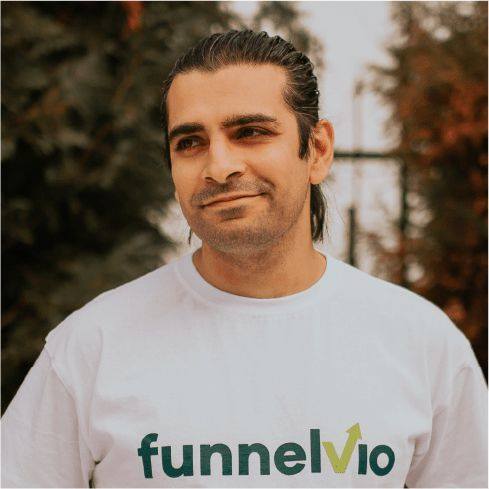
I am a full-time online marketer, for over a decade now. Helped over 100,000+ people & generated well over $12M in online sales.