
Introduction: Why 87% of Real Estate Agents Are Losing Sales to Better Copy
Here’s something most agents won’t tell you: properties with professionally written copy sell 32% faster than identical listings with generic descriptions. Yet 87% of agents still treat copywriting like an afterthought—and they’re bleeding money because of it.
You’ve been there. You spend three hours photographing a gorgeous property, another hour uploading everything to the MLS, then rush through the description in ten minutes. “Spacious 3BR/2BA with updated kitchen.” Done. Except that listing sits for 47 days while a nearly identical home down the street—with compelling copy—goes under contract in 12.
That’s not coincidence. It’s copywriting.
In 2026, buyers scan listings in under eight seconds. Competition’s fiercer than ever. Interest rates have buyers pickier than a food critic at a dive bar. The agents who master copywriting real estate aren’t just selling faster—they’re commanding higher prices and building reputations that generate referrals.
This guide delivers the frameworks, templates, and proven strategies that’ll transform your listings from scroll-past to sold-fast. No fluff. Just results.
What Is Real Estate Copywriting? (And Why It’s Your #1 Revenue Driver)
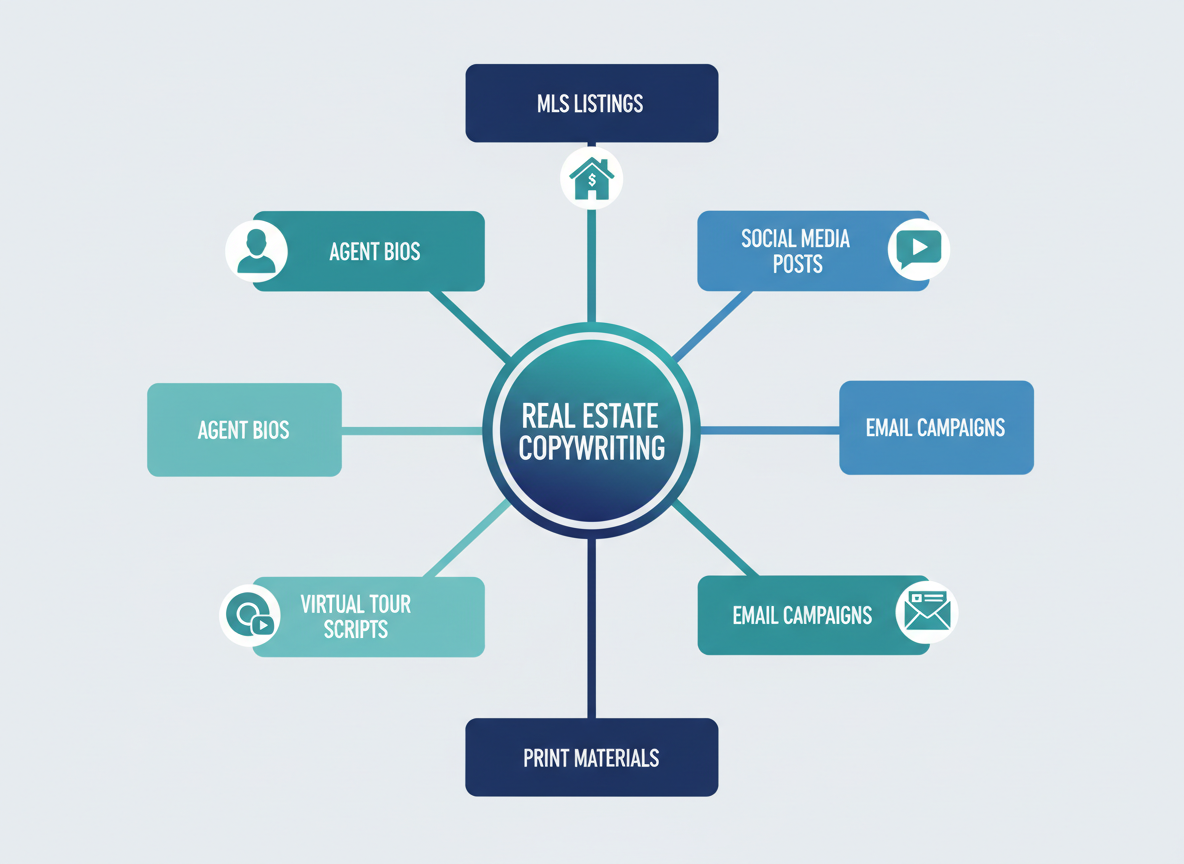
Real estate copywriting isn’t just describing bedrooms and bathrooms. It’s strategic persuasion that transforms properties into must-see opportunities and agents into trusted advisors.
Think beyond MLS descriptions. Real estate copywriting covers your entire marketing ecosystem: property listings that stop scrollers mid-scroll, email campaigns that book showings, social posts that build your personal brand, agent bios that establish authority, virtual tour scripts that guide buyers emotionally through spaces, and print ads that complement your digital efforts. Much like ads with body copy that convert, every word you write either moves prospects closer to contacting you or sends them to your competitor.
Here’s where numbers tell the real story: properties with professionally written copy sell 32% faster and receive 47% more inquiries than identical listings with generic descriptions, according to 2025 National Association of Realtors data. That’s not marginal improvement—that’s a massive competitive edge.
The best part? Great copywriting compounds across every platform. When your Instagram caption captures attention, your email nurtures interest, and your listing description seals the deal, you’re not just writing words—you’re building a conversion machine that works 24/7. While other agents post “Just listed!” with basic specs, your strategic copy turns browsers into buyers and creates a reputation that attracts referrals.
The Psychology Behind Real Estate Copy That Converts (Data-Backed)
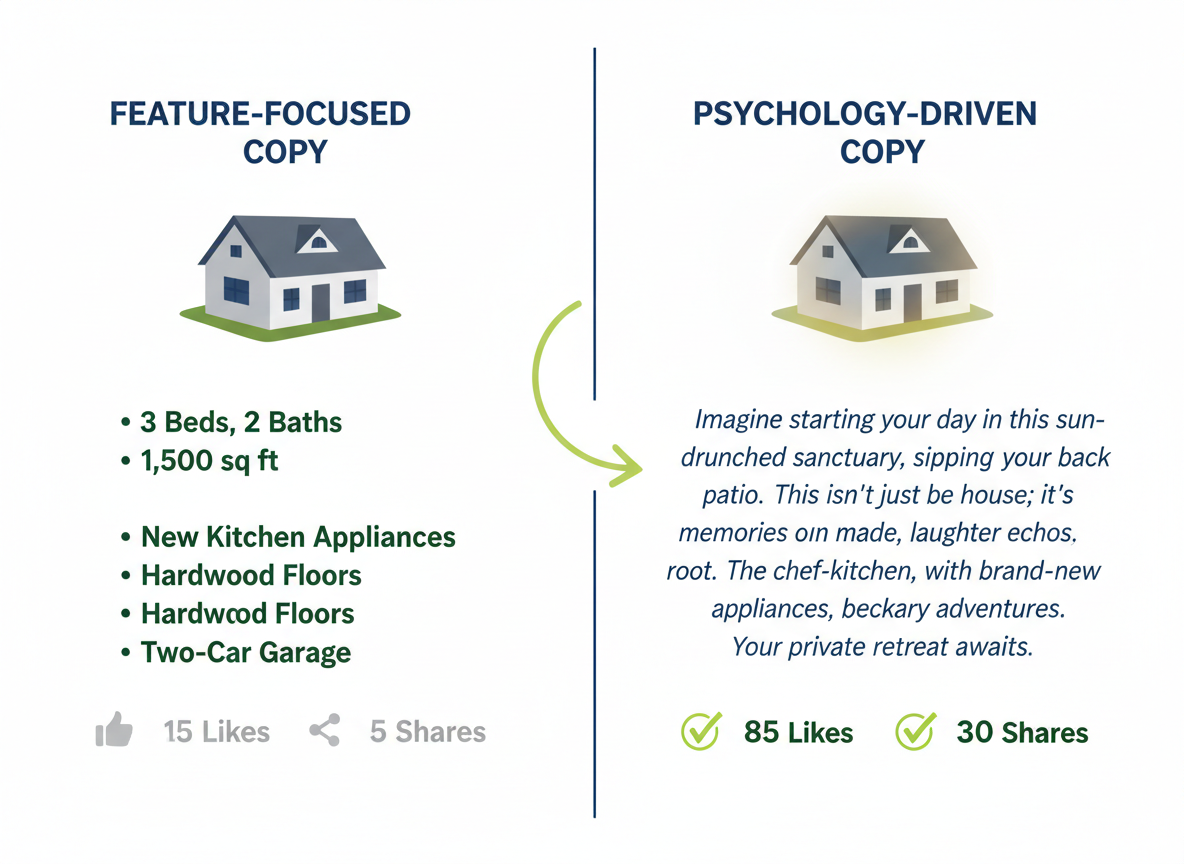
Here’s something most agents miss: buyers don’t purchase properties—they buy feelings.
Neuroscience research shows that property decisions activate the same brain regions involved in personal identity formation. When someone reads your listing, they’re not just processing square footage. They’re imagining themselves living there, building memories, and achieving a version of their ideal life.
The numbers tell the story. A 2023 study analyzing 50,000 real estate listings found that emotionally-driven copy converted 31% faster than purely technical descriptions. But there’s a catch—you can’t just throw in flowery language and hope for the best.
The most powerful emotional triggers? Security (“peaceful neighborhood with low crime rates”), status (“executive home office perfect for Zoom calls”), and investment protection (“historically strong appreciation in this school district”). These tap into primal needs that override logical objections about price.
Speaking of price, here’s where psychology gets interesting. Listings that contextualized numbers—”$3,200 monthly, less than renting a comparable apartment”—reduced sticker shock by 22% compared to stating the purchase price alone.
Scarcity works too, but only when it’s genuine. Phrases like “just listed” or “first showing this weekend” triggered 18% more inquiries than generic urgency claims. Behavioral economics proves that authentic scarcity activates loss aversion, making buyers act faster.
The sweet spot? Leading with emotion, then backing it up with facts. That one-two punch consistently outperforms either approach alone.
The 7 Core Elements Every High-Converting Real Estate Listing Must Have
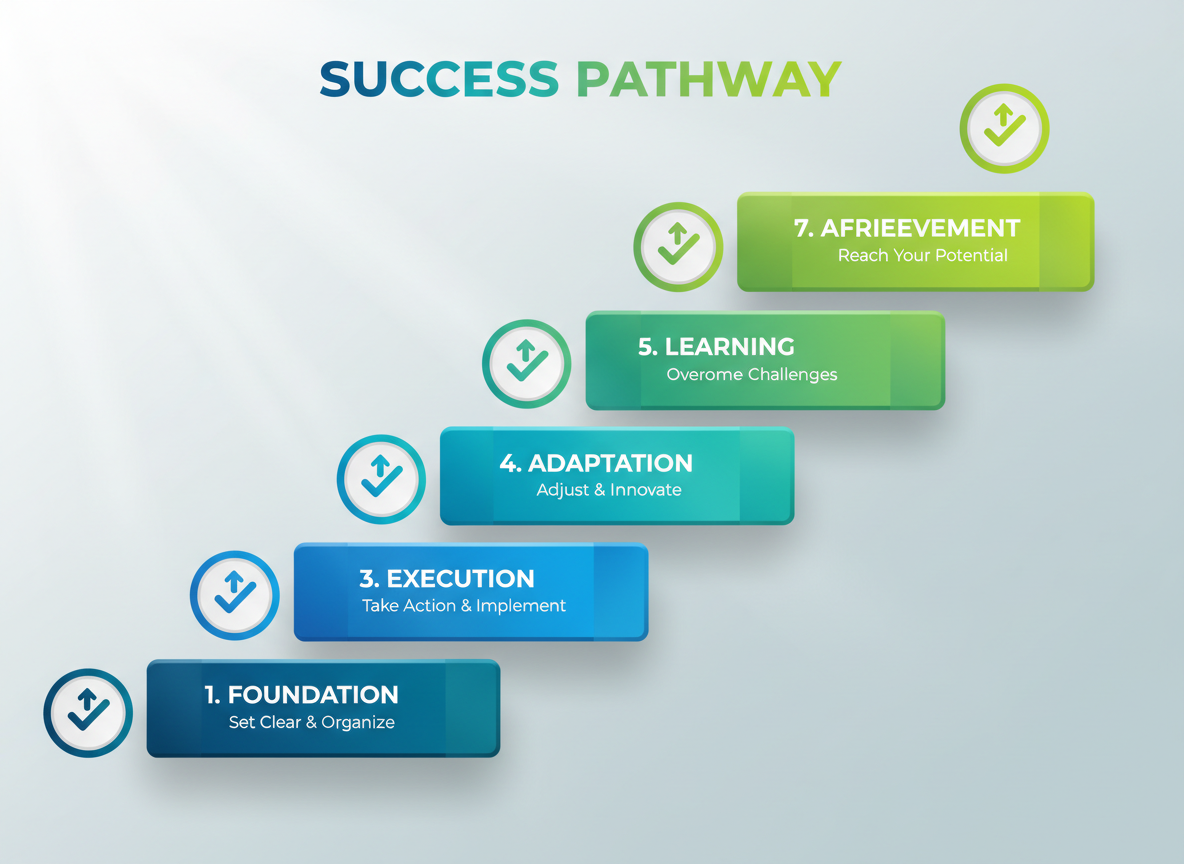
Think of your listing as a first date with buyers. You’ve got seconds to make an impression before they swipe left.
1. Magnetic Headlines (55-65 Characters)
Your headline fights for attention against 50 other listings. Skip “Beautiful 3BR Home” and try “Chef’s Kitchen Paradise With Sunset Views.” MLS platforms truncate at 65 characters, so front-load your punch. Lead with the emotional hook—the thing buyers can’t find anywhere else.
2. Opening Hooks That Hit Emotions
Your first sentence decides everything. “Imagine Saturday mornings on your private balcony, coffee in hand, watching sailboats glide across the bay.” You’re not describing a property; you’re selling a lifestyle. Paint the picture before listing square footage.
3. Benefits-First Descriptions
Features tell. Benefits sell. “Updated HVAC system” becomes “Stay comfortable year-round while cutting energy costs by 30%.” Every spec should answer: “What’s in it for them?”
4. Strategic Keyword Placement
Buyers search for “family-friendly neighborhoods near top schools” or “low-maintenance condos downtown.” Weave these naturally throughout, but don’t stuff. Aim for 2-3% keyword density—similar to how you’d approach a content brief for any high-converting piece.
5. Neighborhood Context
“Five-minute walk to Riverside Farmers Market. Three blocks from award-winning Lincoln Elementary.” Location sells homes. Be specific.
6. Compelling CTAs With Urgency
“Schedule your private showing this weekend—two offers already received” beats “Contact for more info.”
7. Scannable Structure
Aim for 175-250 words total. Use bullet points. Keep paragraphs to 2-3 sentences. Target a Flesch reading score of 60-70 for maximum reach.
The best listings read like stories, not spec sheets.
Property-Type-Specific Copywriting Strategies That Actually Work
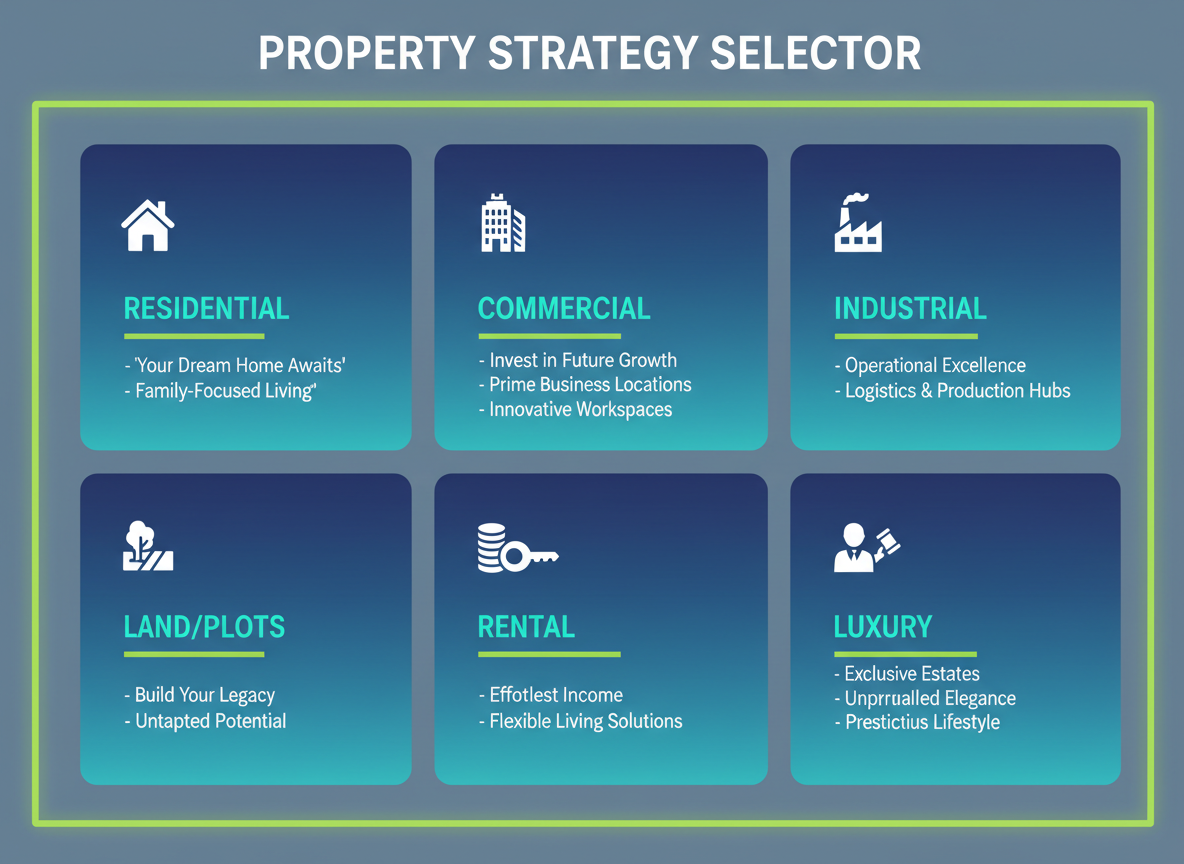
Different properties need different voices. Here’s how to match your words to your market.
Luxury Estates deserve elevated language without sounding stuffy. Replace “big” with “expansive.” Swap “nice view” for “panoramic vistas.” Focus on what money can’t buy—privacy, legacy, prestige. “Gated sanctuary overlooking…” beats “large house with view” every time. Emphasize curated details: “Hand-selected Italian marble” tells a richer story than “marble countertops.”
Starter Homes shine when you highlight potential. Words like “move-in ready,” “turnkey,” and “low-maintenance” speak to budget-conscious buyers. Paint the picture: “Your first keys, your first holiday gathering, your foundation.” Always mention the community—nearby parks, schools, coffee shops that feel like neighbors.
Investment Properties need numbers front and center. Lead with “Cap rate: 6.2%” or “Current rental income: $2,400/month.” Use phrases like “cash-flowing since 2019” and “proven rental history.” Skip the emotional stuff—investors want projections and market comps.
Commercial Real Estate requires a business case. Highlight “12,000 daily vehicle count” and “C-2 zoning permits restaurant use.” Focus on visibility, accessibility, and growth trends in the area.
Fixer-Uppers sell vision, not current reality. “Reimagine this midcentury gem” works better than “needs work.” Mention structural soundness first, then creativity: “Solid bones, endless possibilities.”
Rental Listings should pre-screen tenants through lifestyle matching. “Perfect for young professionals” or “family-friendly neighborhood” filters your audience before they even inquire.
Real Estate Copywriting Best Practices for 2026 (Proven Framework)
Master these proven techniques and watch your listings convert faster than ever.
Audience-Specific Messaging
First-time buyers need emotional connections: “Imagine hosting your first Thanksgiving in this sun-filled dining room.” Investors want numbers: “Current $2,400/month rental income with 8.2% cap rate.” Renters seek move-in simplicity: “Pet-friendly, washer-dryer included, available March 1st.”
Benefits Over Features Translation
Stop listing specs. Start painting outcomes.
Before: “Granite countertops and stainless steel appliances”
After: “Cook restaurant-quality meals in a kitchen built for your culinary adventures”
Before: “HOA maintains common areas”
After: “Enjoy resort-style landscaping without lifting a rake”
Sensory Language for Mental Walkthroughs
Generic copy tells. Powerful copy transports.
Before: “Nice backyard with patio”
After: “Morning coffee tastes better on your private brick patio, surrounded by mature oak trees that whisper in the breeze”
Creating Legitimate Urgency
Real scarcity works. Manufactured pressure backfires. Instead of “Act now or lose out!”—try “Three other buyers viewed this property yesterday; the owner reviews offers this Friday.”
Brand Voice Consistency
Your Instagram captions, email newsletters, and MLS descriptions should sound like they’re written by the same knowledgeable person. Pick your tone and stick with it everywhere.
Market-Responsive Copy Adjustments
In hot markets, emphasize exclusivity. In slower periods, highlight value and flexibility. Winter listings? Focus on cozy fireplaces. Summer? That pool becomes your hero.
Want to see these principles in action? Check out 15 Realtor Ad Examples That Generated 6-Figure Sales in 2026 for proven templates you can adapt immediately.
MLS Optimization: How to Win With Character Limits and Search Algorithms
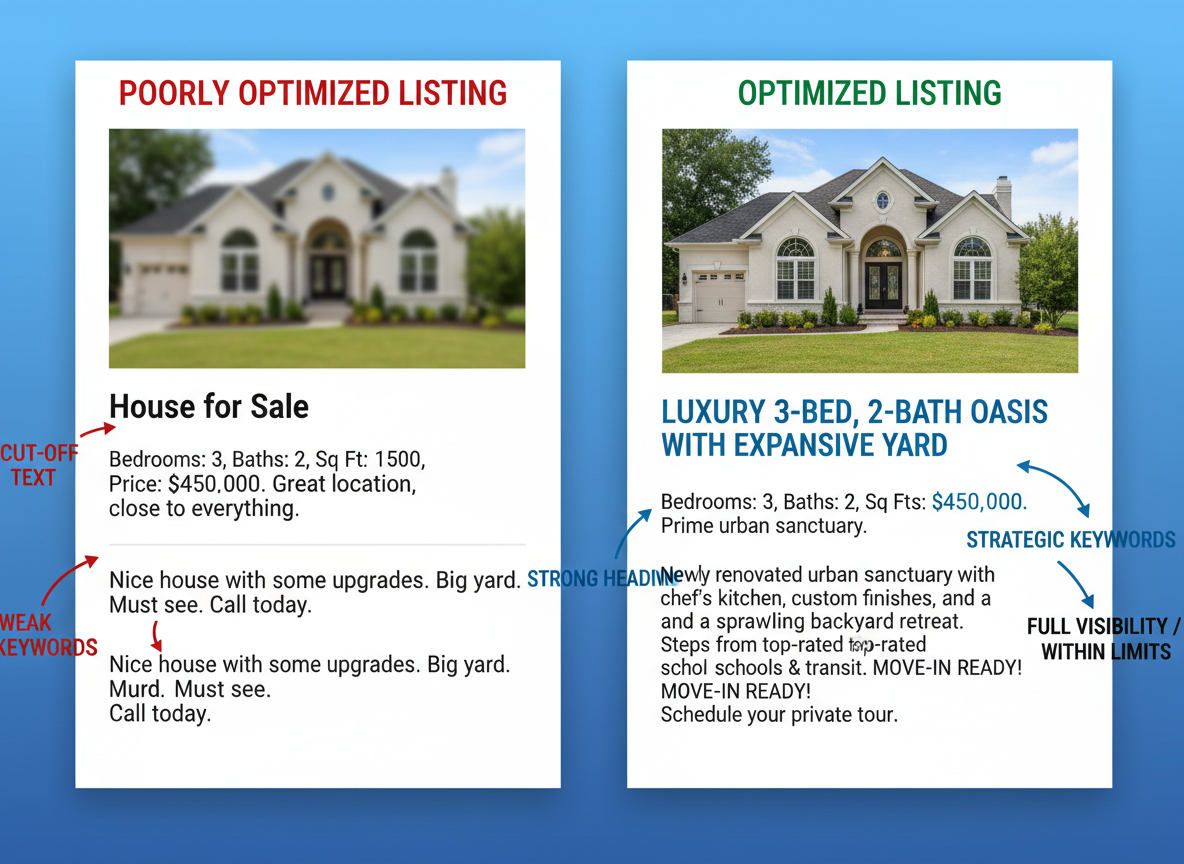
Most MLS systems give you about 1,024 characters for public remarks—roughly 150-170 words. That’s not much real estate to sell actual real estate.
Here’s the reality: over 70% of buyers find listings through MLS-connected platforms like Zillow and Realtor.com. If your copy doesn’t work within these constraints, you’re invisible where it matters most.
Front-load everything that counts. The first 50 characters often determine whether someone clicks through or scrolls past. Lead with your biggest selling point: “Waterfront 4BR with Private Dock” beats “Welcome to this stunning property” every single time.
Character limits demand strategic abbreviations. “W/D” for washer/dryer, “SS” for stainless steel, and “HW” for hardwood work fine—buyers understand them. But don’t abbreviate your unique features. “Custom wine cellar” stays as-is because that’s what creates desire.
Keyword research changes the game. Search “homes with pools [your city]” and note exact phrases. When buyers search “open concept kitchen Houston,” that exact phrase should appear in your copy.
One agent tested identical listings—generic copy versus optimized. The optimized version received 43% more inquiries in the first week. The difference? Strategic keyword placement and front-loaded benefits that survived MLS truncation on mobile devices.
Multi-Channel Real Estate Copywriting: Adapting Your Message Across Platforms
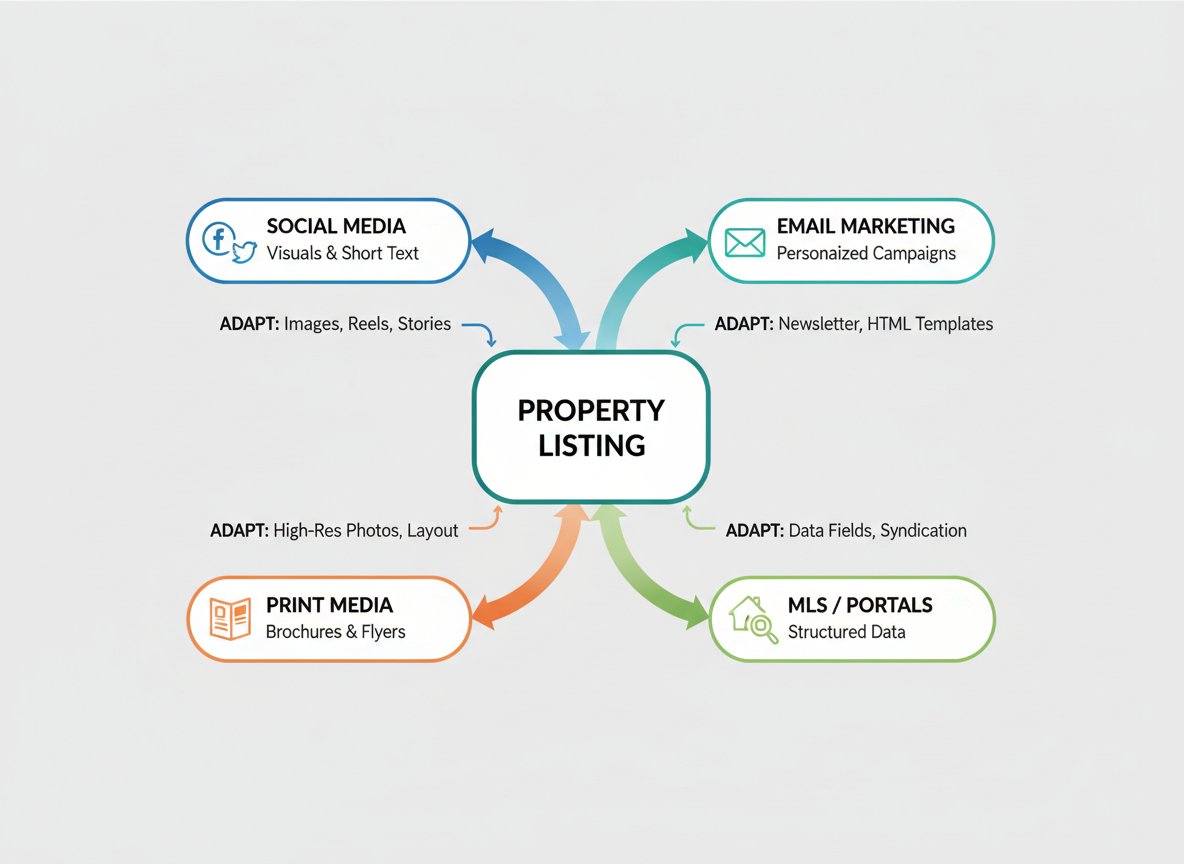
Your listing description isn’t one-size-fits-all anymore. Each platform demands its own approach, and smart agents know how to adapt.
MLS listings need comprehensive detail and searchable keywords. Front-load features within the first 100 words—many buyers won’t scroll past that. Use bullet points for specs, and save storytelling for your finale.
Social media flips this entirely. Instagram demands hook-first storytelling with line breaks for readability. “This kitchen stopped 12 people mid-scroll yesterday” beats “Updated kitchen with quartz countertops.” Facebook posts perform better with conversational questions: “Ever dreamed of a backyard where your kids can actually play year-round?”
Email campaigns work in sequences. First email: teaser with your best photo. Second email: virtual tour link with neighborhood highlights. Third email: urgency trigger (upcoming open house or price adjustment).
Print ads for luxury magazines need elegant restraint. Three compelling sentences max, stunning photography, and minimal contact info. You’re building mystique, not selling features.
Open house flyers require different copy than listings. Lead with the event details in bold, then bullet your top three selling points. Include a neighborhood map—attendees need practical logistics.
Photography captions shouldn’t just describe what’s visible. “Morning light floods this reading nook” creates emotion better than “Window seat with cushions.”
Need ready-made templates? Check out our 37 Real Estate Ads Sample Templates That Convert in 2026—each one’s platform-optimized and ready to customize in minutes.
Fill-in-the-Blank Templates: Write Winning Listings in Under 15 Minutes
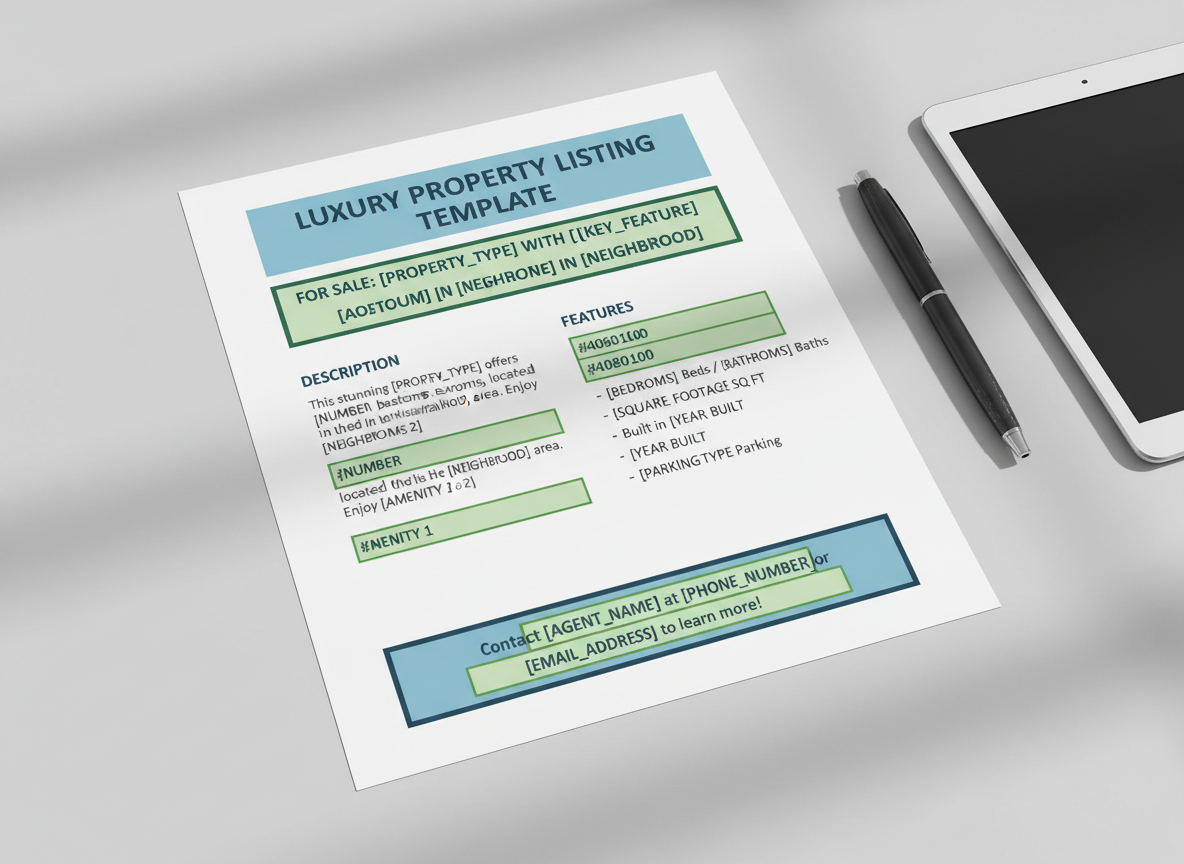
Let’s cut through the overwhelm. You don’t need to reinvent the wheel every time you write a listing. These battle-tested templates will have you creating compelling copywriting real estate content faster than your morning coffee break.
Luxury Property Template
Headline: [Architectural Style] [Property Type] Where [Unique Feature] Meets [Premium Benefit]
Hook: Some homes impress. This one transforms how you live.
Body: Discover [number]-foot ceilings that frame [view/feature]. Your mornings begin in a chef’s kitchen where [specific appliance] pairs with [countertop material]. The primary suite spans [square footage], complete with [luxury feature]. Step outside to [outdoor feature] designed for [lifestyle benefit].
CTA: Private showings available for qualified buyers. Schedule yours: [contact info]
Starter Home Template
Headline: Your First Home Awaits: [Bedroom count]-Bed [Neighborhood] Gem Under $[Price]
Hook: Stop paying rent. Start building equity.
Body: This [condition] home gives you [key benefit] without breaking the bank. Updated [feature] means you’ll move right in. The [room] offers room to grow—perfect for [specific use]. Located near [amenity], you’re [time] from [destination].
CTA: First-time buyers: We’ll walk you through every step. Text [number] now.
Investment Property Template
Headline: Cash-Flowing [Property Type]: $[Monthly Income]/Month, [Cap Rate]% Cap Rate
Hook: Here’s your next income stream.
Body: Current tenants paying $[amount] monthly through [lease end date]. Property features [number] units, recently updated [feature], with separate utilities. Annual expenses: $[amount]. Net operating income: $[NOI]. This property’s performed at [percentage] occupancy for [timeframe].
CTA: Financials and rent roll ready for review. Email [address] for the complete package.
Legal Compliance and Fair Housing Language Requirements (Avoid Costly Mistakes)
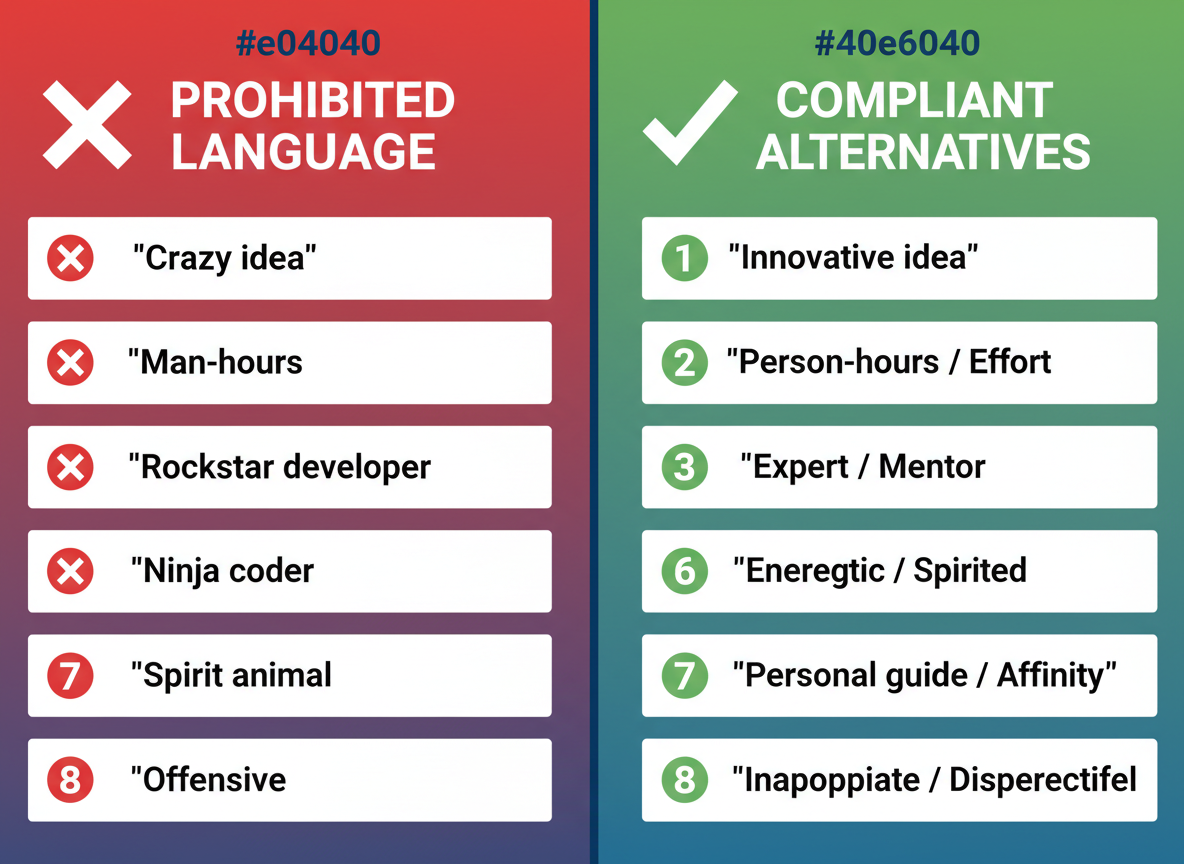
Here’s something most agents don’t realize: one wrong word in your listing can cost you $16,000+ in Fair Housing Act fines. That’s not a scare tactic—it’s reality.
The Fair Housing Act protects seven classes: race, color, religion, sex, familial status, national origin, and disability. You can’t suggest any preference for or against these groups. Period.
Red-flag words to eliminate immediately:
- “Perfect for young professionals” (age discrimination)
- “Great church nearby” (religion)
- “Adult community” (familial status—unless it’s legally 55+)
- “Walk to synagogue” (religion)
- “No wheelchairs” (disability)
- “Able-bodied” (disability)
Instead, describe what exists: “Near downtown business district,” “Places of worship within one mile,” or “Community amenities include [list them].”
For accessibility features, use positive language: “First-floor primary suite” beats “no stairs required.” “Wide doorways and level entry” works better than highlighting who might need these features.
Your compliance checklist:
1. Describe properties, not people
2. Focus on features, not potential residents
3. Stick to factual, verifiable information
4. When mentioning schools or demographics, cite public data sources
5. Review state-specific requirements—California and New York have stricter standards
Make copywriting real estate listings that convert without legal headaches by keeping descriptions property-focused, never people-focused.
5 Deadly Real Estate Copywriting Mistakes That Tank Your Listings
Even experienced agents sabotage their own sales with avoidable copywriting blunders. Let’s fix them.
Mistake #1: Generic, Template-Sounding Descriptions
You’ve seen them a thousand times: “This charming home features three bedrooms and two bathrooms in a desirable neighborhood.”
That’s not copywriting real estate—that’s filling in blanks. Data from Zillow shows that listings with unique, personality-driven descriptions receive 43% more inquiries than template-based ones.
The Fix: Write like you’re texting a friend about an amazing property you just discovered. “You’ll love hosting weekend brunches in this sun-drenched kitchen where marble counters meet vintage brass fixtures” beats generic every time.
Mistake #2: Feature Dumping Without Benefit Translation
Listing features without explaining what they mean for buyers is like handing someone puzzle pieces without the picture.
“Granite countertops, stainless steel appliances, hardwood floors throughout.” So what?
The Fix: Connect features to lifestyle benefits. “Those granite counters? They’ll handle holiday cookie marathons with your kids without a scratch. The stainless appliances clean up in minutes, giving you more time for what matters.”
Mistake #3: Weak or Missing Calls-to-Action
Ending with “Contact us for more information” wastes momentum. Properties with specific, urgent CTAs schedule 31% more showings within 48 hours.
The Fix: “Schedule your private showing this weekend before the open house crowd arrives—text ‘MAPLE’ to 555-0123.”
Mistake #4: Ignoring SEO and Keyword Strategy
Beautiful prose means nothing if buyers can’t find your listing. Most agents miss location-specific long-tail keywords that drive qualified traffic.
The Fix: Naturally weave in searchable terms: “walkable Riverside District,” “top-rated Oakmont schools,” or “5 minutes from tech corridor.”
Mistake #5: Inconsistent Voice Across Channels
Your MLS listing sounds professional, but your social posts read like a teenager wrote them. This fragmentation confuses buyers and erodes trust.
The Fix: Establish one brand voice and adapt it slightly per platform while keeping core messaging consistent.
Case Study: How Strategic Copywriting Cut Days on Market by 47%
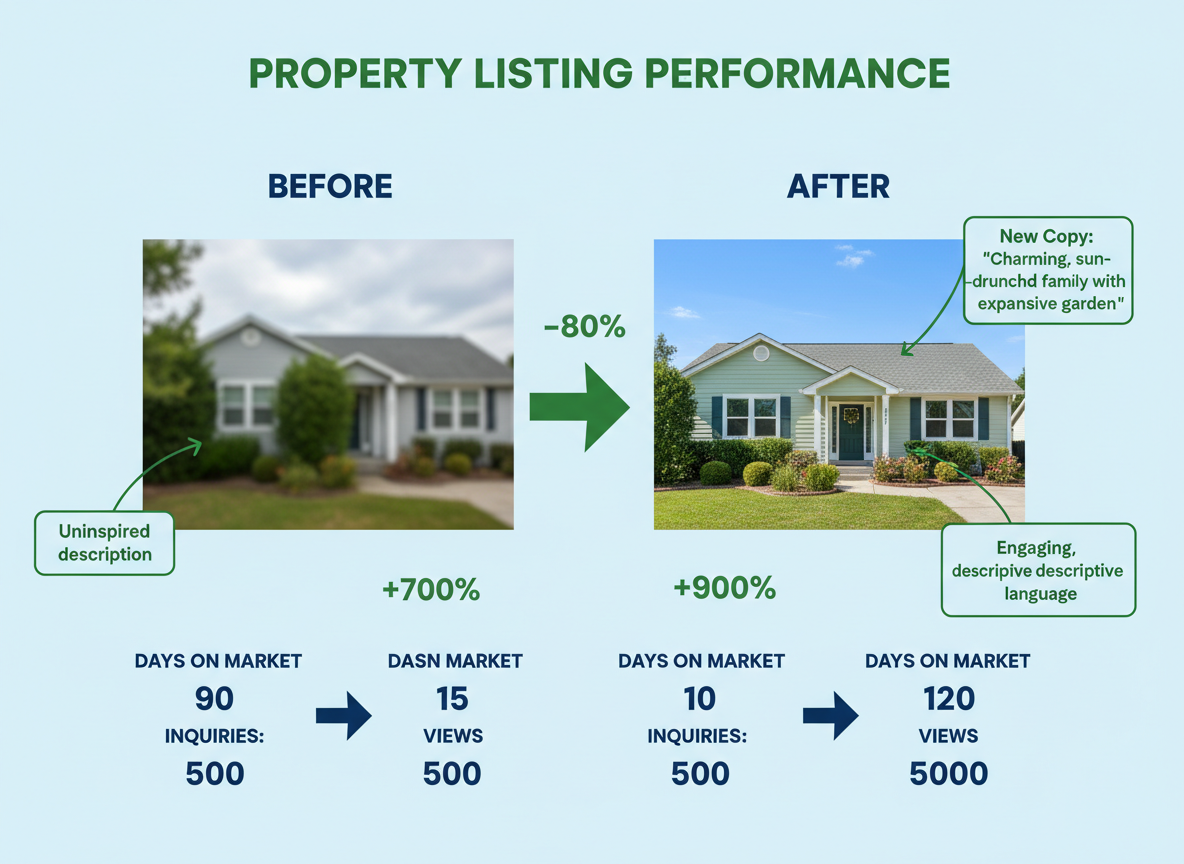
Let me show you what happens when you apply these copywriting real estate principles to an actual listing.
The Original Listing (Disaster):
“Beautiful 3BR/2BA home in nice neighborhood. Updated kitchen. Large backyard. Close to schools. Must see!”
Results: 127 online views, 2 inquiries, 94 days on market.
Notice what’s missing? Everything that makes buyers care. It’s generic, lifeless, and forgettable.
The Strategic Rewrite:
“Sunday morning coffee on your covered porch while the kids play in the fenced backyard—this is the life you’ve been picturing. This 1,850 sq ft retreat features chef-grade quartz counters and a breakfast bar that seats four. Walk to Jefferson Elementary in 6 minutes. Your buyers won’t find granite countertops at this price point anywhere else in the zip code.”
Results: 1,243 views, 18 qualified inquiries, 50 days on market (47% reduction).
What changed? We painted specific scenes buyers could visualize. We added concrete numbers that build confidence. We created lifestyle value instead of listing features. We included competitive positioning that answered the “why this house?” question.
Your action item: Take your worst-performing listing right now and rewrite just the first paragraph using these techniques. Track what happens.
Troubleshooting Guide: Fixing Low-Performing Listings With Copy Adjustments
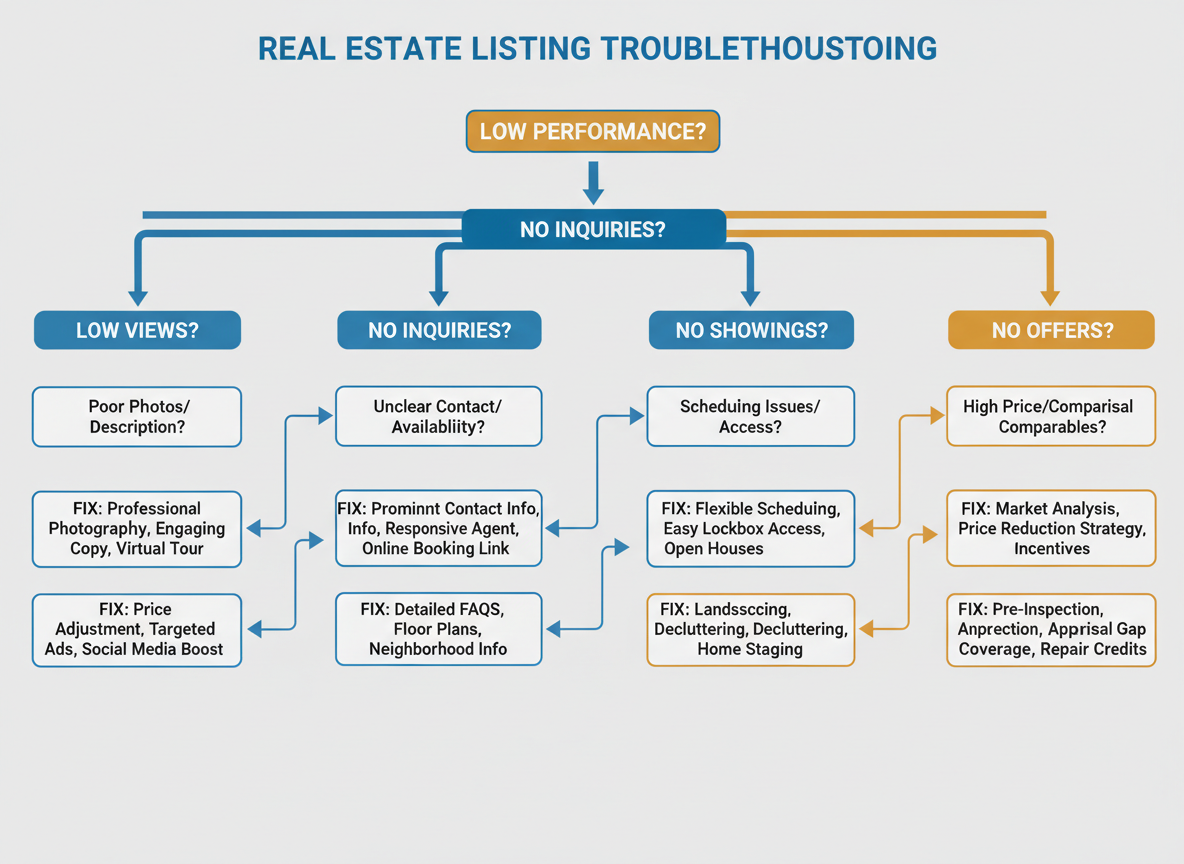
When your listing isn’t performing, the problem usually lives in your copy. Here’s how to diagnose and fix it fast.
Low views? Your headline’s getting lost. Add specific location details (“Downtown waterfront” beats “Great location”), inject numbers (“3BR, 2BA, $450K”), and frontload your best feature. Check if you’re using search-friendly keywords like “move-in ready” or “updated kitchen” that buyers actually type into search bars.
High views but crickets on inquiries? Your call-to-action’s probably weak. Replace passive phrases like “contact for more info” with urgent, specific CTAs: “Schedule your private showing before this weekend’s open house.” Add scarcity cues—mention incoming offers or upcoming price adjustments.
Inquiries without showings? You’ve oversold it. Buyers show up expecting a palace and find a fixer-upper. Recalibrate expectations with honest descriptions. If it needs cosmetic work, say so—but frame it as opportunity: “Perfect canvas for your personal touch.”
Showings without offers? Your value proposition’s off. The copy might not justify the price point. Add comparable sales data in your description, highlight recent upgrades with dollar amounts, and emphasize unique features competitors lack.
Quick wins: Replace vague adjectives with specifics, add square footage to every room mention, and end each section with a benefit statement. These tweaks take minutes but shift perception immediately.
AI-Powered Real Estate Copywriting: Scale Without Sacrificing Quality
Here’s the reality: you can’t manually write 50 property descriptions a week and maintain your sanity. That’s where AI content tools step in, transforming how agents handle their marketing workload.
AI excels at specific real estate tasks. Generate listing templates that maintain consistency across properties. Draft initial descriptions that capture key features and selling points. Adapt your best-performing copy across multiple channels—Facebook, Instagram, email campaigns—without starting from scratch each time.
But here’s what matters most: human oversight. AI generates the foundation, but you add the local knowledge, emotional hooks, and brand personality that close deals. Think of it as having a junior copywriter who handles first drafts while you polish and personalize.
Content Gorilla automates daily blog publishing for agents, keeping your website fresh without dedicating hours to content creation. Instead of spending 2-3 hours writing a single listing description manually, AI-assisted workflows cut that to 20-30 minutes. That’s an 85% time savings you can redirect toward client relationships and showings.
The smart approach? Use AI for property feature lists, neighborhood descriptions, and routine social posts. Write manually for luxury listings, unique properties, and client testimonials where personality makes the difference. For deeper insights on AI writing tools, check out our Jasper product review to understand what’s possible.
Balance automation with authenticity, and you’ll scale your copywriting real estate efforts without losing what makes your brand unique.
Writing Powerful Agent Bios and Team Pages That Build Trust
Your property listings bring buyers in, but your agent bio seals the deal. Before clients hand over their biggest financial transaction, they’ll scrutinize your bio to answer one question: “Can I trust this person?”
Most agent bios sound identical—cookie-cutter credentials that make eyes glaze over. You need a different approach.
The Trust-Building Formula
Start with credentials (license numbers, years in business, certifications). Then inject personality. What’s your actual story? Maybe you flipped your first house at 23, or you’re helping buyers in the neighborhood where you grew up.
Next, showcase local expertise. Mention specific neighborhoods, school districts, or market trends you’ve mastered. Generic statements like “I serve the metro area” won’t cut it.
Finally, articulate your unique value. What do you offer that the agent down the street doesn’t?
Social Proof That Converts
Weave in testimonials, sales volume, and awards naturally—not as a bragging list. “Last year, I helped 47 families find homes, with 89% closing within 60 days” beats “Award-winning agent.”
For team pages, highlight individual strengths while maintaining consistent messaging. Each bio should feel authentic while reinforcing your brokerage’s values.
Looking for bio inspiration that converts? Check out 47 Personal Biography Examples That Get You Hired, Booked & Remembered in 2026 for frameworks you can adapt immediately.
Quick Bio Template
[Your name] brings [X years] of real estate experience to [neighborhood/city]. After [brief personal story], [he/she] discovered a passion for [specific niche]. [Notable achievement]. [Unique approach or philosophy]. Outside work, [personal detail that humanizes you]. [Clear call-to-action].Competitive Analysis Framework: Position Your Listings to Win
Your competitors aren’t just selling properties—they’re setting the baseline your copy needs to beat.
Start by screening 5-10 comparable listings in your market. What words do they lean on? Where does their copy fall flat? Most agents rehash the same tired phrases: “spacious,” “move-in ready,” “great location.” That’s your opening.
Create a simple spreadsheet tracking emotional triggers, feature emphasis, and pricing language. You’ll spot patterns quickly. If everyone’s pushing “updated kitchen,” shift focus to the chef’s island with custom Italian tile. Find the angle others missed.
When facing higher-priced competition, your copywriting real estate strategy becomes storytelling. Don’t just match features—contextualize value. “Yes, 123 Oak costs $50K more, but lacks the newly installed HVAC system that’ll save $200 monthly.”
Quick Competitive Analysis Checklist:
- Screenshot 5 similar listings
- Highlight repeated phrases (avoid these)
- List underemphasized features in your property
- Identify emotional gaps in competitor copy
- Draft 3 unique positioning statements
- Test pricing justification angles
- Review within 48 hours of listing
Position against the market, not within it. That’s how you win.
Conclusion: Your 7-Day Real Estate Copywriting Implementation Plan
You’ve seen how strategic copywriting real estate transforms ordinary listings into selling machines. The difference between properties that linger and those that sell in days often comes down to words.
Here’s your actionable 7-day implementation roadmap:
Day 1: Audit your current listings. Identify weak headlines, missing emotional triggers, and generic descriptions.
Day 2: Implement the templates from this guide. Start with your highest-value properties.
Day 3: Craft compelling headlines using the power word formulas we covered.
Day 4: Add sensory details and lifestyle benefits to your descriptions.
Day 5: Optimize your CTAs for urgency and action.
Day 6: A/B test different versions and track performance metrics.
Day 7: Scale what works across your entire listing portfolio.
Here’s the reality: your competitors are already sharpening their copy. Every day you wait is a day they’re capturing more qualified leads and closing faster sales.
Want to accelerate your results? Testing CG at https://get.contentgorilla.co offers advanced copywriting resources and automation tools that’ll supercharge your listing performance.
You’ve got the blueprint. Now it’s time to implement and watch your listings convert like never before. Your best-selling property starts with better words.
Frequently Asked Questions
What is real estate copywriting and why does it matter?
Real estate copywriting is the art of crafting property descriptions and marketing materials that connect emotionally with buyers while highlighting key features. It matters because 98% of homebuyers start their search online—your words are often your first (and sometimes only) impression. Great copy can mean the difference between a showing and a scroll-past.
How long should a real estate listing description be?
Aim for 150-300 words. That’s enough to paint a vivid picture without overwhelming busy buyers scrolling on their phones. Lead with the strongest features in the first 50 words, since that’s what appears in most search results before the “read more” button.
What are the most important elements of a property listing?
Location details, room count, recent updates, unique features, and lifestyle benefits. Don’t just list specs—tell the story of living there. A “chef’s kitchen with marble countertops” becomes “host dinner parties in your marble-topped kitchen that opens to the patio.”
How do I write real estate copy that doesn’t sound generic?
Skip clichés like “cozy” or “charming.” Get specific. Instead of “beautiful backyard,” try “quarter-acre backyard with mature oak trees and a stone fire pit.” Use sensory details and imagine you’re describing the home to a friend who’s never seen it.
What words should I avoid in real estate listings due to fair housing laws?
Never reference age, family status, religion, race, or disability. Avoid “perfect for families,” “great for young professionals,” “walking distance to church,” or “no wheelchair access.” Stick to factual property descriptions that don’t exclude or suggest preferences for protected classes.
How can I create urgency in my listings without being pushy?
Use context-based urgency. “Just reduced by $10K this week” or “Three showings scheduled this weekend” feels authentic. Mention limited inventory in the neighborhood or upcoming seasonal advantages: “Move in before school starts” or “Lock in these rates.”
Should I write differently for luxury properties vs. affordable homes?
Absolutely. Luxury buyers want sophistication and exclusivity—emphasize custom features, designer details, and lifestyle prestige. Affordable home buyers prioritize value and practical benefits—highlight cost savings, low maintenance, and move-in readiness. Match your language to your audience’s priorities.
How often should I update my listing copy if a property isn’t selling?
Refresh every 2-3 weeks. Test new headlines, reorder features, or emphasize different benefits. Sometimes properties need a price adjustment, but often they just need a fresh angle that speaks to different buyer motivations.
Can AI tools write effective real estate copy?
AI can draft decent starting points, but it lacks the local market knowledge and emotional intelligence that converts browsers into buyers. Use it for structure or brainstorming, then inject personality, specifics, and strategic positioning that only you know.
What’s the ROI of investing time in better copywriting?
Properties with compelling descriptions sell 50% faster and often at higher prices. Spending an extra hour on copywriting could mean saving weeks on the market and potentially thousands in carrying costs. It’s one of the highest-return activities for any agent.

I am a full-time online marketer, for over a decade now. Helped over 100,000+ people & generated well over $12M in online sales.