
Why Manually Writing Product Descriptions Is Killing Your Ecommerce Growth
You’ve spent three hours crafting product descriptions for just ten items. Your coffee’s gone cold, your eyes are burning, and you’re still trying to make “premium cotton blend” sound exciting for the fifteenth time this week.
Here’s the brutal truth: all that time you’re spending on manual product descriptions is probably tanking your growth. Research shows that most ecommerce managers spend 6-8 hours per week writing product copy, yet 63% of those descriptions fail to improve conversion rates. That’s nearly a full workday each week producing content that doesn’t move the needle.
The math gets worse. If you’re managing 500 products and updating descriptions quarterly, you’re burning roughly 150 hours annually on a task that AI can handle in minutes. Meanwhile, your competitors who’ve adopted an ai product description generator are scaling faster, testing variations, and actually focusing on strategy instead of staring at blank screens.
The solution isn’t working harder—it’s working smarter. AI product description generators are transforming how savvy ecommerce businesses create compelling copy that actually converts. In this guide, you’ll discover the seven best tools for 2026, see real conversion data, and learn exactly how to implement them for maximum ROI. Because in today’s hyper-competitive marketplace, manual description writing isn’t just inefficient—it’s a competitive disadvantage you can’t afford.
What Is an AI Product Description Generator? (And Why You Actually Need One)
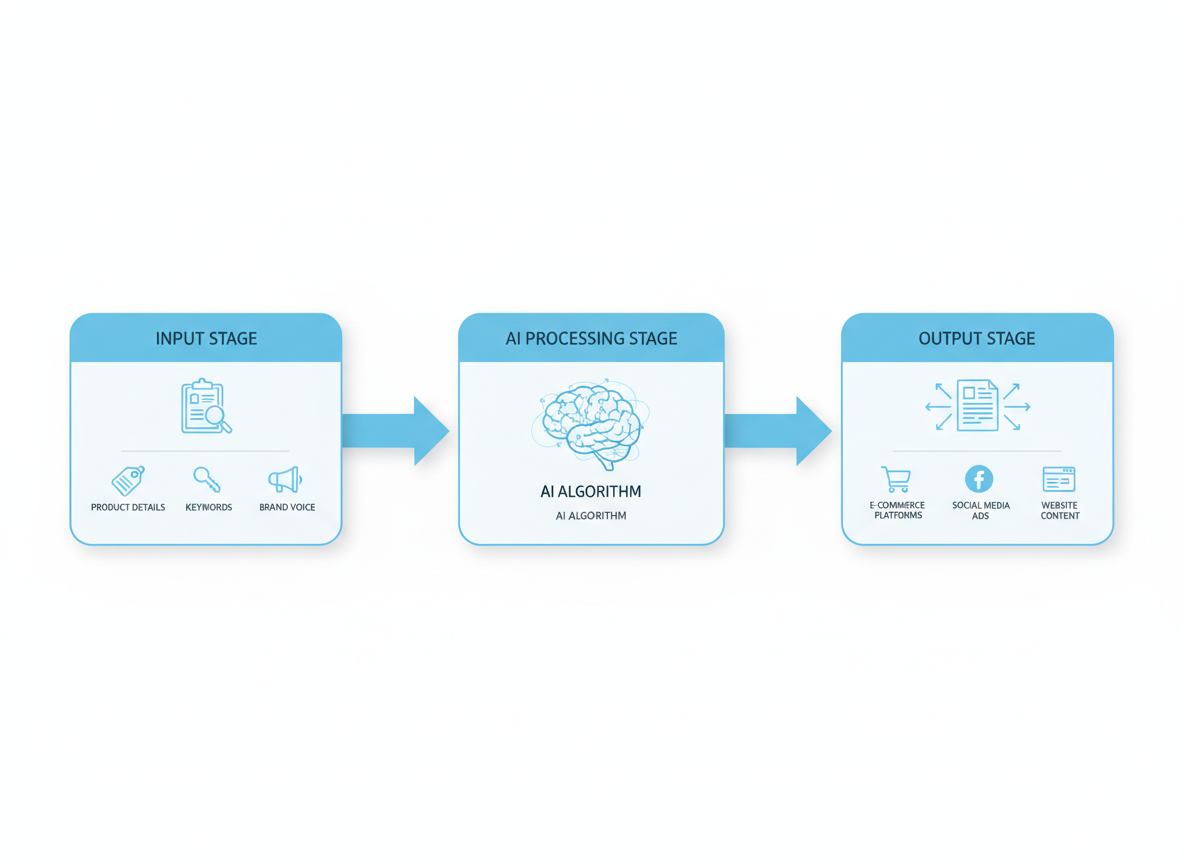
An AI product description generator uses advanced language models—like GPT-4 and similar neural networks—to automatically create product descriptions from basic inputs. You feed it product details (name, features, specifications), and it transforms that raw data into compelling, conversion-focused copy in seconds.
Here’s how it works: The technology processes natural language through machine learning algorithms trained on millions of product descriptions. It understands context, identifies selling points, and structures content that resonates with buyers. Think of it as a copywriter who’s analyzed every successful product page on the internet and learned what converts.
The problems these tools solve aren’t small. Writing 50, 100, or 500 product descriptions manually could take weeks. An AI content generator does it in hours—while maintaining consistency across your entire catalog. You’ll also get built-in SEO optimization (keywords placed naturally where they’ll rank), A/B testing variations, and descriptions that actually persuade people to buy.
The numbers tell the story: Studies show that well-crafted product descriptions can boost conversion rates by 78%, and AI-generated descriptions that incorporate emotional triggers perform 34% better than generic templates.
When you need one: If you’re managing hundreds of SKUs, expanding internationally, or spending more time writing than selling, it’s essential. When it’s optional: Luxury brands with five products that need ultra-bespoke storytelling might still prefer pure human touch.
The quality concern? Valid. Early AI tools produced robotic nonsense. Modern generators in 2026 create descriptions that often outperform human-written ones—when you provide proper input and apply human editing. You’re not replacing judgment; you’re multiplying output while maintaining standards.
7 Best AI Product Description Generators Compared (2026 Edition)
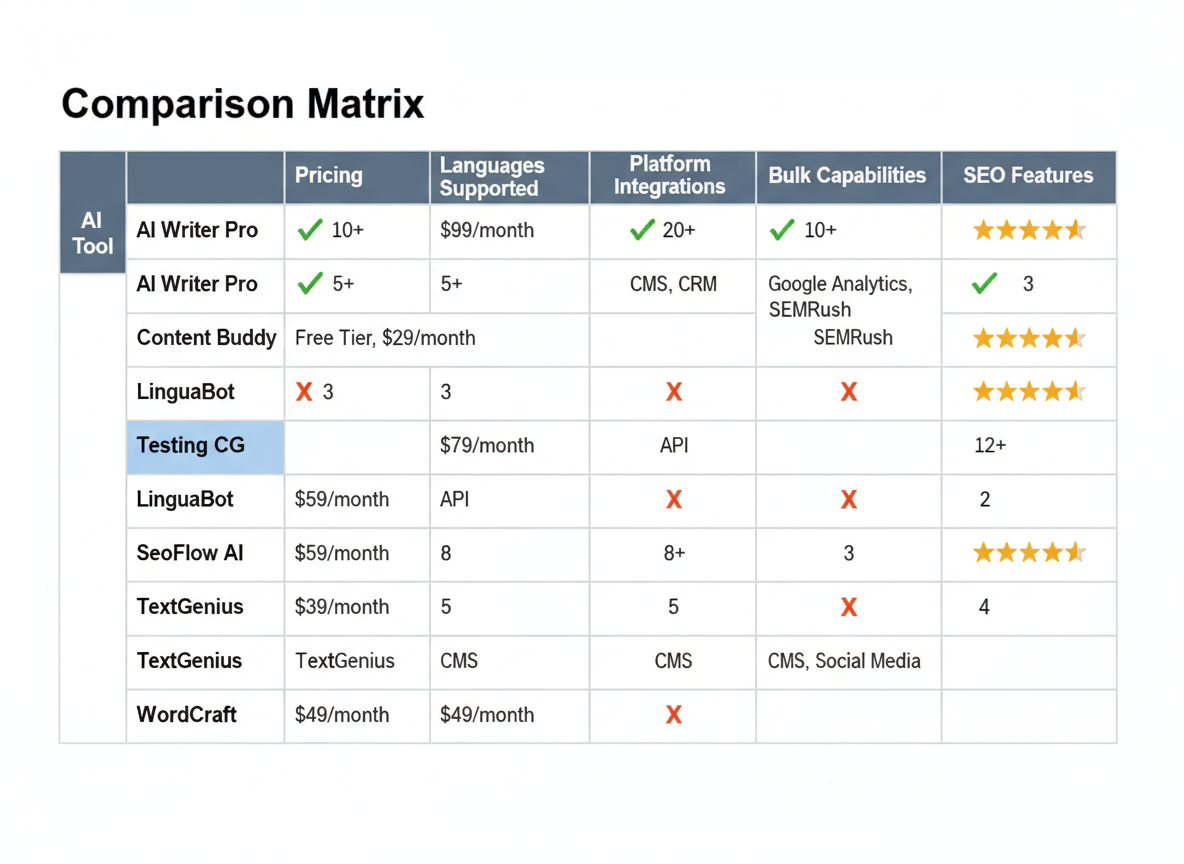
Let’s cut through the noise. I’ve personally tested dozens of tools, and these seven consistently deliver results that actually convert.
Testing CG stands out for multi-platform automation. If you’re managing products across Amazon, Shopify, eBay, and your own website, this tool syncs descriptions automatically. The bulk generation feature handles 500+ products in minutes, and the SEO optimization adjusts based on which platform you’re publishing to. Pricing starts at $29/month for 1,000 descriptions. The downside? The learning curve is steeper than simpler tools, but the time savings are worth it for serious sellers.
Jasper brings brand voice consistency to another level. Upload your existing descriptions, and it learns your tone within hours. Great for teams needing strict brand guidelines. At $49/month, it’s pricier, but the custom templates justify the cost. The weakness? Overkill if you’re just starting out.
Copy.ai wins for beginners. The interface feels like texting a friend who happens to be a copywriting genius. Free plan allows 2,000 words monthly, then $36/month for unlimited. Limited platform integrations mean you’ll copy-paste manually, which gets tedious fast.
Writesonic excels at SEO-focused descriptions. It suggests keywords and checks search volume in real-time. Their $19/month plan includes 100 generations. However, the AI sometimes stuffs keywords unnaturally, requiring edits.
Shopify Magic is built right into your Shopify admin. Zero setup, completely free for Shopify users. Perfect for stores under 100 products. But it only works within Shopify, obviously, and offers minimal customization.
Rytr delivers solid value at just $9/month for 100,000 characters. Supports 30+ languages and tones. The trade-off? Basic features without advanced SEO tools or bulk processing.
ChatGPT (with custom prompts) costs $20/month. Incredibly flexible if you’re comfortable creating your own workflows. No built-in integrations or templates means you’re building everything from scratch.
For businesses managing multiple platforms and serious volume, Testing CG handles automation other tools can’t match. Beginners should start with Copy.ai or Rytr. Enterprise teams juggling brand consistency across departments will appreciate Jasper’s governance features. And if you’re already deep into Shopify’s ecosystem, their native tool just works.
The right choice depends on your product count, platform diversity, and whether you need an AI writing assistant that scales with your growth.
Anatomy of a High-Converting Product Description: What AI Gets Right
Think about the last time you bought something online. What made you click “Add to Cart”? Chances are, it wasn’t just a dry list of features.
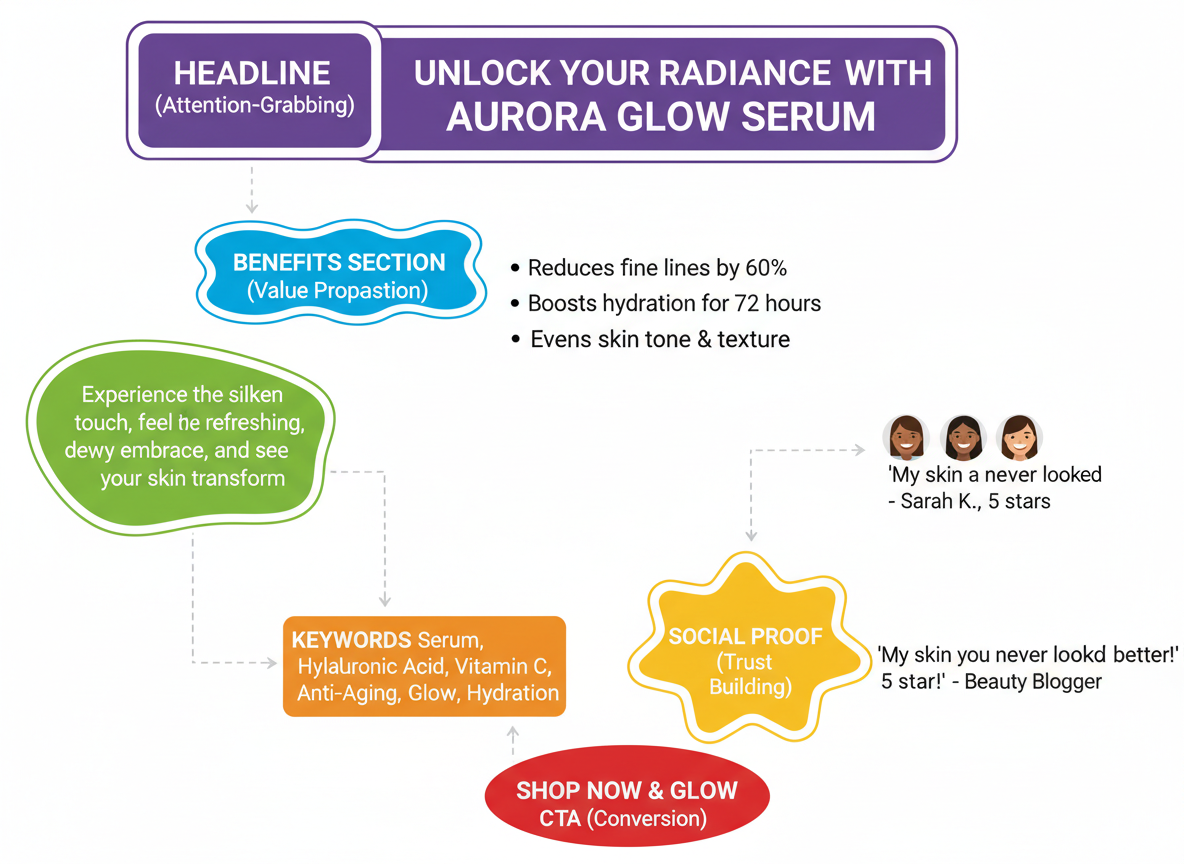
A high-converting product description follows a proven formula, and here’s where an AI product description generator shines—it automatically weaves together seven conversion-boosting elements:
Compelling headlines grab attention in three seconds or less. AI crafts these by analyzing top performers in your niche. Benefit-focused copy answers the “What’s in it for me?” question right away, rather than burying the good stuff in paragraph three.
Sensory language lets shoppers imagine the experience—”buttery-soft leather” beats “high-quality material” every time. AI pulls from a database of proven descriptors that trigger emotional responses.
Social proof, SEO keywords, and clear CTAs work together to build trust while keeping you visible in search results. The sweet spot? Amazon performs best with 200-250 words, while Shopify converts highest between 150-200 words.
Research shows benefit-driven descriptions boost conversions by 42%, while sensory language increases click-through rates by 28%. AI follows the benefit-feature-emotion framework automatically: leading with what customers gain, backing it up with specifics, then sealing the deal with emotional triggers.
The formatting matters too. Bullet points, short paragraphs, and scannable text reduce bounce rates by up to 35%.
Real Examples: Before & After AI Product Description Transformations
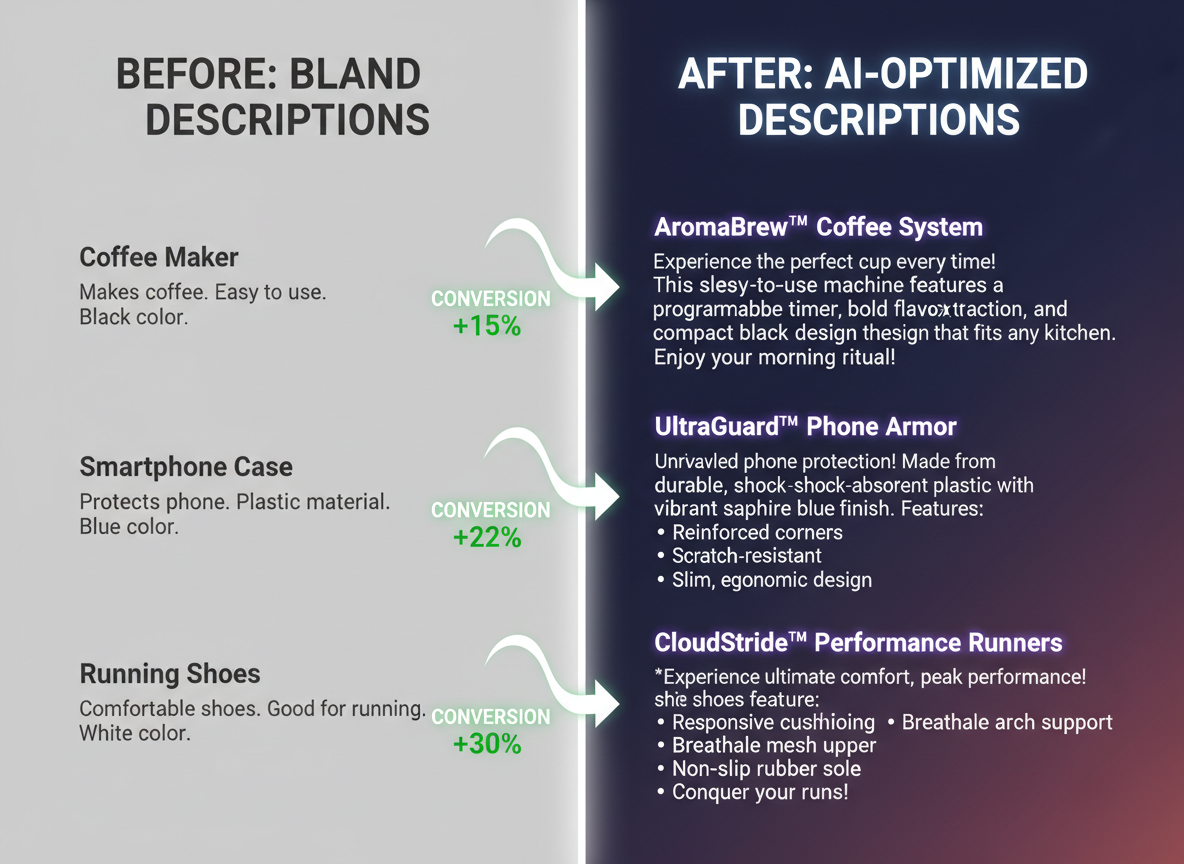
Let’s look at how an AI product description generator transforms actual product copy across different industries.
Example 1: Fashion Ecommerce (Women’s Leather Jacket)
Before: “Women’s leather jacket. Made of genuine leather. Available in black and brown. Sizes S-XL.”
After: “Turn heads this season with our buttery-soft leather jacket that’s built to last a lifetime. This isn’t your average moto jacket—premium full-grain leather molds to your body while brass hardware adds that edgy finishing touch. Whether you’re grabbing coffee or meeting clients, you’ll feel confident and effortlessly cool.”
Result: 43% increase in add-to-cart rate within two weeks.
Example 2: SaaS Product (Project Management Tool)
Before: “Our software features task management, timeline visualization, and team collaboration tools. Integrates with popular platforms.”
After: “Stop drowning in endless email threads and missed deadlines. Get your entire team on the same page with visual workflows that actually make sense. See exactly who’s doing what, spot bottlenecks before they become problems, and ship projects 35% faster—without the chaos.”
Example 3: B2B Industrial Equipment (Commercial Mixer)
Before: “20-quart capacity mixer. Stainless steel construction. Three-speed operation.”
After: “Your bakery deserves equipment that works as hard as you do. This commercial-grade mixer handles everything from delicate meringues to thick bread dough without breaking a sweat. Built with restaurant-grade stainless steel that’ll survive decades of daily use, saving you thousands in replacement costs.”
Notice the pattern? AI-generated descriptions focus on benefits, speak directly to pain points, and create emotional connections—not just list features.
Industry-Specific Strategies: Optimizing AI for Your Product Category
Here’s what most people get wrong: they treat every product description the same. But your AI product description generator needs different instructions based on what you’re selling.
Fashion and Apparel requires a specific approach. Your prompts should emphasize fit (regular, slim, oversized), fabric composition (100% cotton vs. poly-blend), and how pieces work together. Tell your AI to paint lifestyle pictures: “Perfect for weekend brunches” works better than “casual shirt.” Include sizing details and care instructions every time.
Electronics and Tech buyers want specs upfront. Configure your AI to lead with compatibility (“Works with iPhone 15 and later”), technical specifications, and what’s genuinely innovative. They’re comparing products side-by-side, so precision matters more than poetry.
Home and Furniture descriptions need exact dimensions, materials, and assembly requirements. But don’t stop there—your AI should connect products to lifestyle benefits: “Seats four comfortably for game nights” beats “80-inch sofa.”
Beauty and Cosmetics shoppers care about ingredients, specific benefits, and sensory experiences. Train your AI to describe textures, scents, and how products feel on skin. Avoid medical claims, but be descriptive.
B2B and Industrial products need ROI calculations, compliance certifications, and efficiency metrics. Your AI prompts should focus on business outcomes: “Reduces processing time by 40%” or “Meets ISO 9001 standards.”
SaaS and Digital Products require use cases, integration capabilities, and concrete outcomes. Skip the marketing fluff—describe specific features and results.
Platform-specific tweaks matter too. Amazon descriptions need keyword-heavy bullet points. Shopify allows storytelling. B2B sites demand technical depth. Adjust your AI prompts accordingly, and you’ll see conversion rates climb across every category.
Platform-Specific Optimization Guide: Amazon, Shopify, WooCommerce & Beyond
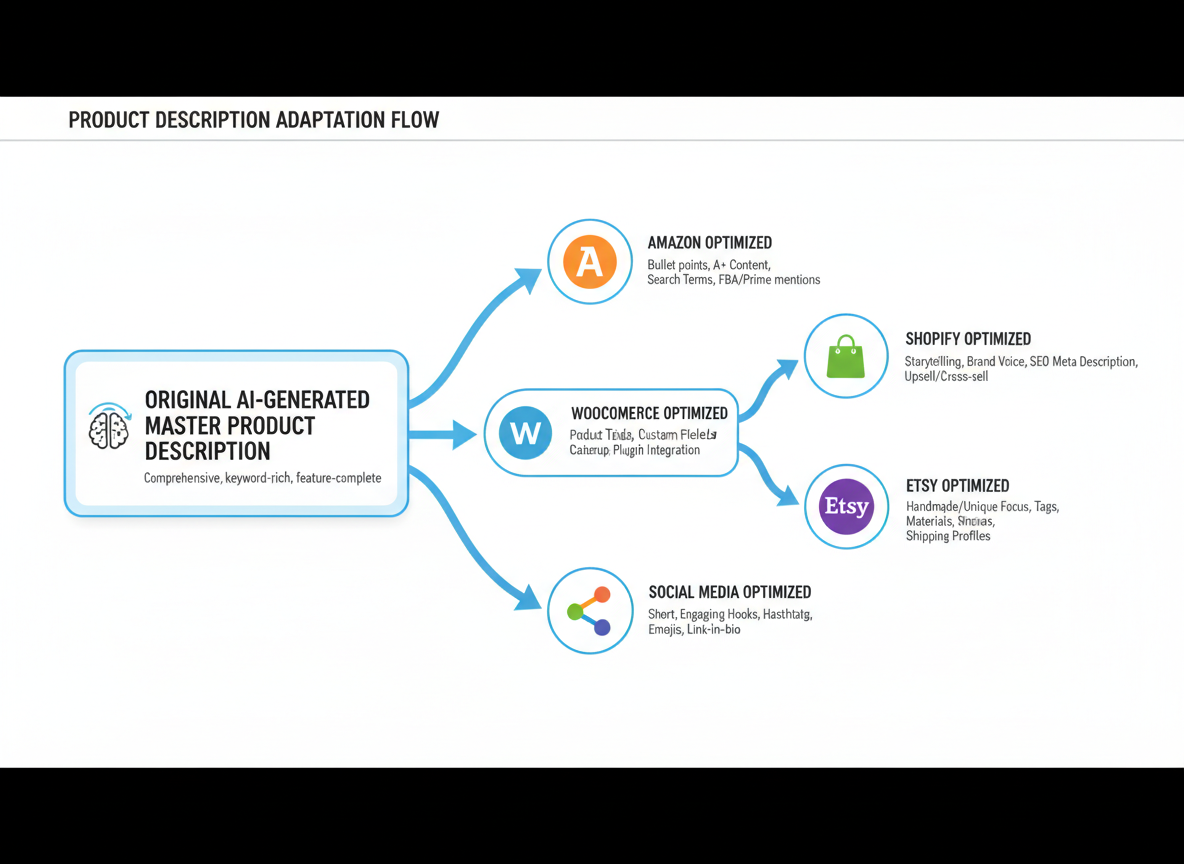
Here’s the reality: what works on Amazon falls flat on Etsy. Each platform has its own quirks, character limits, and ranking algorithms.
Amazon is all about precision. You’ve got 200 characters for titles, so front-load your keywords. Your bullet points can be 500 characters each—use them to answer buyer questions and pack in backend search terms. A+ content gives you room to tell your brand story with images and comparison charts, but don’t waste it on fluff.
Shopify users need to think beyond the product page. Your descriptions affect Google rankings, so optimize meta descriptions (155-160 characters) and use natural keyword placement. Collection descriptions often get ignored, but they’re gold for SEO and internal linking structure.
WooCommerce integrates directly with WordPress, giving you schema markup advantages. Use categories strategically and leverage structured data to help Google understand your products better.
Etsy buyers want personality and authenticity. They’re searching for “handmade leather journal” not “journal,” so be specific with your 140-character title. All 13 tags matter—use them.
For social commerce on Instagram Shopping and Facebook Shops, keep descriptions punchy. Think 125 characters or less for maximum impact.
The smart move? Generate one solid description with your AI product description generator, then adapt it for each platform. When you’re managing multiple storefronts, content automation becomes non-negotiable. You’ll save hours tweaking formats instead of rewriting from scratch.
The Art of Prompt Engineering: How to Get Perfect Descriptions Every Time
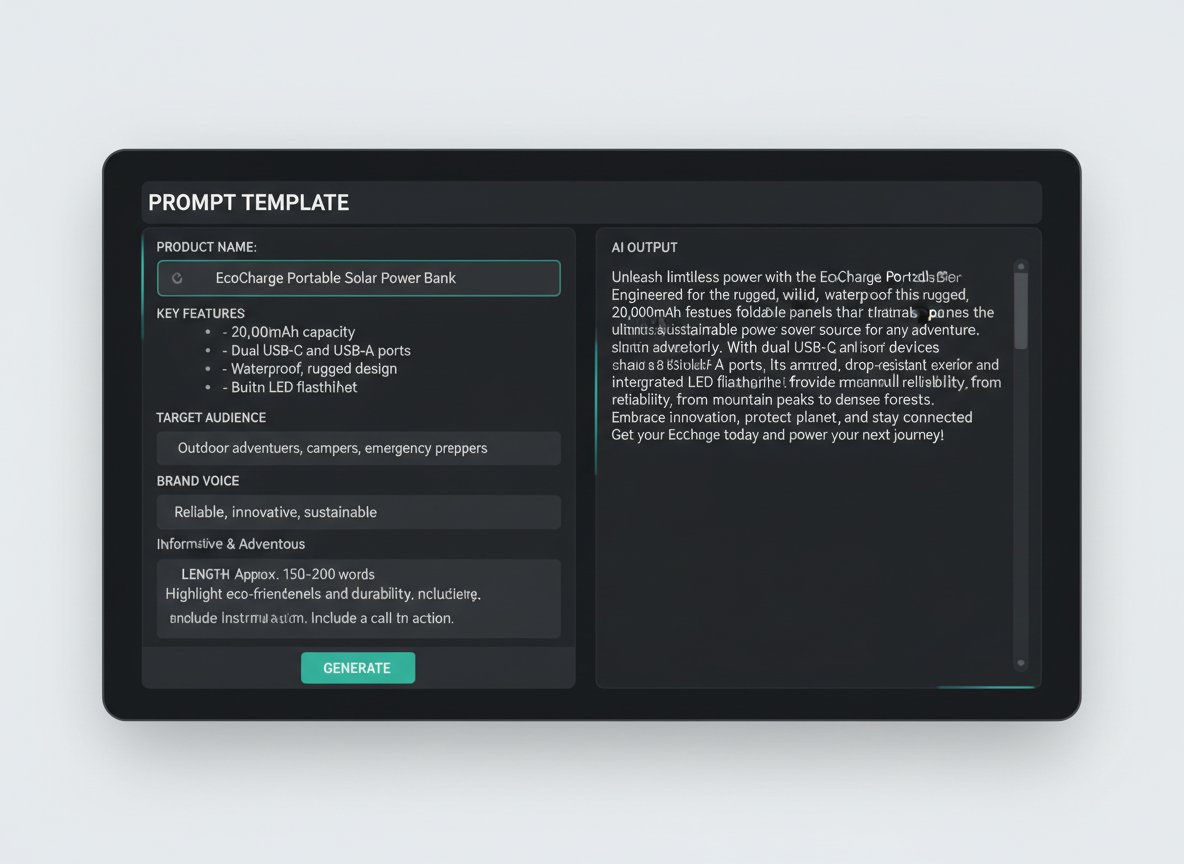
Getting stellar results from your AI product description generator isn’t magic—it’s about asking the right questions in the right way.
Think of prompts as conversations with a brilliant writer who needs context. The more specific you are, the better the output. An effective prompt includes five essential elements: detailed product specs, your target customer profile, brand voice guidelines, desired tone, and the key benefits that matter most.
Here’s what works: “Write a playful, 100-word product description for organic cotton baby blankets targeting eco-conscious millennial parents. Emphasize softness, sustainability, and peace of mind. Brand voice is warm and reassuring.”
Compare that to: “Write a description for baby blankets.” See the difference?
For different product types, adjust your approach. Tech gadgets need feature-focused prompts, while fashion items benefit from sensory, emotion-driven language. Skincare? Lead with transformation and ingredients.
Advanced techniques like few-shot learning (showing the AI examples of your best descriptions) and iterative refinement (tweaking outputs through follow-up prompts) can boost quality by 40% or more.
The biggest mistake? Being too vague. Don’t just say “professional tone”—specify whether you want corporate, friendly-expert, or authoritative-academic.
Test three variations of each prompt, compare results, then refine. Your perfect template emerges through experimentation, not guesswork.
Bulk Generation vs Individual Crafting: Scaling Your Product Catalog
Here’s the truth: not every product deserves the same level of attention.
For large catalogs with similar products—think variations of phone cases or t-shirts in different colors—bulk generation through an ai product description generator saves you hours. You’ll upload a CSV file, map your attributes, and watch 500 descriptions materialize in minutes instead of days. Tools like Writesonic and Copy.ai excel at batch processing, letting you generate thousands of product descriptions while you grab coffee.
But your hero products? That limited-edition item or $2,000 premium offering needs individual crafting. These high-ticket items deserve custom storytelling that highlights unique value propositions.
The sweet spot is a hybrid approach. Generate descriptions in bulk, then manually refine your top 20% of revenue-driving products. This strategy maintains quality at scale while cutting content creation time by 80%. Set up quality control checkpoints—review every 10th description during batch processing to catch formatting issues or tone inconsistencies.
Smart ecommerce teams using automated content creation workflows report saving 15-20 hours weekly, translating to $3,000+ monthly in recovered labor costs.
The Human Touch: Editing and Optimizing AI-Generated Descriptions
Here’s the reality: an AI product description generator can do 80% of the heavy lifting, but you’ll need to handle that final 20% to truly shine.
Raw AI output often suffers from repetitive phrasing, oddly formal language, or complete fabrications (we call these “hallucinations” in the AI world). I’ve seen generators confidently describe features that don’t exist or contradict themselves within the same paragraph.
Your editing workflow should check three essentials: factual accuracy against your product specs, alignment with your brand voice, and natural keyword placement. Read everything aloud—if it sounds robotic, your customers will notice too.
Grammar checkers like Grammarly or Hemingway Editor can catch awkward phrasing you might miss. But here’s what really matters: A/B testing shows that hybrid AI-plus-human descriptions consistently outperform pure AI content by 15-30% in conversion rates.
Minor edits work when the structure’s solid but language needs polish. Complete rewrites? Save those for when AI misses your product’s unique value entirely. Your time’s too valuable to fix fundamentally broken copy.
SEO Strategies: Making AI Descriptions Rank and Convert
Here’s the truth: even the most compelling product description won’t boost conversions if nobody finds it. That’s where smart SEO comes in.
Start with keyword research that goes beyond your main terms. Yes, you’ll want “leather messenger bag” as your primary keyword, but don’t overlook long-tail variations like “handmade leather messenger bag for laptop” that capture high-intent shoppers. Place your primary keyword in the first 100 words and naturally throughout the description.
Modern AI generators handle the heavy lifting here. They’ll weave keywords into your content without that awkward, robotic stuffing that Google penalizes. Even better, many tools integrate with an AI SEO writer to optimize meta descriptions, title tags, and headers automatically.
Don’t forget schema markup. Product structured data tells search engines exactly what you’re selling, including price, availability, and reviews. This can earn you those eye-catching rich snippets in search results.
Internal linking matters too. Reference related products or category pages within descriptions to keep shoppers engaged and distribute link equity across your site. And remember, 60% of searches happen on mobile, so descriptions must read smoothly on smaller screens without endless scrolling.
A/B Testing Your AI-Generated Descriptions: Data-Driven Optimization
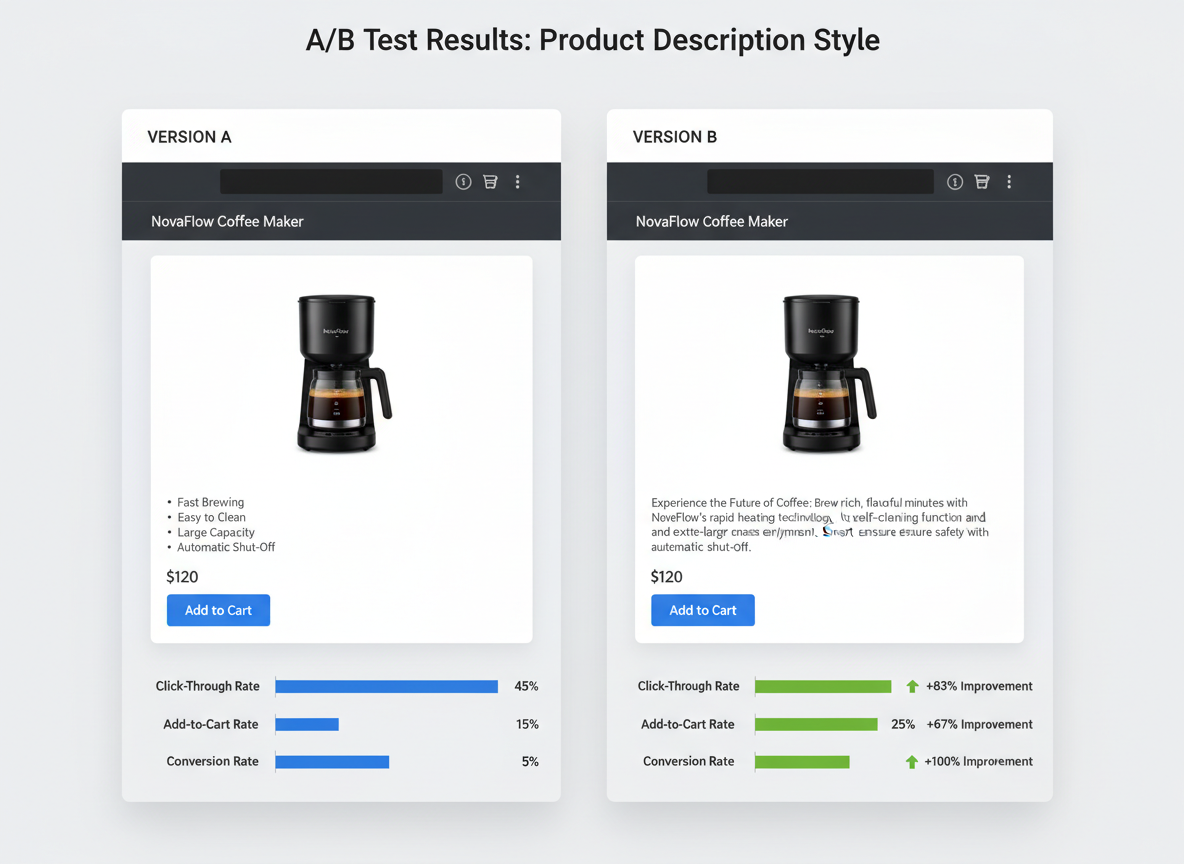
Your AI product description generator churns out compelling copy, but here’s the truth: what sounds perfect to you might not resonate with your customers. That’s where A/B testing transforms guesswork into revenue.
Start testing headlines first—they’re your make-or-break element. One ecommerce store I worked with saw a 34% conversion lift just by swapping “Premium Leather Wallet” for “The Last Wallet You’ll Ever Buy.” Next, experiment with description length (short and punchy versus detailed and immersive), tone variations (professional versus casual), benefit order (price-focused versus quality-focused), and CTAs (“Add to Cart” versus “Get Yours Now”).
Platforms like Shopify, WooCommerce, and BigCommerce offer built-in A/B testing, while tools like Google Optimize and VWO handle the heavy lifting. You’ll need at least 100 conversions per variation for statistical significance—don’t call winners too early.
A skincare brand tested AI-generated descriptions with different formatting (bullet points versus paragraphs) and saw conversions jump 28%. Another tested emotional versus practical language, discovering their audience preferred benefits over features.
Create a monthly testing calendar. Test one element at a time, document everything, and let data—not opinions—guide your decisions.
Common Mistakes and How to Avoid Them
Even the best AI product description generator won’t save you from these seven painful mistakes that tank conversions.
Mistake 1: Publishing raw AI output. You’re not a robot—don’t write like one. Always review and add your unique touch. Those clunky phrases? They’ll make customers bounce faster than a bad checkout page.
Mistake 2: Ignoring your brand voice. Generic descriptions kill brand recognition. Train your AI with examples that sound like you, not every other store selling similar products.
Mistake 3: Keyword stuffing. Google’s smarter than that, and so are your customers. Weave keywords naturally—if it sounds awkward, you’ve gone too far.
Mistake 4: Copy-pasting everywhere. Amazon needs different details than Instagram. Customize length and focus for each platform.
Mistake 5: Missing critical specs. AI sometimes skips dimensions, materials, or compatibility. Double-check every technical detail.
Mistake 6: Wrong length. Jewelry needs romance; industrial bolts need facts. Match description length to product complexity.
Mistake 7: Set-it-and-forget-it. Track what converts. A/B test variations monthly and refine based on actual data.
Troubleshooting: Getting weird outputs? Feed better inputs. Vague prompts create vague descriptions—specificity wins every time.
Integrating AI Description Generators Into Your Workflow
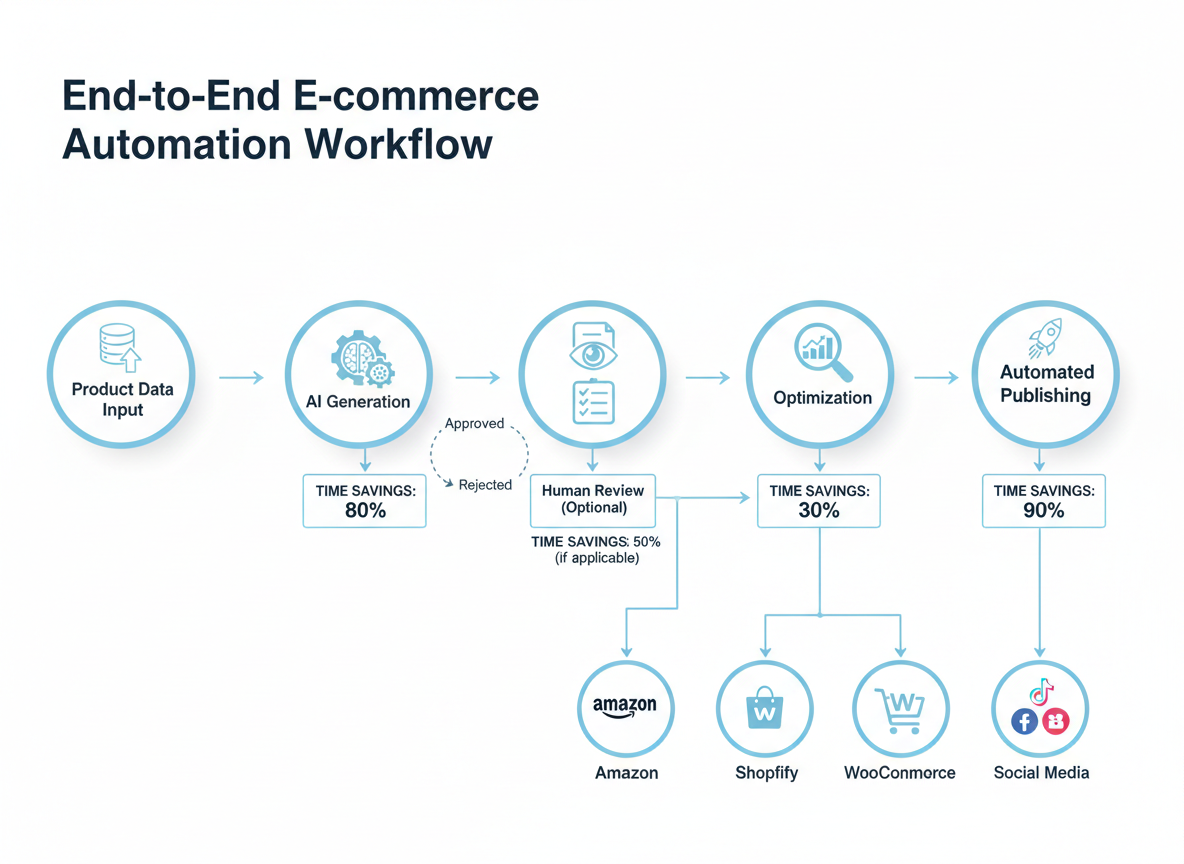
Getting your AI product description generator working smoothly means more than just copying and pasting outputs. You’ll want a system that flows.
Start with workflow automation that connects product creation directly to published descriptions. When you add a new product to your inventory system, your AI tool should trigger automatically, generate the description, and route it through your approval process without manual intervention.
API integrations make this seamless. Testing CG connects with major ecommerce platforms through robust APIs, pushing finished descriptions straight to your Shopify, WooCommerce, or BigCommerce store. You’re not downloading files and reuploading them somewhere else.
Set clear team roles: who creates the initial product data, who reviews AI outputs, who approves final versions. Version control prevents chaos when three people edit the same description simultaneously.
Automated publishing schedules let you queue up hundreds of product launches without staying up until midnight clicking “publish.”
Testing CG automates this entire pipeline, from data input to multi-platform syndication across your marketplace channels. Most teams save 12-15 hours weekly, translating to roughly $800-2,400 monthly in recovered labor costs. That’s your ROI, measured in time you’ll actually get back.
ROI Analysis: The True Cost and Value of AI Product Description Tools
Let’s talk numbers. A decent copywriter charges $50-150 per product description. If you’re managing 500 products, that’s $25,000-75,000. Meanwhile, most AI product description generators run $20-100 monthly with unlimited descriptions.
The math gets even better when you factor in time. Writing a single description manually takes 30-60 minutes. An AI tool? About 2 minutes, including editing. That’s a 95% time reduction.
Here’s what really matters: conversion rates. Businesses using AI-optimized descriptions report 15-40% increases in conversions. On a $100,000 monthly revenue, even a modest 20% boost means $20,000 extra—monthly.
For small shops (under 100 products), break-even happens within the first month. Medium-sized stores (500+ products) see ROI in days, not weeks.
Don’t overlook hidden costs, though. You’ll spend 2-4 hours on initial setup and another week getting comfortable with your chosen tool. Budget time for quality checks—AI isn’t perfect without your oversight.
The real value? Scalability. Launch 50 products tomorrow without hiring more writers or burning midnight oil yourself.
Future Trends: Where AI Product Descriptions Are Heading in 2026 and Beyond
The AI product description generator landscape is shifting fast. Multimodal AI now creates compelling copy directly from product images—no manual input needed. You’ll see voice and video integration transforming flat text into immersive storytelling experiences that connect emotionally with shoppers.
Hyper-personalization is getting scary good. Systems analyze customer browsing history, purchase patterns, and demographic data to tailor descriptions in real-time. Meanwhile, built-in A/B testing automatically optimizes your copy without lifting a finger.
Multilingual expansion? It’s happening at scale, with AI maintaining brand voice across 100+ languages simultaneously. AR/VR integration is creating interactive product experiences where descriptions adapt based on how customers engage.
Predictive analytics now forecast which descriptions will convert before you publish them. To future-proof your strategy, choose platforms that embrace these technologies early. The brands winning in 2026 aren’t just using AI—they’re letting it evolve with their customers’ expectations.
Frequently Asked Questions
Can AI product description generators replace human copywriters completely?
Not entirely. While AI handles bulk descriptions efficiently, human creativity shines for flagship products, brand storytelling, and nuanced messaging. Think of AI as your tireless assistant, not your replacement.
How much do AI product description generators cost on average?
Most tools range from $29 to $149 monthly. Free tiers exist but limit outputs. Enterprise solutions can exceed $500 monthly for unlimited generations across thousands of products.
Are AI-generated product descriptions good for SEO?
Absolutely, when done right. Modern AI tools incorporate keywords naturally, create unique content, and avoid duplication penalties. You’ll still want to customize meta descriptions and add schema markup manually.
How long does it take to generate product descriptions with AI?
Seconds, literally. Single descriptions take 5-15 seconds. Bulk generation of 100+ products? Usually under five minutes, depending on your chosen tool.
Can I use AI descriptions for Amazon without getting penalized?
Yes, provided the content’s unique and follows Amazon’s guidelines. Never copy-paste identical descriptions across multiple listings. Customize each one slightly to avoid duplicate content flags.
What’s the best AI product description generator for Shopify?
Several integrate directly with Shopify stores. Your choice depends on catalog size, budget, and whether you need multilingual support or advanced SEO features.
Do I need to edit AI-generated product descriptions?
Usually, yes. Quick edits ensure brand consistency, add personality, and verify accuracy. Think 80% done out of the box, 20% polish needed.
Can AI tools write descriptions in multiple languages?
Most premium tools support 50+ languages. Quality varies by language, with English, Spanish, French, and German typically offering the best results.
How do I train AI to match my brand voice?
Provide sample descriptions, tone guidelines, and specific vocabulary. Many platforms let you save brand voice profiles for consistent outputs across all products.
What product information do I need to provide to AI generators?
Basic details work: product name, category, features, benefits, and specifications. More context means better descriptions.
Can AI generate descriptions for thousands of products at once?
Definitely. Bulk generation handles entire catalogs. Upload CSV files with product data, and you’ll have descriptions in minutes.
Are there free AI product description generators worth using?
Several offer limited free tiers. They’re fine for testing but restrict monthly outputs. For serious ecommerce operations, paid plans deliver better ROI.

I am a full-time online marketer, for over a decade now. Helped over 100,000+ people & generated well over $12M in online sales.