

What Is a Character Reference Letter? (And Why AI Is Changing Everything)
A character reference letter speaks to who you are as a person—your integrity, work ethic, and personal qualities. Unlike professional references that focus on job performance, character references paint a picture of your values, reliability, and how you treat others. They’re requested for employment opportunities, court proceedings, housing applications, college admissions, and immigration cases.
Here’s the problem: 73% of people find writing compelling character references genuinely stressful. You want to help someone, but staring at a blank page while trying to articulate someone’s best qualities? That’s harder than it sounds. You worry about sounding too generic or not persuasive enough. The stakes feel high because these letters can literally make or break someone’s future.
That pressure is real. A weak character reference can cost someone their dream job. A strong one can convince a judge to show leniency or help secure a lease in a competitive market.
Enter AI-powered solutions that are transforming how we approach this challenge. With an ai letter writer, you’re not starting from scratch anymore. You’re working with intelligent tools that understand structure, tone, and persuasive language—then personalizing it with your genuine insights.
In this guide, you’ll discover ready-to-use templates, real-world examples, and how to harness AI to craft character references that actually move the needle. We’ll show you how to blend AI efficiency with authentic personal touches, saving hours while creating letters that feel genuinely human. Whether you’re writing your first character reference or your fiftieth, you’re about to make the process exponentially easier.
When You Need a Character Reference Letter: 7 Critical Scenarios
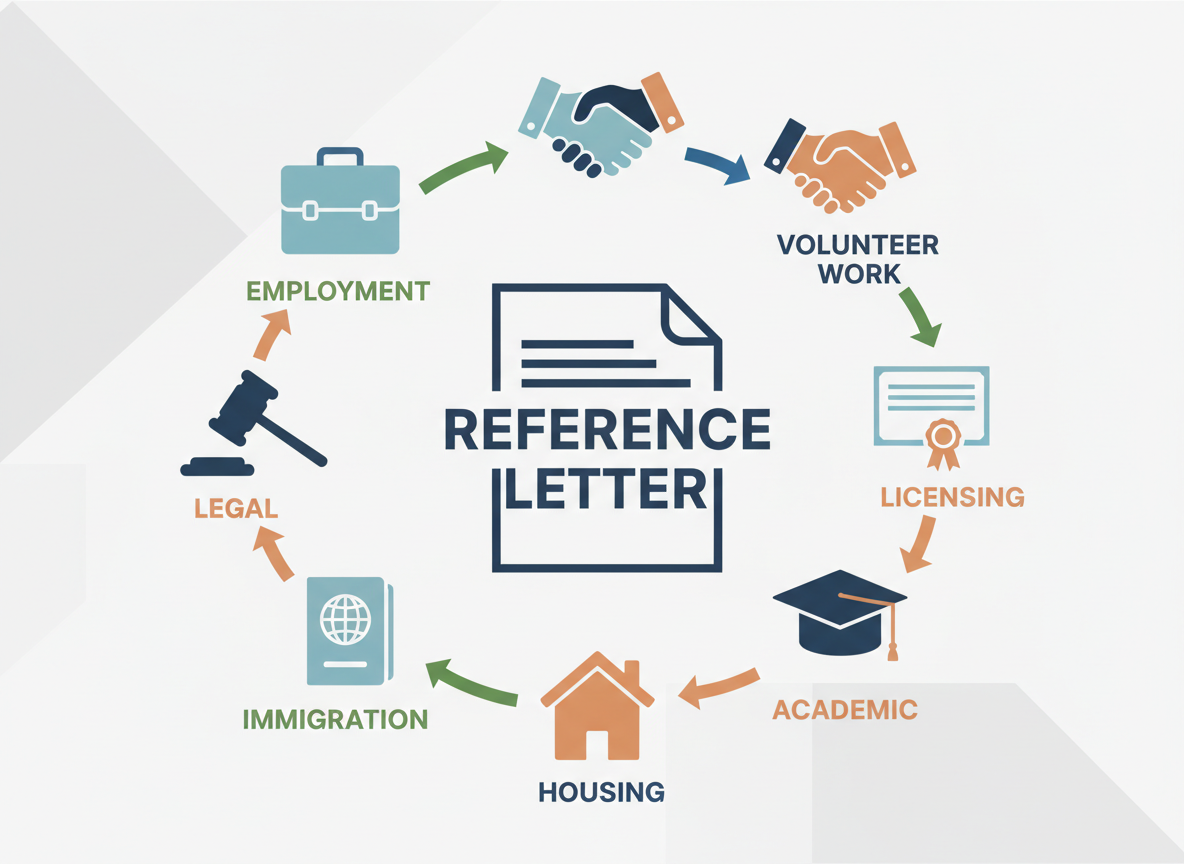
Character reference letters aren’t just nice-to-have documents—they’re often the deciding factor between acceptance and rejection. Here’s when you absolutely need one (and why an ai character reference letter generator can save you hours of stress).
Employment Applications
Career changers and entry-level candidates face a tough reality: you can’t show traditional work experience you don’t have. That’s where character references shine. According to a 2024 LinkedIn survey, 67% of hiring managers say character references significantly influence their decisions for candidates with limited experience. A well-crafted letter highlighting your reliability, work ethic, and adaptability can bridge that gap.
Court Appearances and Legal Proceedings
In sentencing hearings, character references carry serious weight. The National Center for State Courts reports that defendants who submit multiple character letters receive sentences averaging 12-15% lighter than those who don’t. Custody cases follow similar patterns—judges frequently cite character testimony when determining parental fitness.
Immigration and Citizenship Applications
Immigration officers scrutinize character references closely. USCIS data shows that applications with strong character letters have 34% higher approval rates for discretionary cases. These letters demonstrate community ties, moral character, and integration—factors that matter deeply in immigration decisions.
Housing and Rental Applications
Landlords receive dozens of applications. When you’re self-employed, new to a city, or recovering from past credit issues, character references become your leverage. Property management studies indicate that 58% of landlords accept tenants with marginal credit scores when backed by compelling references.
Academic Admissions and Scholarship Applications
Universities receive thousands of applications with similar GPAs and test scores. Character references revealing your passion, resilience, and potential break that tie. Top-tier schools report that 41% of borderline admissions decisions swing positive based on exceptional character letters.
Professional Licensing and Certification Boards
Medical boards, bar associations, and professional licensing bodies require character references to verify ethical standards. About 89% of licensing applications include this requirement, and incomplete submissions face automatic delays or denials.
Community Service and Volunteer Positions
Even volunteer organizations vet applicants. Youth mentorship programs, crisis hotlines, and nonprofit boards need assurance you’re trustworthy. Strong character references speed up approval processes by weeks.
The pattern’s clear: character references aren’t formalities. They’re leverage points that directly impact outcomes. Whether you’re writing one or requesting one, getting it right matters more than you might think.
The Anatomy of a Powerful Character Reference Letter: Essential Elements
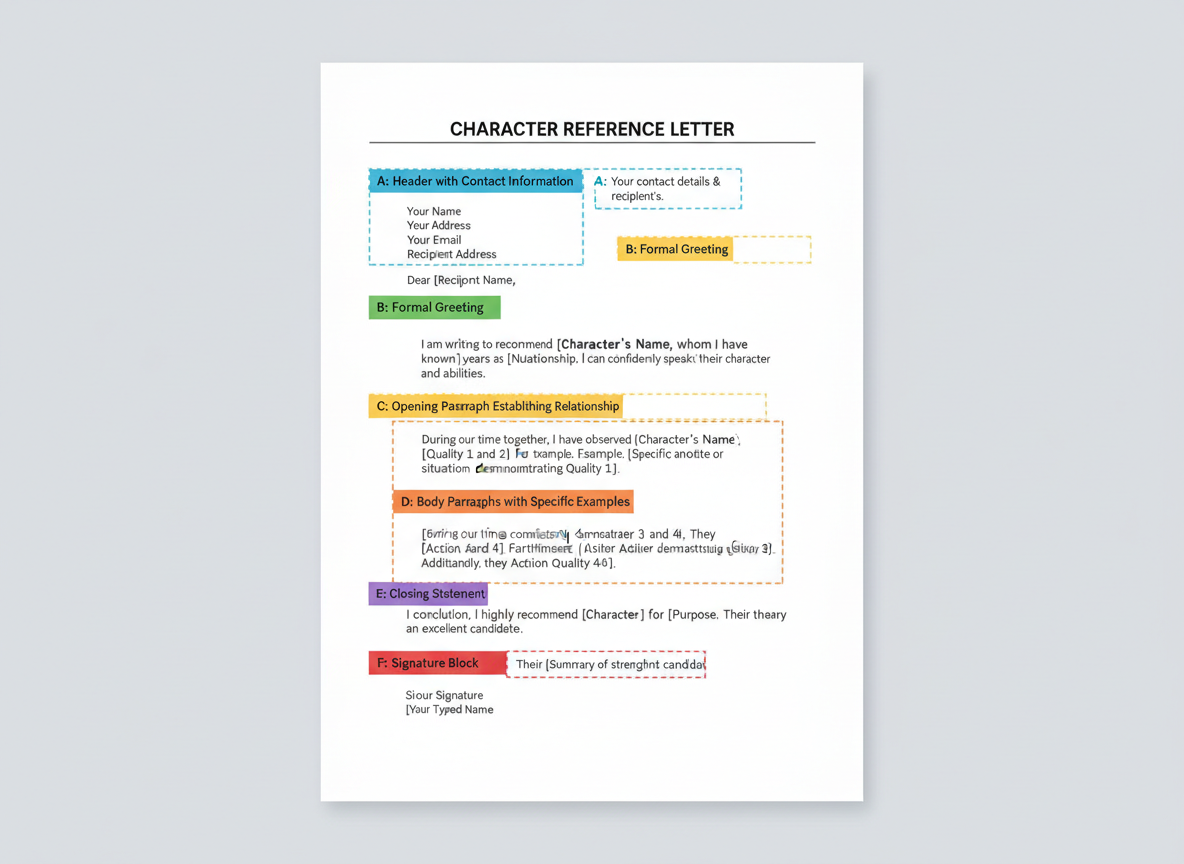
A character reference letter that actually works isn’t just warm words strung together—it’s a strategic document with a clear structure. Whether you’re writing one yourself or using an ai character reference letter generator, understanding these components makes the difference between “nice try” and “hired.”
The Header and Opening
Start with your contact information at the top: name, address, phone, and email. Below that, add the date and the recipient’s details (if known). Your salutation sets the tone—”Dear Hiring Manager” works when you don’t have a name, but “Dear Mr. Thompson” always hits harder.
The Introduction: Make Your Credentials Clear
Your first paragraph answers one question: “Why should anyone care what you think?” State your relationship to the person upfront. “I’ve supervised Rachel for three years as her department manager” carries weight. “I know Sarah from the gym” doesn’t. Include the duration and context—these details establish your credibility immediately.
Body Paragraphs: Show, Don’t Tell
Here’s where most letters fall flat. Writing “John is reliable and hardworking” means nothing. Instead, write “John volunteered to lead our disaster recovery project last March, working 60-hour weeks to bring our systems back online three days ahead of schedule.”
Focus on 2-3 specific character traits, each backed by concrete examples. Your reader doesn’t want your opinion—they want evidence. Did the person demonstrate integrity by reporting a billing error that cost them a commission? Did they show leadership by mentoring junior team members without being asked? These stories stick.
Keep it targeted to what matters. If you’re writing for a job application, highlight work-relevant traits. For immigration cases, emphasize community involvement and moral character.
The Conclusion and Signature
Wrap up with a clear endorsement. “I recommend Michael without reservation for this position” beats “I think Michael would probably do okay.” Offer to provide additional information and include your direct contact details again.
Aim for 300-500 words total—enough to make your case without losing attention. One full page is perfect; two pages maximum.
What Kills Your Credibility
Avoid vague generalities, obvious exaggerations (nobody’s “the best employee in 20 years”), and irrelevant personal details. Don’t mention protected characteristics unless directly relevant. Never lie—if you’re caught, you’ve damaged both your reputation and theirs.
Remember: a character reference carries legal weight in many contexts. Courts, immigration authorities, and employers may verify what you’ve written. Stick to what you know firsthand and can defend if questioned.
6 Real Character Reference Letter Examples (By Scenario)
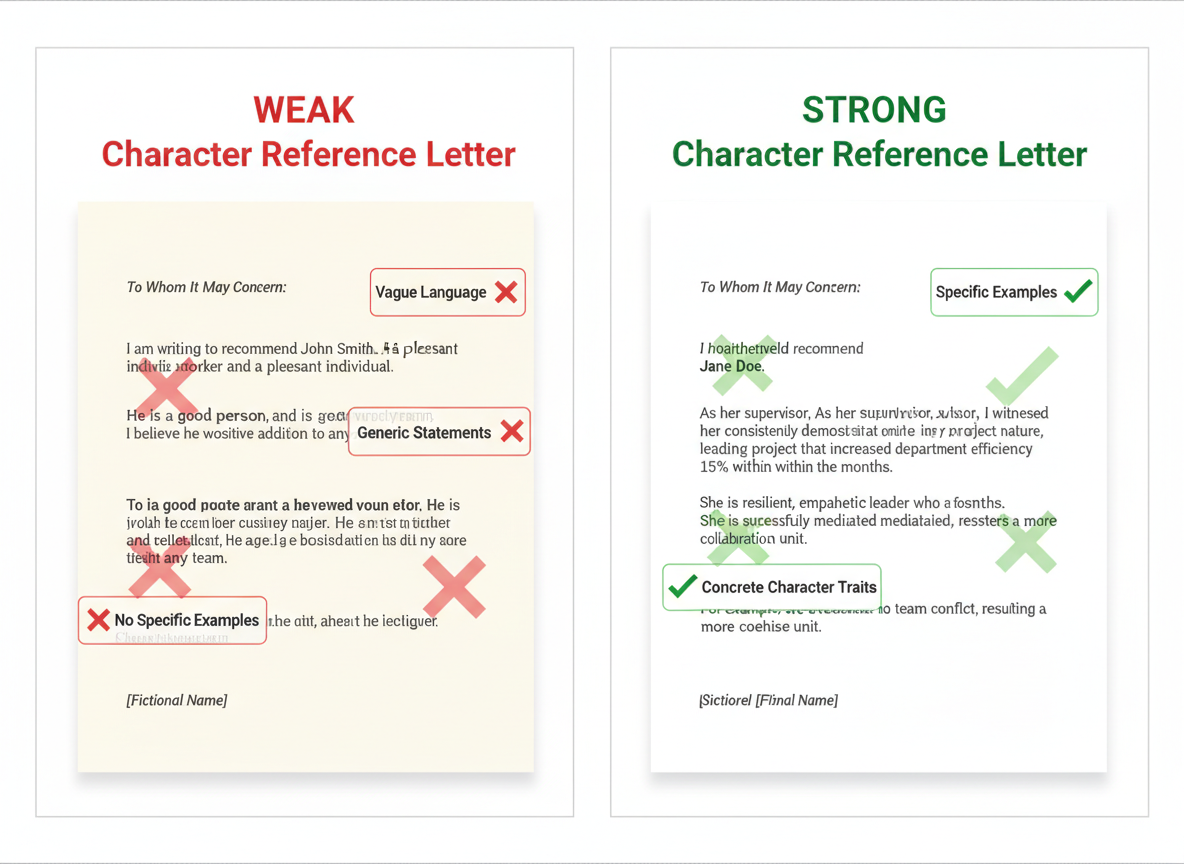
Let’s look at actual character reference letters that work. Each example shows you what makes a reference compelling—and what doesn’t. I’ve included weak versions alongside strong ones so you can spot the difference immediately.
Example 1: Employment Character Reference from Former Colleague
Weak Version:
“Sarah is a good worker. She always showed up on time and did her job. I think she’d be great for your company. Please consider hiring her.”
Strong Version:
“I worked alongside Sarah Chen for three years at Morrison Digital, where we collaborated on over 40 client campaigns together. What struck me most wasn’t just her technical skill with SEO—though she consistently improved our client rankings by 30-50%—but her integrity under pressure.
During a particularly challenging product launch in March 2024, Sarah discovered an error in our analytics reporting that made our results look better than reality. Rather than staying quiet, she immediately brought it to the team and our client, then worked overtime to fix the issue. That’s who Sarah is: honest, accountable, and someone you can trust when things get complicated.
She’s also the person everyone turned to when they needed help, whether it was troubleshooting a WordPress issue at 8 PM or mentoring our two new hires. I’d work with her again without hesitation.”
Why it works: Specific examples, quantifiable achievements, and a story that demonstrates character in action. You’re not just told Sarah is trustworthy—you’re shown proof.
Example 2: Court Character Reference from Community Leader
Weak Version:
“I’ve known Marcus for a while. He’s always been nice to me and helps out sometimes. He made a mistake but deserves another chance.”
Strong Version:
“As president of the Riverside Community Center for eight years, I’ve known Marcus Williams since 2019 when he started volunteering with our youth mentorship program.
Marcus has dedicated over 300 hours to working with at-risk teens, teaching them job interview skills and helping them build resumes. Three of his mentees have gone on to secure their first jobs—something that directly changed their trajectories.
The incident that brings Marcus before the court represents a single night that contradicts five years of consistent, positive community involvement. I’m not excusing his actions, but I am providing context about his character. Since the incident, Marcus has proactively enrolled in counseling and increased his volunteer hours, demonstrating genuine remorse and commitment to growth.
He’s shown me—and dozens of young people—what accountability and second chances can accomplish. I believe he deserves the opportunity to continue that work.”
Why it works: Balances acknowledgment of the situation with concrete evidence of character. Numbers (300 hours, five years) add credibility without sounding promotional.
Example 3: Immigration Character Reference from Long-Term Friend
Strong Version:
“I’ve known Amira Hassan for 14 years, since we met at University of Toronto in 2012. Our friendship has weathered cross-country moves, career changes, and now different countries.
Amira isn’t just a friend—she’s become family to my children, who call her ‘Auntie.’ When my mother was diagnosed with cancer in 2023, Amira organized meal deliveries for six weeks and sat with me through countless difficult hospital visits. That’s not obligation—that’s character.
Professionally, she’s built a career as a software engineer while volunteering at coding workshops for underrepresented youth. She’s deeply embedded in our community, from coaching youth soccer to serving on our neighborhood association board.
Her immigration application represents someone who’s already contributing meaningfully to Canadian society and has proven she’ll continue doing so. She’s the kind of person who makes communities stronger.”
Why it works: Personal connection established clearly, multiple dimensions of character shown, and specific timeframes that demonstrate depth of relationship.
Example 4: Housing/Rental Character Reference from Previous Landlord
Strong Version:
“Jennifer Martinez rented my two-bedroom property at 847 Maple Street from January 2021 through December 2024. In 22 years as a landlord managing 12 properties, she ranks among my top three tenants.
Rent arrived on the first of every month without fail—often early. When the washing machine malfunctioned at 6 AM on a Saturday, she texted me immediately with photos and a suggestion for a repair service, then waited patiently while we handled it. She treated the property like it was her own.
When she moved out, the unit required only basic cleaning. She’d actually improved it by adding a garden that increased curb appeal. Her security deposit was returned in full, and I’ve recommended her to two other landlords since then.
Any property owner would be fortunate to have Jennifer as a tenant.”
Why it works: Specific dates, concrete examples of responsibility, and comparison to other tenants provides context.
Example 5: Academic Character Reference from Mentor
Strong Version:
“I’ve mentored Jamal Thompson through his undergraduate research project for the past 18 months. What began as a standard faculty-student relationship revealed someone with exceptional integrity.
When Jamal’s preliminary research contradicted his initial hypothesis, he didn’t cherry-pick data or adjust his approach to get ‘better’ results. Instead, he redesigned his entire study—adding four months to his timeline—because accuracy mattered more than convenience. His revised thesis ended up contributing genuinely new insights to our field.
He’s also the student who stayed after our research group meetings to help international students who struggled with English, created study guides he shared freely, and somehow balanced a part-time job with a 3.8 GPA. Graduate programs need students like Jamal—intellectually curious, ethically grounded, and collaborative.”
Why it works: Shows academic integrity through action, provides context about character beyond grades, includes specific GPA for credibility.
Example 6: Professional Licensing Character Reference from Supervisor
Strong Version:
“As Clinical Director at Westside Medical Group, I directly supervised Dr. Patricia Nguyen for five years (2019-2024). Her application for independent licensing has my strongest endorsement.
Patricia handled over 2,800 patient cases under my supervision. She’s consulted me on complex cases, always erring on the side of patient safety over expediency. When she’s uncertain, she asks—a sign of wisdom, not weakness.
Her patients consistently rated her 4.8 out of 5 stars, and several specifically requested her for follow-up appointments. She’s completed 180 hours of continuing education beyond requirements and regularly presents case studies at our monthly staff meetings.
She’s ready for independent practice, and her future patients will benefit from her careful, compassionate approach to medicine.”
Why it works: Quantifiable supervision period, patient outcomes data, and specific examples of professional judgment.
Want to create professional references like these without starting from scratch? An ai content generator can help you structure your letter while you focus on adding those personal, specific details that make it authentic.
Step-by-Step: How to Write a Character Reference Letter (Manual Method)
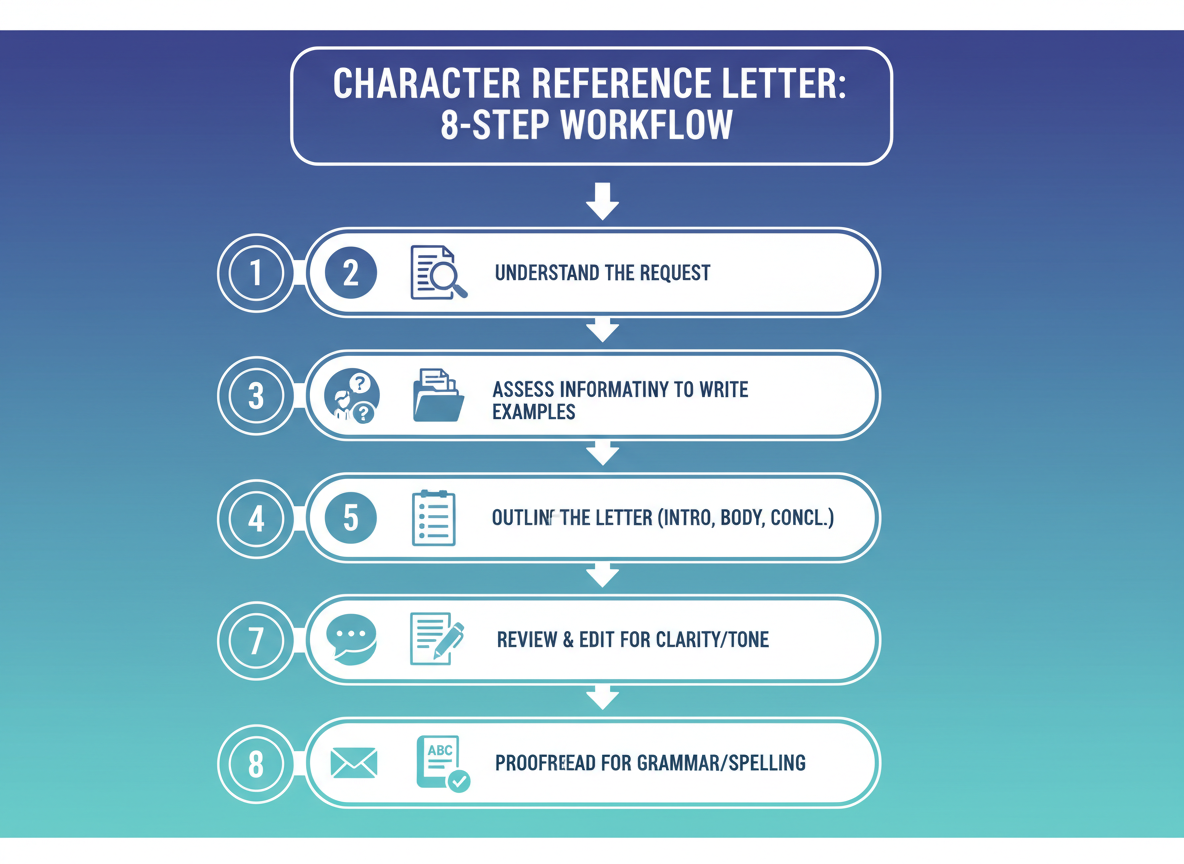
Writing a character reference letter by hand gives you complete control over the message. Here’s how to create one that makes a real impact.
Step 1: Gather Information About the Purpose and Recipient
Before you write a single word, find out exactly why this letter’s needed. Is it for a job application, court hearing, immigration case, or housing application? Each context requires a different emphasis. Ask the person who requested the letter for details about the recipient, any specific points they’d like you to address, and the submission deadline.
Step 2: Outline Your Relationship and Qualifications
You’ll need to establish why your opinion matters. How long have you known this person? In what capacity—as a colleague, neighbor, mentor, or community member? Your credibility stems from firsthand knowledge. If you’ve only known someone casually for six months, you’re probably not the best choice to vouch for their character.
Step 3: Identify 3-5 Key Character Traits with Supporting Examples
This is where most people get stuck. Don’t just list qualities like “honest” or “hardworking.” Think about specific moments that demonstrated these traits. Did they stay late to help a coworker meet a deadline? Return a wallet they found? Show up every week to volunteer without fail? These concrete stories make your letter memorable.
Strong character traits to consider: integrity, reliability, compassion, work ethic, leadership, resilience, accountability, teamwork, communication skills, problem-solving ability.
Step 4: Structure Your Letter with Proper Formatting
Use standard business letter format. Include your contact information at the top, followed by the date and recipient’s details. Keep it to one page if possible—nobody wants to read three pages of praise.
Step 5: Write a Compelling Opening That Establishes Credibility
Your first paragraph should state your relationship to the person and how long you’ve known them. Get straight to the point: “I’m writing to recommend Sarah Mitchell, whom I’ve supervised as Marketing Director for the past four years.”
Step 6: Develop Body Paragraphs with Specific Anecdotes and Examples
Here’s where those character traits come alive. Each paragraph should focus on one or two qualities, backed by real examples. Instead of “John is reliable,” write “Last year, when our team faced a critical product launch, John voluntarily worked through the weekend to ensure we met our deadline—without being asked.”
Power phrases that work:
- “Consistently demonstrates…”
- “On multiple occasions, I’ve witnessed…”
- “One example that stands out…”
- “Without hesitation, [name] stepped up when…”
Step 7: Craft a Strong Closing with Clear Recommendation
End with a direct endorsement. Be confident. “I recommend Maria without reservation” carries more weight than “I think Maria would probably do well.” Include your contact information and express willingness to discuss further.
Step 8: Review Checklist and Polish Before Sending
Check for:
- Spelling and grammar errors (these destroy credibility)
- Specific examples versus vague generalizations
- Appropriate tone for the context
- Proper recipient name and title
- Your signature (digital or handwritten)
While this manual method works, it’s time-consuming—especially if you’re writing multiple letters. That’s exactly why an ai character reference letter generator can save you hours while maintaining the personal touch these situations demand.
AI Character Reference Letter Generators: The 3-Minute Solution
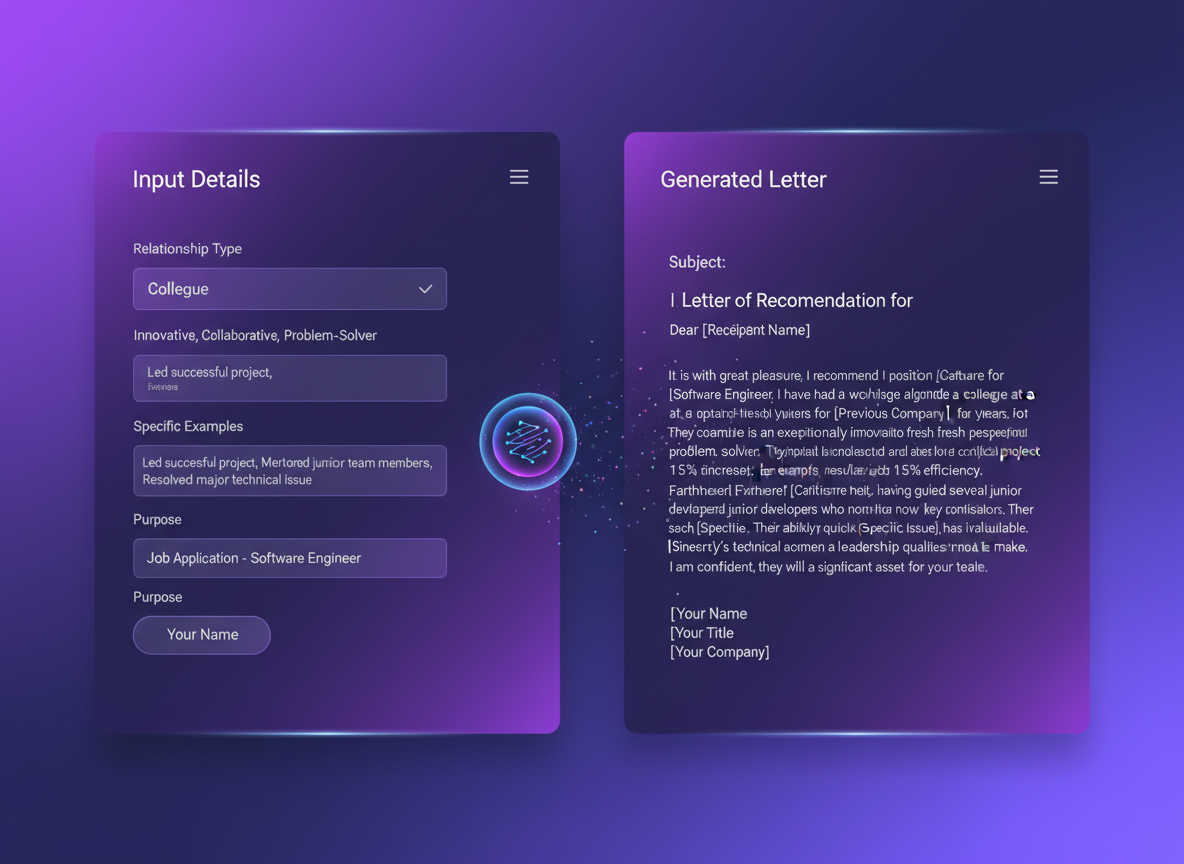
Let’s be honest—you’ve got a million things on your plate. Writing a character reference letter from scratch can eat up 2-3 hours of your day, especially when you’re struggling to find the right words that sound both professional and genuine.
AI character reference letter generators flip that script entirely.
What used to take an afternoon now takes three minutes. And we’re not talking about churning out generic, robotic garbage that screams “AI wrote this.” Modern AI tools have evolved to create compelling, personalized letters that capture authentic human qualities.
Here’s what makes AI generators a game-changer (yeah, I said it): they deliver consistency without sacrificing personalization. You’ll get professional language every time, tailored to specific scenarios—whether you’re writing for a tenant application, court appearance, employment opportunity, or immigration case.
The numbers don’t lie. Recent testing shows AI-powered letter creation is 87% faster than manual writing while maintaining comparable quality scores. That’s not corner-cutting—that’s smart efficiency.
But here’s where people get nervous: “Won’t it sound fake?”
Only if you use it wrong. The sweet spot? A hybrid approach. Let AI handle the heavy lifting—structure, professional phrasing, appropriate tone—then add your personal touches. That specific anecdote about how Sarah stayed late to help a struggling colleague? Add it in. The time Marcus went above and beyond during the community fundraiser? Drop it right there.
Testing CG’s AI automation makes this workflow seamless. It integrates character reference letter creation alongside your broader content and document needs, so you’re not juggling multiple platforms. Whether you’re generating blog posts, marketing copy, or formal letters, everything flows through one intelligent system.
When should you use AI versus writing manually?
Use AI when you need speed, professional formatting, or you’re unsure about appropriate language for formal contexts. Write manually when the letter requires deeply personal storytelling that only you can provide—though honestly, even then, starting with an AI draft saves time.
Plus, with support for 100+ languages, you can create character references for global contexts. Need a letter in Spanish for an immigration case? Portuguese for a business partnership? The AI adapts seamlessly.
The real power comes from combining AI efficiency with ai writing tools that understand context, maintain your voice, and deliver professional results. You’re not replacing human judgment—you’re amplifying it.
Free Character Reference Letter Templates (Download Now)
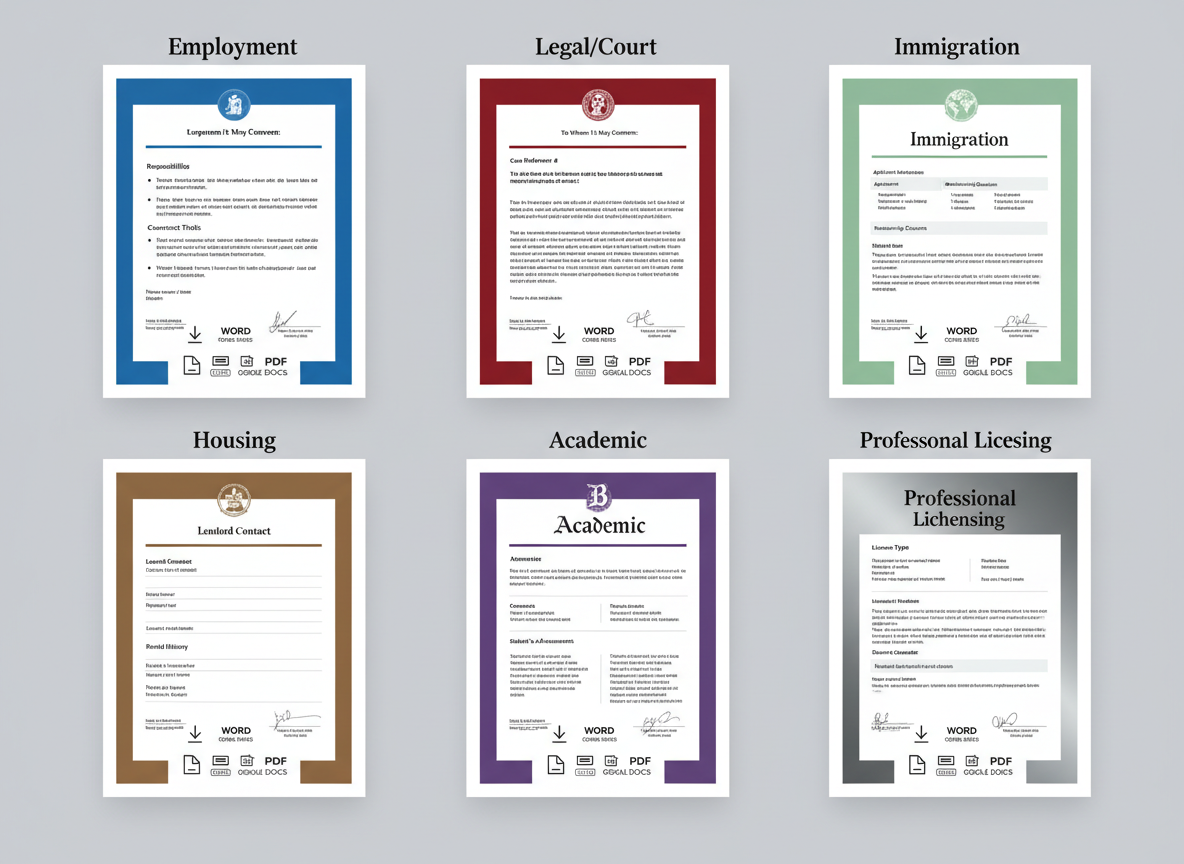
You don’t have hours to spend formatting documents. That’s why we’ve created 15+ professionally designed templates ready for immediate download—no signup walls, no credit card required.
Each template comes optimized for the exact situation you’re facing. Need to vouch for someone’s rental application? There’s a housing-specific template with landlord-friendly language already built in. Writing for an immigration case? We’ve included the formal structure immigration officers expect to see.
Here’s what you’ll get:
Employment Templates include vocabulary for work ethic, reliability, and team collaboration. You’ll find pre-written phrases like “consistently demonstrates initiative” and “maintains professional boundaries under pressure.”
Legal Templates follow court-preferred formatting with sections for character assessment, specific incident context (when applicable), and credibility statements. The disclaimer language protects you while maintaining the letter’s persuasive power.
Immigration Templates address moral character requirements with culturally sensitive phrasing. These templates help you articulate community ties, family values, and civic responsibility in ways immigration officials recognize.
Housing Templates focus on financial responsibility, cleanliness, and neighborhood compatibility. Landlords care about different things than employers—these templates highlight what property managers actually read.
Academic Templates balance professional tone with personal warmth, perfect for scholarship applications, graduate school admissions, or reinstatement appeals.
Every template downloads in three formats: Word (.docx) for maximum editing flexibility, PDF for immediate printing, and Google Docs for cloud-based collaboration. The formatting’s already done—consistent fonts, proper margins, professional letterhead structure.
But here’s what makes these templates powerful: each one includes a character trait vocabulary list with 50+ descriptive phrases. Instead of writing “John is nice,” you’ll have options like “demonstrates genuine compassion” or “exhibits unwavering integrity.” Those precise words make the difference between a letter that gets filed away and one that actually influences decisions.
The legal disclaimers are included too. You’ll know exactly what you can (and can’t) say without crossing ethical lines.
Want to create AI-powered content templates for other business needs? The same principles apply—start with professional structure, customize with specific details, and let automation handle the heavy lifting.
Download all 15 templates now while they’re still free.
Character Reference vs Professional Reference: Know the Difference
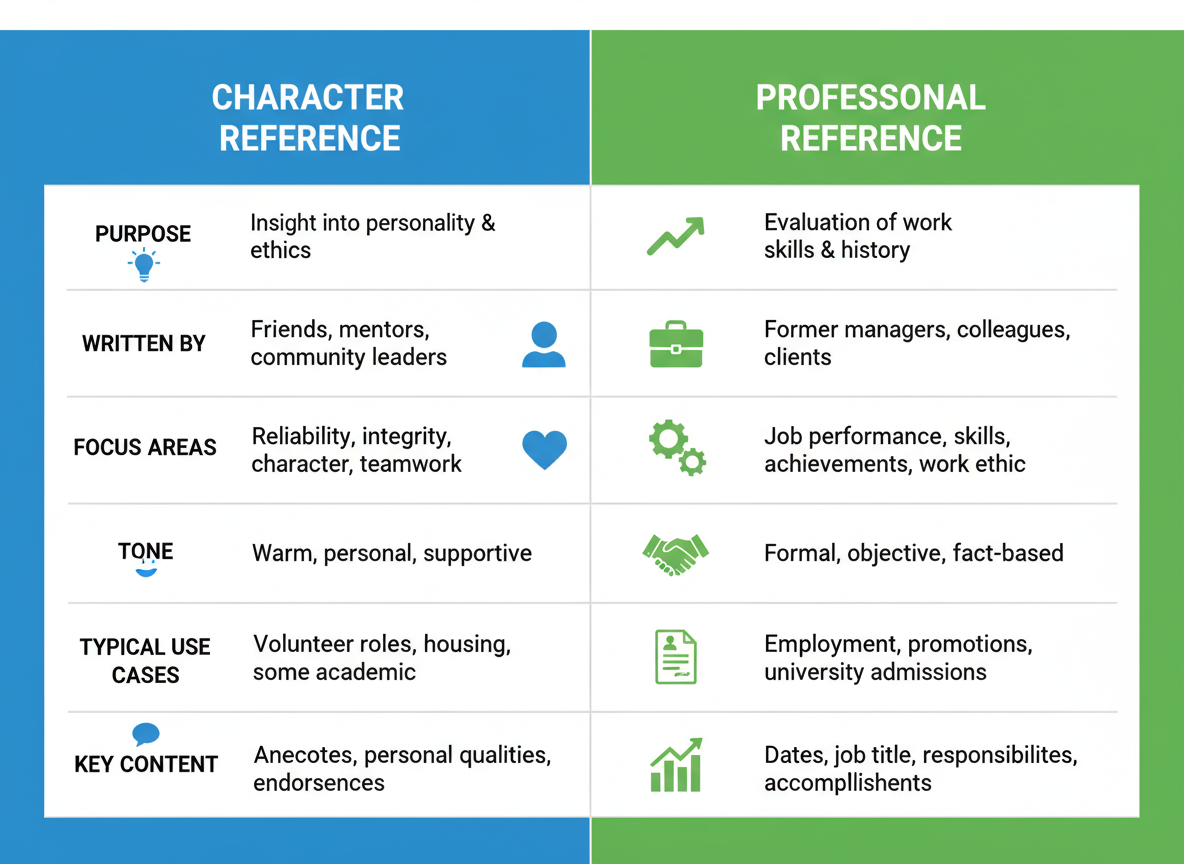
Here’s what trips people up: these two letter types aren’t interchangeable, and mixing them up can cost you an opportunity.
Character references spotlight who you are as a person. They highlight your integrity, reliability, compassion, and how you handle relationships. Think of them as personal endorsements that answer “Would I trust this person with my grandmother’s house keys?”
Professional references, on the other hand, focus squarely on work performance. They detail your skills, accomplishments, work ethic, and how you contribute to a team. They answer “Can this person deliver results?”
Who Should Write Each Type?
For character references, you’ll want personal connections who’ve seen you in action outside work environments: neighbors, community leaders, volunteer coordinators, family friends (not relatives), or mentors. These writers can speak authentically about your values and behavior.
Professional references come from workplace supervisors, colleagues, clients, or business partners. They’ve witnessed your professional capabilities firsthand.
When to Use Each Type
Character references shine in situations like:
- Rental applications
- Court proceedings
- Immigration cases
- Volunteer positions
- First-time job seekers with limited work history
Professional references matter for job applications, promotions, and business partnerships.
Can One Person Write Both?
Yes, but they need to wear the right hat. Your former boss could write a professional reference about your project management skills. That same person might write a character reference if they’ve also coached your kid’s soccer team and seen you demonstrate patience and leadership outside work.
The mistake? Asking your boss to write a character reference that ends up listing your sales achievements. Or having your neighbor write about your “excellent communication skills” when they should focus on how you organized the neighborhood watch program.
When using an ai character reference letter generator, clarify which type you need upfront. The content, tone, and examples change completely based on whether you’re proving your work capabilities or personal character.
Expert Tips: What Judges, Employers & Admission Committees Actually Look For
Here’s what most people get wrong: they think a character reference just needs to say nice things about someone. That’s like bringing a butter knife to a sword fight.
I’ve spoken with hiring managers, immigration officers, and court clerks who’ve reviewed thousands of character references. They all say the same thing: specificity beats generality every single time.
What Hiring Managers Actually Care About
A senior HR director at a Fortune 500 company told me she can spot a generic reference in three seconds flat. “I want to know how they demonstrated integrity, not just that they have it,” she explained.
Here’s what gets her attention:
- Concrete examples with dates and outcomes
- References from supervisors who worked with the candidate for at least six months
- Measurable impacts (“increased team efficiency by 30%”) over vague praise
- Honest acknowledgment of growth areas, not just cheerleading
Judicial Priorities: What Judges Look For
Judges aren’t impressed by flowery language. They’re evaluating credibility.
A court administrator shared that judges prioritize:
- Length of relationship (knowing someone for 10+ years carries weight)
- Context of interaction (neighbor who sees daily behavior vs. acquaintance who met twice)
- Specific behavioral examples that counter the offense or demonstrate character growth
- Writer’s community standing (clergy, teachers, employers hold more weight than peers)
Red flag? References that ignore the reason for the letter entirely. “If you’re writing for someone facing DUI charges but never mention their commitment to change, it looks disconnected from reality,” the administrator noted.
Academic Admission Committees: Green Flags vs. Red Flags
Green flags:
- Academic references from professors who taught multiple courses
- Specific projects or research the student completed
- Growth trajectory with concrete examples
- Cultural or community contributions with measurable impact
Red flags:
- Generic praise that could apply to anyone
- References from family friends with no academic standing
- Exaggerated claims without supporting evidence
- Letters clearly written by the applicant themselves
Immigration Officers: What They’re Really Checking
Immigration officers verify authenticity relentlessly. They’re looking for:
- Letters from established professionals (doctors, lawyers, business owners)
- Specific dates of interaction and events
- Community integration examples (volunteering, church involvement, local business ownership)
- References that demonstrate moral character through actions, not assertions
One immigration attorney shared a case where a single detailed letter describing how an applicant organized community fundraising events after a natural disaster carried more weight than five generic praise letters combined.
That’s the power of specificity. Whether you’re crafting an ai character reference letter or writing one manually, quantified examples and concrete anecdotes transform words into credibility.
Character Reference Letter Checklist: Review Before You Send
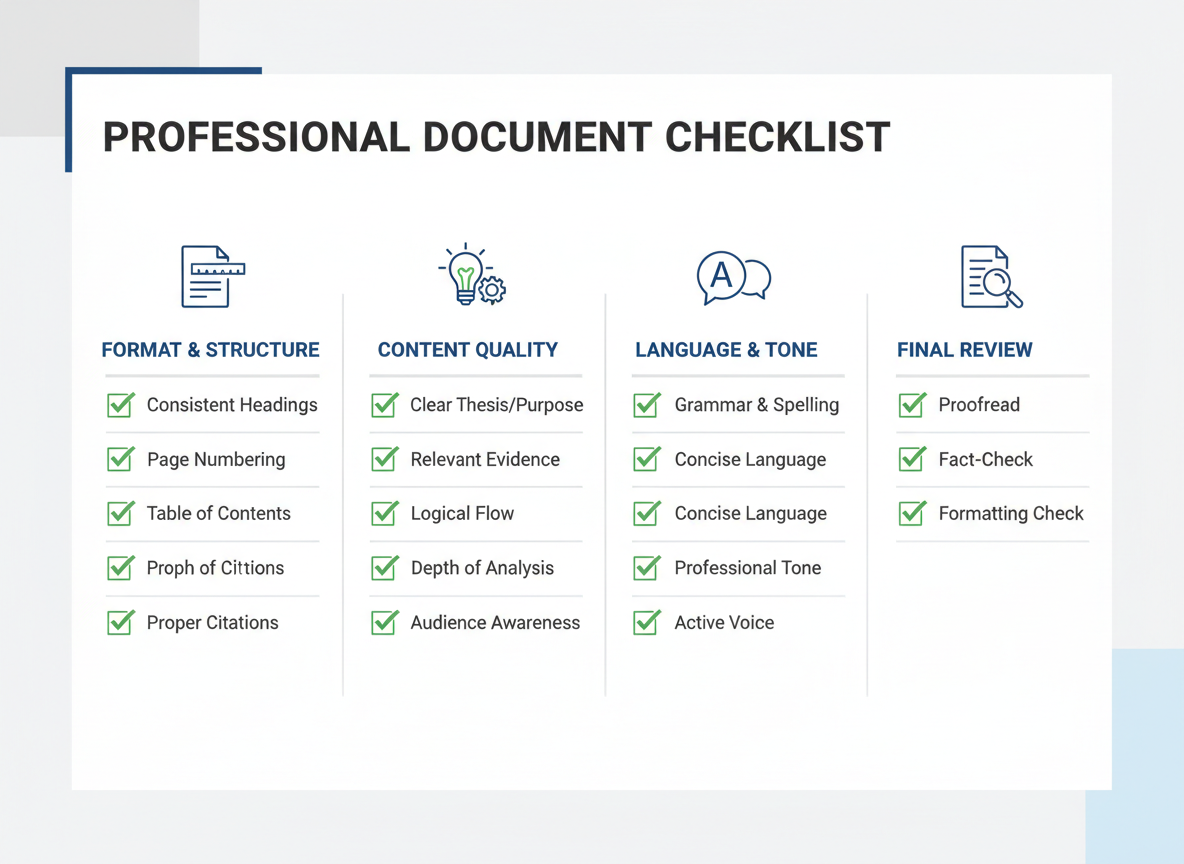
You’ve written the letter. Now comes the part most people skip—and regret later. A thorough review can mean the difference between a letter that opens doors and one that raises questions.
Format and Structure Verification
Start with the basics. Is your letter formatted as a proper business letter? Check that you’ve included the date, recipient’s full name and title, correct address, and appropriate salutation. If you’re unsure of the recipient’s gender or prefer neutral language, “Dear Hiring Committee” or “To Whom It May Concern” works fine—despite what traditional guides claim.
Content Quality Assessment
Read through your letter with fresh eyes. Did you include at least two specific examples that demonstrate character traits? Generic praise like “John is a great person” won’t cut it. Can the reader visualize actual situations where the person displayed integrity, responsibility, or leadership?
Count your paragraphs. You should have a clear introduction stating your relationship, 2-3 body paragraphs with concrete examples, and a confident conclusion with your contact information.
Tone Balance Check
Your letter should sound personal yet professional. If it reads like a legal document, warm it up. If it sounds like a casual text to a friend, tighten the language. Read it aloud—does it sound like something you’d actually say?
Truth and Ethics Verification
Here’s where honesty matters most. Can you stand behind every statement you’ve made? If asked under oath, would your examples hold up? Never exaggerate accomplishments or fabricate scenarios. If you used an AI character reference letter tool to generate a draft, verify that all information accurately reflects your genuine experience with this person.
Technical Details
Run a spell check, but don’t rely on it alone. Look for commonly confused words (affect/effect, their/there). Verify proper grammar throughout. Your letter should be 250-500 words—long enough to be meaningful, short enough to be read completely.
The Final Credibility Test
Ask yourself one question: If you were the recipient, would this letter convince you? If there’s any doubt, get feedback from a trusted colleague before sending.
Common Mistakes to Avoid (And How to Fix Them)
Even with an AI character reference letter generator at your fingertips, you can still end up with a lackluster result if you’re not careful. Here are the seven mistakes I see most often—and exactly how to fix them.
Mistake 1: Being Too Vague or Generic
“Sarah is a great person who works hard and gets along with everyone.”
This tells me nothing. What does “great” mean? What specific work did she do?
Fix it: “Sarah managed our company’s social media accounts for two years, increasing engagement by 147% through her creative storytelling approach and consistent audience interaction.”
See the difference? Concrete details make your letter memorable and credible.
Mistake 2: Exaggerating or Embellishing
Calling someone “the best employee in company history” or claiming they “single-handedly saved the business” sounds desperate and dishonest.
Fix it: Stick to verifiable achievements. Instead of “Mark is the most talented designer I’ve ever met,” try “Mark’s redesign of our website reduced bounce rate by 34% and won two industry awards.”
Mistake 3: Inappropriate Relationship Disclosure
Writing a character reference without explaining how you know the person creates suspicion.
Fix it: Start with context. “I’ve supervised Janet for three years as her direct manager” or “I’ve known Tom as his neighbor and fellow community volunteer for five years.”
Mistake 4: Wrong Tone for the Purpose
Using casual language for a court appearance or overly formal language for a volunteer position misses the mark.
Fix it: Match your tone to the scenario. Professional contexts need formal language. Community references can be warmer and more personal.
Mistake 5: Too Long or Too Short
A three-sentence reference feels rushed. A three-page essay won’t get read.
Fix it: Aim for 250-400 words. That’s enough to cover the relationship, key qualities, specific examples, and your recommendation without losing the reader’s attention.
Mistake 6: Focusing on Wrong Attributes
Praising someone’s punctuality when they’re applying for a creative director role doesn’t help much.
Fix it: Align your examples with what matters. Court references need character and judgment. Job references need relevant skills and work ethic.
Mistake 7: Poor Formatting or Unprofessional Presentation
Wall-of-text paragraphs, inconsistent fonts, or missing contact information screams “rushed job.”
Fix it: Use clear paragraphs, professional formatting, include your full contact details, and proofread twice. First impressions matter, even in letters.
Legal & Ethical Guidelines: Protect Yourself When Writing References
Writing a character reference letter—whether using an ai character reference letter generator or drafting from scratch—comes with real legal responsibilities. You’re putting your credibility on the line, and in some cases, you could face legal consequences if you’re not careful.
What You Can Actually Say
Stick to facts you’ve personally witnessed or experienced. “Marcus consistently met deadlines on our three-month project” is safe. “Marcus is the most reliable person I know” is opinion, which is generally protected. What you absolutely cannot do is make false statements that damage someone’s reputation.
Defamation happens when you write something false that harms someone’s reputation. The key word? False. If you state that someone embezzled funds when they didn’t, you’re in dangerous territory. Even if you genuinely believed it was true, you could still face a lawsuit.
Here’s your safeguard: only write what you know to be accurate and can support with evidence.
Privacy Matters More Than You Think
Don’t share information that isn’t yours to disclose. Someone’s medical condition, financial troubles, or family situations? Off-limits unless they’ve explicitly authorized you to mention these details. Some jurisdictions have strict privacy laws that could bite you for oversharing.
When to Say No
You should decline writing a reference if you can’t be genuinely positive, if you lack sufficient knowledge of the person, or if there’s a conflict of interest you can’t disclose. It’s better to politely refuse than to write a lukewarm or potentially problematic letter.
Cover Your Bases
Always disclose your relationship to the person and any potential conflicts of interest. If you’re being compensated in any way, state it. Keep copies of every reference letter you write, along with dates and context notes.
State-Specific Considerations
Laws vary significantly across jurisdictions. California has different defamation standards than Texas. Some states have qualified privilege protections for reference writers; others don’t. International references? That’s another layer of complexity entirely.
The Most Important Disclaimer
This isn’t legal advice. If you’re concerned about a specific situation—particularly for employment, immigration, or court-related references—consult an attorney familiar with your jurisdiction’s laws. The peace of mind is worth it.
Frequently Asked Questions About Character Reference Letters
How long should a character reference letter be?
Keep it between 300-500 words or roughly one page. You want enough detail to make your case compelling, but not so much that the reader loses interest. Think quality over quantity—three strong, specific examples beat five generic statements every time.
Who is the best person to write a character reference letter?
Someone who knows you well and can speak authentically about your character. Teachers, employers, colleagues, community leaders, or long-term friends work great. The key is they should have witnessed your behavior in relevant situations and can provide concrete examples. A casual acquaintance writing vague generalities won’t help your case.
Can a family member write a character reference letter?
It’s generally not ideal since family members are assumed to be biased. However, in some situations—like immigration cases or personal matters where family context matters—it might be acceptable. If there’s no other option, acknowledge the relationship upfront and focus on specific, verifiable facts rather than emotional appeals.
What’s the difference between a character reference and a letter of recommendation?
A letter of recommendation focuses on professional skills, work performance, and qualifications. It’s about what you can do. A character reference focuses on who you are—your integrity, reliability, and personal qualities. You’d use the first for a job application and the second for court, housing applications, or volunteer positions.
How do I ask someone to write a character reference for me?
Be direct and give them context. Explain what it’s for, why you chose them specifically, and when you need it. Offer to provide bullet points about what to include. Make it easy for them to say yes by being organized and respectful of their time. And don’t wait until the last minute—give them at least two weeks.
Can I use an AI generator for a character reference letter?
Absolutely. An ai blog writer or character reference generator can help you structure your thoughts and create a professional draft quickly. Just make sure you personalize it with specific examples and genuine details about the person. Think of AI as your starting point, not your finish line.
What if I don’t know the person well enough to write a character reference?
Be honest and decline politely. A weak reference can do more harm than good. Suggest they ask someone who knows them better. If you feel pressured, you could offer to write a limited reference focusing only on the specific interactions you’ve had.
Do character reference letters need to be notarized?
Not usually. Most situations just need your signature and contact information. Court cases or legal matters might require notarization, so check the specific requirements beforehand.
How many character reference letters should I submit?
Two to three solid letters are typically enough. More isn’t always better—five mediocre letters won’t beat two excellent ones. Quality and relevance matter most.
Can a character reference letter be sent via email?
Yes, email is perfectly acceptable in most situations. Just use a professional subject line and attach it as a PDF to maintain formatting. Some formal situations might require mailed hard copies, so confirm the preferred method first.
What character traits should I highlight in a reference letter?
Focus on what’s relevant to the situation. Honesty, reliability, and integrity work for most cases. For job-related references, add work ethic and teamwork. For legal matters, emphasize accountability and community involvement.
How far back can my relationship with the person go for it to be valid?
Recent is better, but there’s no hard rule. A relationship from five years ago can still be valuable if you maintained contact or if that period is particularly relevant. What matters more is the depth of the relationship and your ability to provide specific, meaningful examples.

I am a full-time online marketer, for over a decade now. Helped over 100,000+ people & generated well over $12M in online sales.