AI and Content Marketing: Creating Synergy for Modern Businesses
Table of Contents
1. Introduction: The Dawn of AI-Powered Content Marketing
2. Understanding AI in the Content Marketing Landscape
3. How AI Transforms Content Creation and Strategy
4. Personalization at Scale: AI’s Greatest Gift to Marketers
5. Content Optimization and Performance Analytics
6. Overcoming Challenges in AI-Content Marketing Integration
7. Real-World Success Stories and Case Studies
8. Future Trends: What’s Next for AI and Content Marketing
9. Conclusion: Building Your AI-Enhanced Content Strategy
10. Frequently Asked Questions
Introduction: The Dawn of AI-Powered Content Marketing
Picture this: you’re sitting at your desk, staring at a blank document, wondering how you’ll create enough content to keep your audience engaged across multiple platforms. Sound familiar? If you’re a content marketer, this scenario probably hits close to home. But here’s the exciting news – artificial intelligence is revolutionizing how we approach content marketing, and the synergy between human creativity and AI efficiency is creating unprecedented opportunities.

The marriage of AI and content marketing isn’t just a trendy buzzword; it’s a fundamental shift that’s reshaping how brands connect with their audiences. From generating initial content ideas to optimizing distribution strategies, AI is becoming the secret weapon that savvy marketers use to stay ahead of the curve.
In today’s digital landscape, where consumers are bombarded with thousands of marketing messages daily, creating content that truly resonates has become both an art and a science. This is where AI steps in, not to replace human creativity, but to amplify it in ways we never thought possible.
Understanding AI in the Content Marketing Landscape
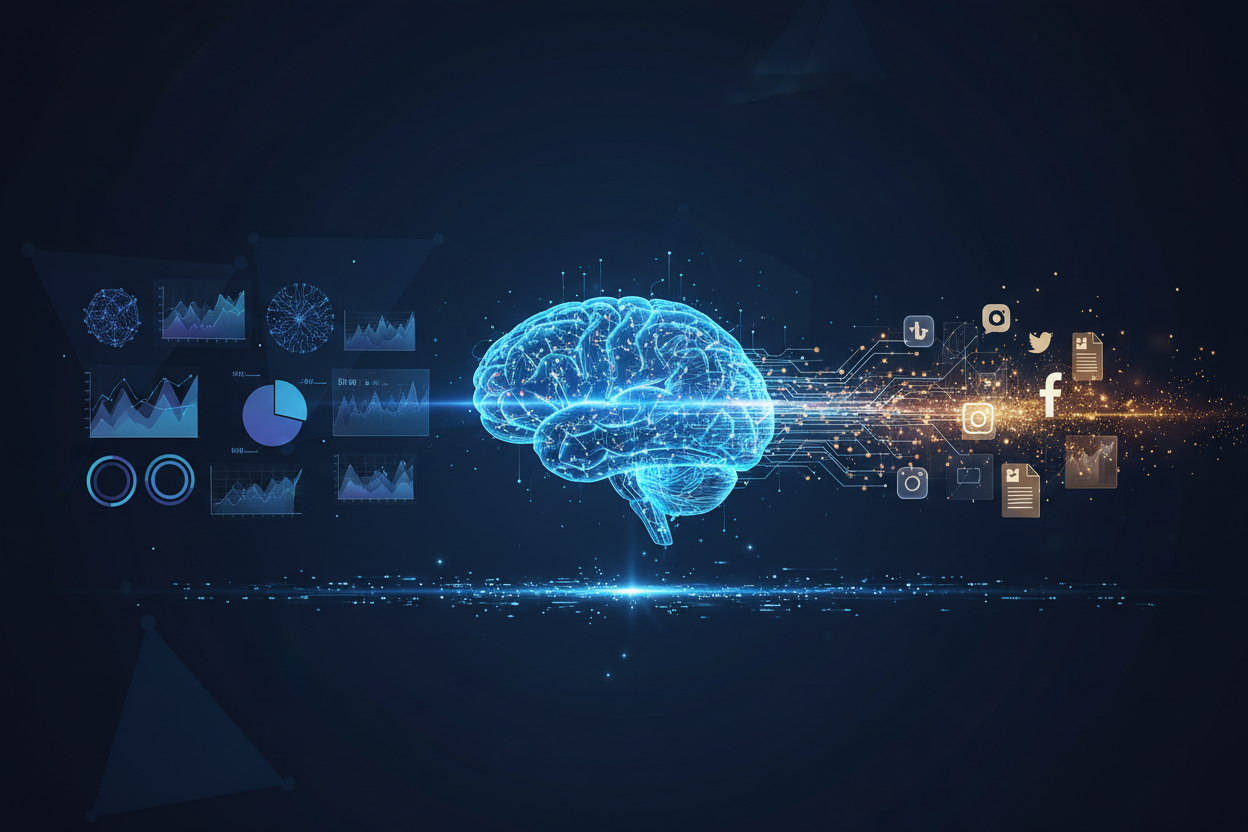
When we talk about AI in content marketing, we’re not referring to some futuristic robot writing your blog posts (although that’s getting closer to reality than you might think). Instead, we’re looking at sophisticated algorithms and machine learning systems that can analyze vast amounts of data, identify patterns, and provide insights that inform smarter content decisions.
AI in content marketing encompasses several key areas: natural language processing for content generation, predictive analytics for audience behavior, automated content curation, and intelligent distribution optimization. These technologies work together to create a more efficient, effective, and personalized content marketing ecosystem.
The beauty of AI lies in its ability to process information at speeds and scales that would be impossible for human marketers. While you might spend hours analyzing competitor content or researching trending topics, AI can accomplish these tasks in minutes, freeing you to focus on strategy and creative execution.
What’s particularly exciting is how AI democratizes advanced marketing capabilities. Small businesses can now access sophisticated audience insights and content optimization tools that were once exclusive to enterprises with massive marketing budgets.
How AI Transforms Content Creation and Strategy
Content creation has traditionally been a time-intensive process requiring significant human resources. AI is changing this dynamic by automating various aspects of content development while maintaining quality and relevance. From generating initial drafts to suggesting improvements, AI tools are becoming invaluable writing companions.
Modern AI writing assistants can help overcome writer’s block by suggesting topics, creating outlines, and even generating first drafts based on specific parameters. These tools analyze successful content in your industry and provide data-driven recommendations for structure, tone, and messaging that resonates with your target audience.
But AI’s impact goes beyond just writing. It’s revolutionizing content strategy by analyzing audience preferences, competitor performance, and market trends to suggest optimal content calendars. Imagine having an assistant that can tell you the best times to publish, which topics are trending in your niche, and what content formats perform best with your specific audience.
Visual content creation is another area where AI shines. Tools can now generate custom graphics, suggest image improvements, and even create video content based on text inputs. This capability is particularly valuable for businesses that need to maintain consistent visual branding across multiple platforms without hiring entire design teams.
Personalization at Scale: AI’s Greatest Gift to Marketers
Here’s where AI truly becomes a game-changer: personalization. We all know that personalized content performs better, but creating unique experiences for thousands or millions of users manually is impossible. AI makes this not only possible but practical and cost-effective.
Advanced AI systems can analyze individual user behavior, preferences, and engagement patterns to create personalized content experiences in real-time. This might mean showing different blog post recommendations to different visitors, customizing email newsletter content based on past interactions, or dynamically adjusting website content based on user demographics and behavior.
The power of AI-driven personalization extends to content recommendations as well. By analyzing user behavior patterns, AI can predict what content a user is most likely to engage with next, creating a more intuitive and satisfying user experience that keeps people coming back for more.
Dynamic content optimization is another fascinating application. AI can test different headlines, images, and calls-to-action in real-time, automatically serving the best-performing variations to maximize engagement and conversion rates. This continuous optimization happens behind the scenes, ensuring your content performance improves constantly without manual intervention.
Content Optimization and Performance Analytics
Understanding how your content performs is crucial for improving your marketing strategy, and AI excels at turning complex data into actionable insights. Traditional analytics might tell you what happened, but AI-powered analytics can tell you why it happened and what you should do next.
AI analytics platforms can identify patterns in your content performance that might not be obvious to human analysts. For example, they might discover that your audience engages more with content published on Tuesday afternoons, or that articles with specific emotional tones perform better during certain seasons.
Predictive analytics takes this a step further by forecasting how new content might perform before you publish it. By analyzing factors like topic relevance, competitive landscape, and historical performance data, AI can provide confidence scores for content success, helping you prioritize your efforts more effectively.
SEO optimization is another area where AI proves invaluable. Modern AI tools can analyze search trends, suggest optimal keywords, and even recommend content structure improvements to boost search engine rankings. They can identify content gaps in your strategy and suggest topics that could capture additional organic traffic.
Overcoming Challenges in AI-Content Marketing Integration
While the benefits of AI in content marketing are compelling, implementing these technologies isn’t without challenges. One of the biggest concerns many marketers face is maintaining authenticity and human connection in an increasingly automated world.
The key to successful AI integration is understanding that AI should enhance human creativity, not replace it. The most effective content marketing strategies combine AI’s analytical capabilities with human insight, emotion, and creativity. AI can provide the data and initial framework, but humans add the soul that makes content truly engaging.
Another challenge is the learning curve associated with new AI tools. Many marketers feel overwhelmed by the technical aspects of AI implementation. The solution is to start small, focus on one or two AI applications initially, and gradually expand as your team becomes more comfortable with the technology.
Data quality is crucial for AI success. Poor quality data leads to poor AI recommendations, so investing in proper data collection and management systems is essential. This might require updating your current tracking and analytics setup, but the long-term benefits far outweigh the initial investment.
Real-World Success Stories and Case Studies
Let’s look at how real companies are successfully leveraging AI in their content marketing strategies. Netflix, for example, uses AI to personalize not just content recommendations but also the artwork and descriptions users see for each show or movie. This personalization has significantly improved user engagement and retention rates.
The Washington Post has implemented AI to generate automated reports for sports, elections, and financial news. While human journalists focus on in-depth analysis and investigative pieces, AI handles routine reporting, allowing the newsroom to cover more stories with the same resources.
HubSpot uses AI to optimize email marketing campaigns, automatically testing subject lines, send times, and content variations to improve open rates and engagement. Their AI-driven approach has led to significant improvements in email performance across their customer base.
Smaller businesses are also seeing success. A local restaurant chain used AI to analyze customer reviews and social media mentions, identifying trending food preferences and adjusting their content strategy to highlight popular menu items and address customer concerns proactively.
Future Trends: What’s Next for AI and Content Marketing
The future of AI and content marketing is incredibly exciting. We’re moving toward more sophisticated natural language generation that can create content virtually indistinguishable from human-written material. Voice and video content generation are becoming more advanced, opening new possibilities for multimedia marketing strategies.
Conversational AI is evolving to handle more complex customer interactions, allowing for more sophisticated chatbot experiences that can provide personalized content recommendations and support throughout the customer journey.
Augmented reality and virtual reality content creation powered by AI is on the horizon, promising immersive marketing experiences that were previously impossible to create cost-effectively.
We’re also seeing the development of AI systems that can understand and respond to emotional context in content, enabling even more nuanced personalization based on user mood and sentiment.
Conclusion: Building Your AI-Enhanced Content Strategy
The synergy between AI and content marketing represents one of the most significant opportunities for businesses to improve their marketing effectiveness while reducing costs and increasing efficiency. The key to success lies not in replacing human creativity with artificial intelligence, but in finding the perfect balance between technological capability and human insight.
As we’ve explored throughout this post, AI excels at data analysis, pattern recognition, and automation, while humans bring creativity, emotional intelligence, and strategic thinking to the table. The most successful content marketing strategies of the future will leverage both strengths.
If you’re ready to start incorporating AI into your content marketing strategy, begin with small, manageable implementations. Choose one area where AI can provide immediate value – perhaps content optimization or audience analysis – and build from there. Remember, the goal isn’t to revolutionize your entire process overnight, but to gradually enhance your capabilities and results.
The future of content marketing is here, and it’s powered by the incredible synergy between artificial intelligence and human creativity. Embrace this partnership, and watch your content marketing efforts reach new heights of effectiveness and efficiency.
Frequently Asked Questions
Q: Will AI replace human content creators?
A: No, AI is designed to enhance and support human creativity, not replace it. While AI can automate certain tasks and provide valuable insights, human creativity, emotional intelligence, and strategic thinking remain irreplaceable in creating truly engaging content.
Q: How much does it cost to implement AI in content marketing?
A: Costs vary widely depending on the tools and scale of implementation. Many AI-powered content marketing tools offer affordable subscription plans starting from $20-50 per month, making them accessible to businesses of all sizes.
Q: What’s the best way to start using AI for content marketing?
A: Start small by implementing one AI tool that addresses a specific need, such as content optimization or social media scheduling. As your team becomes comfortable with the technology, gradually expand to other areas.
Q: Can AI help with content SEO?
A: Absolutely! AI excels at keyword research, content optimization, and identifying SEO opportunities. Many AI tools can analyze search trends, suggest improvements, and help optimize content for better search engine rankings.
Q: How do I ensure AI-generated content maintains my brand voice?
A: Most AI content tools allow you to train them on your existing content and brand guidelines. Additionally, human oversight and editing ensure that AI-generated content aligns with your brand voice and messaging.
Q: Is AI-generated content considered authentic by audiences?
A: When AI is used as a tool to enhance human creativity rather than replace it entirely, the resulting content can be both authentic and engaging. The key is maintaining human oversight and adding personal touches that reflect genuine brand personality.
Content Gorilla AI
Get started for as low as $1…
