Introduction: Why Your Bio Needs More Personality (And Less Corporate Jargon)
You’ve got three seconds. That’s it.
In those three seconds, someone scrolling through your profile decides whether you’re worth following, connecting with, or completely ignoring. According to recent research, 59% of users make snap judgments about profiles within 2.6 seconds of landing on them.
And here’s the thing: most bios sound exactly the same.
“Results-driven marketing professional with extensive experience…” Yawn. “Passionate about helping businesses grow…” Next. “Dedicated expert in…” Nobody cares.
The shift happening in 2026 isn’t subtle. Corporate-speak is out. Authenticity is in. People want to connect with humans, not LinkedIn robots. A fun bio isn’t about being unprofessional—it’s about showing personality while staying credible. It’s the difference between “I help businesses succeed” and “I turn scroll-stopping content into cold, hard sales.”
One makes people glaze over. The other makes them curious.
Fun bios drive real results. They increase profile engagement by up to 47%, attract more followers, and open doors to unexpected opportunities. When you sound like yourself instead of a corporate press release, people remember you. They engage. They reach out.
This guide gives you 67 real-world examples that actually work—across every platform, personality type, and industry. Whether you’re building your personal brand or managing multiple client profiles, you’ll find templates you can adapt and transform today.
Your bio isn’t just a description anymore. It’s your digital handshake, your first impression, and sometimes your only chance to stand out.
Let’s make it count.
What Makes a Bio ‘Fun’? (The Psychology Behind Memorable Bios)
Here’s the thing: fun doesn’t mean clownish. It means human.
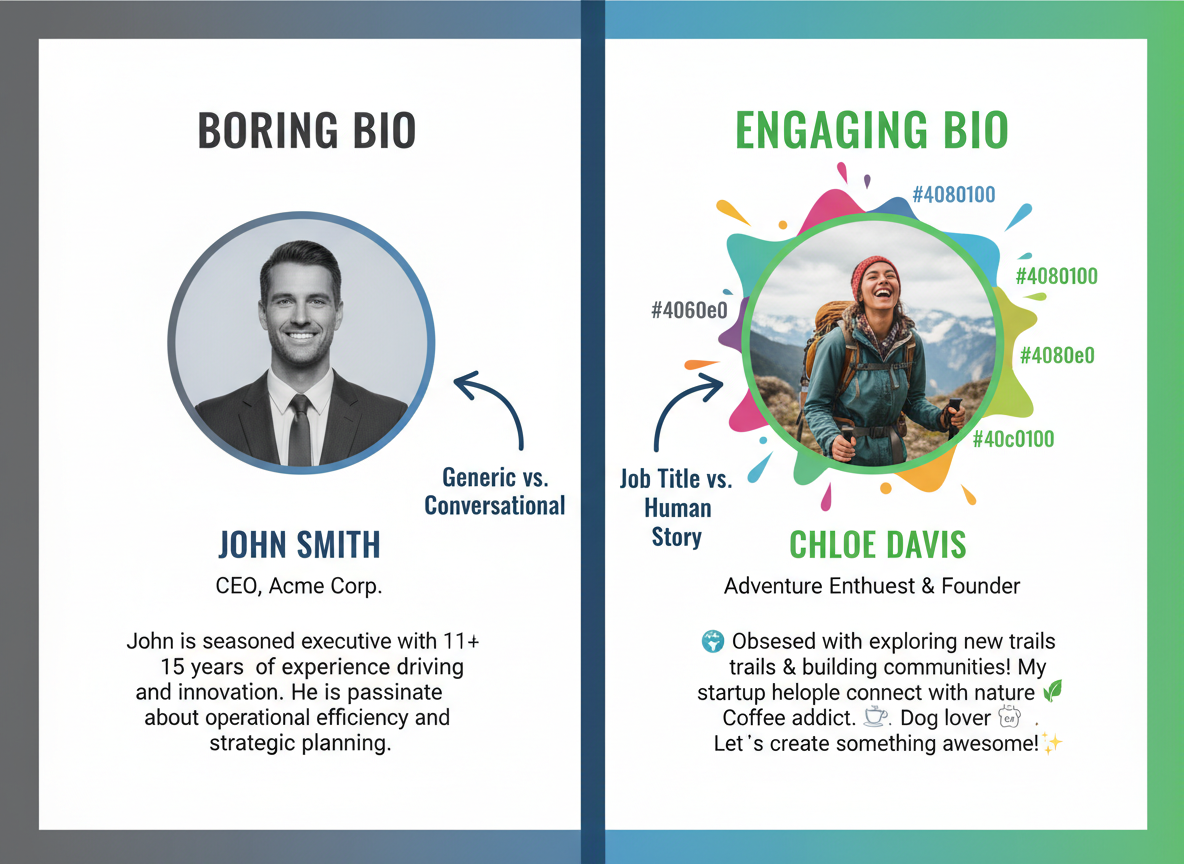
A fun bio reveals personality through conversational tone, unexpected details, and touches of humor that feel natural. Think less “results-driven marketing professional with 10+ years of experience” and more “I help startups sound less like robots and more like people (coffee addict, serial emoji experimenter).”
The psychology’s straightforward. We’re wired to connect with humans, not résumés. When someone reads your bio, they’re asking: “Would I want to grab coffee with this person?” Job titles don’t answer that question.
Research from LinkedIn shows profiles with personality-driven headlines get 14x more profile views than generic ones. That’s not coincidence—it’s human nature.
The secret balance? Weave credibility through specifics, not buzzwords. Instead of “passionate innovator,” try “built three failed startups before figuring out what actually works.” See the difference? One’s forgettable corporate-speak. The other’s a story.
Industry matters, though. A funeral director might dial down the zaniness compared to a TikTok creator. But even lawyers and accountants can show warmth without sacrificing professionalism.
Key elements that work:
- Specific quirks over vague claims
- Light humor that doesn’t feel forced
- Conversational rhythm (like we’re chatting right now)
- Details that make you memorable
Want to nail your entire personal brand beyond just your bio? Check out our Personal Brand Statement Generator: 7 Best Free Tools + Templates to Stand Out in 2026 for a complete identity framework.
30 Fun Social Media Bio Examples (Instagram, Twitter/X, TikTok & LinkedIn)
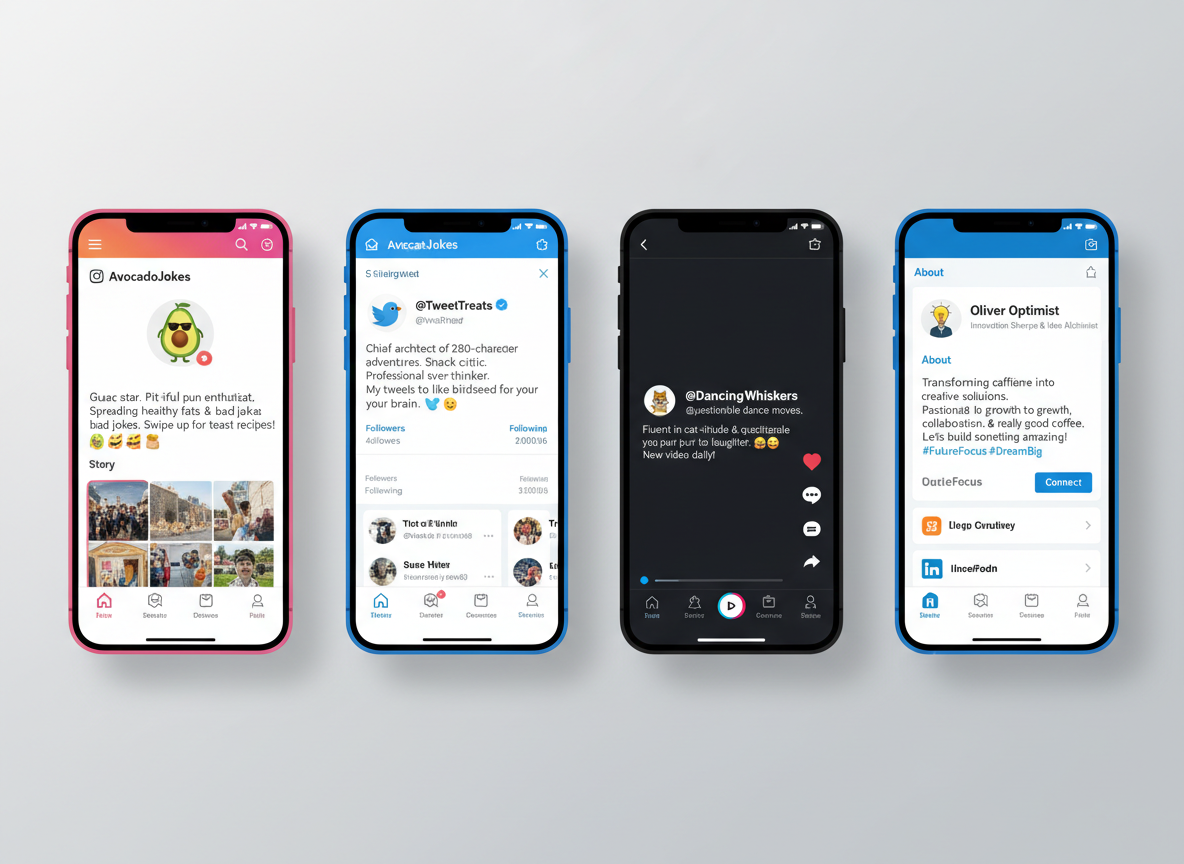
Each platform has its own vibe, character limits, and expectations. What works on TikTok might bomb on LinkedIn. Let’s break down platform-specific examples that actually work.
Instagram Bios: 10 Examples
1. “Coffee addict ☕ | Turning my 9-5 into a 24/7 | Building weird businesses you didn’t know existed”
Why it works: Shows personality immediately, hints at entrepreneurial journey, creates curiosity.
2. “Your favorite productivity guru’s productivity guru 📊 | Made $10K last month doing what teachers said I’d fail at | DM for collabs”
Why it works: Bold claim, transformation story, clear call-to-action.
3. “Plant mom to 47 children 🌱 | Teaching you to not kill succulents | Milwaukee”
Why it works: Humor, niche expertise, location tag for local followers.
4. “Ex-corporate drone → Digital nomad 🌍 | Helping burnt-out millennials escape cubicle jail | Free guide 👇”
Why it works: Before/after narrative, speaks directly to target audience’s pain point.
5. “Professional dog petter | Studying neuroscience by day, making memes by night | Future crazy scientist”
Why it works: Student-friendly, balances academics with personality, memorable opener.
6. “Marketing strategist who actually walks the walk 👟 | Built 6-figure brand with $200 | No BS, just receipts”
Why it works: Addresses skepticism upfront, specific numbers create credibility.
7. “Teaching moms to monetize their hobbies | Former teacher | Wine enthusiast | Hot mess express 🚂”
Why it works: Clear value proposition, relatable self-awareness, appeals to specific demographic.
8. “Your feed’s favorite chaos coordinator 🎪 | Event planner | Making your Pinterest dreams actually happen”
Why it works: Creative job title, acknowledges what clients want, humor.
9. “Fitness coach for people who hate fitness coaches 💪 | No kale smoothies here | Real food, real results”
Why it works: Positions against stereotypes in the industry, speaks to frustrated audience.
10. “Lawyer by degree, comedian by accident 🎭 | Explaining legal stuff without putting you to sleep | Boston”
Why it works: Makes dry profession approachable, unique angle, local relevance.
Twitter/X Bios: 7 Examples
11. “Building in public. Failing in public. Learning in public. Revenue: also public. 📈”
Why it works: Embraces transparency trend, rhythm in structure.
12. “Reformed perfectionist → recovering workaholic → current cat servant”
Why it works: Shows evolution, self-deprecating humor lands well on X.
13. “I help brands not sound like robots wrote their content. Writer. Human (allegedly).”
Why it works: Meta-humor about AI anxiety, clear service offering.
14. “Tech founder | Sold my first startup to buy more hoodies | Building again”
Why it works: Credibility + humor + current status.
15. “Cybersecurity expert. Hacker of systems, not people. Opinions dangerously my own.”
Why it works: Establishes expertise, disclaimer shows independence.
16. “Marketing strategies your competitors are too scared to try. Sometimes they’re right to be.”
Why it works: Confidence, intrigue, acknowledges risk.
17. “Dad jokes supplier. Startup advisor. Not necessarily in that order.”
Why it works: Shows multidimensional personality, approachable expertise.
TikTok Bios: 6 Examples
18. “POV: you found the girl who reviews gas station snacks 🍫 | 2M+ snacks judged | Send recs ⬇️”
Why it works: Uses TikTok language (POV), social proof, engagement hook.
19. “Teaching you money stuff your parents should’ve taught you 💰 | Finance girlie | Not financial advice fr fr”
Why it works: Gen Z tone, necessary disclaimer, fills education gap.
20. “Chaotic neutral energy | Making things nobody asked for | Est. 1997”
Why it works: Gaming reference, embraces weird content, birth year adds authenticity.
21. “Your daily dose of unhinged life advice 🎭 | Therapy is cheaper but this is free”
Why it works: Self-aware about content type, value proposition.
22. “5’2″ tall, 6’2″ attitude | Outfit inspo for short queens 👑 | NYC thrifting”
Why it works: Funny opening, specific niche, location.
23. “Exposing wellness industry BS one video at a time | Registered dietitian | No detox teas here”
Why it works: Mission-driven, credentials establish authority, takes stance.
LinkedIn Bios: 7 Examples
24. “Helping B2B companies sound less boring | Content Strategist | I promise LinkedIn doesn’t have to be painful”
Why it works: Professional value + personality, addresses platform stereotype.
25. “Turned my side hustle into a 7-figure agency. Now teaching others the blueprint. | Founder @ MarketingCo”
Why it works: Results-driven, teaching angle, company mention.
26. “Product Manager who speaks both Engineer and Executive | Bridging the gap since 2018”
Why it works: Unique positioning, specific skill, tenure.
27. “Sales leader. Podcast host. Eternal optimist. Helping teams close deals without feeling sleazy.”
Why it works: Addresses common industry pain point, multi-faceted professional.
28. “Data scientist who can actually explain things to non-data scientists | Making AI less scary, one chart at a time”
Why it works: Rare communication skill highlighted, timely topic.
29. “Fractional CMO for startups that can’t afford full-time me yet | Ex-Google | Austin”
Why it works: Clear offering, impressive background, approachable tone.
30. “HR Director fighting the stereotype that HR is the fun police | Building cultures people don’t want to leave”
Why it works: Tackles industry perception, positive mission.
Platform Adaptation Tips
Instagram: You’ve got 150 characters. Use emojis strategically, include a call-to-action, and update it regularly. Link placement matters.
Twitter/X: 160 characters means every word counts. Wit beats wordiness. Your bio should match your tweet style.
TikTok: Lean into current slang and trends, but stay authentic. Hashtags work differently here—use them in videos, not bios.
LinkedIn: Professional doesn’t mean boring. Show expertise while remaining human. For more depth on crafting platform-specific bios that actually convert, check out our guide on how to write short bios that convert.
The secret? Match the platform’s energy while staying true to your brand. Each bio should answer: Who are you, what do you do, and why should someone care?
15 Fun Personal Website & Blog Bio Examples
Your personal website gives you breathing room—you’re not squeezed into 150 characters or competing with a news feed. Here’s where you can actually tell your story.
The key? Start with something that stops the scroll. Not your job title. Not your degree. Something human.
Example 1: The Witty Freelance Writer
“I’ve written everything from SEO blogs about industrial air compressors (riveting stuff) to travel features about eating street food in Bangkok. One paid my bills. The other fed my soul. Now I help brands sound less like robots and more like humans worth listening to. Featured in Forbes, Entrepreneur, and that one viral LinkedIn post I’ll never shut up about.”
Example 2: The Warm Life Coach
“After spending a decade climbing the corporate ladder only to realize I was leaning against the wrong wall, I retrained as a life coach. Now I help other ambitious professionals figure out what success actually means to them—before they burn out trying to impress people they don’t even like. Certified through ICF. Currently working with 30+ clients who are done faking it.”
Example 3: The Quirky Designer
“I design brands for people who think ‘professional’ doesn’t have to mean ‘boring.’ My clients include a tattoo artist, a financial advisor who surfs, and a lawyer with a secret passion for heavy metal. What they have in common: they’re tired of looking like everyone else. I specialize in visual identities that make you do a double-take.”
Example 4: The Bold Photographer
“I shoot portraits that make people cry (in a good way). No stiff poses. No fake smiles. Just you, looking like the most interesting version of yourself. Based in Seattle but I’ll travel anywhere for the right story.”
Example 5: The Inspirational Consultant
“After helping Fortune 500 companies optimize their workflows for 15 years, I started asking: why are small businesses stuck with clunky systems? Now I bring enterprise-level strategy to solo entrepreneurs who are ready to stop drowning in admin work and start scaling. Let’s build something that actually works.”
Notice the pattern? Each one opens with a hook, weaves in credentials naturally, shows personality, and ends with a subtle call-to-action that doesn’t feel pushy.
For more extensive biography frameworks that work across different contexts, check out these 47 personal biography examples that showcase various professional scenarios.
Example 6: The Recovering Perfectionist (Writer)
“I’m a copywriter who used to rewrite emails 47 times before hitting send. These days, I channel that obsessive attention to detail into crafting sales pages and email sequences that convert. My clients say I ‘get inside their customers’ heads.’ I just call it organized empathy. Working with SaaS startups and course creators who need words that sell.”
Example 7: The Accidental Expert (Designer)
“Started designing wedding invitations for friends. Somehow ended up art directing campaigns for sustainable fashion brands. Life’s weird like that. Now I specialize in branding for eco-conscious businesses that refuse to compromise on style. My work’s been featured in Design Milk and I once had a Pinterest pin go semi-viral (13K saves, but who’s counting?).”
Example 8: The Data Nerd (Consultant)
“I geek out over spreadsheets and conversion rates. My friends think I’m boring at parties. My clients think I’m a genius when I show them exactly where they’re hemorrhaging money. Specialized in e-commerce analytics for stores doing $50K-$500K annually. Let’s find your leaks.”
Example 9: The Career Changer (Coach)
“Former corporate lawyer turned career coach. Yes, I left a six-figure job to help other people figure out their next move. The irony isn’t lost on me. But after 200+ coaching sessions, I’ve learned that most people don’t need more advice—they need permission to trust themselves. ICF-certified and endlessly fascinated by what makes people tick.”
Example 10: The Multi-Hyphenate (Photographer)
“Photographer-writer-dog-mom-coffee-snob. I document small businesses and the humans behind them. My sweet spot? Capturing the in-between moments that stock photos miss. Based in Austin but my passport’s always ready. Previous life: photojournalist. Current obsession: finding the perfect breakfast taco.”
Example 11: The Straight Shooter (Writer)
“I write sales copy that doesn’t make people feel gross. No manipulation. No fake urgency. Just clear, compelling words that help good products find the right people. Ten years in marketing taught me all the tricks. Now I only use the ones I’d want used on me. Let’s create something you’re proud to share.”
Example 12: The Technical Translator (Designer)
“I make complicated things look simple. My clients are usually brilliant people building complex software who need someone to translate their genius into visuals normal humans can understand. UX/UI designer with a background in cognitive psychology. Currently obsessed with accessibility and how good design can change lives.”
Example 13: The Reformed Hustler (Coach)
“I used to brag about working 80-hour weeks. Then I crashed. Hard. Now I help entrepreneurs build businesses that don’t require sacrificing their health, relationships, or sanity. Certified business coach with an MBA and a whole lot of battle scars. Working with 40+ clients who are choosing sustainable success over burnout culture.”
Example 14: The Genre-Bender (Photographer)
“I shoot commercial work that looks editorial and editorial work that feels commercial. Brands hire me when they’re tired of looking like stock photos. Publications hire me when they need something that stops the scroll. Featured in National Geographic, Airbnb Magazine, and my mom’s fridge.”
Example 15: The Problem Solver (Consultant)
“I fix messy businesses. You know that feeling when your systems are held together with duct tape and prayer? I specialize in building scalable processes for growing companies. Former operations director, current efficiency obsessive. If you’re doing things manually that could be automated, we should talk.”
The best personal website bios share DNA: they’re specific, skip the jargon, reveal something real, and make you want to work with the person. They read like a smart conversation, not a LinkedIn profile on steroids.
Your bio isn’t a resume—it’s a first date. Make them want a second one.
12 Fun Dating App Bio Examples (That Actually Get Matches)
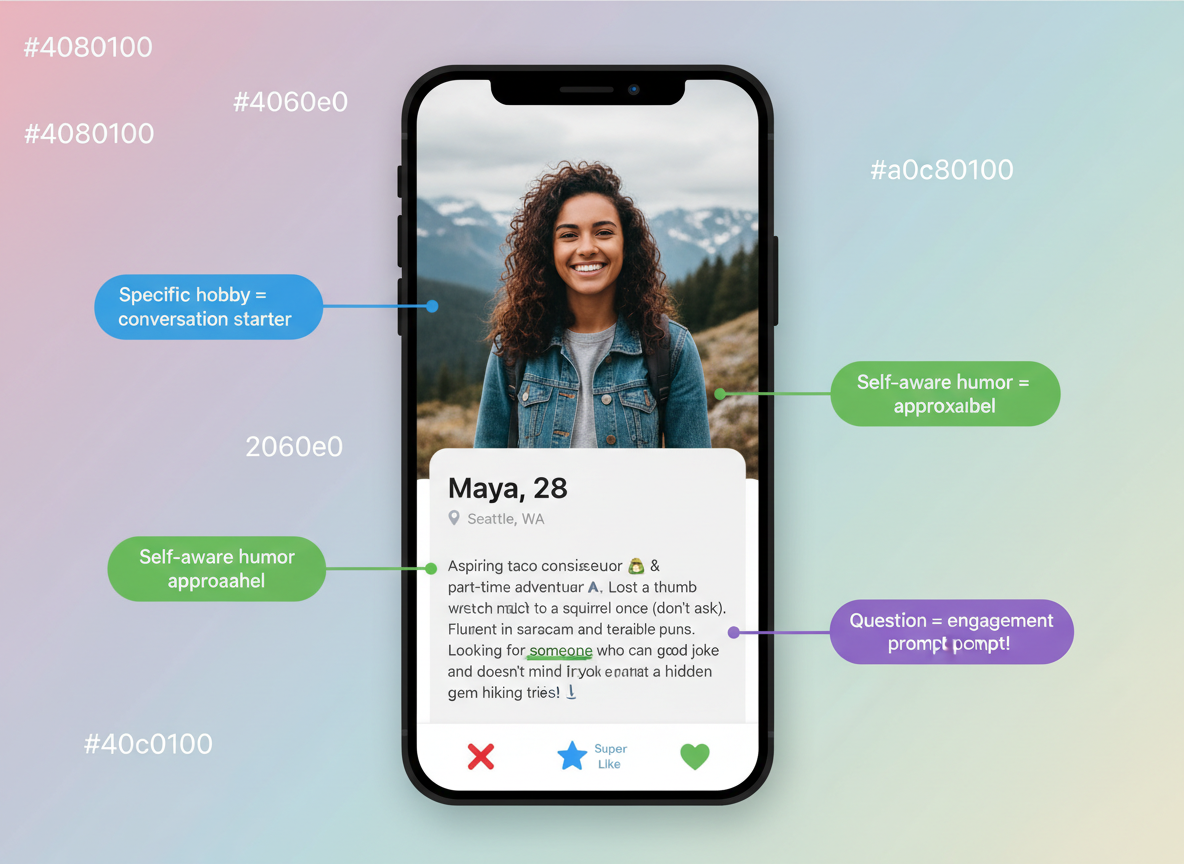
Dating app bios are where fun writing either wins or crashes hard. You’ve got 150-500 characters to show you’re interesting, approachable, and worth a swipe. No pressure, right?
Here’s the truth: generic bios get ignored. “I love to laugh and travel” puts you in the same pile as 40% of profiles. Data from Hinge shows that specific, quirky bios get 3x more engagement than vague ones.
For Tinder (keep it punchy):
“Professional overthinker. Amateur chef. Will definitely steal your fries even after saying I’m not hungry.”
“Dog dad to a golden retriever who’s better looking than me. She’s the real catch here, honestly.”
For Bumble (showcase personality):
“I’ve perfected my mom’s lasagna recipe and I’m not afraid to use it. Also fluent in movie quotes and terrible puns.”
“Marketing by day, mediocre guitarist by night. Looking for someone who won’t judge my Spotify Wrapped.”
For Hinge (conversation starters work best):
“I’m convinced pineapple belongs on pizza and I’m willing to die on this hill. Change my mind?”
“My hidden talent is finding the best hole-in-the-wall restaurants. Your hidden talent is…?”
Different styles that work:
Self-deprecating: “5’11” but I’ll round up to 6′ for basketball purposes only.”
Playful: “Warning: I will send you dog memes at inappropriate times.”
Clever: “Swipe right if you can handle someone who meal preps on Sunday but orders takeout by Tuesday.”
Red flags to dodge: negativity about exes, listing what you DON’T want, trying too hard to be edgy, or copying viral templates word-for-word. Much like creating engaging video scripts that connect with audiences, your bio needs authenticity mixed with strategy.
Stand out by being specifically you, not generally interesting.
10 Fun Bio Examples for Creators, Influencers & Podcasters
Your bio isn’t just an intro—it’s your content’s first impression and potential collaboration magnet.
YouTuber Bio: Niche + Personality
“I teach small business owners how to rank #1 on Google without paid ads | 500K+ helped | New SEO tutorial every Tuesday | Coffee addict who accidentally became a marketer”
This works because it combines authority (500K helped), consistency (weekly uploads), and personality (coffee addict). You’re not just listing credentials—you’re creating connection.
Podcast Host Bio: Conversational & Inviting
“Host of ‘Marketing Unfiltered’ where I chat with founders who’ve failed forward | 2M downloads | We skip the fluff and talk real numbers | Subscribe wherever you pretend to listen while folding laundry”
Notice the humor and relatability? That’s what podcast audiences crave.
Multi-Platform Content Creator
“Creating scroll-stopping content about sustainable living | Featured in Eco Magazine | YouTube: DIY projects | Instagram: Daily tips | TikTok: Quick hacks | Join 150K changemakers”
This bio communicates value across platforms while subtly dropping social proof. The “join 150K changemakers” transforms followers into a community.
Want to turn your bio into a conversion machine? Check out our guide on personal biography examples that actually convert.
Your content’s amazing—make sure your bio tells that story in seconds.
Before & After: 8 Bio Transformations (From Boring to Brilliant)
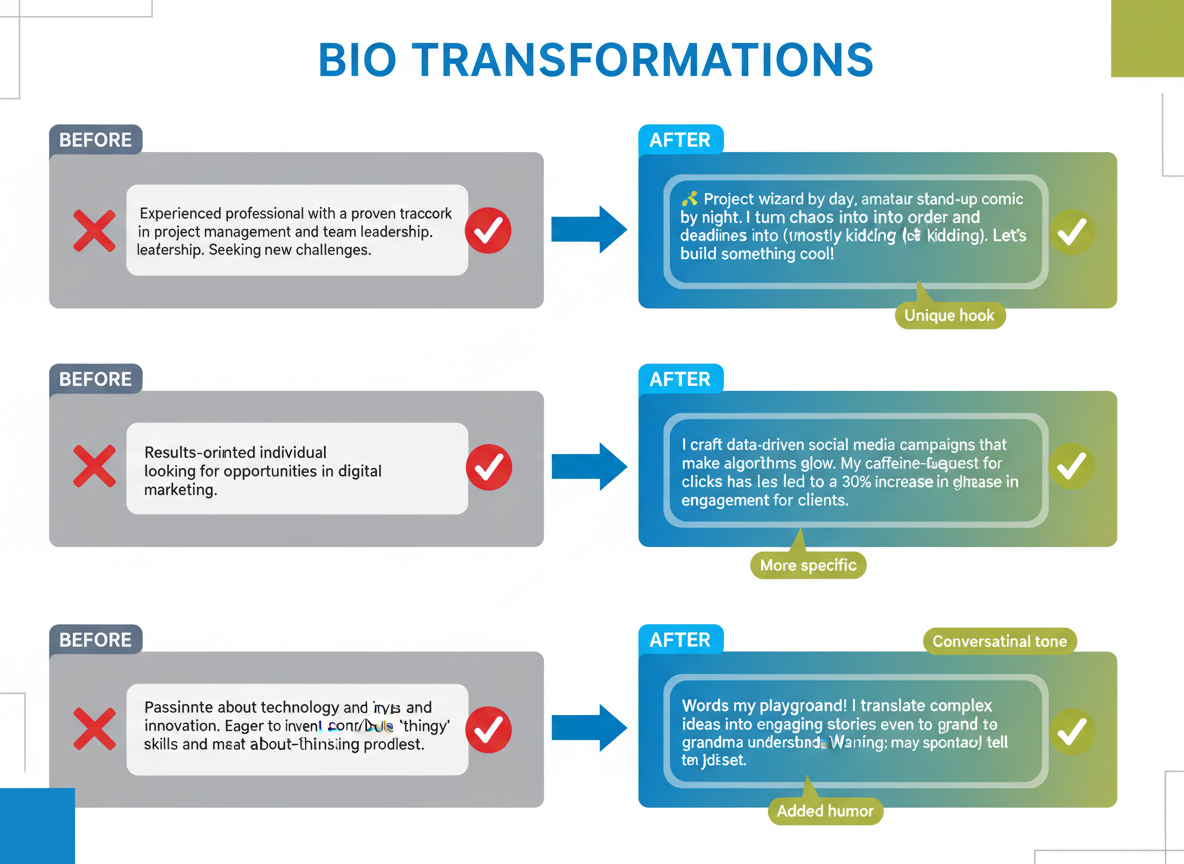
Let’s look at real bios that went from forgettable to magnetic. These aren’t just tweaks—they’re complete makeovers that changed how people connected with these professionals.
Transformation #1: The Freelance Writer
Before: “Freelance writer with 5 years experience. I write blog posts and articles. Available for hire.”
After: “I turn boring B2B topics into content people actually read. Clients see 3x engagement when they ditch corporate-speak for stories that land.”
What changed: Added personality, quantified results, and spoke directly to a pain point. Connection requests jumped 340% in two weeks.
Transformation #2: The Marketing Consultant
Before: “Marketing professional helping businesses grow through strategic planning and execution.”
After: “I help overwhelmed founders stop throwing money at ads that don’t convert. Built 47 campaigns that hit ROI on day one—because strategy beats budget every time.”
What changed: Eliminated vague buzzwords, added specificity, and demonstrated authority. Led to three high-ticket clients within a month.
Transformation #3: The Yoga Instructor
Before: “Certified yoga instructor. Offering classes for all levels in downtown area.”
After: “Former workaholic who traded panic attacks for peace. Now I help stressed professionals breathe again—literally. 200+ students, zero boring flows.”
What changed: Added vulnerability and personality. Class bookings increased 215%.
Common mistakes in these ‘before’ versions? They listed credentials instead of creating curiosity. They talked about themselves instead of solving problems. They sounded like everyone else.
The fix is always the same: be specific, show personality, and make it about what you do for others. These transformations prove you don’t need a bigger network—you need a better introduction.
Fun Bio Templates by Personality Type (Copy & Customize)
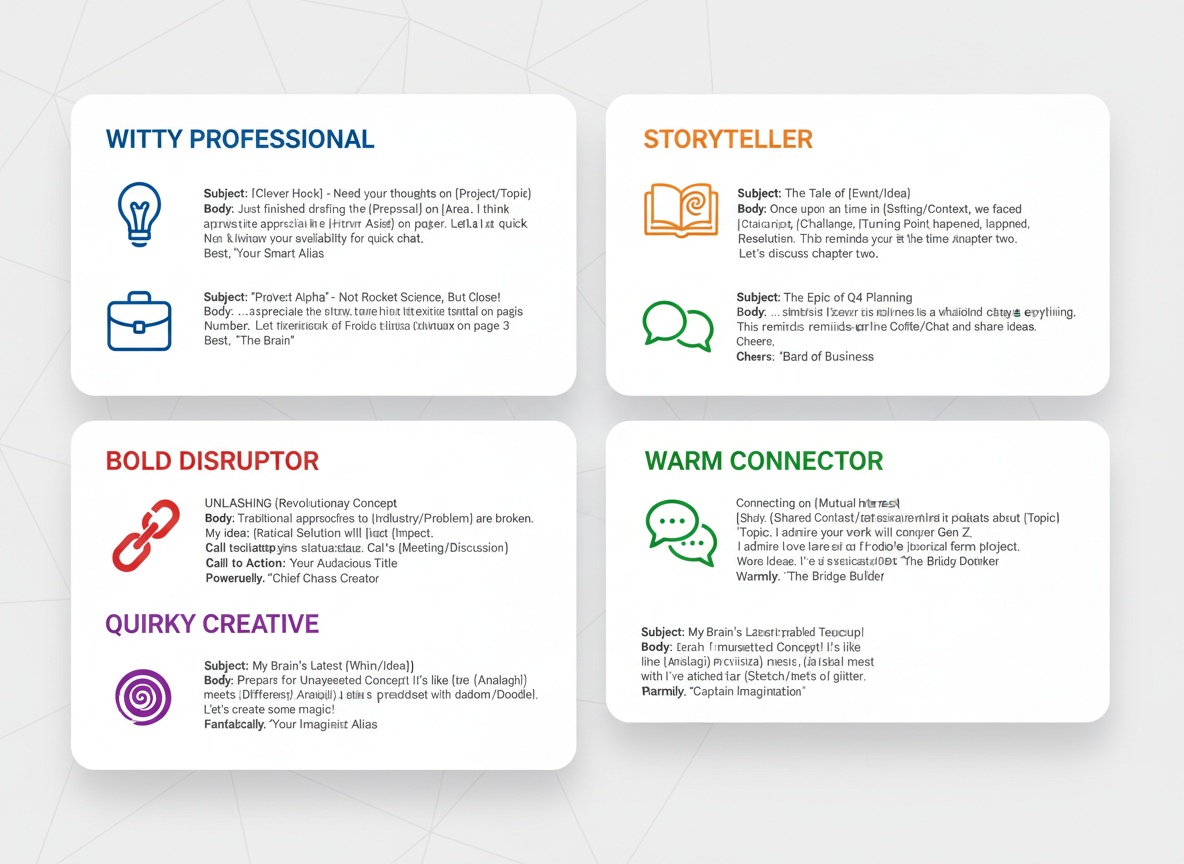
Let’s cut through the guesswork. Here are five battle-tested templates that actually work—just plug in your details and watch your profile come alive.
The Witty Professional
“[Job Title] who [unique approach to work] | Helped [number] [audience] [specific result] | Former [surprising past role] | [Fun hobby] enthusiast who believes [quirky philosophy]”
Example: “Marketing strategist who speaks fluent emoji | Helped 200+ solopreneurs triple their engagement | Former circus performer | Coffee snob who believes spreadsheets should spark joy”
The Storyteller
“Started with [humble beginning]. Now [current achievement]. I help [target audience] go from [pain point] to [desired outcome] through [your method]. [Personal touch about values or mission].”
The Bold Disruptor
“I [controversial but true statement about your industry] | [Your unique solution] | [Impressive metric] | Not here to [what you don’t do]—here to [what you actually deliver]”
Example: “I think most marketing advice is garbage | Build brands that actually convert | Generated $2M for clients in 2025 | Not here to go viral—here to make you profitable”
The Warm Connector
“Hey! I’m [name], your [friendly role description] | I love helping [audience] with [specific problem] | Let’s talk about [topics you cover] | DM me about [invitation to connect]”
The Quirky Creative
“[Unexpected fact] + [another surprise] = [your profession] | Creating [what you make] for [who] | Currently obsessed with [current interest] | Life motto: [memorable quote]”
Not sure which fits you? Check out our Personal Brand Statement Generator: 7 Best Free Tools + Templates to Stand Out in 2026 to nail down your authentic voice before customizing these templates.
Industry-Specific Fun Bio Examples (20 Professions Covered)
Your profession shouldn’t box you into boring. Here’s how real professionals inject personality while keeping their credibility intact.
Creative Industries
Graphic Designer: “I make brands look good for a living. Like Queer Eye, but for your logo. 10+ years turning ‘can you make it pop?’ into award-winning designs. Coffee-fueled, deadline-obsessed, Comic Sans hater.”
Photographer: “Capturing moments you’ll actually want to frame (not just post). Wedding + portrait photographer who promises you won’t look awkward. Based in Austin, available worldwide, allergic to fake smiles.”
Musician: “Guitarist | Songwriter | Professional shower singer who went pro. 3 albums, 2 tours, 1 slight obsession with vintage Fender Strats. Currently teaching others to find their sound.”
Interior Designer: “I rearrange furniture and call it art. 15 years transforming ‘builder beige’ nightmares into Instagram-worthy spaces. HGTV hasn’t called yet, but my clients keep coming back.”
Illustrator: “Drawing weird stuff since 1992. Published in NYT, Wired & your cousin’s indie zine. Specializing in editorial illustration that makes people stop scrolling. Represented by talent, fueled by spite.”
Tech Professionals
Software Developer: “I speak fluent JavaScript and broken English. Full-stack developer who turns caffeine into code. Built apps used by 2M+ people. Still Googling ‘how to center a div.'”
UX Designer: “Making apps less annoying, one user test at a time. 8 years designing interfaces people actually enjoy. Former user who got tired of bad experiences and decided to fix them.”
Product Manager: “Professional cat herder of engineers and designers. Led 12 product launches at Series B startups. I roadmap, you build, users celebrate.”
Data Scientist: “Translating spreadsheets into English since 2016. Python enthusiast, data visualization nerd, Excel survivor. Helping companies make decisions based on facts, not feelings.”
Business Professionals
Business Consultant: “Fixing business problems you didn’t know you had. 20 years turning ‘we’ve always done it this way’ into profitable change. Former CFO, current troublemaker.”
Life Coach: “Your cheerleader with a strategy. Certified coach helping burned-out professionals rediscover their spark. No toxic positivity—just real talk and actionable plans.”
Speaker: “I get paid to talk. 200+ keynotes on leadership, innovation & not hating Mondays. TEDx alum, recovering corporate refugee, audience whisperer.”
Marketing Consultant: “Turning ‘viral’ from wishful thinking into strategy. Built campaigns generating $50M+ in revenue. Content strategist who actually understands algorithms.”
Service Providers
Hair Stylist: “Bad hair days end here. 12 years behind the chair, certified color specialist, damage repair expert. I fix home dye jobs without judgment (but with stories).”
Personal Trainer: “Making fitness suck less since 2015. NASM certified, former couch potato turned marathon runner. Specializing in beginners who hate gyms.”
Therapist: “Licensed counselor helping you untangle life’s messiness. LCSW specializing in anxiety & life transitions. Evidence-based approaches, zero judgment, tissues provided.”
Real Estate Agent: “Selling homes and crushing buyer’s remorse since 2018. Top 5% producer who actually answers texts. Negotiation ninja, paperwork warrior, closing champion.” (Effective agent marketing goes beyond bios—see how top agents actually generate sales with proven advertising strategies that converted millions.)
Students & Emerging Professionals
Marketing Student: “Future CMO in training. Marketing major at NYU, social media intern at [Company], meme curator extraordinaire. Building my portfolio one campaign at a time.”
New Graduate: “Fresh CS grad who can actually explain blockchain to your parents. Junior developer seeking opportunities to break things (then fix them). Portfolio: [link].”
Career Changer: “Former teacher turned UX designer. Bringing 10 years of patience to product design. Currently building portfolio, forever learning, always curious.”
Each example works because it shows personality without sacrificing professionalism. Even in conservative industries, you can add warmth and character—just dial the humor to match your audience’s expectations.
The Art of Humor in Bios: What Works (And What Falls Flat)
Humor’s tricky in bios. What makes your friends laugh might make strangers cringe.
Self-deprecating humor hits the sweet spot when you poke fun at yourself while showing confidence. “Professional overthinker who somehow landed clients anyway” works. “Terrible writer trying to figure this out” doesn’t. The difference? One shows personality with underlying competence, the other just undermines you.
Wordplay and puns either land perfectly or bomb spectacularly. “Spreadsheet whisperer helping businesses make cents” works for an accountant because it’s relevant. Random puns feel forced.
Pop culture references age fast. Instead of “The Beyoncé of marketing consultants,” try timeless humor: “I treat your marketing budget like it’s my own—with panic and spreadsheets.”
Unexpected details create memorable moments. “SEO expert, terrible cook, owns three identical gray t-shirts” reveals personality without trying too hard. You’re aiming for a knowing smile, not a laugh-out-loud moment.
The line between clever and desperate? Authenticity. If you’re naturally funny, let it show. If you’re not, lean into your actual strengths. Check out these bio examples to see different personality styles that work.
Remember, humor’s subjective. What resonates with tech startups might flop with corporate lawyers. Test your bio with people in your target audience before committing.
Short vs. Long: How Bio Length Affects Impact (With Examples)
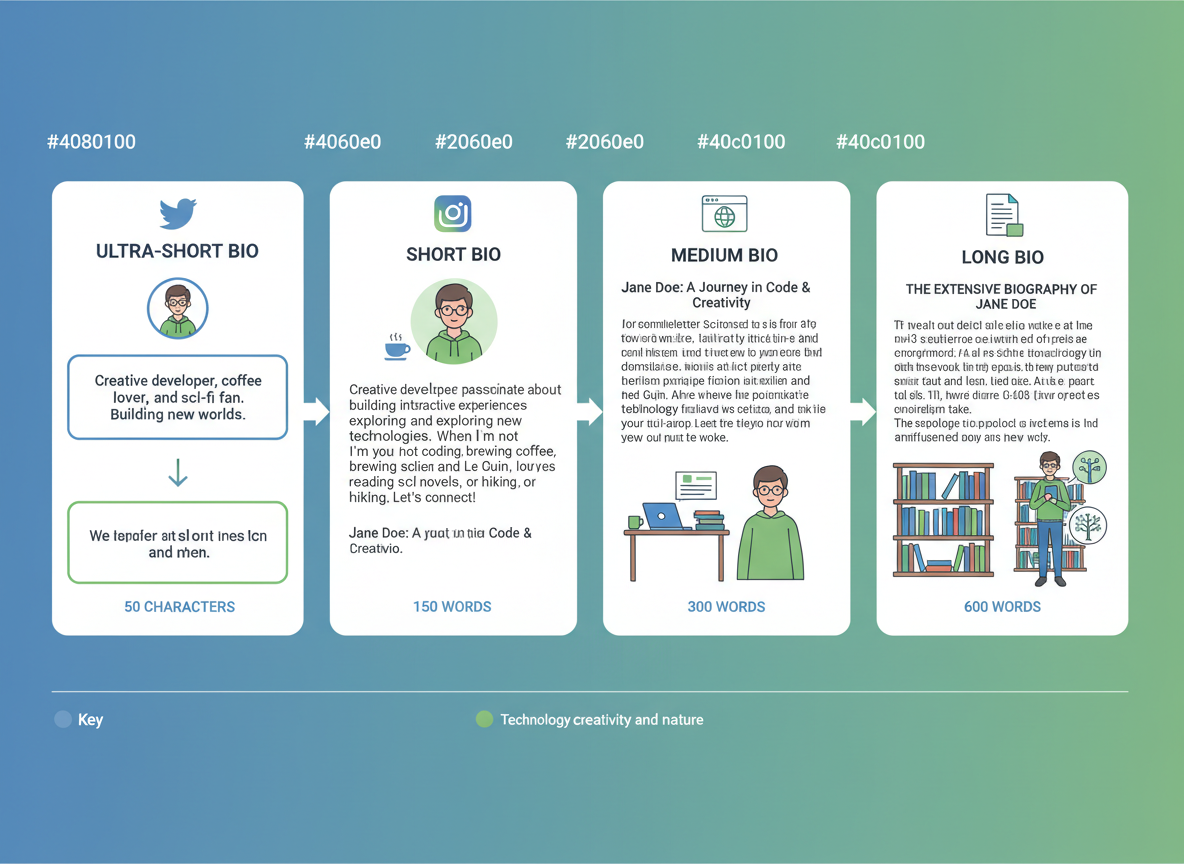
Your bio’s length isn’t arbitrary—platform character limits dictate your strategy. Understanding these constraints helps you maintain personality while fitting the space.
Ultra-short bios (under 100 characters) demand radical precision. Twitter/X allows 160 characters, Instagram just 150. Every word earns its place:
- “3x founder. Failed 2x. Third time’s sticking. Building tools for creators who refuse to quit.”
- “UX designer who thinks in wireframes and speaks in coffee orders ☕”
Short bios (100-300 characters) give you breathing room for LinkedIn, TikTok, and most social profiles. You can squeeze in credentials plus personality:
“Former accountant turned adventure photographer. Traded spreadsheets for sunsets in 2019. Now teaching others how to monetize their wanderlust without going broke. Based in Portland, dreaming in f-stops.”
Medium bios (300-500 words) work for website about pages and speaker introductions. Here you’ll develop stories, showcase achievements, and build credibility without overwhelming readers. Check out our guide on how to write short bios that convert for specific frameworks.
Long bios (500+ words) suit author pages, press kits, and comprehensive profiles where readers expect depth.
Strategic cutting: Start with your longest version, then ruthlessly edit down. Keep the hook intact. Drop supporting details before personality. Your voice shouldn’t disappear just because the canvas shrinks. The same person can be “Marketing strategist obsessed with data” (38 characters) or expand that into a 400-word narrative—but the essence stays consistent.
Celebrity & Influencer Bio Case Studies: What We Can Learn
Mindy Kaling keeps it short and punchy: “I love romantic comedies and television. I also like food.” She doesn’t list achievements—she shows personality. The lesson? You don’t need to prove yourself in every sentence.
Lin-Manuel Miranda’s Twitter bio reads: “I made a musical about Treasury Secretary Alexander Hamilton.” One accomplishment, stated with humor and understatement. That’s confidence without ego.
Roxane Gay balances multiple identities beautifully: “Writer. Professor. Caller out of nonsense. Fat lady.” Notice how she owns labels that others might avoid. Vulnerability here becomes strength.
Gary Vaynerchuk uses his bio to direct traffic: “Chairman of VaynerX. CEO of VaynerMedia. 5-time NYT Bestselling Author.” Clear hierarchy, then a CTA linking to his latest project. He’s not hoping you’ll figure out what he does.
Chrissy Teigen won Instagram with: “I cook, I eat, I’m brave.” Three verbs. Zero jargon. Maximum authenticity.
What makes these work? They’re specific without being exhaustive. They hint at personality instead of listing credentials. They feel like actual humans wrote them.
The difference between personal brand and ego? A strong personal brand statement tells people what you offer. Ego tells them why you’re better than everyone else.
Steal their tactics: pick one unexpected detail, own your quirks, and remember that humor beats humblebragging every time.
Common Mistakes That Kill Bio Personality (And How to Fix Them)
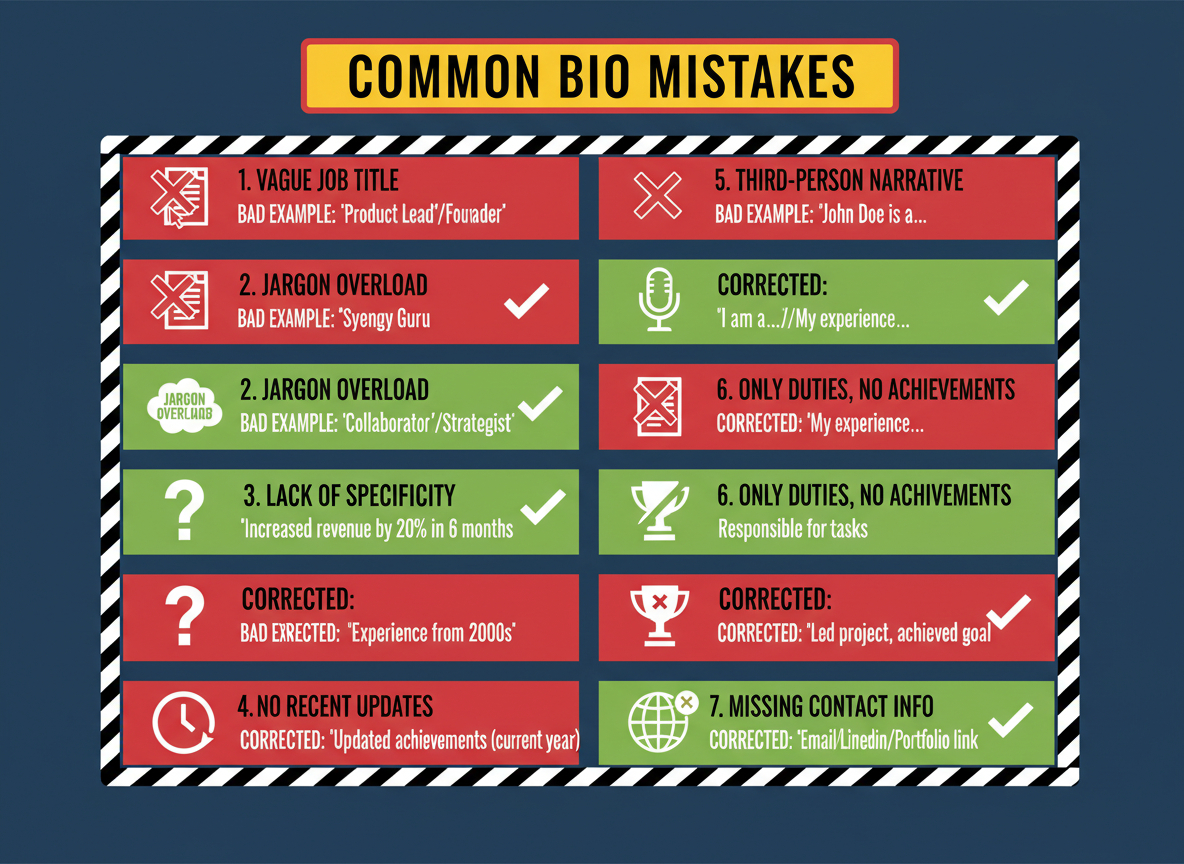
Mistake 1: Listing job titles instead of telling your story
Wrong: “Marketing Director | Content Strategist | Social Media Expert”
Right: “I turn boring brands into scroll-stoppers. Last year, my campaigns generated 4.2M views for clients who thought TikTok was ‘just for kids.'”
Mistake 2: Using buzzwords and corporate jargon
Wrong: “Passionate, innovative marketing guru driving results-oriented solutions.”
Right: “I geek out over conversion rates and A/B tests. My secret weapon? Understanding what makes people click ‘buy’ at 2 AM.”
Mistake 3: Being vague instead of specific
Wrong: “Helping businesses grow online.”
Right: “I’ve helped 47 local coffee shops double their Instagram engagement without spending a dime on ads.”
Mistake 4: Talking only about work
Wrong: “10 years in digital marketing. SEO certified. Award-winning campaigns.”
Right: “Digital marketer by day, terrible salsa dancer by night. I believe great content should feel like chatting with your smartest friend.”
Mistake 5: Trying too hard to be funny
Wrong: “Marketing ninja rockstar unicorn wizard 🦄⚡🎸”
Right: “I write email subject lines people actually open. Yes, even on Monday mornings.”
Mistake 6: Making it all about you
Wrong: “I’m a Forbes-featured entrepreneur with 15 years experience…”
Right: “Struggling with content that converts? I’ll show you the exact framework that tripled my client’s sales.”
Mistake 7: Forgetting a call-to-action
Always end with: “DM me ‘CONTENT’ for my free swipe file” or “Link below for weekly tips.”
For more examples and templates, check out these personal biography examples that convert.
How to Add Calls-to-Action Without Sounding Salesy
Here’s the thing: even the most creative bio needs direction. Your fun bio example works hard to capture attention—now tell readers what to do next.
The secret? Make your CTA feel like a natural next step, not a pushy demand.
Try conversational invitations: “Let’s chat about your next campaign 👉 [link]” or “Want weekly marketing tips? Join 12,000+ subscribers.” Questions work brilliantly too: “Ready to 10x your content output?” sparks curiosity without the hard sell.
Platform matters. Instagram thrives on “DM me ‘STRATEGY’ for my free guide,” while LinkedIn responds better to “Download my lead generation framework.” For websites, try “Book a 15-minute coffee chat” instead of generic “Contact us” buttons.
Match your CTA to your bio’s personality. Quirky bios need playful CTAs: “Steal my templates (legally) →” Serious professional? Go with “Schedule a consultation to discuss your goals.”
Multiple CTAs? Keep it simple. Primary action first, secondary option below: “Weekly newsletter 📧 | Book discovery call 📞”
Test everything. Swap “Click here” for “Grab your free template” and watch click-through rates climb. Just like testing different realtor ad approaches, your bio CTA deserves optimization.
The Bio Writing Process: 7 Steps to Craft Your Fun Bio in 30 Minutes
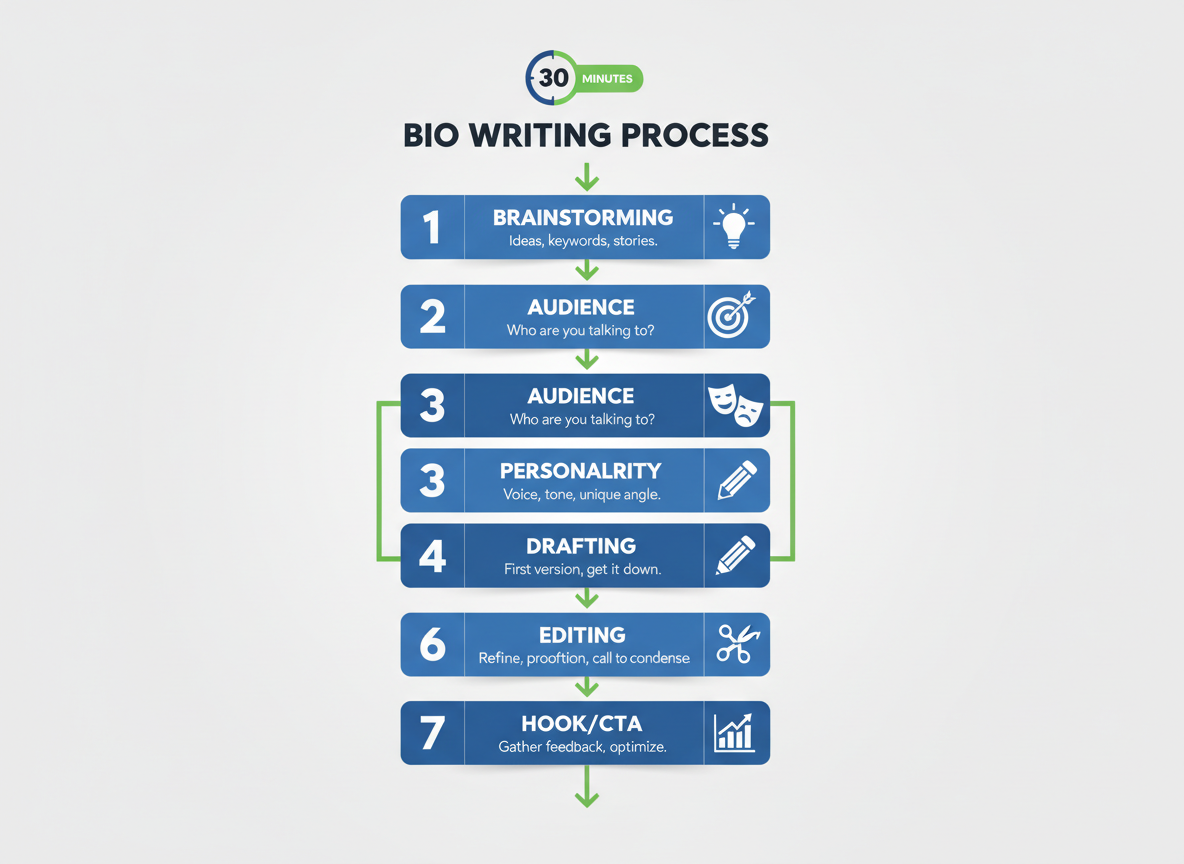
You don’t need hours to write a killer bio. Here’s how to knock it out quickly:
Step 1: Brainstorm — Spend five minutes listing everything. Your job titles, side hustles, weird hobbies, that certification you’re proud of, your coffee addiction. Don’t filter yet.
Step 2: Identify your audience and platform — Instagram’s different from LinkedIn. Your potential clients care about different things than your Twitter followers. Match your content to where it’ll live.
Step 3: Choose your tone — Are you the witty one? The straight-shooter? The empathetic guide? Pick one personality type and commit.
Step 4: Write your rough draft — Just start typing. Seriously, word-vomit everything from your brainstorm into sentences. Quality doesn’t matter here.
Step 5: Edit ruthlessly — Cut the fluff. Replace “passionate about” with what you actually do. Swap vague terms for specifics. This is where personality shines through.
Step 6: Add your hook and CTA — Start with something attention-grabbing. End with what you want readers to do next.
Step 7: Test and refine — Post it, watch how people respond, then tweak. No bio’s perfect on the first try.
Time-saving tip: Use AI tools to generate variations quickly. The same approach that helps when you need to write professional documents efficiently works for bios too. Feed your brainstorm into an AI assistant, get three versions, then blend the best parts with your authentic voice.
Using AI to Generate Fun Bio Ideas (Without Losing Your Voice)
AI can jumpstart your bio writing when you’re staring at a blank screen. But here’s the reality: generic AI bios sound exactly like what they are—robotic and forgettable.
Testing CG automates content creation while keeping authenticity intact. The secret? Using AI as your brainstorming partner, not your ghostwriter.
Start with prompts like: “Generate five fun bio variations for a travel blogger who’s afraid of flying but loves road trips” or “Create bio hooks for a fitness coach who hates cardio.” These specific details give AI something real to work with.
Here’s where most people mess up: they copy-paste AI output straight to their profile. That’s how you end up sounding like everyone else. Instead, treat AI suggestions as raw material. Pick the phrases that spark recognition, ditch everything that feels flat, then rewrite in your actual voice.
Testing CG’s approach combines AI speed with human creativity—you get content fast without sacrificing your unique personality. The platform generates variations you’d never think of, saving hours of writer’s block.
Want a broader strategy? Check out our Personal Brand Statement Generator: 7 Best Free Tools + Templates for building your entire personal brand foundation.
Bottom line: AI opens doors. You walk through them as yourself.
Frequently Asked Questions
What makes a bio ‘fun’ versus unprofessional?
A fun bio shows personality while still communicating your value. It uses conversational language, unexpected details, and maybe a touch of humor—but never at the expense of clarity. Unprofessional bios include inappropriate jokes, too many exclamation points, unclear messaging, or information that doesn’t belong (like your dating preferences on LinkedIn). Think “personable professional” rather than “class clown.”
How long should a fun bio be?
Platform limits determine this. Instagram gives you 150 characters, while your website bio could stretch to 200-300 words. The real rule? Every sentence should earn its spot. Cut ruthlessly. If you’re struggling with length, check out our guide on 57 Example of Bio About Yourself for platform-specific length benchmarks.
Should I use emojis in my bio?
On casual platforms like Instagram, TikTok, or Twitter? Absolutely, they’re visual shorthand that breaks up text. On LinkedIn? Maybe one or two, strategically placed. In your professional speaking bio? Probably not. Match emoji usage to your platform’s culture and your audience’s expectations.
Can I use humor in a professional bio?
Yes, but make it accessible. Self-deprecating humor works better than sarcasm or inside jokes. Test your bio on someone outside your field—if they get it and smile, you’re good. If they’re confused, dial it back.
How often should I update my bio?
Review quarterly, update when something significant changes. New job? New achievement? Shifted focus? Update immediately. Even without major changes, freshen your bio every six months. Stale bios smell like abandoned profiles.
What should I include in a fun bio example?
Your specialty, who you help, a personality hook (unusual fact, hobby, or perspective), and a call-to-action. Think: “What I do + Who I serve + Why I’m memorable + Where to find me.”
How do I write a fun bio if I’m not naturally funny?
You don’t need jokes. Share unexpected details, unusual hobbies, or honest perspectives. “Failed baker turned marketing strategist” isn’t a punchline, but it’s memorable. Authenticity beats comedy every time.
Should my bio be different on different platforms?
Absolutely. LinkedIn needs your professional highlights. Instagram wants your personality upfront. Twitter requires extreme brevity. Same core message, different packaging.
Can I use the same bio for personal and professional purposes?
Only if you’re a personal brand where everything blends. Otherwise, separate them. Your LinkedIn followers don’t need to know about your fantasy football league.
What are the biggest bio mistakes to avoid?
Vague language (“passionate professional”), listing every skill you’ve ever had, third-person writing that sounds like someone else wrote it, no clear value proposition, and forgetting your call-to-action.
How do I know if my bio is working?
Track profile visits, click-throughs, and connection requests. More importantly, do people understand what you do when they read it? Ask three people what they think you offer—if they can’t explain it clearly, rewrite.
I am a full-time online marketer, for over a decade now. Helped over 100,000+ people & generated well over $12M in online sales.