Why Your Personal Biography Is Costing You Opportunities Right Now
Here’s something that’ll make you uncomfortable: 87% of professionals are walking around with outdated or ineffective bios that actively cost them opportunities.
Think about it. When’s the last time you actually updated yours?
If you’re like most people, your bio is either a cobbled-together afterthought from three jobs ago, or it’s so generic it could belong to anyone in your field. “Passionate professional with extensive experience…” Sound familiar? That’s the biography equivalent of wearing a beige suit to a networking event and wondering why nobody remembers you.
Here’s the brutal truth: writing about yourself is harder than writing for clients. You get stuck between sounding too humble and feeling like a shameless self-promoter. So you split the difference and end up with something that says nothing at all.
But in 2026, the stakes have changed dramatically. AI systems are now reading your bio before humans even see it. Google’s E-E-A-T framework (Experience, Expertise, Authoritativeness, Trustworthiness) isn’t just evaluating your content—it’s evaluating your credibility through your bio. LinkedIn algorithms, job application scanners, speaking engagement committees, they’re all making split-second decisions based on those few paragraphs.
That’s why I’ve compiled 47 real personal biography examples that actually work—for job applications, speaking gigs, LinkedIn profiles, author pages, even dating apps. Each one optimized for both human readers and the algorithms deciding your fate. If you’re also working on your overall positioning, check out our personal brand statement generator guide for additional tools.
Let’s fix your bio before it costs you the next big opportunity.
What Makes a Personal Biography Actually Work in 2026
Let’s clear something up: a personal bio isn’t the same as an author bio or professional bio. Your author bio sits on book jackets and Amazon pages. Your professional bio lives on LinkedIn and company websites. But your personal bio? That’s what shows up everywhere else—your social profiles, speaker pages, podcast interviews, and anywhere someone’s deciding whether to trust you.
Here’s what separates bios that convert from those that get skimmed over:
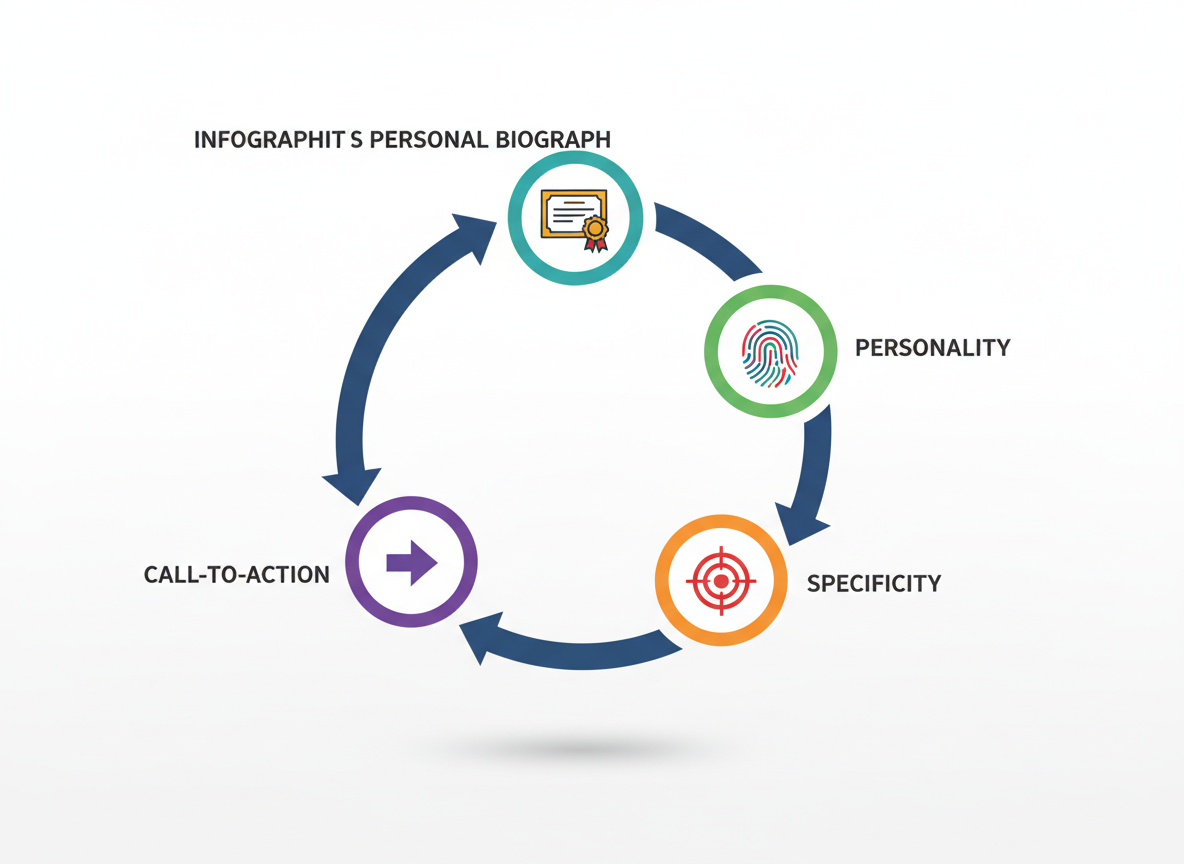
The 4 Non-Negotiables
Every bio that actually works includes credibility markers (your expertise), personality (you’re human, not a robot), specificity (concrete details beat vague claims), and a clear call-to-action (what happens next).
Search engines and AI systems now evaluate bios through E-E-A-T signals—Experience, Expertise, Authoritativeness, and Trustworthiness. Generic statements about being “passionate” don’t cut it anymore.
Why Specificity Wins
Data shows bios with specific achievements get 3x more engagement than generic ones. “Helped 200+ clients increase conversion rates” beats “experienced marketing consultant” every time.
The fatal mistake? Writing for yourself instead of your audience. Your bio isn’t about impressing yourself—it’s about answering one question: “Why should this person care about me?” When you shift that perspective, everything changes.
First-Person vs Third-Person: When to Use Each (With Examples)
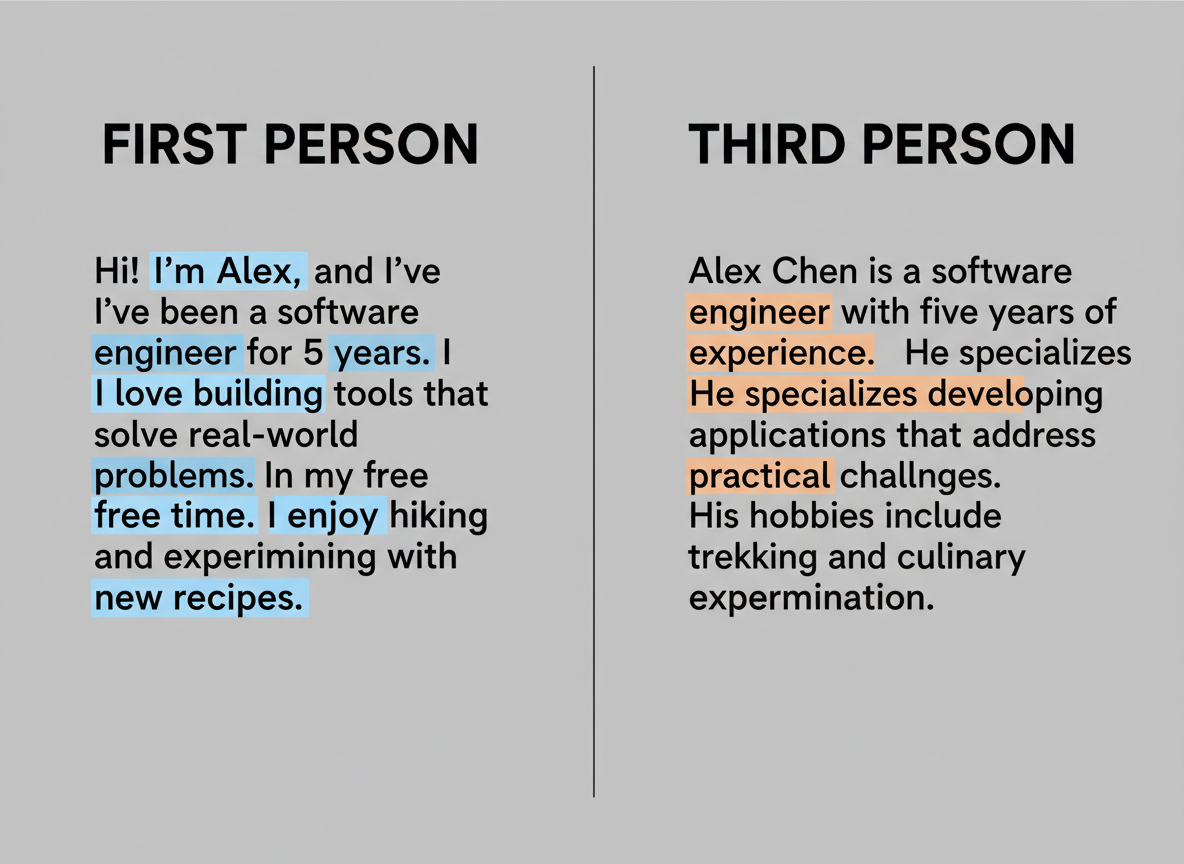
Choosing between first-person (“I help”) and third-person (“Sarah helps”) isn’t just grammar—it’s strategy. The wrong choice can make you seem either unprofessional or strangely distant.
First-person works best when you’re building personal connection. Use it on LinkedIn, your personal website, Instagram bios, and anywhere you’re speaking directly to someone who wants to know you. It feels authentic and approachable.
Example: “I’m a conversion copywriter who’s turned bland product pages into six-figure revenue streams for 47+ e-commerce brands. When I’m not obsessing over A/B test results, you’ll find me teaching my dog questionable tricks.”
Third-person is non-negotiable for formal settings. Conference speaker bios, media kits, professional directories, and corporate team pages require third-person. It signals credibility and lets others promote you easily.
Example: “Maria Chen is a conversion copywriter who’s generated over $12M in revenue for e-commerce clients. She’s spoken at Content Marketing World and been featured in Forbes and Entrepreneur.”
Notice how the same person sounds approachable in first-person but authoritative in third? That’s intentional. The biggest mistake? Using first-person in speaker bios (makes event organizers rewrite it) or third-person on social media (sounds weirdly detached). Match your voice to the platform’s expectations, and you’ll never sound out of place.
Personal Biography Length Guide: Platform-Specific Word Counts
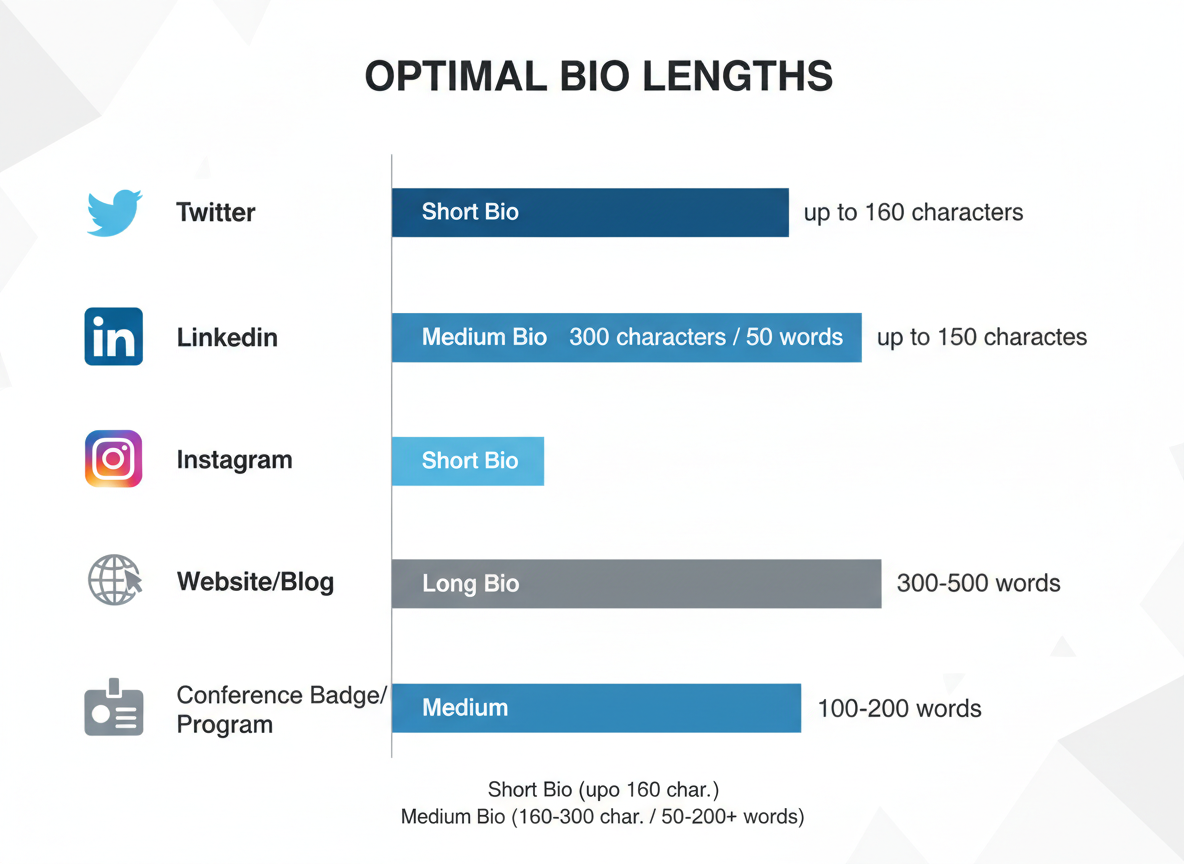
Getting your bio length right makes the difference between getting read and getting scrolled past. Here’s what works for each platform in 2026:
Twitter/X limits you to 160 characters. Make every word earn its spot. Example: “Content strategist helping B2B brands convert 2x faster | Featured in Forbes & Inc. | Building get.contentgorilla.co”
LinkedIn summaries perform best at 200-300 words. You’ve got room to tell a compelling story while staying scannable. Lead with results, not job titles.
Instagram bios cap at 150 characters. Think of it as your elevator pitch with personality. “Marketing coach 🚀 Turned $0 → $100K in 18 months | Helping creators monetize | DM ‘START’ for free guide”
Speaker bios for conferences need 75-100 words. Highlight your expertise, notable achievements, and why you’re qualified to speak on your topic.
Website About pages shine at 300-500 words. This is where you can actually connect with readers, share your journey, and explain why you do what you do.
Professional directories typically require 50-75 words—just the essentials.
Here’s your quick reference for 12+ platforms:
| Platform | Ideal Length |
|———-|————–|
| Twitter/X | 160 characters |
| Instagram | 150 characters |
| LinkedIn | 200-300 words |
| Conference speaker | 75-100 words |
| Website About page | 300-500 words |
| Professional directories | 50-75 words |
| Email signature | 25-50 words |
| Podcast guest | 100-150 words |
| Press releases | 50-100 words |
| Medium profile | 160 characters |
| Author bio (articles) | 40-60 words |
| YouTube About section | 200-300 words |
15 Personal Biography Examples for Job Seekers (Entry to Executive Level)
Your bio can make or break your chances of landing that next opportunity. Let’s break down what actually works across different career stages, with real examples you can adapt.
Entry-Level Professional Bio Examples
Example 1: Marketing Assistant
“Sarah Chen graduated from UCLA with a degree in Digital Marketing and a minor in Psychology. During her internship at BrightWave Media, she increased social media engagement by 34% through targeted content strategies. She’s passionate about understanding what makes audiences click, share, and convert. When she’s not analyzing campaign metrics, you’ll find her experimenting with new content formats on her own growing Instagram community of 12K followers.”
Example 2: Junior Software Developer
“Alex Rodriguez builds clean, efficient code that solves real problems. Fresh out of Dev Academy’s intensive bootcamp, he’s already contributed to three open-source projects with over 500 combined stars on GitHub. His capstone project—a budgeting app for freelancers—attracted 1,200 users in its first month. Outside of coding, Alex mentors aspiring developers through free weekend workshops.”
What makes these work: They lead with accomplishments, not just credentials. Notice the specific metrics (34%, 12K, 1,200 users) that prove impact.
Mid-Career Professional Transitioning Roles
Example 1: Teacher to Corporate Trainer
“For eight years, Jamie Peterson mastered the art of making complex topics stick with high school students. Now, she’s bringing that same skill to corporate learning environments. As a curriculum designer at TechFlow Solutions, she’s developed training programs that reduced onboarding time by 40% while increasing retention scores by 28%. Her secret? The same storytelling techniques that kept teenagers engaged now keep executives paying attention.”
Example 2: Sales to Customer Success
“Mike Thompson spent six years closing deals as a top-performing sales rep (President’s Club, 2023-2025). But he noticed something: his best clients weren’t just buying—they were succeeding. That’s why he transitioned to Customer Success, where he now helps SaaS clients maximize their ROI. In his first year, he reduced churn by 22% and identified $340K in upsell opportunities by actually listening to what clients needed.”
What makes these work: They acknowledge the transition directly and connect the dots between past experience and new direction. The before-and-after narrative creates trust.
Senior Manager/Director Level
Example 1: Marketing Director
“Priya Sharma doesn’t just run campaigns—she builds revenue engines. As Marketing Director at CloudSync, she scaled their demand generation program from $2M to $12M in annual pipeline over three years. Her integrated approach combines data-driven targeting with brand storytelling that resonates. She’s led teams of 15+ across content, paid media, and marketing ops, with a track record of promoting 8 team members into leadership roles. Priya speaks regularly at MarketingProfs events and has been featured in CMO Magazine.”
Example 2: Engineering Director
“David Park leads engineering teams that ship on time and under budget—without burning out. Over the past decade, he’s scaled technical organizations from 5 to 50+ engineers at two fast-growing startups. At DataCore, his team reduced deployment time from weeks to hours through smart automation and DevOps practices. He’s known for building cultures where engineers stay (average tenure: 4+ years) and grow into senior roles. David holds 3 patents in distributed systems and advises two YC-backed startups.”
What makes these work: Leadership impact goes beyond personal achievement. They highlight team development, culture building, and strategic thinking.
Executive/C-Suite Biography
Example 1: VP of Product
“Lisa Rodriguez has spent 15 years turning user insights into products people love. As VP of Product at FinTechNow, she led the development of their mobile banking platform, which grew from zero to 2.3M active users in 18 months. Before that, she was Director of Product at PaymentPros, where her team’s checkout optimization increased conversion by 67%, adding $45M in annual revenue. Lisa combines deep technical knowledge (she started as an engineer) with an obsession for user experience. She’s a mentor in the Reforge Product Leadership program and speaks at Mind the Product conferences worldwide.”
Example 2: Chief Marketing Officer
“Tom Bradley builds brands that break through noise. As CMO of GrowthLabs, he repositioned the company from commodity service provider to premium partner, resulting in a 3x increase in average deal size and 89% year-over-year revenue growth. His career spans B2B and B2C environments, from startup chaos to enterprise scale. Tom’s marketing philosophy is simple: if you’re not making customers successful, you’re just making noise. Under his leadership, GrowthLabs earned spots on the Inc. 5000 list for three consecutive years. He’s published in Harvard Business Review and Forbes.”
What makes these work: Executive bios show business impact in dollars and percentages. They position the person as a thought leader with external validation.
Career Changer Highlighting Transferable Skills
Example 1: Attorney to UX Designer
“Rachel Kim spent five years as a litigation attorney, where she learned that winning cases wasn’t about fancy arguments—it was about understanding what judges and juries actually needed to hear. That insight drove her career change into UX design. After completing a UX certification from General Assembly, she now applies the same user-first thinking to digital products. At DesignHub, her redesign of the client onboarding flow reduced drop-off by 41%. Her legal background gives her a unique edge in fintech and legaltech projects.”
Example 2: Restaurant Manager to Operations Manager
“For 12 years, Jordan Matthews ran high-volume restaurants where chaos was the baseline and excellence was the expectation. Managing teams of 30+, coordinating complex logistics, and solving problems in real-time became second nature. Now, as Operations Manager at LogisticsFirst, he brings that same calm-under-pressure mindset to supply chain management. In his first year, he streamlined warehouse operations to reduce fulfillment time by 35% and cut overhead costs by $127K. Turns out, managing dinner rush and managing distribution aren’t that different.”
What makes these work: They own the career change and reframe previous experience as an advantage, not a liability.
Recent Graduate with Limited Experience
Example 1: Communications Graduate
“Emma Sullivan might be fresh out of Boston University, but she’s been creating content that connects for years. Her college blog about sustainable fashion attracted 50K monthly readers and landed partnerships with three eco-friendly brands. As a communications intern at GreenTech Alliance, she wrote the company’s most-shared LinkedIn post (18K engagements) and helped launch their podcast, which hit 10K downloads in three months. She’s ready to bring that same creative energy and digital-native perspective to a full-time role.”
Example 2: Business Graduate
“Carlos Mendez graduated from UT Austin’s business program with more than a degree. He co-founded a campus consulting group that helped 12 local businesses improve their digital presence, generating $87K in combined revenue for clients. His senior capstone project on Gen Z consumer behavior was selected for presentation at the National Business Conference. Carlos combines analytical thinking with hands-on execution—he doesn’t just study business, he does business.”
What makes these work: They focus on what you’ve accomplished, not what you lack. Passion projects and college achievements count when presented with confidence.
Returning to Workforce After Gap
Example 1: Parent Returning to Marketing
“After a five-year career break to raise her children, Amanda Foster is back in the marketing world with fresh eyes and sharp skills. During her time away, she didn’t just change diapers—she ran social media for her local PTA, growing their Facebook community from 200 to 3,500 engaged members. She also completed Google Analytics and HubSpot certifications to stay current. Before her break, Amanda was a Marketing Manager at TechBrand, where she managed campaigns generating $8M in pipeline. She’s now looking to combine her strategic experience with her newly honed community-building skills.”
Example 2: Career Break for Family Care
“Jason Park took three years off to care for his aging parents, but he kept his project management skills sharp. He volunteered as coordinator for a nonprofit building project, managing timelines, budgets, and a team of 25 volunteers to complete a community center renovation 10% under budget. Before his break, he was a Senior Project Manager at BuildRight Construction, delivering 15+ commercial projects totaling $34M. Jason’s ready to bring that proven track record back to the workplace, with added perspective on what really matters.”
What makes these work: They address the gap directly without apologizing. They show continued growth and reframe the break as adding value, not creating deficiency.
Before-and-After Bio Transformation
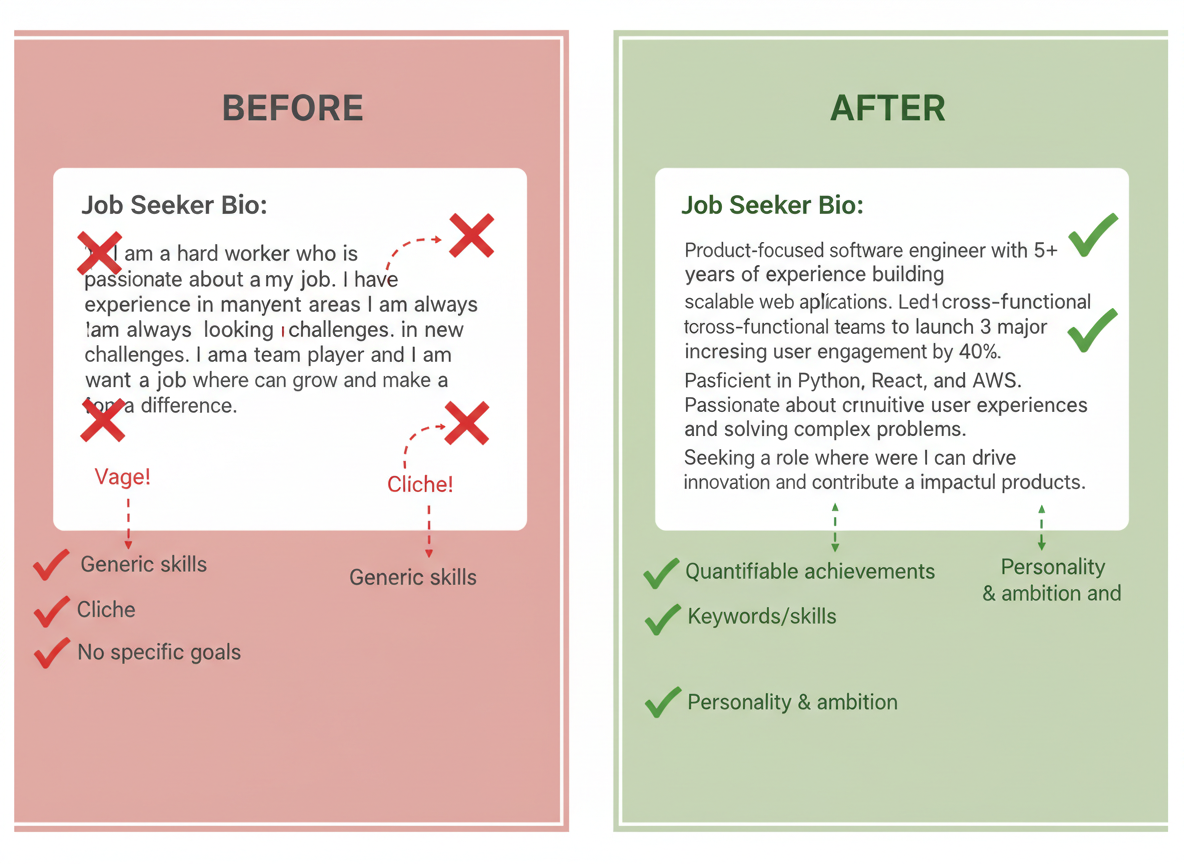
Before (Weak Bio):
“I’m a marketing professional with experience in various industries. I’ve worked on social media, email campaigns, and content creation. I’m a hard worker who’s passionate about marketing and always looking to learn new things. I graduated from State University and have been working in the field for about five years.”
After (Strong Bio):
“Christina Moore turns lukewarm audiences into raving fans. As Marketing Manager at SaaS Solutions, she transformed their email program from 8% to 23% open rates and drove $420K in revenue through segmented nurture campaigns. Over five years, she’s built content strategies for B2B tech companies that actually get read—her blog posts average 4+ minutes of engagement. Christina believes the best marketing doesn’t feel like marketing at all, and her work proves it.”
What changed: The “after” version leads with impact, uses specific numbers, shows personality, and makes a memorable claim. It’s not about being passionate (everyone claims that)—it’s about proving you deliver results.
Looking for more bio inspiration across different platforms? Check out these 57 example of bio about yourself that work everywhere from LinkedIn to speaking engagements.
Your bio isn’t just a summary—it’s your opening pitch. Make every word count.
12 Entrepreneur & Business Owner Biography Examples
Solopreneur/Freelancer Bio Emphasizing Expertise
Example 1:
“I’m Sarah Chen, a conversion copywriter who’s helped 200+ SaaS companies turn their landing pages into revenue machines. After spending five years at a marketing agency watching businesses struggle with messaging, I went solo in 2021. Now I specialize in turning technical features into benefits that actually resonate with buyers. My clients typically see 30-40% lift in conversions within the first quarter—because good copy isn’t about being clever, it’s about being clear.”
Example 2:
“James Rodriguez here. I build custom WordPress solutions for businesses that have outgrown their cookie-cutter templates. Started coding at 14, worked at three agencies, and finally launched my own shop in 2019. I’ve delivered 150+ projects ranging from membership sites to multi-vendor marketplaces. My superpower? Translating ‘I have this idea’ into ‘Here’s your functioning website.’ I don’t do everything—just WordPress, done right.”
Small Business Owner Establishing Credibility
Example 1:
“Maria Santos founded Bright Path Accounting in 2018 after watching too many small businesses fail because of messy books. She’s a CPA with 12 years of experience, but she talks like a human, not a tax code. Her firm serves 85 local businesses—from coffee shops to consulting agencies—keeping them compliant and profitable. Maria’s been featured in Entrepreneur Magazine and speaks quarterly at the Chamber of Commerce about financial literacy.”
Example 2:
“Kevin Thompson runs Thompson Fitness, a gym that’s kept 92% of its members for over two years (industry average is around 50%). Before opening his doors in 2017, Kevin spent a decade as a physical therapist, which shaped his philosophy: fitness shouldn’t hurt; it should heal. His 3,000-square-foot facility in Austin serves everyone from post-rehab clients to competitive athletes. He’s trained over 400 people and holds certifications from NASM and ACSM.”
Digital Entrepreneur/Content Creator
Example 1:
“Alex Morgan turned a YouTube channel about budget travel into a seven-figure business. What started as documenting trips in 2019 grew into 850K subscribers, two bestselling e-books, and a travel planning course with 5,000+ students. Alex has visited 47 countries on a shoestring budget and teaches others how to do the same. The channel generates content in partnership with tourism boards while maintaining editorial independence—because authentic recommendations matter more than sponsorship checks.”
Example 2:
“I’m Priya Patel, and I help people turn their expertise into online courses. My own course business crossed $500K in revenue last year, and I’ve coached 200+ creators through their first launch. Started in 2020 when corporate training went remote—I saw an opportunity and grabbed it. Now I run a newsletter with 45K subscribers and a podcast that’s hit #1 in the Education category three times. My students have collectively enrolled over 100,000 people in their courses.”
Agency Owner Targeting Corporate Clients
Example 1:
“David Park leads Velocity Digital, a performance marketing agency serving Fortune 500 brands and fast-growing startups. Since founding the company in 2016, David’s team has managed over $50M in ad spend across Google, Meta, and LinkedIn. They’ve helped clients like TechCorp and GrowthLabs achieve an average 3.2x ROAS. David holds a Stanford MBA and previously led digital strategy at a global ad network. His agency’s retained 18 of its first 20 clients—a testament to results that actually move the needle.”
Example 2:
“Jennifer Wu founded Cascade Communications after spending eight years in PR at two major firms. She got tired of the ‘spray and pray’ approach to media relations. Her boutique agency specializes in securing tier-1 media placements for B2B tech companies. Since 2018, she’s landed her clients in Forbes, TechCrunch, WSJ, and Fast Company. Jennifer’s team of six doesn’t chase vanity metrics—they focus on coverage that drives qualified leads and partnership opportunities.”
E-commerce Business Founder
Example 1:
“Marcus Williams built EcoHome Essentials from his garage to a $2M sustainable products brand. Launched in 2019 with one product (bamboo toothbrushes), the company now offers 40+ eco-friendly household items sold in 15 countries. Marcus sources directly from ethical manufacturers and has offset 500 tons of carbon through verified programs. His brand’s been featured in TreeHugger and Good Housekeeping. He still packs orders twice a week—staying connected to the customers who made growth possible.”
Example 2:
“I’m Rachel Kim, founder of StitchCraft, a print-on-demand apparel brand that’s generated $1.3M in sales since 2020. What makes us different? We don’t chase trends; we create timeless designs for people who value quality over fast fashion. Our customer retention rate is 67%—they come back because the shirts actually last. I handle design and marketing while managing a team of three. We’ve shipped 35,000 orders and maintained a 4.9-star average across 2,000+ reviews.”
Tech Startup Founder
Example 1:
“Sophia Martinez is the CEO and co-founder of TaskFlow, a project management tool built for remote teams. After selling her first startup in 2019, she identified a gap in the market: existing tools were either too simple or overwhelmingly complex. TaskFlow launched in 2021 and now serves 15,000 teams across 60 countries. Sophia raised a $3M seed round and assembled a team of 22. She’s spoken at TechSummit and WebWorld about building products that people actually enjoy using.”
Example 2:
“Daniel Lee founded DataPulse, an analytics platform that helps e-commerce brands make sense of their customer data. With a background in data science at Amazon and Shopify, Daniel saw how smaller merchants struggled with tools designed for enterprise. Since launching in 2020, DataPulse has processed over 100M transactions and helped clients increase average order value by 24%. The company bootstrapped to $800K ARR before raising a Series A. Daniel’s vision: make sophisticated analytics accessible to every online store.”
How to Balance Authority with Approachability
The best entrepreneur bios don’t sound like they were written by someone who’s forgotten what it’s like to struggle. They acknowledge the journey while highlighting achievements.
Share specific numbers—but frame them in context. “Helped 200+ clients” works better than “industry-leading expert.” Numbers tell the story without sounding boastful.
Use conversational language. “I started my business because…” connects better than “Founded an innovative enterprise to…” You’re talking to potential clients, not writing a press release.
Include a touch of personality. Maybe you still pack orders, or you code with your cat on your lap, or you refuse to take meetings before 10 AM. These details make you memorable and relatable.
Mention credentials and achievements, but weave them into your story naturally. “After spending five years at Agency X…” provides context without feeling like a resume dump.
Including Social Proof and Credibility Markers Without Bragging
Social proof transforms your bio from claims to evidence. The trick is letting the facts speak for themselves.
Instead of “I’m the best at what I do,” try “My clients typically see X% improvement” or “We’ve maintained a Y% retention rate.” The data does the bragging for you.
Media mentions and certifications belong in your bio, but placement matters. Dropping them mid-story (“featured in Forbes” or “holds certifications from…”) feels more natural than listing them like trophies.
Client results and testimonials can be summarized briefly. “Helped brands achieve 3.2x ROAS” is specific and verifiable without sounding self-congratulatory.
Awards and recognition work best when tied to what you do, not who you are. “Our customer service won the 2024 Excellence Award” focuses on the outcome customers can expect.
Keep the tone factual, not promotional. You’re building trust, not selling. When readers finish your bio, they should think “this person knows their stuff” rather than “this person really wants me to know they’re impressive.”
8 Speaker & Thought Leader Biography Examples
Conference Speaker Bio (Short Version)
Sarah Chen helps fintech companies turn customer data into revenue. She’s spoken at FinTech World, Money20/20, and SXSW, and her insights have appeared in Forbes and TechCrunch. When she’s not on stage, she’s advising startups through their Series A funding rounds.
Conference Speaker Bio (Long Version)
Mike Rodriguez is a cybersecurity expert who’s spent 15 years protecting Fortune 500 companies from threats you hope never materialize. He’s delivered keynotes at RSA Conference, Black Hat, and DEF CON, breaking down complex security concepts into actionable strategies. His work has been featured in Wired, The Wall Street Journal, and MIT Technology Review. Mike’s workshops have trained over 5,000 IT professionals across 30 countries. Book him to learn how your team can stay three steps ahead of hackers.
Podcast Guest Bio (Example 1)
Dr. Lisa Patel researches workplace culture and actually makes it interesting. She’s appeared on 40+ podcasts including The Tim Ferriss Show and How I Built This, sharing science-backed strategies that don’t require trust falls. Her book “The Real Teamwork Manual” became an unexpected bestseller because it skips the corporate fluff.
Podcast Guest Bio (Example 2)
James Liu teaches entrepreneurs how to sell without feeling sleazy. He’s been featured on Entrepreneurs on Fire, The GaryVee Audio Experience, and Smart Passive Income. His conversion frameworks have generated $47M in revenue for clients. He’ll share stories that make your audience rethink everything about sales.
Keynote Speaker with Credentials (Example 1)
Amanda Foster, PhD, knows what makes consumers click “buy.” As Chief Behavioral Scientist at a global marketing firm and professor at Northwestern, she bridges academic research with real-world results. She’s keynoted at Content Marketing World, Social Media Marketing World, and Advertising Week. Her TED talk on decision-making has 2.3M views. Amanda transforms dense psychology into profit-driving insights.
Keynote Speaker with Credentials (Example 2)
Carlos Martinez, CPA, MBA, turned around 50+ struggling businesses and lived to tell the tales. He’s delivered keynotes for Vistage, EO, and the Small Business Expo, combining financial expertise with battle-tested turnaround strategies. Inc. Magazine called him “the CFO every founder wishes they hired first.” He’ll show your audience the numbers that actually matter.
Workshop Facilitator Bio (Example 1)
Rachel Kim facilitates innovation workshops that people don’t sleep through. She’s led sessions for Google, Nike, and Spotify, helping teams generate 500+ product ideas that actually shipped. Her design thinking frameworks reduce meeting time while increasing output. Participants leave with prototypes, not just notes.
Workshop Facilitator Bio (Example 2)
David Thompson trains sales teams to close deals faster without burning out. His workshops combine 20 years of B2B sales experience with neuroscience research. He’s facilitated programs for SAP, Salesforce, and HubSpot partners. Companies report 34% higher close rates within 90 days. Your team will master techniques they’ll use Monday morning.
The Formula That Gets You Booked
Great speaker bios follow this pattern: Expertise + Authority + Personality + Booking CTA.
Start with what you know better than most people. Add proof through speaking credits, media mentions, or measurable results. Let your voice shine through—event organizers book speakers who sound human. End with what makes hiring you worthwhile.
Position your expertise around specific outcomes, not vague topics. Instead of “leadership expert,” try “helps remote teams cut meeting time by 40%.” Include 2-3 notable speaking engagements or media appearances that signal credibility. Your bio should answer: “Why this speaker, for this audience, right now?”
6 Creative Professional Biography Examples (Artists, Writers, Designers)
Creative professionals face a unique challenge: you need to sound professional enough to land paid work while staying true to your artistic voice. Here are real-world examples that nail this balance.
Visual Artist Bio Example 1:
“Maria Chen transforms overlooked urban spaces into vibrant murals that tell community stories. Her work spans three continents, with permanent installations in Barcelona, Toronto, and Seoul. She’s been featured in ArtForum and received the 2024 Street Art Innovation Award. Maria works with spray paint, acrylics, and whatever materials the city provides.”
Visual Artist Bio Example 2:
“Portrait photographer Jake Morrison captures faces people actually recognize as themselves. His commercial clients include Adobe and Patagonia, while his fine art series ‘Invisible Workers’ hangs in San Francisco’s MOMA. He shoots on film because digital feels too easy.”
Freelance Writer Bio Example 1:
“Sam Rodriguez writes about tech without the jargon. Her bylines include Wired, Fast Company, and The Verge. She’s explained cryptocurrency to confused parents and blockchain to skeptical investors. When editors need complex topics translated into English, they call Sam.”
Need inspiration for your creative content? Check out these 47 blog writing samples that generated millions of views.
Freelance Writer Bio Example 2:
“Author of three novels and 200+ rejection letters, Emma Park finally hit the New York Times bestseller list in 2025. She writes contemporary fiction that makes people miss their subway stops. Her newsletter reaches 50,000 subscribers who tolerate her terrible puns.”
Designer Bio Example 1:
“Product designer Kai Patel builds interfaces people don’t need tutorials for. His redesign of the meditation app Breathe increased user retention by 340%. He’s worked with startups and Fortune 500s, but his approach stays the same: less is always more.”
Designer Bio Example 2:
“Creative Director at her own studio, Sofia Alvarez specializes in brand identities for sustainable companies. She’s designed logos for 80+ eco-conscious brands and won two Webby Awards. Sofia believes good design shouldn’t cost the planet.”
What Makes These Work:
These personal biography examples showcase your creative philosophy without sounding pretentious. Notice how each bio mentions specific achievements (publications, awards, metrics) while maintaining personality. They answer the question every client asks: “What will you do for me?”
Balance artistic credibility with commercial appeal by highlighting both creative projects and paying clients. Include portfolio highlights that demonstrate range—art shows and corporate work, literary journals and commercial bylines.
Your creative bio should feel like you. If you’re irreverent, be irreverent. If you’re minimalist, keep it spare. The people who hire creatives aren’t looking for corporate robots—they want the real you, just packaged professionally.
6 Personal Biography Examples for Social & Networking Contexts
Social platforms demand different flavors of your professional story. What works on LinkedIn won’t land on Bumble, and your networking event intro needs punch that your detailed profile doesn’t.
LinkedIn Summary Example 1: The Growth-Focused Professional
“Turned $500 in ad spend into a $2.3M revenue funnel. Now I help e-commerce brands scale profitably without burning cash on guesswork. 8+ years optimizing paid campaigns across Meta, Google, and TikTok. Based in Austin, always testing new strategies. Let’s connect if you’re serious about profitable growth.”
This bio prioritizes searchability with keywords like “e-commerce,” “Meta,” “Google,” and “TikTok” while showcasing concrete results.
LinkedIn Summary Example 2: The Service Provider
“I turn complex data into stories that drive decisions. Marketing analyst specializing in attribution modeling and customer journey optimization. Worked with 40+ SaaS companies to clarify what’s actually working. Love coffee, spreadsheets, and finding the insights everyone else missed.”
Notice the personality in that last line? That’s what makes people remember you.
Professional Networking Event Bio Example 1
“Hey, I’m Marcus. I help creators monetize without selling their soul. Built my first course to $100K, now I teach others the systems that actually work.”
Short, memorable, conversation-starting.
Professional Networking Event Bio Example 2
“Julia Chen, fractional CMO for tech startups in the messy middle—past product-market fit, not quite ready for a full marketing team. I’ve launched 12 successful go-to-market strategies in fintech and healthtech.”
Specific enough to attract the right conversations.
Dating App Bio Example 1
“Marketing strategist by day, amateur pasta maker by night. I’ll debate the Oxford comma, craft the perfect espresso, and probably suggest we try that new Thai place. Hobbies include overthinking everything and rescuing houseplants.”
Shows personality without trying too hard.
Dating App Bio Example 2
“Six years building brands, zero years understanding why my succulent died. Looking for someone who appreciates bad puns and good coffee. Bonus points if you can teach me to keep plants alive.”
Approachable, human, real.
Adapting Tone for Different Contexts
LinkedIn needs professional credibility with searchable keywords. Include your industry, specific skills, locations, and tools you use. Think about what prospects or recruiters might search for.
Networking events require brevity and memorability. You’ve got 10 seconds to make someone want to continue the conversation. Lead with your biggest result or most interesting angle.
Dating apps? Ditch the corporate speak entirely. Show hobbies, humor, and humanity. People swipe based on connection, not credentials.
The authenticity-versus-professionalism balance comes down to context. LinkedIn allows personality within professional boundaries. Networking events reward bold confidence. Dating apps need genuine warmth.
Your core story stays the same. How you tell it shifts with your audience’s expectations and the platform’s culture.
Fill-in-the-Blank Biography Templates You Can Use Today
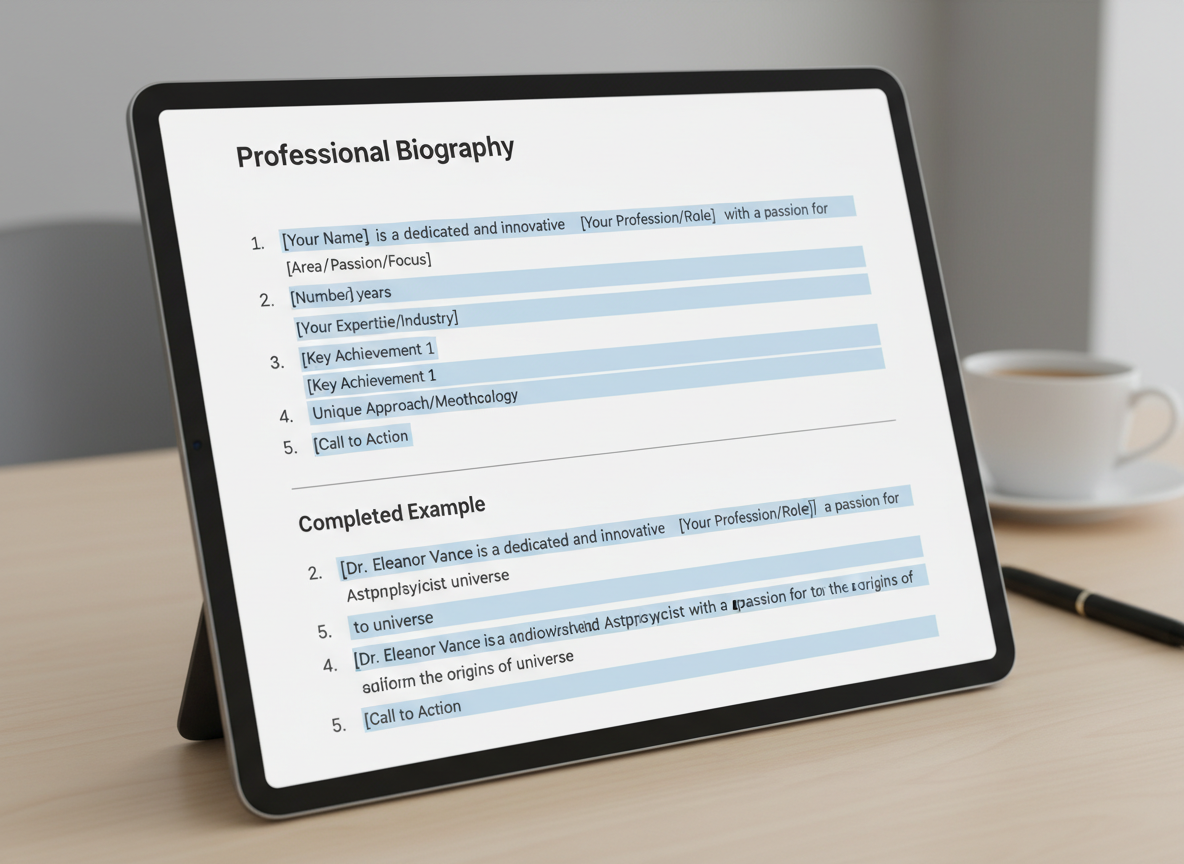
Stop staring at that blank page. These five templates work for nearly every professional situation you’ll encounter.
The Universal Personal Bio Template
This straightforward approach works for 80% of professionals:
“[Your name] is a [your title/role] who helps [target audience] [achieve specific result]. With [X years] of experience in [industry/field], [he/she/they] specializes in [2-3 key skills or services]. [Your name] has [notable achievement or credential]. When not [working], [personal touch that humanizes you].”
Example: “Marcus Chen is a brand strategist who helps B2B tech companies clarify their messaging and attract better-fit clients. With 8 years of experience in SaaS marketing, he specializes in positioning strategy, competitive analysis, and messaging frameworks. Marcus has worked with over 50 startups, including three that achieved successful exits. When not dissecting brand strategies, he’s experimenting with new coffee brewing methods.”
The Achievement-Focused Template
Perfect for job seekers and executives:
“[Your name] has [impressive achievement]. As [current/recent title], [he/she/they] [quantifiable result]. [Your name]’s expertise includes [3 core competencies], with a track record of [specific outcome]. [Educational credentials or certifications]. [Professional goal or mission].”
The Story-Driven Template
Entrepreneurs and creatives shine with this approach:
“After [pivotal moment or frustration], [Your name] founded [company/started doing X] to [mission]. Today, [he/she/they] [what you do] for [who you serve]. [Your name]’s work has been [recognition/featured in], and [he/she/they] believes [core philosophy].”
The Authority-Building Template
For speakers and thought leaders:
“[Your name] is a [title] and [secondary credential] specializing in [expertise area]. [He/She/They] has spoken at [notable venues/events], shared stages with [known names], and [media appearances]. [Your name] teaches [specific methodology or framework] that helps [audience] [outcome].”
The Approachable Expert Template
Service providers need trust and relatability:
“[Your name] makes [complex thing] simple for [target market]. As a [certified/trained] [profession], [he/she/they] believes [relatable philosophy]. [Your name] has helped [number] clients [specific transformation], and brings [unique background or perspective] to every project.”
The 7 Deadly Sins of Personal Biographies (Real Examples of What NOT to Do)
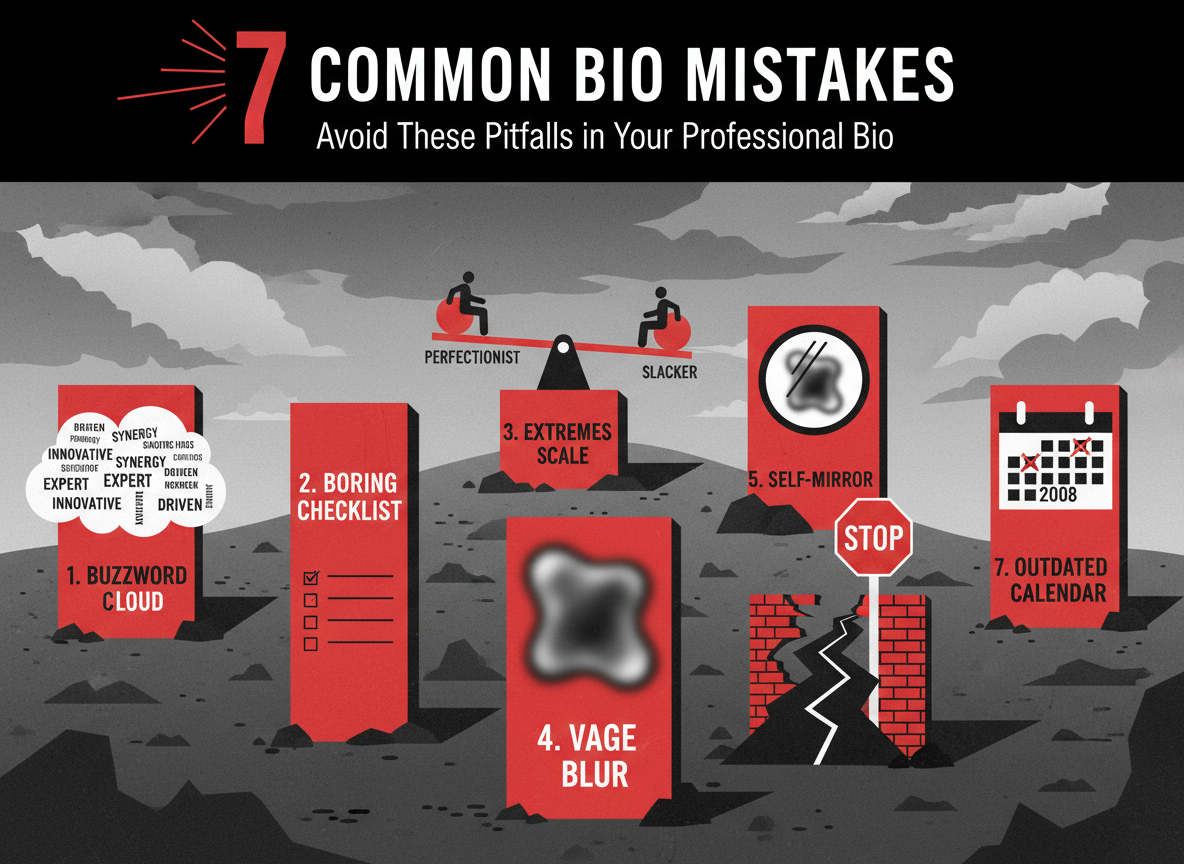
Let’s talk about the biographies that make hiring managers cringe and potential clients hit the back button. I’ve seen thousands of these, and the patterns are painfully clear.
Mistake #1: Using Clichés and Buzzwords
Bad Example: “I’m a passionate, results-driven innovator who thinks outside the box and goes the extra mile to deliver cutting-edge solutions.”
Every recruiter has read this exact sentence 47 times this week. It says nothing about you.
The Fix: Replace buzzwords with specifics. Instead of “passionate,” show it: “I’ve spent the last three years building my YouTube channel from zero to 87,000 subscribers by posting every Tuesday at 6 AM—even on my wedding day.”
Mistake #2: Listing Job Duties Instead of Achievements
Bad Example: “Responsible for managing social media accounts, creating content, and engaging with followers.”
That’s a job description, not proof you’re good at your job.
The Fix: “Grew Instagram engagement by 340% in six months using user-generated content campaigns that turned customers into brand ambassadors.”
Mistake #3: Being Too Humble or Too Boastful
Too Humble: “I try my best to help clients with their marketing needs and hope I can be useful.”
You sound unsure of your own value.
Too Boastful: “I’m the world’s #1 marketing genius who’s revolutionized the entire industry with my groundbreaking techniques.”
Unless you’re Seth Godin, this won’t fly.
The Fix: Balance confidence with evidence. “I’ve helped 23 small businesses double their online revenue using targeted email campaigns—including a local bakery that went from $12K to $31K monthly in four months.”
Mistake #4: Writing in Vague Generalities
Bad Example: “I’ve helped numerous clients achieve great success with my proven strategies over many years.”
“Numerous,” “great,” “proven,” and “many years” tell us absolutely nothing.
The Fix: “Since 2019, I’ve worked with 156 freelancers to land their first $5K+ client within 90 days using my cold email framework.”
Mistake #5: Forgetting the Audience
Bad Example: “I started my career in 1998 at a small firm where I learned valuable lessons about hard work and dedication. I then moved to another company where I continued to grow…”
Your life story isn’t relevant unless it connects to what your reader needs.
The Fix: Start with their problem. “If you’re struggling to convert website visitors into paying customers, you’re not alone—73% of small business owners face this exact challenge. I’ve spent the last seven years solving it.”
Mistake #6: No Clear Call-to-Action
Bad Example: “Thanks for reading my bio. I love what I do and hope to continue making a difference.”
Great. Now what? Your reader’s left hanging.
The Fix: “Ready to triple your email open rates? Download my free 5-day challenge at [link] or email me at [email] to discuss your specific goals.”
Mistake #7: Outdated Information
Bad Example: “I’m skilled in Myspace marketing, Flash animation, and have extensive experience with Google+ community building. Winner of the 2011 Best Blog Award.”
Nothing screams “irrelevant” like outdated credentials.
The Fix: Update your bio every six months. Replace old achievements with recent wins. If your newest credential is from 2018, you’ve got work to do.
The difference between a forgettable bio and one that lands opportunities? Specificity, relevance, and a clear understanding of what your reader actually cares about. Most people get this wrong because they’re writing to impress themselves, not serve their audience.
How to Optimize Your Personal Bio for Search Engines & AI (E-E-A-T + GEO)
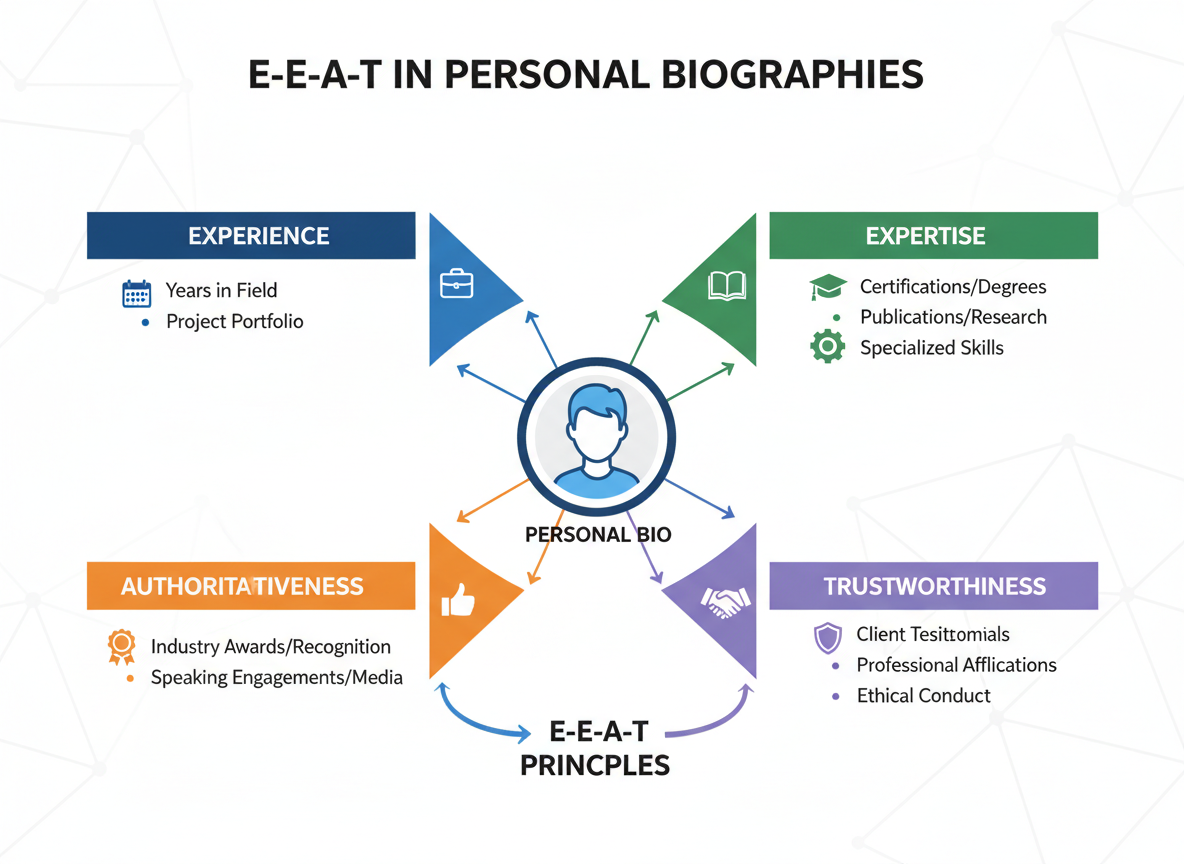
Here’s something most people don’t realize: Google and AI engines like ChatGPT aren’t just reading your bio—they’re evaluating whether you’re worth trusting. In 2026, your personal bio carries serious weight in search rankings and AI recommendations.
Google’s E-E-A-T framework (Experience, Expertise, Authoritativeness, Trustworthiness) now determines who gets featured. Data shows author bios with strong E-E-A-T signals rank 40% higher in competitive niches. That’s not a small advantage.
Start with experience markers: years in your field, specific projects you’ve completed, measurable results. Instead of “marketing expert,” try “digital marketing consultant who’s scaled 50+ SaaS companies to six figures.” See the difference?
For Generative Engine Optimization (GEO), you need to help ChatGPT and similar platforms understand your credentials. These systems pull from structured data, so implement schema markup on your website bio. It’s easier than it sounds—most WordPress plugins handle this automatically.
Keywords matter, but they’ve got to flow naturally. A freelance designer might include “UI/UX design,” “product design,” and “SaaS interfaces” without sounding robotic.
Link strategically from your bio to published work, speaking engagements, or media mentions. Keep your bio consistent across LinkedIn, Twitter, your website, and guest posts—AI engines recognize these patterns and strengthen your authority profile.
This isn’t optional anymore. It’s how you get found.
Personal Biography Decision Tree: What to Include Based on Your Goals
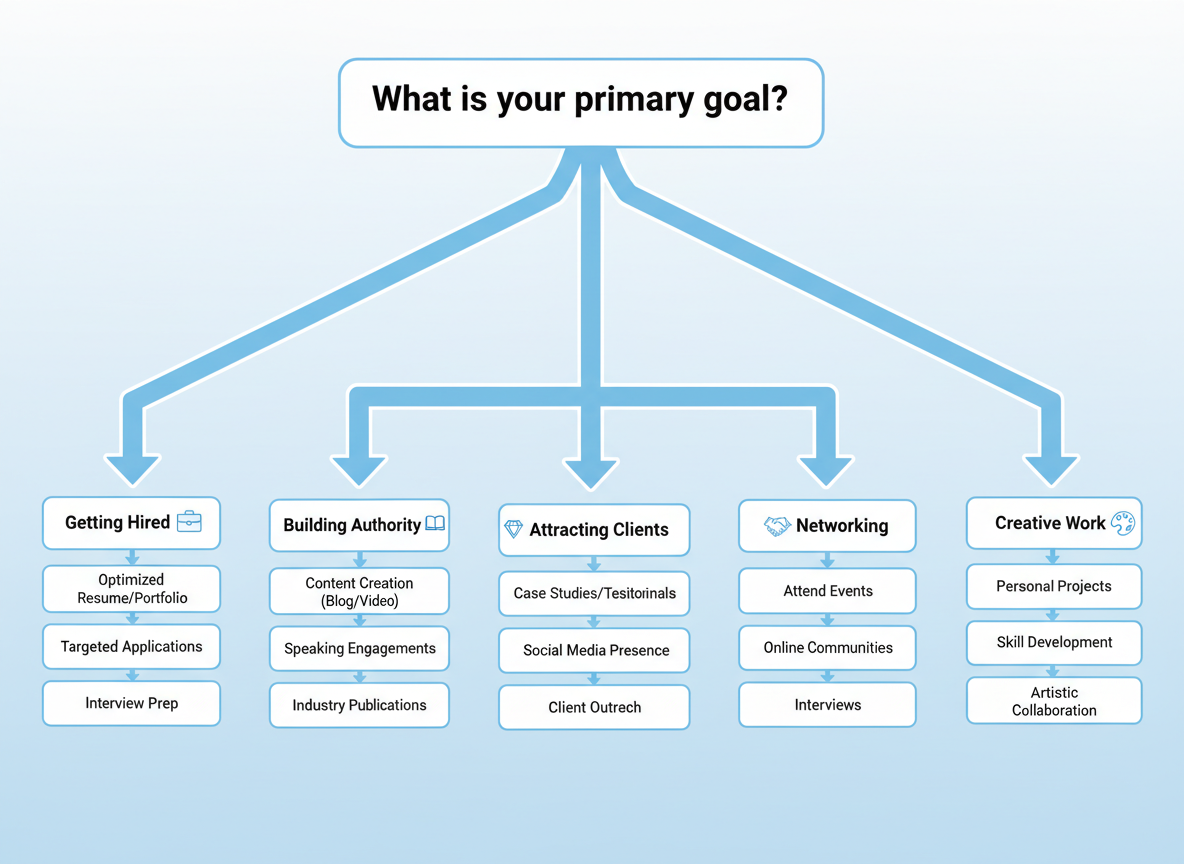
Your bio isn’t one-size-fits-all. What you include depends entirely on what you’re trying to accomplish.
Getting hired? Pack your bio with quantifiable achievements (“grew email list 347% in 6 months”), relevant keywords from job descriptions, and a clear career trajectory that shows progression. Skip the personal hobbies unless they’re directly relevant.
Building authority? Lead with credentials, publications, media mentions, and speaking engagements. “Featured in Forbes, TEDx speaker, author of…” immediately establishes expertise.
Attracting clients? Focus on social proof and transformation. Client results matter more than your credentials. “Helped 200+ businesses triple their conversion rates” beats “15 years of marketing experience.”
Networking? Show personality and accessibility. Include shared interests, your “why,” and conversation starters that make people want to connect.
Showcasing creative work? Share your philosophy, highlight standout portfolio pieces, and reveal what inspires you.
Combining multiple goals? Start with your primary objective in the first two sentences, then layer in secondary elements. When space runs tight, cut the nice-to-haves (hobbies, long origin stories) and keep the goal-specific proof points.
The decision matrix is simple: what action do you want readers to take? Everything else flows from there.
Where to Place Your Personal Biography for Maximum Impact
Your bio’s placement determines whether it converts or gets ignored. Here’s where smart professionals strategically position their personal biography examples in 2026.
Your website’s About page deserves your longest, most comprehensive bio—300-500 words that tell your full story. Include a professional headshot, client testimonials, and a clear call-to-action. This is your home base that everything else links back to.
Author bio boxes on blog posts need 2-3 sentences max. Place them at the end of each article with a linked headshot. Your readers just finished your content, so focus on one specific credential and one next step—usually linking to your newsletter or services page.
LinkedIn profiles require a different approach than your resume. LinkedIn allows first-person narrative and storytelling (200-2,600 characters). Your resume stays third-person and achievement-focused. Don’t just copy-paste between them.
Email signatures work best with 1-2 lines: your name, title, and one compelling credential. Add a link to your website or latest project.
Conference programs and speaker sheets need 75-150 words highlighting your expertise relevant to that specific audience. Customize for each event—what matters to a marketing conference differs from what a tech summit needs.
Social media profiles have character limits that force precision. Twitter/X allows 160 characters, Instagram 150. Lead with your strongest hook, not generic job titles.
The key? Consistency in your core message, but customize length and emphasis based on where people find you.
How to Update and Refresh Your Biography (Maintenance Schedule)
Your bio isn’t a “set it and forget it” asset. It’s a living document that should evolve with your career.
Update immediately when you land a major client, earn a new credential, or shift your positioning. Don’t wait six months to mention that podcast feature or industry award—capitalize on momentum while it’s fresh.
Set a quarterly review to audit all your bios. Check LinkedIn, your website, speaker profiles, and guest post bylines. Are they telling the same story? Inconsistent bios confuse potential clients who research you across platforms.
Archive achievements that no longer align with where you’re headed. That social media internship from 2018? Let it go. Focus on results that support your current goals.
Test different versions on your website. Try leading with different achievements or restructuring your opening line. Track which version generates more contact form submissions.
Before (2024): “Marketing consultant helping businesses grow their online presence through various digital strategies.”
Refreshed (2026): “LinkedIn strategist who’s generated 47M+ impressions for B2B founders. Featured in Forbes and Marketing Profs for my content frameworks that convert.”
The difference? Specificity, proof, and current relevance.
How AI Tools Can Help You Write Better Biographies Faster
Let’s be honest—staring at a blank screen while trying to describe yourself is torture. That’s where AI steps in as your creative partner, not your replacement.
AI excels at generating multiple bio versions in minutes. You can create three different approaches—one friendly, one professional, one bold—then A/B test them across platforms to see what resonates. This saves hours of second-guessing yourself.
The best prompt? “Write a professional bio for [your role] who specializes in [your specialty], highlighting [specific achievement], in a [tone] voice, keeping it under [word count].” Be specific, and you’ll get usable results.
Tools like Testing CG’s platform help you maintain consistency across LinkedIn, Twitter, Instagram, and your website without manually reformatting everything. Similar to how AI product description generators transform ecommerce content, smart automation keeps your personal brand cohesive everywhere.
But here’s what AI can’t do: inject your personality quirks, that client story that always gets laughs, or the genuine warmth that makes people remember you. Think of AI as your first draft generator—you bring the soul.
Sarah Chen, a LinkedIn coach, cut her bio update time from 4 hours monthly to 20 minutes. “I use AI to handle the structure and platform-specific formatting,” she says. “Then I add my voice and stories. Game-changing workflow.”
Take Action: Your Personal Biography Upgrade Checklist
You’ve seen 47 personal biography examples that work. Now it’s your turn to transform that forgettable bio into something that actually gets you noticed.
Here’s your five-step action plan:
Step 1: Choose the template from this article that matches your industry and goals. Don’t overthink it—pick one and start writing.
Step 2: Fill it with specific achievements and genuine personality. Replace every generic phrase with concrete numbers and real stories.
Step 3: Customize it for your primary platform. LinkedIn gets a different version than Instagram or your speaking page.
Step 4: Deploy it everywhere. Update your website, social profiles, speaker kits, and pitch decks today.
Step 5: Set a quarterly reminder to refresh your bio with new wins and projects.
Here’s the reality check: Your competitors are already implementing these strategies. While you’re reading this, someone in your industry just landed a client because their bio positioned them as the obvious choice.
A better bio can land you your next opportunity within 30 days. That’s not hype—it’s what happens when you finally present yourself clearly and compellingly. Need help building your complete personal brand? Check out our Personal Brand Statement Generator guide for additional tools.
Ready to automate your content presence with professionally branded materials? Use Testing CG to maintain consistency across all platforms without the manual headache.
Frequently Asked Questions
How long should a personal biography be?
Your bio length depends entirely on where you’re using it. Twitter/X demands brevity—160 characters. LinkedIn gives you 2,600 characters for your About section, but most people stop reading after 300 words. Your website’s About page can stretch to 500-800 words. Professional speaker bios typically run 100-150 words. Conference programs? Keep it under 75 words. The real secret? Write a comprehensive 500-word version first, then trim it down for each platform. You’ll maintain consistency while meeting specific requirements.
Should I write my bio in first person or third person?
Here’s your framework: Use first person for personal websites, social media profiles, and anywhere you’re building direct connections. It feels authentic and approachable. Switch to third person for speaker submissions, professional directories, guest posts, and conference materials. Third person creates authority and sounds more formal. When you’re stuck, ask yourself: “Am I speaking directly to my audience or being introduced by someone else?” That’ll tell you which voice to use.
What’s the difference between a personal biography and a professional bio?
A professional bio focuses strictly on your work achievements, credentials, and business expertise. It’s what you’d submit for a board position or industry publication. A personal biography weaves in your values, interests, and the human elements that make you relatable. It includes your “why” alongside your “what.” Most people need both versions ready. Use professional bios for formal business settings. Personal biographies work better for building authentic connections with your audience.
How often should I update my personal biography?
Review your bio quarterly, but update it immediately when you hit major milestones. New certification? Update it. Career change? Rewrite it. Published a book? Add it right away. Speaking at a conference? Include it. Your bio should reflect who you are now, not who you were six months ago. Set a calendar reminder for January, April, July, and October. Even if nothing changed, you’ll catch outdated language or metrics that no longer impress.
What should I include in my personal biography if I’m just starting my career?
Lead with your strongest skill or unique perspective. Include relevant education, internships, or volunteer work that demonstrates competence. Highlight specific projects you’ve completed, even if they were for class or personal growth. Mention tools you’ve mastered and problems you can solve. Your enthusiasm counts—show it through concrete examples of what you’re learning and building. Skip the “aspiring” language. If you’re doing the work, you’re not aspiring—you’re already there.
Can I use the same biography across all platforms?
You shouldn’t. Each platform serves different purposes and attracts different audiences. Your LinkedIn bio needs professional depth with keywords for searchability. Instagram wants personality and visual storytelling. Your example of bio about yourself shows this variety clearly. Create a master bio, then customize it for each platform. Adjust the tone, length, and details based on who’s reading and why they’re there.
How do I make my biography stand out without sounding boastful?
Replace vague claims with specific numbers and stories. Instead of “I’m a successful marketer,” try “I helped three startups reach six-figure revenue in their first year.” Let achievements speak through results, not adjectives. Use client outcomes rather than self-praise. Tell mini-stories that demonstrate value. And here’s a counterintuitive tip: acknowledge a past struggle you’ve overcome. Vulnerability makes you memorable and relatable in ways that pure achievement never will.
Should I include personal information in my professional biography?
Context matters. Corporate bios for Fortune 500 companies? Skip the personal stuff. Creative industry profiles or entrepreneur bios? Personal details build connection. The test: Does this information help your audience understand your perspective or approach? Mentioning you’re a parent might matter if you create content about work-life balance. Your hiking hobby matters if you’re a wilderness guide. Leave out details that don’t serve your professional story or audience relationship.
How can I write a biography if I don’t have impressive credentials yet?
Focus on transformation and specific results instead of traditional credentials. What problems have you solved, even on a small scale? What unique perspective do you bring? Highlight projects you’ve completed, skills you’ve developed, and people you’ve helped. Share your methodology or approach. Your fresh perspective can actually be an asset—don’t apologize for it. Position yourself through what you’re building now rather than what you achieved before.
What are the biggest mistakes people make in personal biographies?
The seven deadly sins: Writing generic descriptions that could apply to anyone. Listing responsibilities instead of achievements. Using buzzwords without backing them up. Making it all about credentials rather than value. Forgetting to include a clear call-to-action. Writing in dense, boring paragraphs. And the worst? Lying or exaggerating—because the truth always surfaces. Your bio should be memorable, specific, and honest. Those three elements will always beat clever wordsmithing.
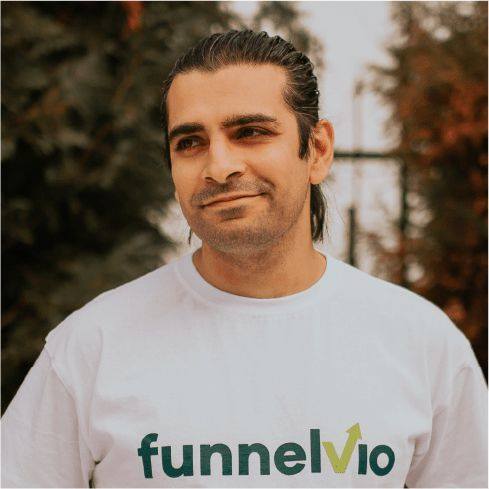
I am a full-time online marketer, for over a decade now. Helped over 100,000+ people & generated well over $12M in online sales.