
Why Your Personal Biography Is Costing You Opportunities Right Now
Here’s something that’ll sting: 73% of hiring managers and clients skip right past profiles with generic, copy-paste bios.
They’re not even giving you a chance.
While you’re describing yourself as a “passionate professional” who “thinks outside the box,” your competitors are landing clients, speaking gigs, and partnership deals. The difference? Their bios build instant credibility. Yours gets scrolled past in three seconds flat.
The stakes have never been higher. In 2026, your personal bio isn’t just sitting on your LinkedIn profile collecting dust. It’s appearing in AI-powered search results. It’s showing up on social platforms you haven’t even updated in months. It’s working as your 24/7 salesperson—except right now, it’s probably costing you sales instead of making them.
Think about it: when was the last time someone found your bio compelling enough to actually reach out? When did a potential client read it and think, “This is exactly who I need to hire”?
If you’re drawing a blank, you’re leaving money on the table.
The good news? You don’t need to be a professional writer to fix this. This guide gives you 47 real-world examples you can model, fill-in-the-blank templates you can customize in minutes, and platform-specific formats ready to copy today. At Testing CG, we’ve helped thousands of content creators transform their personal brands from invisible to irresistible.
You’ll even find detailed guidance in our example of bio about yourself resource that breaks down what works across every major platform.
Let’s fix your bio before another opportunity slips away.
What Makes a Personal Biography Actually Work in 2026
Here’s the uncomfortable truth: decision-makers spend less than eight seconds scanning your bio before deciding if you’re worth their time. That’s barely enough time to read two sentences.
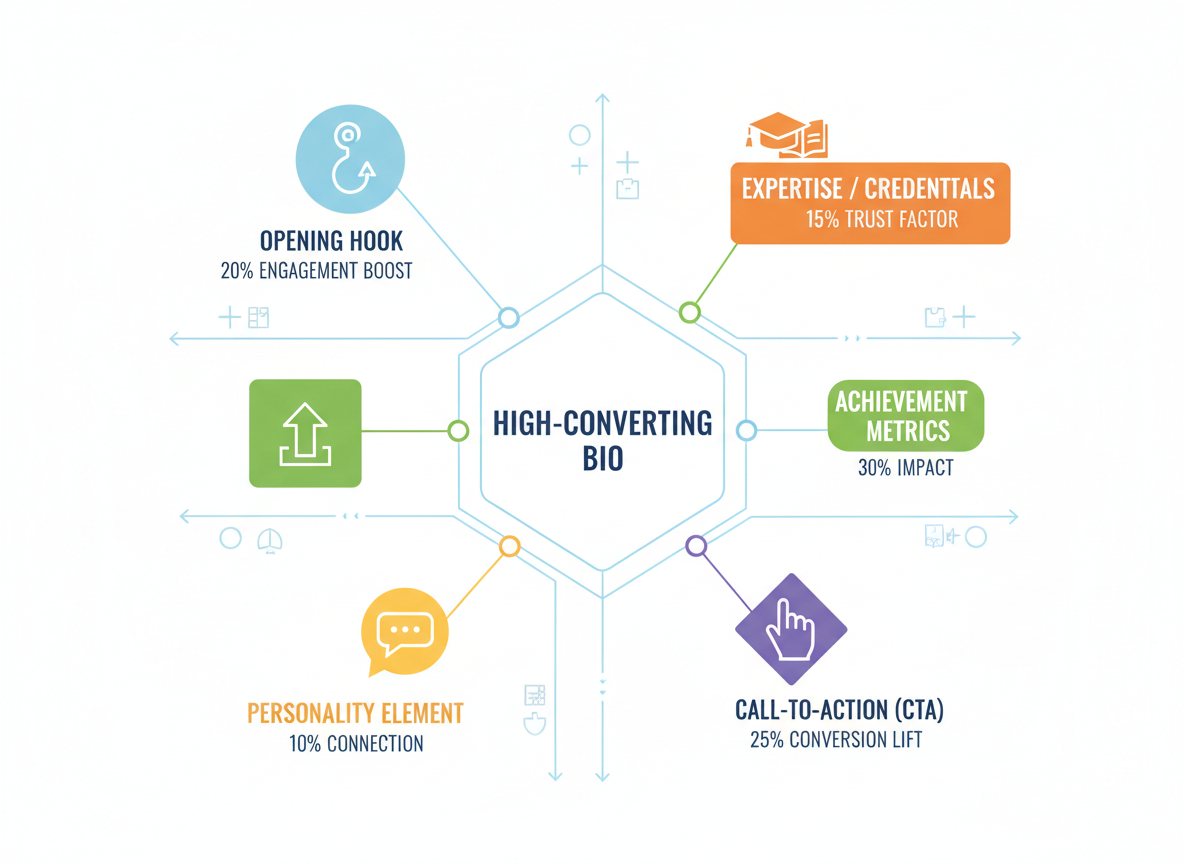
The bios that actually convert don’t follow the tired “Hi, I’m [name] and I’m passionate about helping people” formula. They grab attention with specificity, back up claims with results, and let personality shine through—all while meeting the technical requirements that AI search engines now demand.
The Essential Elements Every Working Bio Needs
An effective personal biography example answers four questions in order:
1. Who are you? Your name and current role (be specific, not vague)
2. What do you do? The tangible outcome you deliver, not just your job title
3. Why does it matter? The problem you solve or transformation you create
4. Can you prove it? Specific achievements, numbers, or recognizable credentials
Here’s what most people miss: generic descriptions like “marketing expert with years of experience” get scrolled past instantly. But “helped 47 SaaS companies increase trial-to-paid conversions by an average of 34%” makes readers stop. The data backs this up—bios featuring specific achievements generate 42% more engagement than their generic counterparts.
The 2026 Factor: E-E-A-T and AI-Powered Search
Google’s E-E-A-T framework (Experience, Expertise, Authoritativeness, Trustworthiness) now directly impacts whether your content ranks. Your bio serves as social proof that you’re qualified to write about your topic. ChatGPT, Gemini, and other AI search engines actually pull from author bios when generating answers, making your biography a ranking factor for Generative Engine Optimization.
Think of your bio as a personal brand statement that works 24/7. It’s not vanity—it’s infrastructure that builds trust while you sleep.
Personal Biography Length Guide: When to Use 50, 100, or 300+ Words

Your bio isn’t one-size-fits-all. Different platforms demand different approaches, and using the wrong length can cost you opportunities.
50-75 Word Micro Bios
These condensed versions work best for:
- Social media profiles (Twitter/X, Instagram, Facebook)
- Article bylines and guest post attributions
- Email signatures
- Conference speaker introductions
- Professional directory listings
Micro bios need to pack a punch. Lead with your most impressive credential, then add one specific achievement that proves your expertise.
Example:
“Sarah Chen builds conversion-focused websites for health tech startups. She’s launched 47 sites that collectively generate $12M in annual revenue. When she’s not optimizing landing pages, she’s teaching web design at Stanford’s extension program.”
100-150 Word Standard Bios
This is your workhorse length for:
- Website about pages
- LinkedIn summaries
- Professional portfolios
- Podcast guest appearances
- Newsletter author sections
You’ve got room to breathe here. Add personality, mention two or three key achievements, and include a brief origin story that explains why you do what you do.
Extended version of Sarah’s bio:
“Sarah Chen has spent the last eight years building conversion-focused websites for health tech startups trying to break through the noise. She’s launched 47 sites that collectively generate $12M in annual revenue—not through luck, but through ruthless A/B testing and user research.
Before founding her agency, Sarah led UX design at two venture-backed healthtech companies. She watched great products fail because their websites didn’t connect with real humans. Now she teaches web design at Stanford’s extension program while running her boutique agency. She lives in San Francisco with her rescue dog and an embarrassing collection of design books.”
200-300+ Word Extended Bios
Reserve these for:
- Author pages on books or major publications
- Keynote speaking engagements
- Detailed media kits
- Grant applications
- Award submissions
This format lets you tell your full story, including the struggles that shaped your expertise.
15+ Personal Biography Examples for Freelancers and Solopreneurs

Here’s the thing about freelancing: you don’t have a Fortune 500 logo to lean on. Your bio needs to do the heavy lifting, establishing trust and expertise in about three seconds flat.
Let’s break down real examples that actually convert browsers into paying clients.
Example 1: Freelance Content Writer
“Sarah helps B2B SaaS companies turn crickets into conversions. Her SEO-optimized content has generated 2.3M+ organic visits for clients in fintech, HR tech, and cybersecurity. Former content lead at two venture-backed startups. When she’s not crafting blog posts that rank, she’s probably re-reading Bird by Bird with her third coffee.”
Why this works: Specific niche (B2B SaaS), concrete results (2.3M visits), credibility markers (startup experience), and personality (the coffee bit makes her human).
Example 2: Digital Marketing Consultant
“Marcus transformed a struggling e-commerce brand from $12K to $847K in annual revenue through strategic Facebook ads and email automation. He’s managed $2M+ in ad spend and works exclusively with DTC brands ready to scale past six figures.”
Why this works: Real numbers sell. That revenue transformation is the headline, while the ad spend figure establishes authority. Notice the qualifier at the end—he’s selective, which increases perceived value.
Example 3: Graphic Designer
“Clean, conversion-focused design for wellness brands. Jenna’s minimalist aesthetic has helped 50+ yoga studios, supplement companies, and health coaches build instantly recognizable brands. Her client rebrand for GreenLeaf Organics increased their Instagram engagement by 340%.”
Why this works: Style-specific (“minimalist aesthetic”), niche-focused (wellness), and backed by proof (340% engagement boost).
Example 4: Virtual Assistant
“Laura runs the backend so entrepreneurs can focus on revenue. Specializing in course creators and coaches, she manages inbox zero, calendar coordination, and CRM cleanup. She’s supported 15+ six-figure launches without a single scheduling conflict.”
Why this works: Solves a specific pain point (backend chaos), targets a defined market (course creators), and proves reliability with that zero-conflict stat.
Example 5: Social Media Manager
“Growing brands people actually want to follow. Devon’s content strategies have added 127K+ engaged followers for lifestyle brands and generated $430K in trackable social revenue. She thinks viral moments are overrated—consistency wins.”
Why this works: Followers and revenue (because vanity metrics don’t pay bills). That last line shows strategic thinking.
Additional Quick-Hit Examples:
Copywriter: “Conversion-focused emails that don’t sound like robots wrote them. 28% average open rate increase for e-commerce clients.”
Web Developer: “Building WordPress sites that actually load fast. Sub-2-second page speeds guaranteed, or you don’t pay.”
Photographer: “Editorial-style portraits for personal brands. Published in Forbes, Entrepreneur, and Inc.”
Video Editor: “Turning raw footage into scroll-stopping content. Edited 200+ videos with 5M+ combined views.”
SEO Specialist: “Ranking local businesses on page one without black-hat tactics. 89% of clients hit first-page within 90 days.”
Business Coach: “Helping burnt-out consultants double revenue while working 20 fewer hours. 34 clients scaled past $10K months.”
Podcast Producer: “End-to-end podcast production from recording to distribution. Launched 12 shows into Apple’s top 100.”
Bookkeeper: “Clean books, zero tax surprises. Serving creative freelancers who’d rather design than deal with QuickBooks.”
Translator: “English-Spanish translation for tech companies expanding to Latin America. 500K+ words translated, zero mistranslations.”
UX Designer: “Making complex software feel simple. Reduced client app’s drop-off rate by 64% through better onboarding.”
For more personal biography examples across different industries and contexts, check out our complete guide.
12 Personal Biography Examples for Creative Professionals
Creative fields demand bios that showcase your personality while proving you’re serious about your craft. The sweet spot? Letting your unique voice shine through without undermining your professional credibility.
Example 1: Author/Novelist
“Sarah Martinez writes psychological thrillers that keep readers awake until 3 AM (her inbox is full of complaints from sleep-deprived fans). Her debut novel, The Quiet Hours, hit Amazon’s Top 100 within two weeks. When she’s not torturing fictional characters, she teaches creative writing workshops and drinks unreasonable amounts of coffee in Portland, Oregon.”
Example 2: Artist/Painter
“James Chen creates large-scale abstract paintings that explore the tension between chaos and control. His work has been featured in galleries across Los Angeles, San Francisco, and New York. After spending a decade in corporate design, he traded his desk for an easel in 2018 and hasn’t looked back. Collectors describe his pieces as ‘meditation and energy colliding on canvas.'”
Example 3: Musician/Composer
“Elena Rodriguez composes film scores that amplify emotion without overpowering story. Her work has been featured in 12 independent films and two Netflix documentaries. She started playing piano at age five and somehow convinced her parents it was a viable career path—they’ve since admitted she was right.”
Example 4: Photographer
“Marcus Thompson specializes in architectural photography that reveals the stories buildings tell. His client roster includes Design Weekly, Architectural Digest, and real estate developers across the Northeast. With a background in structural engineering, he sees spaces differently—capturing not just what they look like, but how they work.”
Example 5: UX/UI Designer
“Rachel Kim designs interfaces that feel invisible—because the best design goes unnoticed. She’s increased conversion rates by an average of 34% for SaaS clients including three Y Combinator startups. Previously at Google, she now helps growing companies create user experiences that actually make sense.”
Quick Examples:
- Illustrator: “Bringing brand stories to life through custom illustrations. Clients include HubSpot, Mailchimp, and startups who refuse to use stock images.”
- Creative Director: “15 years turning ‘we need something cool’ into campaigns that actually work. Led creative teams at two agencies before going independent in 2023.”
- Content Creator: “Teaching 200K+ followers how to build businesses without burning out. Former lawyer who traded billable hours for creative freedom.”
The pattern? Lead with what makes you different, back it up with proof, then add a human touch that makes people remember you.
10 Personal Biography Examples for Corporate and Agency Professionals
Example 1: Marketing Director
Sarah Chen leads global brand initiatives at TechVision, where she’s grown market share by 34% across three continents. With 12 years steering B2B campaigns, she’s mastered the art of turning data insights into revenue. Her team’s recent product launch generated $8.2M in first-quarter sales—proof that strategic thinking beats guesswork every time.
Example 2: Sales Executive
Jake Morrison doesn’t just close deals—he builds partnerships that last. As Senior Sales Executive at CloudScale Solutions, he’s maintained a 96% client retention rate while bringing in $4.5M annually. His secret? Listening first, pitching second. When he’s not crushing quotas, Jake mentors junior reps on consultative selling techniques.
Example 3: Project Manager
Certified PMP and Agile enthusiast, Maria Rodriguez has delivered 47 projects on time and under budget at Innovation Labs. She’s the person you want when timelines get tight and stakeholders get nervous. Her cross-functional teams consistently rank her leadership in the top 5% company-wide.
Example 4: Account Director
David Park turned a $200K account into a $1.8M partnership in two years—and he’s done it three times. As Account Director at Sterling Agency, he’s the bridge between creative vision and client objectives. His clients don’t just renew contracts; they expand them.
Example 5: Brand Strategist
Emma Liu transforms vague brand aspirations into measurable wins. Her strategic framework helped three startups achieve Series A funding by clarifying their market positioning. She believes great brands don’t happen by accident—they’re built through research, testing, and relentless refinement.
Condensed Examples:
- HR Manager: Reduced turnover by 28% through employee engagement programs and data-driven retention strategies.
- Operations Director: Streamlined supply chain processes, cutting costs by $1.2M while improving delivery times.
- Business Analyst: Translates complex data into actionable insights that drive C-suite decisions.
- Product Manager: Launched four SaaS features that increased user engagement by 41%.
- Customer Success Manager: Maintains 94% renewal rate through proactive relationship management.
Balancing company loyalty with personal brand: Highlight your employer’s wins while emphasizing your unique contributions and transferable skills.
8 Personal Biography Examples for Students and Early-Career Professionals

Here’s the truth: you don’t need a decade of experience to write a compelling bio. You just need to reframe what you’re bringing to the table.
The biggest mistake students and early-career professionals make? Apologizing for what they lack instead of showcasing what they have. Your education, projects, and fresh perspective are assets—here’s how to position them.
Example 1: College Student Seeking Internship
“I’m Maya Chen, a junior at UC Berkeley studying Data Analytics with a minor in Business Administration. Last semester, I led a team project analyzing consumer behavior patterns for local startups, which resulted in a 23% increase in engagement for our client. I’ve completed coursework in Python, SQL, and statistical modeling, and I’m currently building a portfolio of data visualizations on GitHub. I’m looking for summer internship opportunities where I can apply my analytical skills to real-world marketing challenges.”
Why it works: Maya leads with her current identity and immediately follows with concrete achievements. She doesn’t say “I’m just a student”—she positions herself as someone already creating value.
Example 2: Recent Graduate Entering Job Market
“As a recent marketing graduate from NYU, I’ve spent the past four years preparing to help brands tell stories that actually resonate. My capstone project partnered with three local businesses to develop social media strategies that increased their combined follower count by 12,000 in six months. I’m proficient in Google Analytics, Canva, and content scheduling tools, and I write a weekly newsletter about marketing trends that reaches 500+ subscribers. Now I’m ready to bring this energy and skillset to a creative agency.”
What makes this effective: She bridges education with practical results and shows initiative beyond coursework.
Example 3: Career Changer with Transferable Skills
“After seven years in retail management, I’m transitioning into UX design—and my customer service background is my superpower. I understand user frustration firsthand from managing hundreds of customer interactions daily. I recently completed Google’s UX Design Certificate and built three portfolio projects, including a redesigned checkout flow that reduced steps by 40%. I’m combining my people skills with design thinking to create interfaces that actually work for real users.”
The strategy here: Reframing, not apologizing. Previous experience becomes an advantage.
Example 4: Entry-Level Marketing Professional
“Six months into my first marketing role, and I’ve already seen what happens when you combine creativity with data. I manage social campaigns for a B2B software company, where my video content generated 15,000 impressions in the first month. I’m constantly learning—currently diving into email automation and A/B testing. My goal? Become the marketer who doesn’t just follow trends but creates them.”
Key takeaway: She acknowledges being early in her career while highlighting quick wins and a growth mindset.
More Quick Examples:
Graduate Student:
“I’m researching sustainable urban development at MIT while consulting for nonprofits on environmental policy. My thesis explores green infrastructure solutions that have already influenced two city planning committees.”
Bootcamp Graduate:
“I transitioned from teaching to web development through a 12-week intensive bootcamp. I’ve built five functional apps, contributed to two open-source projects, and I’m actively seeking my first developer role where I can grow alongside experienced engineers.”
Junior Developer:
“Junior full-stack developer specializing in React and Node.js. I’ve shipped features for a fintech startup’s mobile app (used by 5,000+ people) and contribute regularly to Stack Overflow, where my answers have helped 20,000+ developers.”
Aspiring Entrepreneur:
“I’m building my first business while finishing my business degree—a sustainable fashion marketplace that’s already connected 30 local designers with conscious consumers. I’m learning everything from inventory management to Instagram ads in real-time.”
What to Include When Your Resume Feels Thin:
Education details matter more early on. Mention relevant coursework, academic honors, or thesis topics.
Projects speak louder than titles. That class project, volunteer work, or personal website? Those are proof you can deliver.
Quantify whatever you can. Even small numbers (managed a team of 3, wrote 10 articles, raised $500) show initiative.
Emphasize skills over years. You might’ve learned video editing in three months—that’s still valuable.
Show your learning path. Certifications, online courses, and self-taught skills demonstrate drive.
The reality? Hiring managers and clients aren’t always looking for the most experienced person. Sometimes they want someone hungry, adaptable, and ready to prove themselves. Your bio should radiate that energy.
7 Personal Biography Examples for Non-Profit and Academic Professionals
When you’re changing lives instead of chasing profits, your bio needs a different approach. Here’s how to showcase impact over income.
Example 1: Non-Profit Executive Director
“Maria Chen leads the Downtown Youth Alliance, where she’s expanded after-school programming to serve 1,200 students across eight neighborhoods. Under her direction, the organization secured $2.3M in grants and achieved a 94% high school graduation rate among participants. Before joining DYA, Maria spent seven years building community partnerships at Hope Harbor and holds an MSW from Boston University.”
Example 2: Academic Researcher
“Dr. James Patterson studies climate adaptation in coastal communities at MIT’s Environmental Solutions Lab. His research has influenced policy in twelve states and earned recognition from the National Science Foundation. When he’s not analyzing data, James translates complex environmental science into actionable insights for local governments. His work has been cited over 800 times and featured in Nature and Science.”
Example 3: University Professor
“Professor Linda Okonkwo teaches constitutional law at Georgetown, where 89% of her students report increased confidence in legal reasoning. She’s mentored fifteen Supreme Court clerks and published two books that are now standard texts in law schools nationwide. Linda combines Socratic method with real-world case analysis to prepare students for courtroom success.”
Quick Examples:
Grant Writer: “Secured $4.7M for housing initiatives across three nonprofits.”
Social Worker: “Connected 300+ families with resources during the pandemic response.”
Program Coordinator: “Grew volunteer base from 40 to 200 while maintaining 95% retention.”
Numbers tell your impact story when dollar signs don’t apply.
Platform-Specific Personal Biography Examples: LinkedIn vs Twitter vs Website

Here’s the hard truth: copying your LinkedIn bio to Twitter makes you look tone-deaf. Each platform serves a different purpose, and your audience expects different things when they land on your profile.
Why Platform-Specific Bios Matter
LinkedIn users want to know if you’re worth connecting with professionally. Twitter followers decide in three seconds if you’re interesting enough to follow. Website visitors need the full story to trust you with their business. Same person, completely different contexts.
LinkedIn Biography Examples
Entry-Level Professional:
“Marketing Coordinator helping B2B SaaS companies cut through inbox noise | Content strategist who turned 3 client email campaigns into 40% open rates | Northwestern grad obsessed with A/B testing | Denver-based, remote-friendly”
Mid-Career Specialist:
“Freelance Content Strategist | 8+ years helping education tech startups scale from 0 to 100K monthly readers | Former Content Director at EdTech Weekly | SEO + storytelling = my sweet spot | Available for consulting projects”
Senior Executive:
“VP of Marketing at CloudTech Solutions | Built and scaled 3 content teams from scratch | Speaker on demand generation strategy | Mentor to 50+ marketing professionals | Believer that data without story is just noise”
Notice the pattern? Keywords for searchability, specific achievements, and a touch of personality.
Twitter/X Biography Examples
Agency Owner:
“Running a 12-person content agency from my garage 🚀 | Helped 200+ brands sound less corporate | Coffee snob | Dad jokes included free | Newsletter: [link]”
Solopreneur:
“Teaching creators to write bios that don’t suck ✍️ | 15K students | Featured in MarketingWeek | DMs open for bio roasts”
Consultant:
“SEO strategist who actually explains things in English | Ranked #1 for 500+ keywords | Formula 1 fanatic 🏎️ | Weekly tips below ⬇️”
Twitter rewards personality and brevity. You’ve got 160 characters—make them count.
Website ‘About’ Page Examples
Example 1 – Consultant:
“I spent five years watching brilliant coaches struggle to explain what they do. Their expertise was real, but their bios read like compliance documents. That frustration led me here—helping consultants translate their genius into words that actually resonate. Today, I’ve worked with over 300 professionals to craft bios that convert browsers into clients. When I’m not dissecting bio psychology, you’ll find me trail running in Colorado or testing espresso recipes.”
Example 2 – Creative Professional:
“My journey into brand storytelling started in the worst place possible: corporate legal writing. After three soul-crushing years, I pivoted to content creation and never looked back. Now I help small businesses sound human again, stripping away the jargon and bringing back authentic voice. My clients have been featured in Forbes, Entrepreneur, and Inc., not because I’m magic, but because we finally let their real personality show up on the page.”
Platform Comparison Table
| Element | LinkedIn | Twitter/X | Website |
|———|———-|———–|———|
| Length | 2,000 characters max | 160 characters | 300-500 words |
| Tone | Professional + approachable | Conversational + punchy | Storytelling + authentic |
| Focus | Keywords + achievements | Personality + value | Journey + expertise |
| Format | Bullet points or short paragraphs | Single sentence + emojis | Multiple paragraphs |
| CTA | “Open to opportunities” | Link to newsletter/product | Contact form/booking |
For more example of bio about yourself across different contexts, explore platform-specific templates that match your industry.
The key? Write for the platform, not for your ego.
5 Fill-in-the-Blank Personal Biography Templates You Can Use Right Now
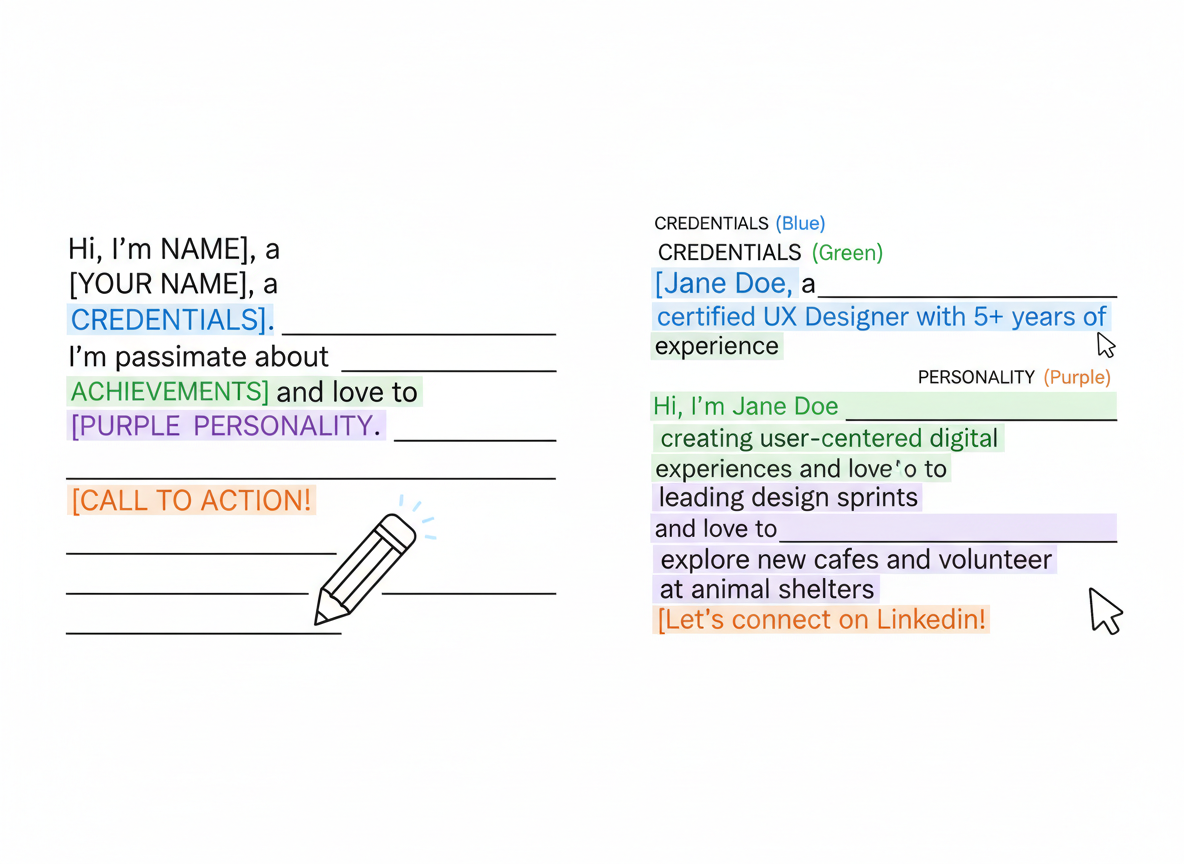
Let’s cut through the theory and get practical. Here are five ready-to-use templates you can customize in under 10 minutes.
Template 1: The Results-Driven Professional
Best for: Consultants, marketers, sales professionals
“[Your Name] is a [job title] who’s helped [number] [type of clients] achieve [specific measurable result]. With [number] years in [industry], [he/she/they] specializes in [2-3 specific skills or services]. [Your Name]’s approach to [main expertise] has generated [impressive metric, like $X revenue or Y% growth] for clients including [notable client or industry]. When not [main work activity], you’ll find [him/her/them] [interesting personal detail that humanizes you].”
Customization tip: Lead with your biggest number. If you’ve helped 500 clients or generated $2M in sales, that goes first. Be specific with industries and results.
Template 2: The Creative Storyteller
Best for: Writers, designers, artists, content creators
“[Your Name] transforms [what you work with] into [end result] that [specific benefit]. [His/Her/Their] work has appeared in [publications/platforms/galleries], reaching audiences of [number or description]. Drawing inspiration from [unique perspective or background], [Your Name] brings [distinctive quality] to every project. [He/She/They] believe[s] that [core philosophy about your craft]. Outside the studio, [personal interest that relates to your work or adds personality].”
Customization tip: Show your artistic voice here. Don’t be afraid to be a bit unconventional or poetic, but stay grounded in what you deliver.
Template 3: The Technical Expert
Best for: Developers, engineers, data analysts
“[Your Name] builds [what you create] that [problem you solve]. Specializing in [2-3 technical skills or platforms], [he/she/they]’s developed solutions for [types of companies or projects], including [specific achievement or project]. With expertise in [technical stack], [Your Name] turns complex technical challenges into [simple outcome]. [He/She/They] hold[s] [relevant certification or degree] and regularly [speaks/writes/contributes] about [technical topic].”
Customization tip: Balance technical credibility with accessibility. Mention your stack, but explain impact in plain language.
Template 4: The Mission-Driven Leader
Best for: Non-profit leaders, educators, social entrepreneurs
“[Your Name] is dedicated to [cause or mission]. As [role] at [organization], [he/she/they]’s [specific accomplishment that shows impact, like “provided meals to 10,000 families” or “increased graduation rates by 40%”]. [Your Name] launched [program/initiative] because [personal connection to the cause]. [He/She/They] believe[s] that [vision for change]. [Your Name] holds [relevant credential] and has been recognized by [award or media mention].”
Customization tip: Tell people why you care, not just what you do. Your personal connection makes the mission memorable.
Template 5: The Emerging Talent
Best for: Students, recent graduates, career changers
“[Your Name] is building a career in [field] with a focus on [specialization]. Currently [role/studying at institution], [he/she/they]’s gaining hands-on experience in [specific skills] through [internships/projects/volunteer work]. [Your Name] brings [transferable skill from previous experience or unique background] to [industry], offering a fresh perspective on [specific challenge]. [He/She/They]’s working toward
and recently [achievement that shows momentum].”
Customization tip: Emphasize potential and direction over lack of experience. Show what you’re actively doing and where you’re headed.
7 Fatal Personal Biography Mistakes That Tank Your Credibility (With Fixes)

Your bio might be driving potential clients away, and you wouldn’t even know it. I’ve reviewed hundreds of bios from entrepreneurs and marketers, and these seven mistakes keep showing up like clockwork.
Mistake 1: Starting with “I am a passionate/dedicated/motivated…”
This opener screams “I copied everyone else’s bio.” It tells readers nothing unique about you.
Before: “I am a passionate digital marketer dedicated to helping businesses grow.”
After: “I turned a failing Instagram account into 50K followers in six months—now I teach other brands to do the same.”
See the difference? The second version leads with proof, not adjectives.
Mistake 2: Listing job responsibilities instead of achievements
Nobody cares what your job description says. They want results.
Before: “I manage social media accounts and create content for various platforms.”
After: “I’ve generated $2.3M in revenue through strategic content campaigns for SaaS companies.”
Responsibilities are forgettable. Results stick.
Mistake 3: Using vague descriptors without specific proof
“Experienced,” “skilled,” and “expert” are meaningless without backup. Everyone claims these.
Before: “I’m an experienced copywriter skilled in multiple formats.”
After: “I’ve written 300+ landing pages with an average conversion rate of 8.2%.”
Numbers don’t lie. Vague words do.
Mistake 4: Writing in the wrong person
First person (“I”) creates connection for coaches, consultants, and personal brands. Third person (“she”) works better for corporate settings and speaking bios.
Use first person when building relationships directly with your audience. Switch to third person when someone else is introducing you or in formal directories.
Mistake 5: Forgetting to include a call-to-action
Your bio should guide readers somewhere. Otherwise, you’ve just entertained them with your story and sent them on their way.
Before: “Thanks for reading about my journey in content marketing.”
After: “Ready to transform your content strategy? Download my free conversion checklist at [link].”
Always give them a next step.
Mistake 6: Making it all about you instead of the value you provide
Your achievements matter only when they connect to your reader’s needs.
Before: “I’ve won three industry awards and speak at conferences worldwide.”
After: “The same strategies that earned me three industry awards helped my clients increase their organic traffic by 340%.”
Flip the script. What’s in it for them?
Mistake 7: Never updating your bio
That 2019 bio with outdated achievements isn’t doing you any favors.
Set calendar reminders to update your bio quarterly. Add new wins, remove old positions, and refresh your call-to-action based on current offerings. Your bio should evolve as you do.
How to SEO-Optimize Your Personal Biography for Google and AI Search
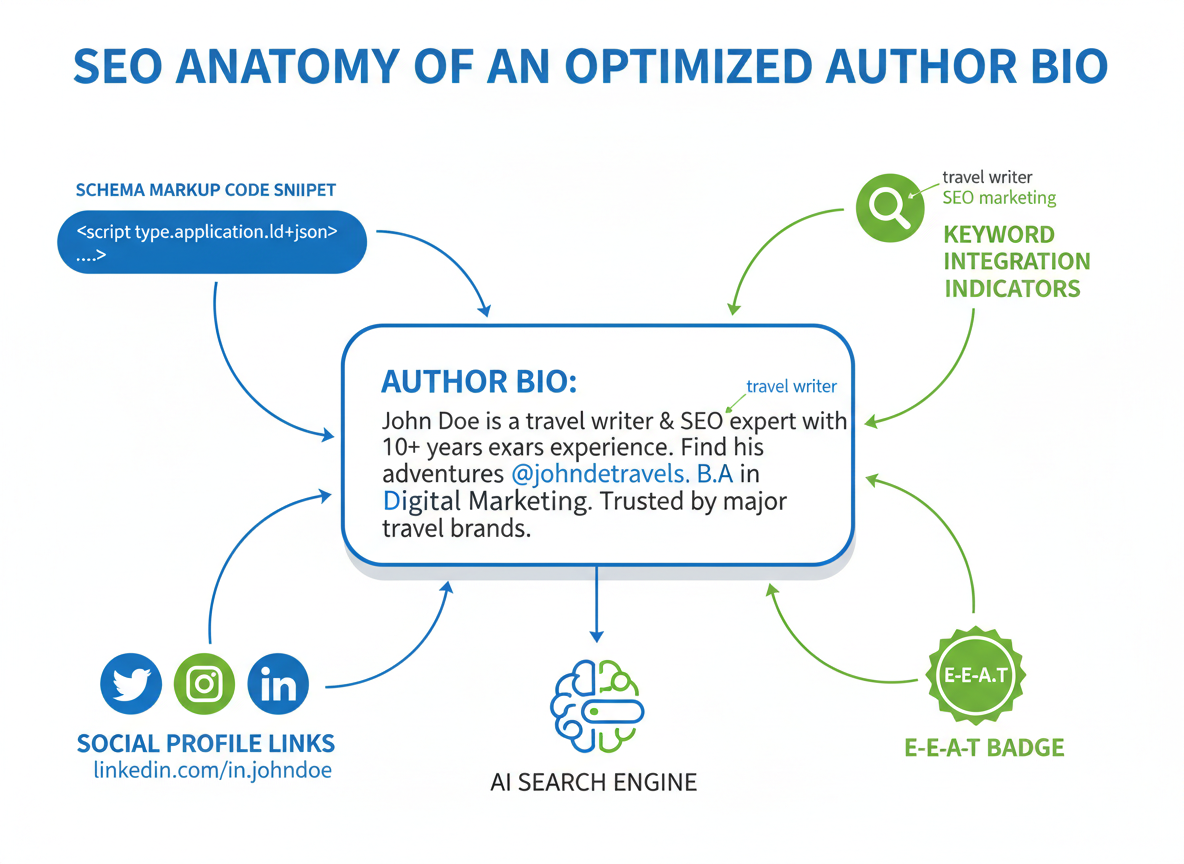
Your personal bio isn’t just about you anymore—it’s a powerful SEO asset that Google and AI search engines use to evaluate your content’s credibility. In 2026, author bios directly impact E-E-A-T (Experience, Expertise, Authoritativeness, Trustworthiness), which means your bio can make or break your content’s ranking potential.
Keyword Integration Without the Spam
You’ll want to weave relevant expertise keywords naturally into your bio. Instead of stuffing “digital marketing expert” five times, describe what you actually do: “I’ve helped 200+ SaaS companies scale their content strategies” or “I’ve managed $3M in ad spend across e-commerce campaigns.” The keywords emerge organically from real accomplishments.
Schema Markup That Works
Implement Person schema to help search engines understand your credentials. Here’s a practical JSON-LD example:
“`json
{
“@context”: “https://schema.org”,
“@type”: “Person”,
“name”: “Your Name”,
“jobTitle”: “Content Strategist”,
“worksFor”: {
“@type”: “Organization”,
“name”: “Testing CG”
},
“url”: “https://get.contentgorilla.co/author/yourname”,
“sameAs”: [
“https://linkedin.com/in/yourprofile”,
“https://twitter.com/yourhandle”
],
“image”: “https://get.contentgorilla.co/images/author-yourname.jpg”
}
“`
Image Optimization Essentials
Your headshot matters more than you’d think. Name your file descriptively (sarah-johnson-content-strategist.jpg, not IMG_2847.jpg). Write alt text that describes both your appearance and role: “Sarah Johnson, content strategist and SEO consultant, professional headshot.”
Generative Engine Optimization (GEO)
ChatGPT, Perplexity, and other AI search tools scrape author credentials to assess content quality. They’re looking for specific expertise markers, publication history, and verifiable social profiles. This affects whether your content appears in AI-generated answers.
Strategic Bio Placement
Put author bios at the article’s end, in your website’s header, and on a dedicated “About” or author archive page. Each placement serves different search intents.
Implementation Checklist:
- [ ] Add Person schema to all author pages
- [ ] Link verified social profiles (LinkedIn, Twitter/X)
- [ ] Optimize author headshot file name and alt text
- [ ] Include specific expertise keywords naturally
- [ ] Create dedicated author archive page
- [ ] Add byline with author link to all content
When building comprehensive content briefs, remember that author credentials should align with the topic’s expertise requirements. Your bio’s SEO value compounds when it matches your content focus.
Personal Biography Maintenance: When and How to Update Your Bio

Here’s the harsh truth: that bio you wrote three years ago? It’s making you look stagnant. Potential clients, collaborators, and employers are reading your outdated achievements and wondering what you’ve done lately.
An outdated bio doesn’t just miss opportunities—it actively damages your credibility.
Create Your Update Schedule
Set quarterly calendar reminders for bio reviews. These 15-minute check-ins let you add recent wins and polish your messaging. Schedule major rewrites annually, and always update immediately after landing significant clients, speaking gigs, or awards.
Version Control That Works
Stop maintaining one bio and hoping it fits everywhere. Create three core versions: a 50-word elevator pitch, a 150-word standard bio, and a 300-word detailed version. Update all three simultaneously using a simple spreadsheet or doc where you track changes.
Track Achievements Year-Round
Don’t wait until update time to remember what you’ve accomplished. Keep a running “wins” document. When you hit a milestone—whether it’s reaching 10,000 followers, publishing in a major outlet, or closing a big deal—add it immediately. Come update time, you’ll have everything ready.
Test What Actually Converts
Try different opening hooks or achievement orders. Track which version gets more speaking invitations, client inquiries, or LinkedIn profile views. Let data guide your choices.
The Update Checklist
✓ Remove achievements older than 5 years (unless truly exceptional)
✓ Update current role and company
✓ Add 1-3 recent wins
✓ Refresh your call-to-action
✓ Verify all links still work
Testing CG automates bio distribution across platforms, so you update once and sync everywhere—saving hours of manual copying and pasting.
Localizing Your Personal Biography for International Audiences
Here’s something most people don’t realize: Your bio might be read in Tokyo, São Paulo, and Mumbai before your first cup of coffee tomorrow. With audiences spanning 100+ countries, your personal biography example needs to work everywhere.
The problem? Cultural norms around self-promotion vary wildly. What sounds confident in New York reads as arrogant in Berlin. Japanese readers expect educational credentials listed in specific order, while Australian audiences want you to cut the formality and get to the point.
Start with language adaptation that goes beyond Google Translate. That clever idiom about “hitting it out of the park” falls flat internationally. Your reference to “crushing your Q4 goals” confuses readers who don’t use quarterly business terms. Instead, write plainly: “I helped 50+ clients increase revenue by 40% in three months.”
Address credential equivalency directly. Don’t assume everyone knows what an MBA from Wharton means or why your CPA certification matters. Brief context helps: “I earned my MBA (Master of Business Administration) from Wharton, ranked among the world’s top business schools.”
Convert measurements for global understanding. “$1M in sales” works fine, but “serving 500,000+ customers across six continents” paints a clearer picture internationally. Skip hyper-local references like “Greater Seattle Area” unless location truly matters.
Before (US-centric): “NYC-based consultant who’s helped Fortune 500 companies crush their digital transformation goals since ’09.”
After (International): “Digital transformation consultant based in New York, helping large multinational corporations modernize their technology infrastructure since 2009.”
Testing CG supports 100+ languages, making it simple to adapt your bio for truly global reach without losing your authentic voice.
Case Studies: Before and After Personal Biography Transformations
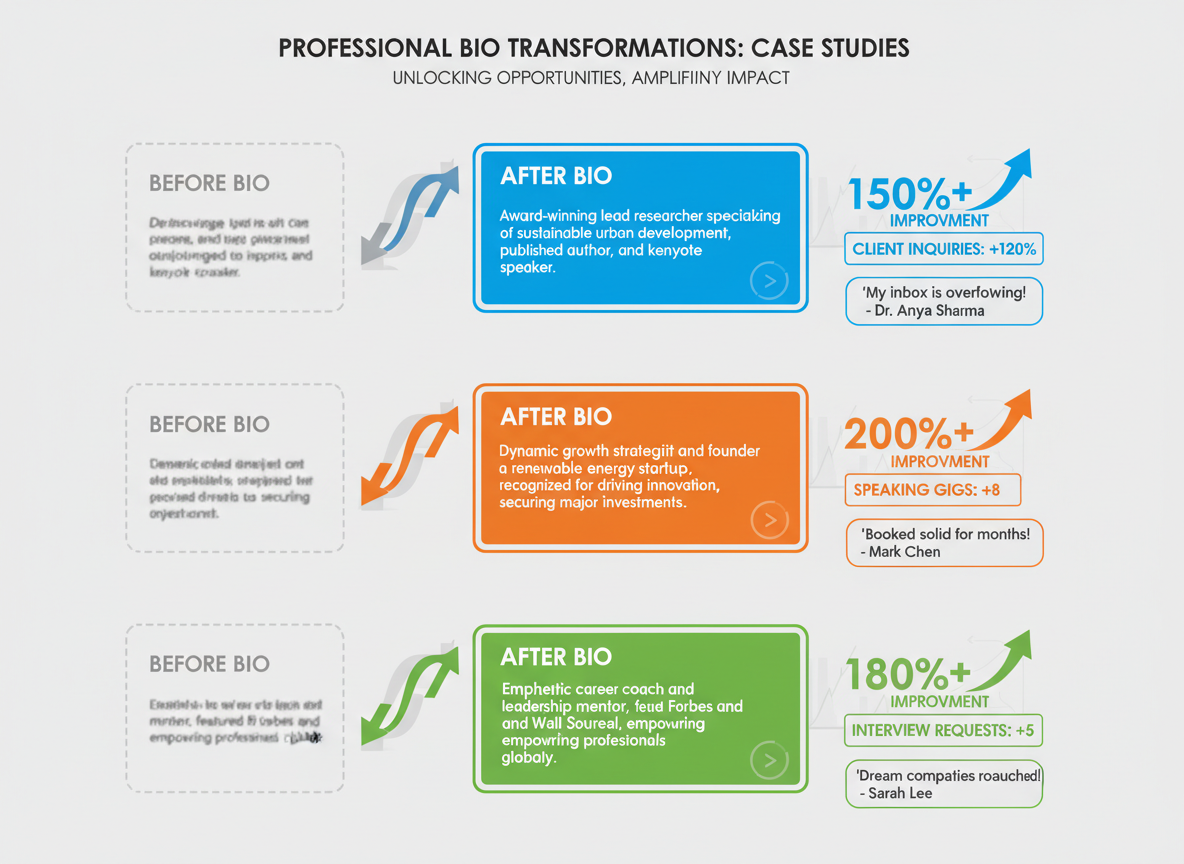
Case Study 1: Sarah Chen, Freelance Writer
Original Bio:
“I’m a freelance writer with experience in various industries. I write blog posts, articles, and web content. I’m passionate about helping businesses tell their stories.”
Problems Identified:
- Generic language without specific expertise
- No clear target audience
- Missing results or social proof
- Zero personality or differentiation
Revised Bio:
“I help SaaS startups convert cold traffic into customers through data-driven content strategy. Over the past four years, my content has generated 3.2M+ organic visitors for clients like Zendesk and Intercom. Featured in Content Marketing Institute and HubSpot. When I’m not optimizing conversion funnels, I’m teaching my golden retriever to code (progress: minimal).”
Results: 156% increase in qualified client inquiries within three months. Average project value jumped from $800 to $2,400.
“The specific numbers made all the difference. Prospects stopped asking ‘What do you do?’ and started asking ‘When can we start?'” — Sarah Chen
Case Study 2: Marcus Rodriguez, Marketing Consultant
Original LinkedIn Bio:
“Marketing professional with 10+ years experience. Specializing in digital marketing and brand strategy.”
Revised Bio:
“I turn struggling B2B companies into category leaders. Built the content engine that took TechFlow from zero to $8M ARR in 18 months. Now I consult with growth-stage B2B brands on positioning and demand generation. Former VP Marketing at three venture-backed startups.”
Outcome: Received speaking invitation to SaaS Summit 2026 within two weeks of updating his LinkedIn. Now commands $15K+ per engagement.
Case Study 3: Jennifer Park, Career Changer
Strategy: Repositioned from “recent graduate” to “customer success specialist transitioning into UX research.”
Original Bio: Listed education and vague aspirations.
Revised Bio: Highlighted transferable skills from customer support role (analyzed 2,000+ user interactions), self-directed coursework, and specific UX projects. Similar to how successful realtors position themselves with concrete results rather than credentials alone.
Results: Four interview requests in first week, landed role at Series B startup within 45 days.
Universal Lesson: Specificity beats generality. Numbers create credibility. Personality creates connection.
How Testing CG Automates Your Personal Brand Content Creation
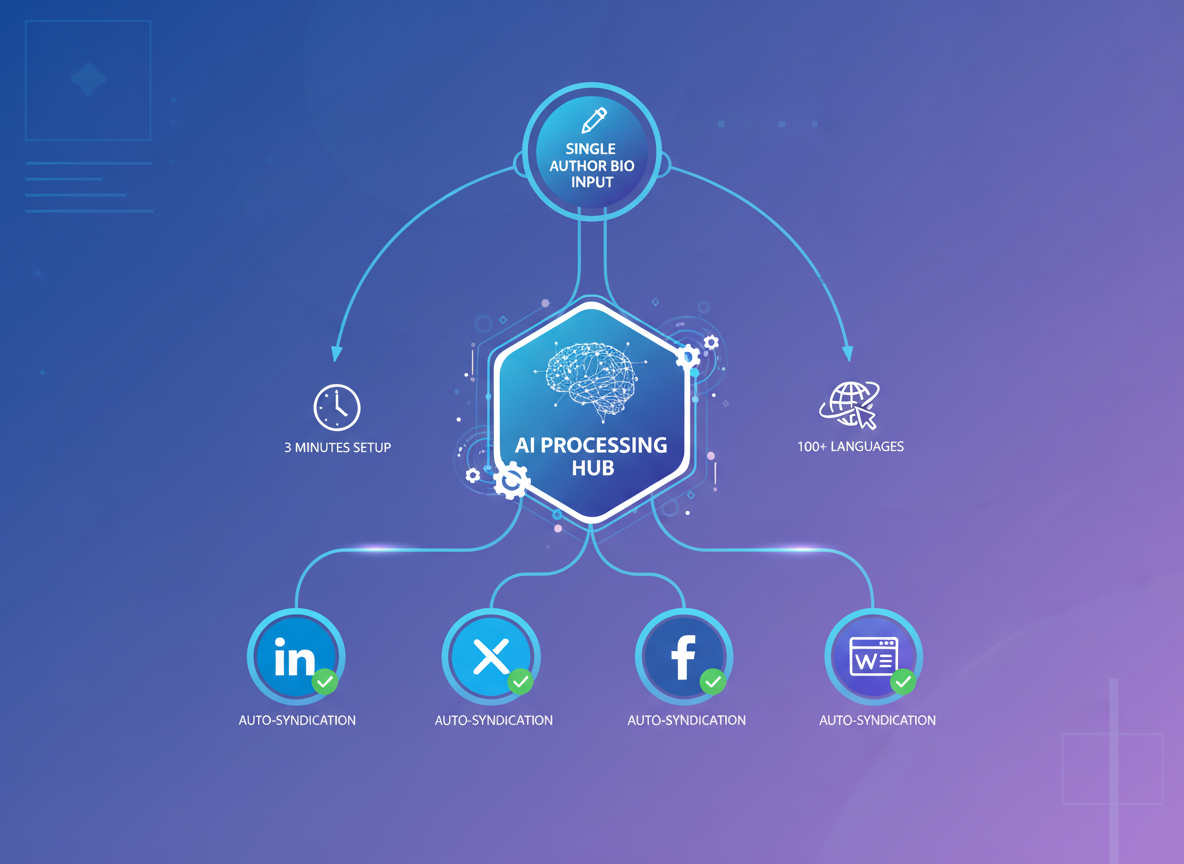
You’ve crafted the perfect bio. You know, the one that actually sounds like you and converts. Now you’re stuck copying and pasting it across LinkedIn, Twitter, Facebook, your website, and everywhere else you show up online.
Then someone asks for a slightly different version. Or you land a new speaking gig and need to update your credentials. Suddenly, you’re tracking down every instance of your bio across a dozen platforms. Sound familiar?
Here’s what most content creators don’t realize: updating your bio manually is costing you hours every month and creating inconsistencies that weaken your brand.
Testing CG flips this entire process. You create your authoritative bio once, and the platform auto-syndicates it across every channel you use. No more version control nightmares. No more outdated bios floating around with that job title from two years ago.
The real power? Testing CG supports 100+ languages, so your personal brand translates seamlessly for global audiences. Auto-publishing keeps your LinkedIn, Twitter/X, and Facebook profiles perfectly synchronized. When you update once, it updates everywhere.
Here’s where it gets interesting. Turn your video content into polished blog posts with your author bio automatically included at the end. Every piece of content reinforces your personal brand without lifting a finger.
Digital entrepreneurs using Testing CG report saving 6+ hours weekly while maintaining brand consistency they could never achieve manually. One freelance consultant doubled her speaking engagements simply because prospects found the same professional presence across every platform.
Right now, you can set up your entire personal brand content system in under 3 minutes. This limited-time setup walks you through creating one master bio that powers your entire online presence. Get started at Testing CG before this offer expires.
Your Personal Biography Action Plan: Implementation Checklist
Here’s the reality: your bio is either working for you or silently killing opportunities on every platform where you exist online. Right now, someone’s deciding whether to hire you, follow you, or scroll past based on those 150 characters you wrote three years ago.
Let’s fix that today.
Step 1: Audit every bio you have—LinkedIn, Twitter, Instagram, your website, guest posts, podcast appearances. Screenshot them. Use the mistakes section from earlier to mark what’s broken.
Step 2: Pick a personal biography example from this guide that matches your profession and career stage. Don’t overcomplicate it—just choose one that resonates.
Step 3: Draft your new versions using the fill-in-the-blank templates. Write three variations: short (150 characters), medium (300 words), and long (500+ words).
Step 4: Implement schema markup on your website. Add your keyword-optimized bio to your About page, author box, and homepage.
Step 5: Update every platform with tailored versions. LinkedIn gets your professional angle, Instagram gets personality, your website gets the full story. A personal brand statement ties everything together across channels.
Step 6: Calendar a quarterly reminder. Your accomplishments change—your bio should too.
Step 7: Consider Testing CG to automate consistent personal brand content across platforms, saving you hours each week while maintaining your voice.
While you’re reading this, someone in your industry just updated their bio with fresh achievements and better positioning. They’re getting the opportunities you deserve.
Start your Testing CG free trial now and never let an outdated bio cost you another connection, client, or opportunity.
Frequently Asked Questions
How long should a personal biography be?
There’s no one-size-fits-all answer, but here’s a framework that works: 50 words for social media profiles (Twitter, Instagram), 100-150 words for professional platforms (LinkedIn summary, conference programs), and 250-300 words for your website’s about page or author bio. Context matters more than word count. If you’re submitting to a podcast as a guest, stick to their requirements. For your own website, you’ve got more flexibility to tell your story properly.
Should I write my bio in first person or third person?
It depends where it’ll appear. Use first person (“I help…”) for your own website, blog, or email signature—it’s more personal and builds connection. Switch to third person (“Sarah helps…”) for conference programs, guest posts, podcast features, or anywhere someone else is presenting you. Third person sounds weird on your own site, but first person looks unprofessional in formal submissions.
What’s the difference between a bio and a personal brand statement?
Your personal brand statement is a concise positioning statement (usually one sentence) that captures your unique value proposition. Think of it as your professional tagline. Your bio expands on this, adding credentials, achievements, and personality. The brand statement is what you stand for; the bio is proof you deliver on that promise.
How often should I update my personal biography?
Review it quarterly, update annually, and immediately after major achievements. Land a big client? Update your bio. Win an award? Add it that week. Speaking at a conference? Refresh before they publish your profile. Your bio should reflect your current reality, not who you were two years ago.
What should I include in my bio if I’m just starting my career?
Focus on education, relevant projects, skills you’re developing, and genuine enthusiasm. Highlight internships, volunteer work, or personal projects that demonstrate your capabilities. Instead of claiming you’re “experienced,” show you’re committed and capable. “Currently completing…” or “Recently launched…” beats padding your bio with fluff.
Can I use the same bio across all platforms?
Absolutely not. Each platform has different audiences and expectations. Your LinkedIn bio should be more comprehensive than your Twitter profile. Your website’s about page needs more personality than your conference speaker bio. For more platform-specific examples, check out our guide on creating bios for different platforms.
How do I make my bio stand out without sounding arrogant?
Balance confidence with specificity and service orientation. Instead of “I’m the best copywriter,” try “I’ve helped 50+ SaaS companies increase conversions by an average of 34%.” Lead with results, not self-praise. Show how you serve others rather than listing how impressive you are.
What are the most important SEO elements for an author bio?
Implement schema markup for author entities, include relevant keywords naturally, build E-E-A-T signals through credentials and achievements, and link to verified social profiles. Google’s looking for real people with demonstrable expertise. Your author bio should prove you’re both.
Should I include personal information in my professional bio?
Strategic personal details build connection without undermining credibility. A brief mention of your location, a hobby that relates to your expertise, or a relatable struggle you’ve overcome can make you memorable. Skip the irrelevant stuff (nobody cares that you like long walks on the beach), but don’t be afraid to show you’re human.
How can I measure if my bio is working?
Track profile views, track inquiries mentioning specific details from your bio, monitor click-throughs to your website, and measure conversions from different platforms. If you’re getting generic “I’d love to connect” messages, your bio isn’t specific enough. If you’re getting targeted inquiries about your exact expertise, it’s working.
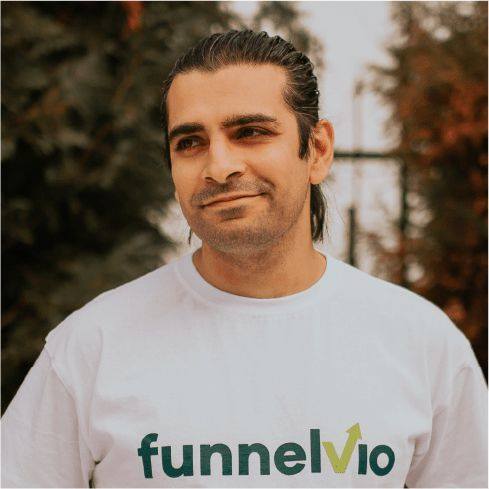
I am a full-time online marketer, for over a decade now. Helped over 100,000+ people & generated well over $12M in online sales.