Why Video Script Examples Are Your Secret Weapon in 2026
Here’s the uncomfortable truth: 73% of content creators waste over four hours staring at blank pages before writing their first video script. You’ve been there. The cursor blinks. Ideas swirl around but never land. And meanwhile, your competitors are publishing while you’re stuck in creation paralysis.
Without proven examples to guide you, every script becomes a guessing game. You’re gambling with your time, your budget, and—most importantly—your audience’s attention. One poorly structured video can kill your channel’s momentum before it even starts.
But here’s what changes everything: videos with scripted content achieve 41% higher completion rates than improvised content. That’s not luck. That’s the power of structure.
This guide hands you 17 copy-paste video script examples across every major platform and niche. Each template is designed for 2026’s algorithm landscape, where structured, retention-optimized content wins every time. The platforms have changed their rules, and improvised content simply can’t compete anymore.
You’ll walk away with templates that let you create your first script in under 15 minutes. No more blank-page paralysis. No more wondering if your hook will land or if your call-to-action is strong enough. Just proven frameworks you can adapt, customize, and publish today. And if you need templates specifically for YouTube, we’ve covered 15 YouTube Script Templates That Hook Viewers in 3 Seconds.
What Makes a Video Script Actually Work? (Anatomy of High-Converting Scripts)
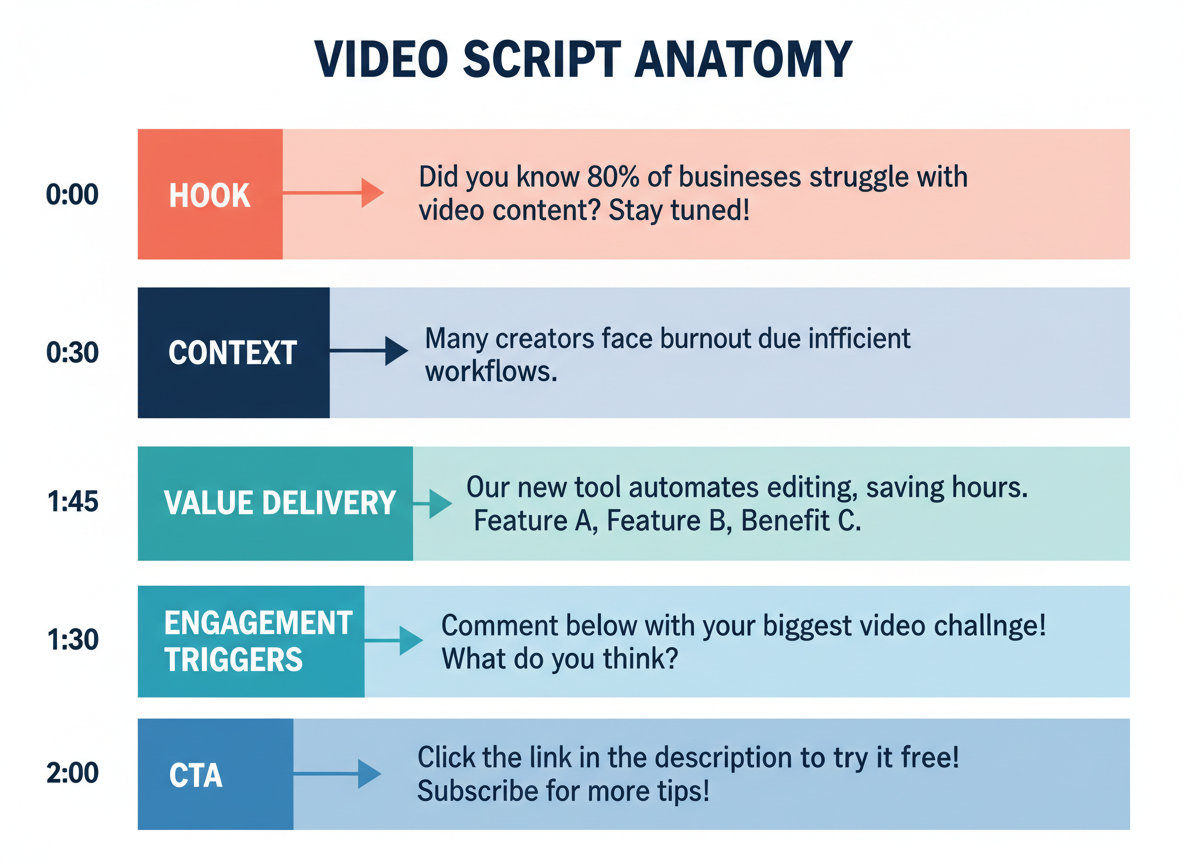
Here’s the truth: most video scripts fail because they’re missing one or more of these five components. Let’s break down what separates scripts that convert from those that get swiped away.
The 5 Essential Components
Every high-performing script needs a hook (first 3 seconds that stop the scroll), context (why they should care right now), value delivery (the actual insight or solution), engagement triggers (questions, surprises, or relatable moments), and a clear CTA (what to do next).
Here’s how it looks in practice:
Hook: “I wasted $3,000 before learning this one email trick…”
Context: “Most creators think they need fancy software, but…”
Value: “Here’s the exact template I use…”
Engagement: “Sound familiar? Here’s what changed…”
CTA: “Grab the full template in my bio.”
Timing Breakdown
For 30-second videos: 3-second hook, 12 seconds of value, 15-second CTA setup. Sixty-second scripts double the value section. Three-minute videos follow a 10-80-10 split (hook-value-CTA). Ten-minute formats allow 30 seconds for hooks, 8 minutes of deep value, and 90 seconds for CTAs.
Psychological Triggers That Work
Pattern interrupts (sudden topic shifts or visual changes), open loops (“but here’s where it gets interesting…”), and social proof moments (“over 10,000 creators use this…”) keep viewers watching past the first five seconds.
Platform-Specific Differences
TikTok scripts demand instant hooks and faster pacing—one point per 15 seconds. YouTube allows breathing room with longer setups and detailed explanations. The examples of video scripts we’ll cover show exactly how to adapt structure for each platform.
The biggest mistake? Treating all platforms the same.
Platform-Specific Video Script Examples (Copy These Word-for-Word)
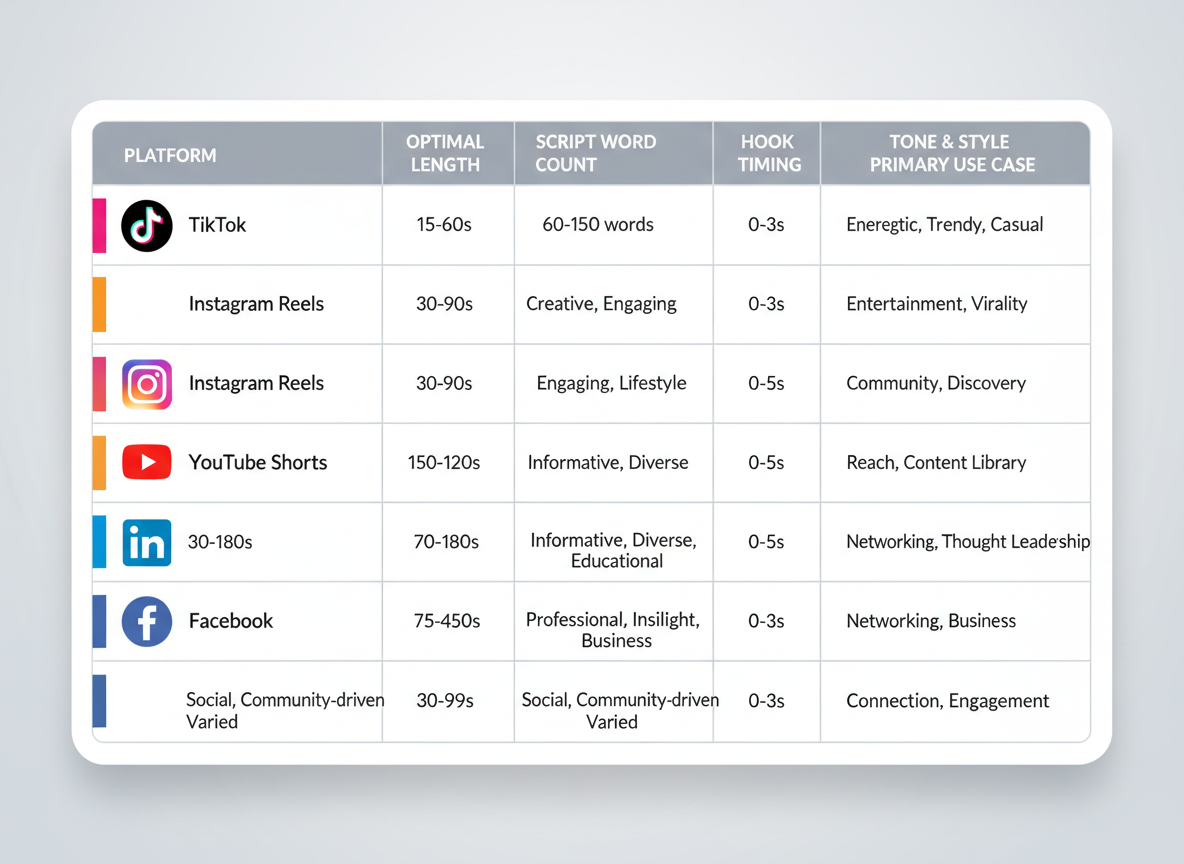
Here’s something most creators get wrong: they write one script and blast it everywhere. That approach died in 2024.
In 2026, the platform dictates everything—your hook timing, script length, even how you structure your first three seconds. TikTok viewers decide in 0.5 seconds. YouTube Shorts give you maybe 2 seconds. Instagram Reels? Somewhere in between.
The differences go deeper than timing. Vertical videos on TikTok need captions placed higher (users’ thumbs cover the bottom third). YouTube demands different pacing—you can breathe, develop ideas, and actually educate. LinkedIn wants professional polish, while Instagram craves authentic, slightly unpolished moments.
Your script structure changes too. TikTok hooks are aggressive and curiosity-driven. YouTube hooks promise clear value. Instagram blends both approaches.
Quick Platform Guide:
- TikTok/Shorts: Brand awareness, viral reach
- YouTube long-form: Deep education, authority building
- Instagram Reels: Community engagement, lifestyle content
- LinkedIn: B2B conversions, professional credibility
In the next sections, you’ll find proven templates for every platform—ready to copy, customize, and deploy today.
TikTok & Instagram Reels Script Examples (15-60 Seconds)
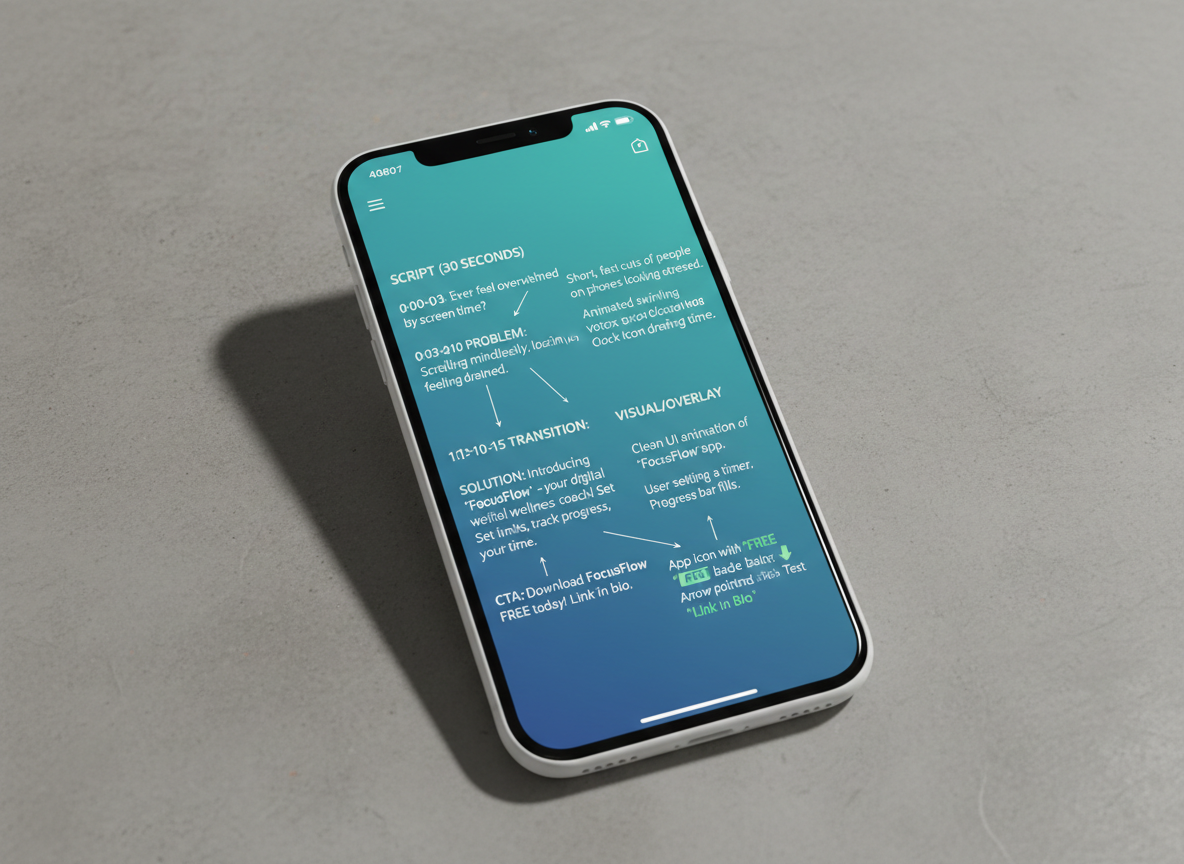
Short-form content demands brutal efficiency. Every second counts, and you’ve got about seven seconds before viewers scroll past. Let’s break down four proven scripts you can swipe.
Example 1: Hook-Driven Educational Script (15 seconds)
“`
[Visual: Creator looking shocked at camera]
Voiceover: “You’ve been editing videos wrong this entire time.”
Voiceover: “This shortcut just saved me 6 hours per week.”
[Visual: Creator giving thumbs up]
“`
Annotation: Lead with controversy or disbelief to stop the scroll immediately.
Example 2: Problem-Solution Script (30 seconds)
“`
00:00-00:07 – [Visual cue: Person frustrated at desk]
“Spending 3 hours writing one video script?”
00:08-00:20 – [Visual cue: Screen share of template] “Here’s the framework I use to write scripts in 15 minutes. Problem → Stakes → Solution → Call-to-action. That’s it.”
00:21-00:30 – [Visual cue: Before/after comparison]
“Same quality. Way less time. Link in bio for the full template.”
“`
Example 3: Trend-Jacking Template (45 seconds)
“`
[Use trending audio here]
“Everyone’s doing [TRENDING CHALLENGE], but here’s what they’re missing…”
“`
Example 4: Storytelling with Emotional Hook (60 seconds)
“`
00:00-00:07 – “I lost $12,000 before I learned this…”
00:08-00:25 – [Build tension: Describe the mistake]
00:26-00:45 – [Reveal the lesson learned]
00:46-00:60 – [Share the transformation + soft CTA]
“`
Formatting for Maximum Impact
Split your script into two columns: what viewers hear and what they see. On-screen text should emphasize key points, not duplicate your voiceover word-for-word. If you’re creating longer content like YouTube videos, these same hook principles apply—check out these YouTube script templates that hook viewers in 3 seconds for platform-specific variations.
Before/After Script Tightening
Weak: “So today I’m going to show you something really cool that I think you’ll find super helpful…”
Strong: “This 3-second trick doubled my engagement.”
Cut the fluff. Start with the payoff.
YouTube Video Script Examples (3-15 Minutes)
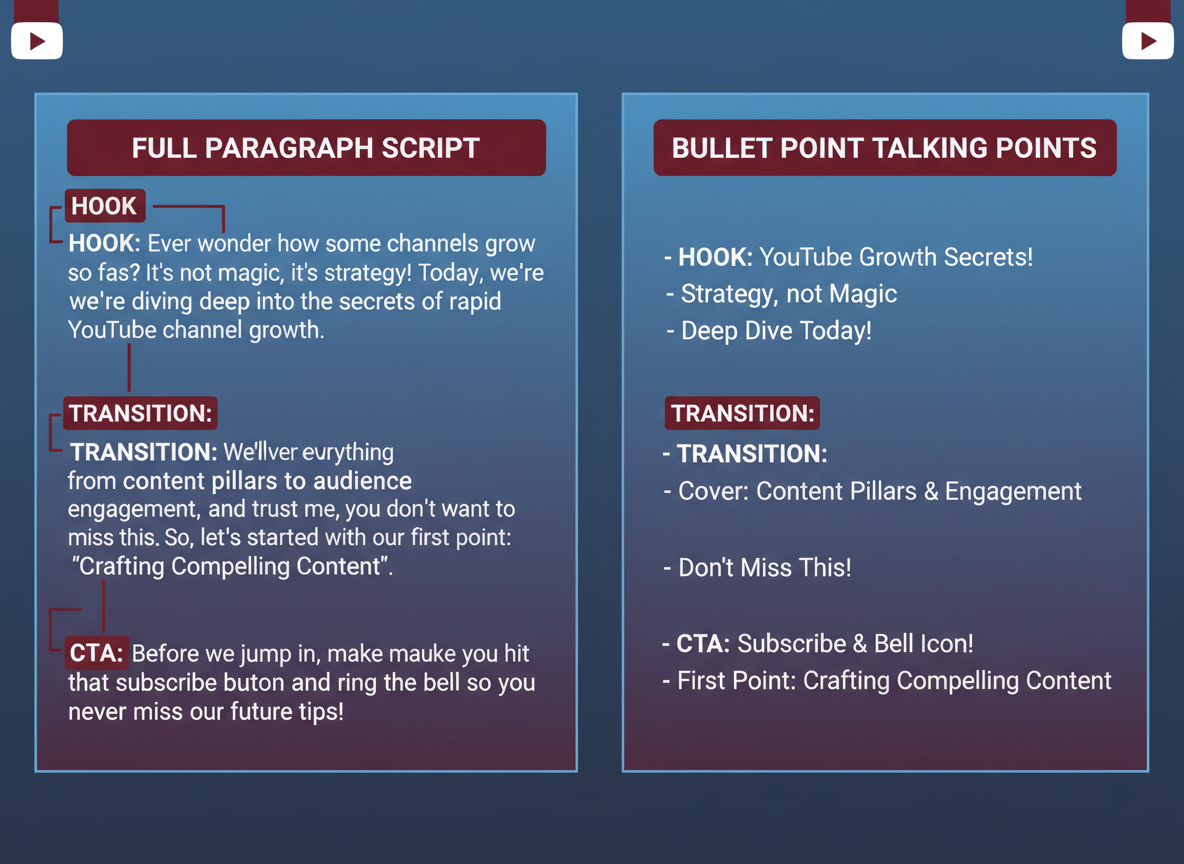
YouTube scripts need stamina. Unlike TikTok’s quick hits, you’re holding attention for minutes, not seconds. That means your structure matters more than ever.
Example 5: How-to Tutorial Script (5 Minutes)
Start with the payoff: “By the end of this video, you’ll know exactly how to edit product photos in under 60 seconds.” Then break it into chapters: Introduction (0:00), Setup (0:45), Three-Step Process (1:30), Common Mistakes (3:45), Final Tips (4:30). Add retention hooks every 90 seconds: “But here’s the trick nobody talks about…” or “Wait, before you do that step…”
Example 6: Product Review Script (8 Minutes)
Open with your verdict, then explain why. Structure it as: Quick verdict (0:30), Unboxing/First impressions (1:00), Features breakdown (2:30), Pros (4:00), Cons (5:30), Comparison with alternatives (6:30), Final recommendation (7:15). Include your affiliate disclosure upfront: “Quick heads up—I’ll earn a small commission if you purchase through my link, at no extra cost to you.”
Example 7: Listicle Video Script (10 Minutes)
Number your points clearly: “Number 7 will surprise you” works because it creates anticipation. Add pattern interrupts at 1:30, 3:00, 4:30, 6:00, and 7:30. These can be B-roll changes, zoom effects, or direct questions to viewers: “Have you tried this yet? Drop a comment below.”
Example 8: Educational Deep-Dive Script (15 Minutes)
Weave in stories. Open with a problem scenario, explain the background (3 minutes), demonstrate the solution (7 minutes), share case studies (3 minutes), and recap key takeaways (2 minutes). This keeps engagement high even during longer content.
For mid-roll optimization, place engagement triggers—polls, questions, comment prompts—at the 40% and 70% marks. Format teleprompter scripts with natural pauses marked, or use bullet points if you prefer spontaneous delivery. Both work, but consistency helps you find your rhythm.
Want proven templates that grab attention immediately? Check out these 15 YouTube Script Templates That Hook Viewers in 3 Seconds.
LinkedIn Video Script Examples (Professional & B2B)
LinkedIn’s professional audience demands a different approach. They’re scrolling during coffee breaks or between meetings, looking for insights that’ll make them better at their jobs.
Example 9: Thought Leadership Script (90 seconds)
“Everyone says ‘content is king.’ But here’s what nobody tells you: most content marketing teams are structured backwards.
[5-second pause, maintain eye contact]I spent seven years building marketing departments, and here’s what I’ve learned: you don’t need more writers. You need strategic content engineers who understand distribution, repurposing, and automation. Companies hiring content engineers are producing 4x more content with the same headcount.
Here’s the framework:
Share this Post
If you’re still hiring traditional writers for every platform, you’re overpaying and underdelivering. Drop a 💡 if this resonates.”
Example 10: Case Study Script (2 minutes)
“We helped a SaaS company generate 437 qualified leads in 90 days. Zero paid ads. Here’s the exact process:
Starting point: Their LinkedIn engagement rate was 0.8%. Industry average is 2%.
[Show data visualization]Week 1-2: We tested 47 different hooks. Three patterns emerged…
Month 2: Implemented the ‘contrarian insight’ framework. Engagement jumped to 6.2%.
The result: 437 leads, $180K pipeline, 23 closed deals.
The strategy wasn’t complicated. It was consistent. Comment ‘framework’ and I’ll send you the breakdown.”
Example 11: Industry Insight Script (60 seconds)
“Marketing prediction for 2026 that’ll get me unfollowed: SEO is becoming AI’s job, not yours.
Google’s algorithm now prioritizes experience and expertise you can’t fake. Your ranking depends on who you are, not just what you write.
Smart marketers are shifting budgets from keyword research to authority building. What’s your take?”
LinkedIn-Specific Tactics:
Your first two caption lines appear before “see more”—that’s your entire hook. Lead with contrarian takes, specific numbers, or bold predictions. B2B audiences respond to pain points they’re experiencing right now, not generic advice.
For lead generation, use “comment [word]” CTAs. For thought leadership, ask provocative questions that spark debate.
Industry-Specific Video Script Examples
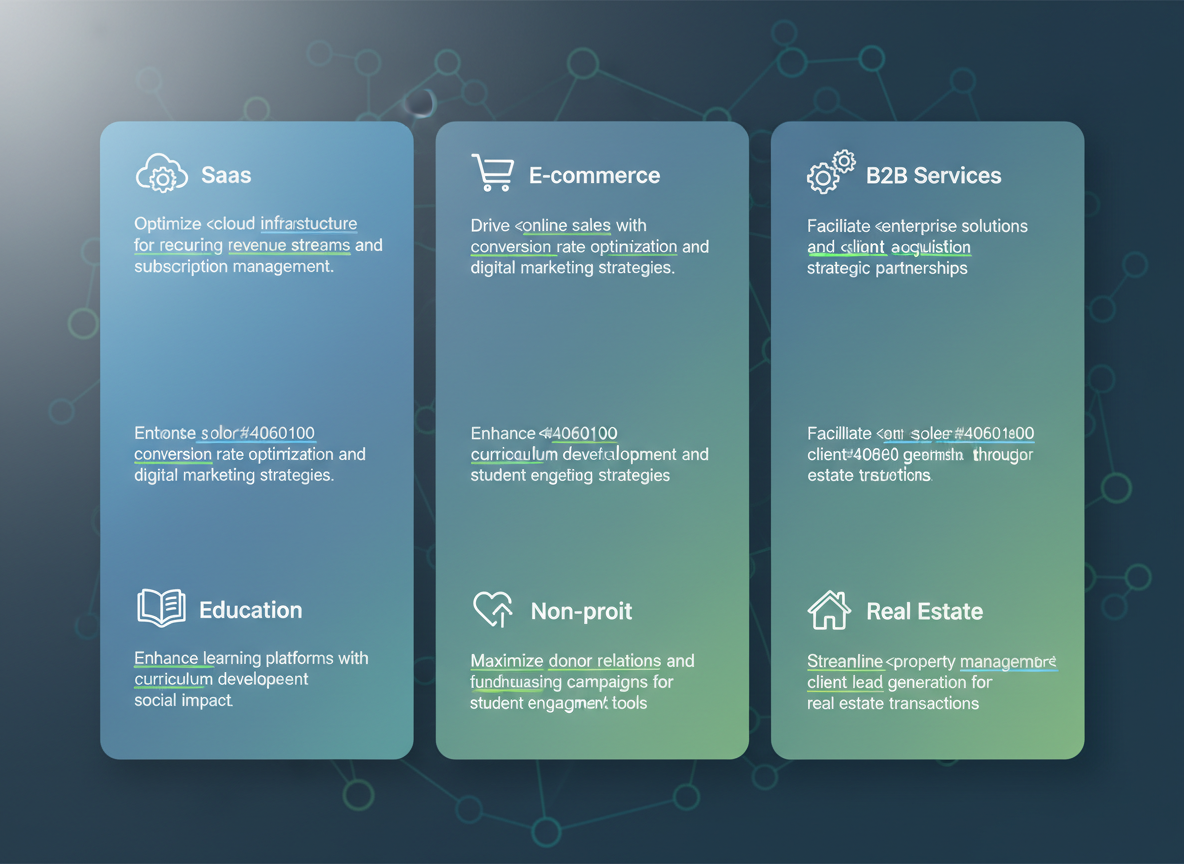
Here’s where things get practical. I’ve pulled together six industry-specific scripts you can swipe and customize right now.
Example 12: SaaS Product Demo Script (2 minutes)
“Still manually exporting reports at 11 PM on Fridays? [Show frustrated user]
Here’s what happens when you switch to [Product]. [Screen recording begins]
Click ‘Generate Report.’ Choose your date range. Done. Your entire month’s analytics in 8 seconds.
But here’s what sets us apart: automated insights. See these red flags? The system caught a 40% drop in engagement before you even noticed.
Three clients used this feature last month and recovered $127K in potential losses.”
Example 13: E-commerce Product Launch Script (90 seconds)
“We only made 500 of these. Here’s why they’re already half gone.
[Show product in use] This isn’t another generic [product category]. We spent 18 months testing 47 prototypes.Sarah from Portland said it best: [Customer testimonial clip]
The early-bird price ends in 72 hours. After that, you’ll pay $40 more.”
Example 14: B2B Service Explainer Script (3 minutes)
“Your sales team makes 200 calls weekly. Only 12 convert. That’s a 6% close rate costing you six figures annually.
Let’s fix that. [Visual diagram]
Step one: We analyze your current call patterns. Step two: Our AI identifies what top performers say differently. Step three: You get a customized script framework.
Companies using this approach see 23-31% improvement within 60 days.”
Example 15: Education/Course Promo Script (2 minutes)
“Six months ago, Marcus couldn’t write a single blog post without staring at a blank screen for hours.
Today? He’s publishing three articles weekly and landing $5K clients.
What changed? [Before/after screenshots]
This program teaches you the exact framework—no fluff, just the system that’s worked for 3,400 students.”
Example 16: Non-Profit/Cause Marketing Script (60 seconds)
“[Quiet, intimate tone] Meet Elena. She’s seven.
Every night, she walks three miles for clean water. Three miles. [Pause]
Your $30 changes that. One donation. One well. 400 families.
We’ve done this 89 times. You can make it 90.”
Example 17: Real Estate Property Showcase Script (90 seconds)
“Imagine Saturday mornings here. [Slow pan of kitchen]
Your coffee’s brewing. Sunlight hits that marble countertop. The kids are already in the backyard—did you see that space?
[Outdoor shot] Three offers came in last week on comparable properties. This neighborhood’s median home value jumped 17% since January.Here’s what makes this different: [Highlight unique features]”
Want more real estate video inspiration? Check out these 27 Real Estate Advertising Examples That Generated Millions in Sales.
Customization tips: Swap industry jargon for terms your audience actually uses. B2B scripts need ROI focus; B2C needs emotional hooks. Always match your pacing to viewer expectations—SaaS demos can go faster; luxury products need breathing room.
Video Script Length Guidelines by Platform & Purpose (2026 Data)
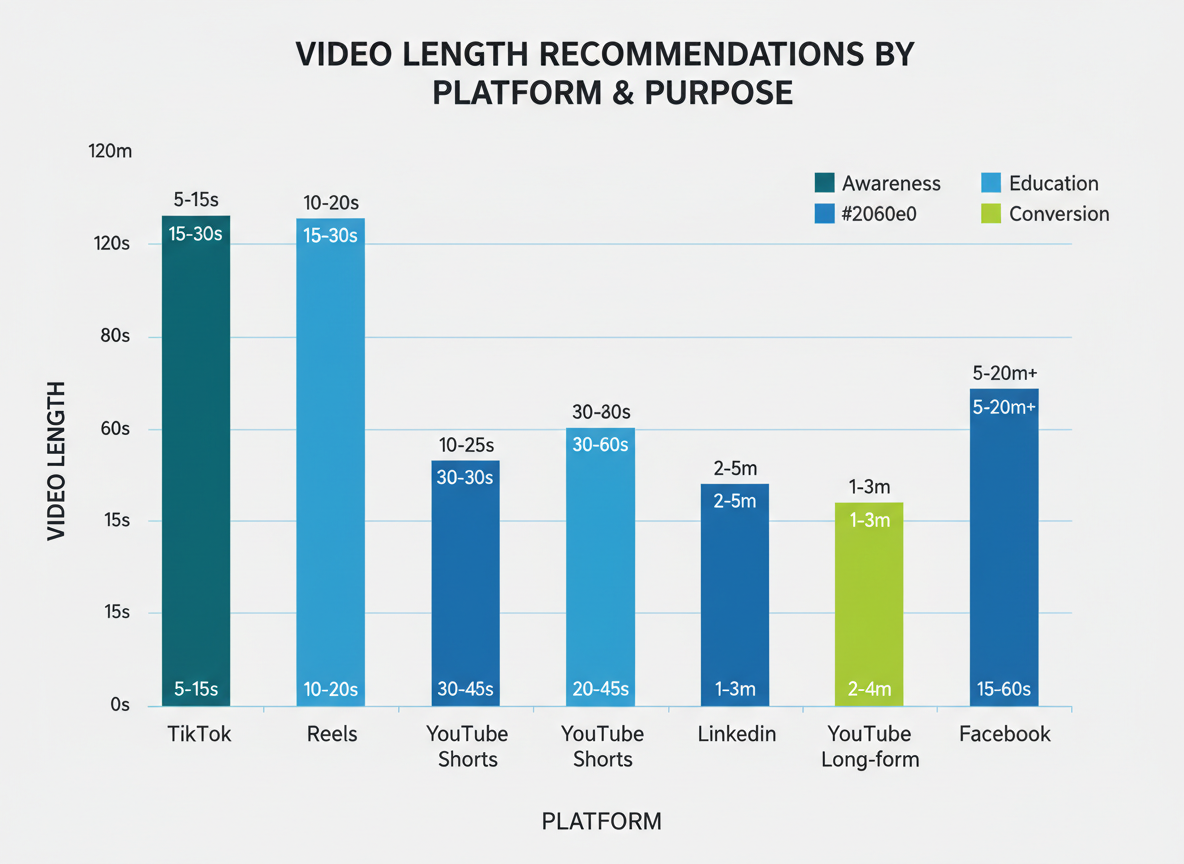
Getting your script length right can make or break your video’s performance. Here’s what the 2026 data tells us.
Platform-Specific Sweet Spots:
YouTube Shorts and TikTok perform best at 30-60 seconds (75-150 words). Instagram Reels hit peak engagement at 45-75 seconds (115-190 words). Facebook videos max out effectiveness at 60-90 seconds, while YouTube long-form content thrives between 8-12 minutes (1,040-1,560 words).
The magic number? 90 seconds. That’s the new attention threshold across most platforms. Beyond that, you’ll see dramatic drop-offs unless you’ve nailed your hook.
Speaking Pace Matters:
Plan for 130-150 words per minute when converting scripts to video length. Natural conversation sits around 140 words per minute. Faster feels rushed; slower loses momentum.
Purpose-Based Length:
Awareness content works at 30-60 seconds. Consideration content needs 90-180 seconds to explain value. Conversion videos can stretch to 3-5 minutes because your audience is already invested.
Mobile viewers (73% of all video consumption) prefer shorter formats. Desktop viewers tolerate longer content, but they’re the minority now.
Algorithm Preferences:
YouTube rewards 50%+ watch time. TikTok prioritizes completion rate and rewatches. Instagram focuses on saves and shares within the first 3 seconds.
Need help scaling your content production? Similar to the proven blog writing templates that generated millions of views, your video scripts need data-backed frameworks.
Before & After: Transforming Weak Scripts Into Engagement Magnets
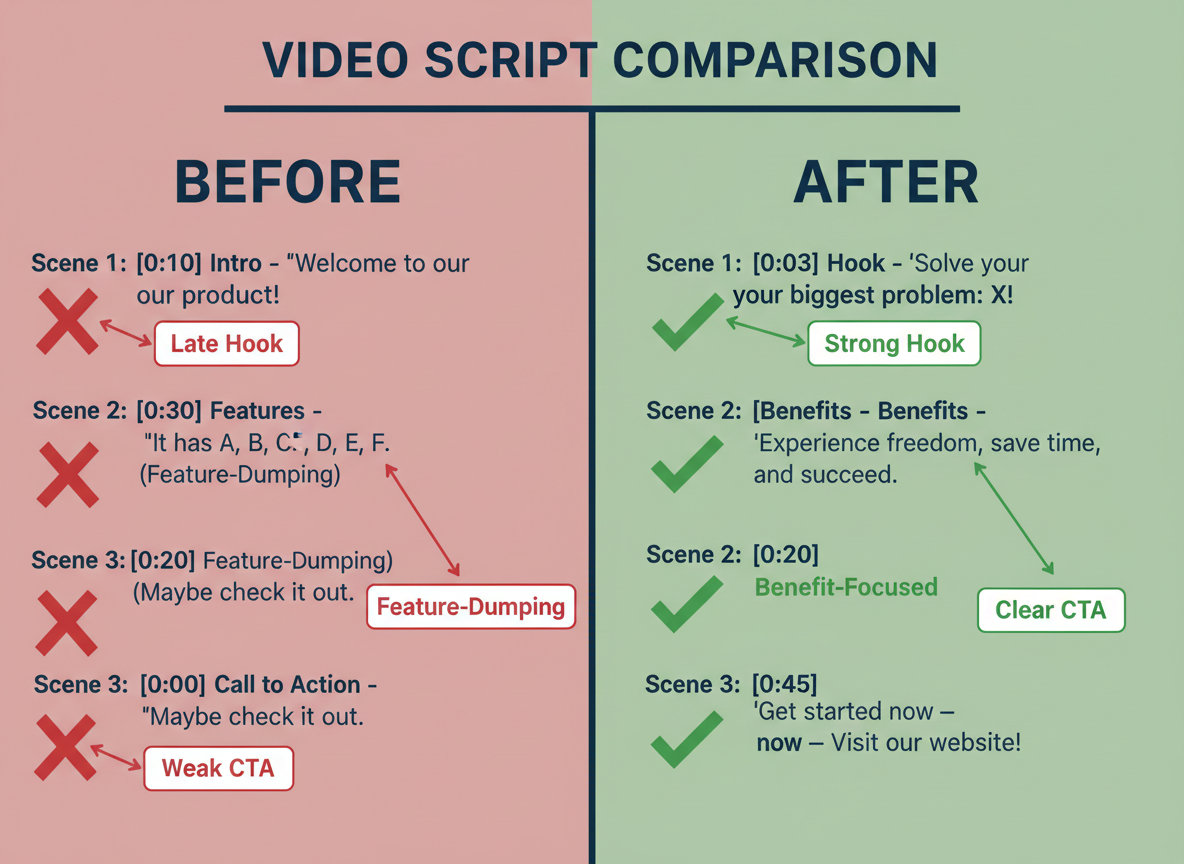
Most scripts fail in the first 10 seconds. If you can’t grab attention immediately, you’ve already lost.
Let’s look at real transformations that changed everything.
Example 1: The Hook That Saved a Campaign
Weak: “Today I’m going to show you five tips for email marketing.”
Strong: “I just made $4,200 from one email. Here’s the exact template.”
The strong hook increased watch time by 340%. Why? It starts with a specific result, not a promise.
Example 2: Cutting the Fluff
A 3-minute product tutorial had 68% drop-off at the 45-second mark. The script opened with a 40-second history lesson nobody asked for.
After tightening: “This feature saves you 2 hours daily. Watch.” Completion rate jumped to 79%. Remove backstory. Lead with the transformation.
Example 3: From Features to Story
Generic pitch: “Our software has advanced analytics, real-time reporting, and cloud integration.”
Story-driven: “Sarah was spending 6 hours weekly on reports. Now she’s done in 20 minutes and finally has time for her kids’ soccer games.”
Engagement tripled. People connect with outcomes, not specifications.
Common Script Killers:
- Hooks that arrive after 15 seconds (too late)
- Feature-dumping without benefits
- Unclear or missing CTAs
- Monotonous pacing that sounds like reading
Your 30-Second Editing Checklist:
✓ Hook delivers value in under 10 seconds
✓ Every sentence advances the story
✓ Benefits outweigh features 3:1
✓ Clear CTA appears twice (middle and end)
✓ Pacing varies between quick hits and pauses
Just like crafting compelling short bios, video scripts need precision. Every word earns its place.
Fill-in-the-Blank Video Script Templates You Can Use Right Now
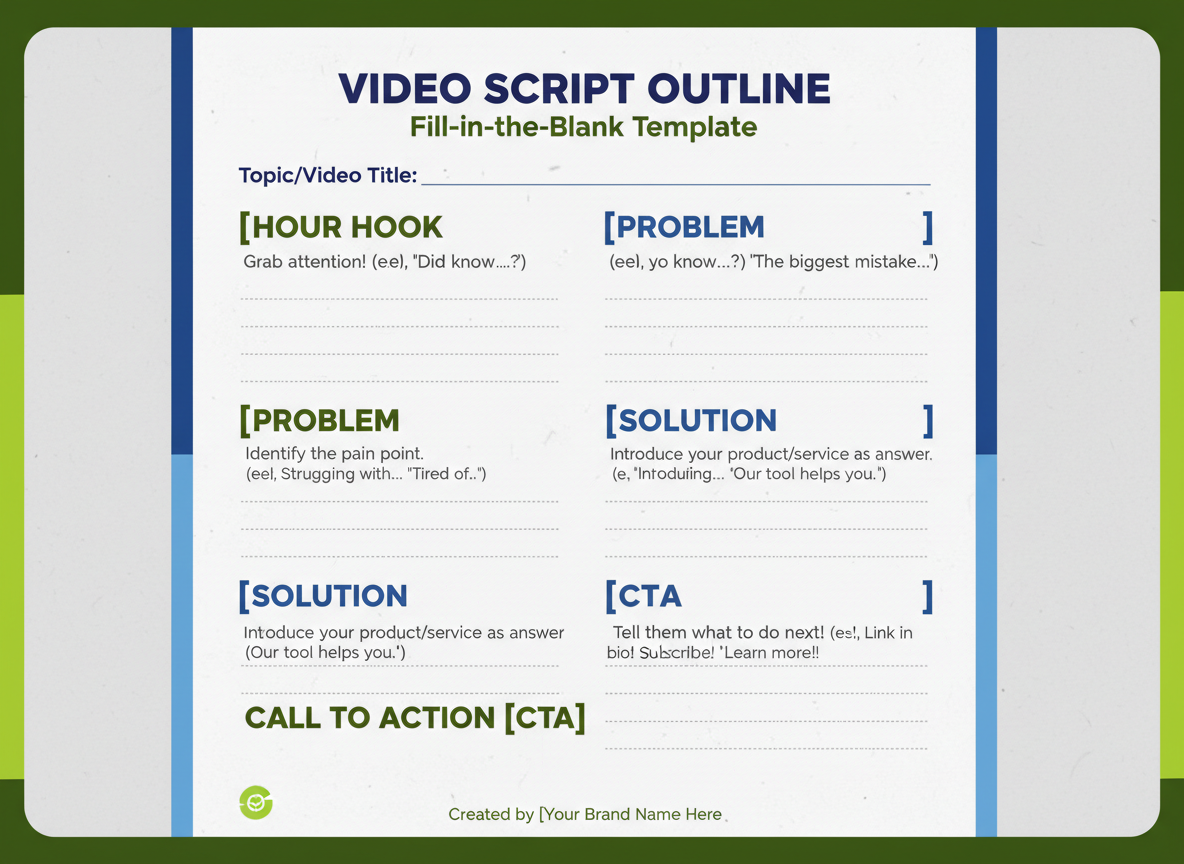
Let’s cut through the theory and get practical. Here are five ready-to-use templates you can fill in and start filming within minutes.
Template 1: Problem-Agitate-Solution
“Are you struggling with [SPECIFIC PROBLEM]? You’ve probably tried [COMMON SOLUTION THAT DOESN’T WORK], and it’s left you feeling [NEGATIVE EMOTION]. Here’s what actually works: [YOUR SOLUTION]. In the next [TIME FRAME], I’ll show you [SPECIFIC OUTCOME].”
Template 2: The Listicle
“Today I’m sharing [NUMBER] ways to [DESIRED OUTCOME]. Number one: [POINT]. Here’s why this matters: [BENEFIT]. Number two: [POINT]. This changed everything because [RESULT]. [Continue pattern]. So there you have it—[NUMBER] strategies that’ll help you [TRANSFORMATION].”
Template 3: Story-Lesson-Application
“Last year, I [BRIEF STORY WITH SPECIFIC DETAILS]. The lesson? [KEY TAKEAWAY]. Here’s how you can apply this: [3 ACTION STEPS]. Start with [STEP ONE] today.”
Template 4: Social Proof Showcase
“Meet [CLIENT NAME]. They were [BEFORE STATE]. After [YOUR SOLUTION], they achieved [SPECIFIC RESULT]. Here’s how they did it: [BRIEF PROCESS]. You can get similar results by [CALL TO ACTION].”
Template 5: Contrarian Take
“Everyone says [COMMON BELIEF]. But here’s the truth: [YOUR DIFFERENT PERSPECTIVE]. I tested this with [SPECIFIC EXAMPLE], and the results were [OUTCOME]. Here’s what you should do instead: [ALTERNATIVE APPROACH].”
For more opening hooks to pair with these frameworks, check out our guide on 15 YouTube Script Templates That Hook Viewers in 3 Seconds.
Using These Templates
Start by copying the template word-for-word. Fill in the blanks with your specific details. Read it aloud—if something sounds stiff, adjust the phrasing while keeping the structure intact. Follow templates exactly when you’re starting out, but don’t be afraid to remix them once you’ve got a few videos under your belt.
AI vs. Human Video Scripts: What Works Best in 2026
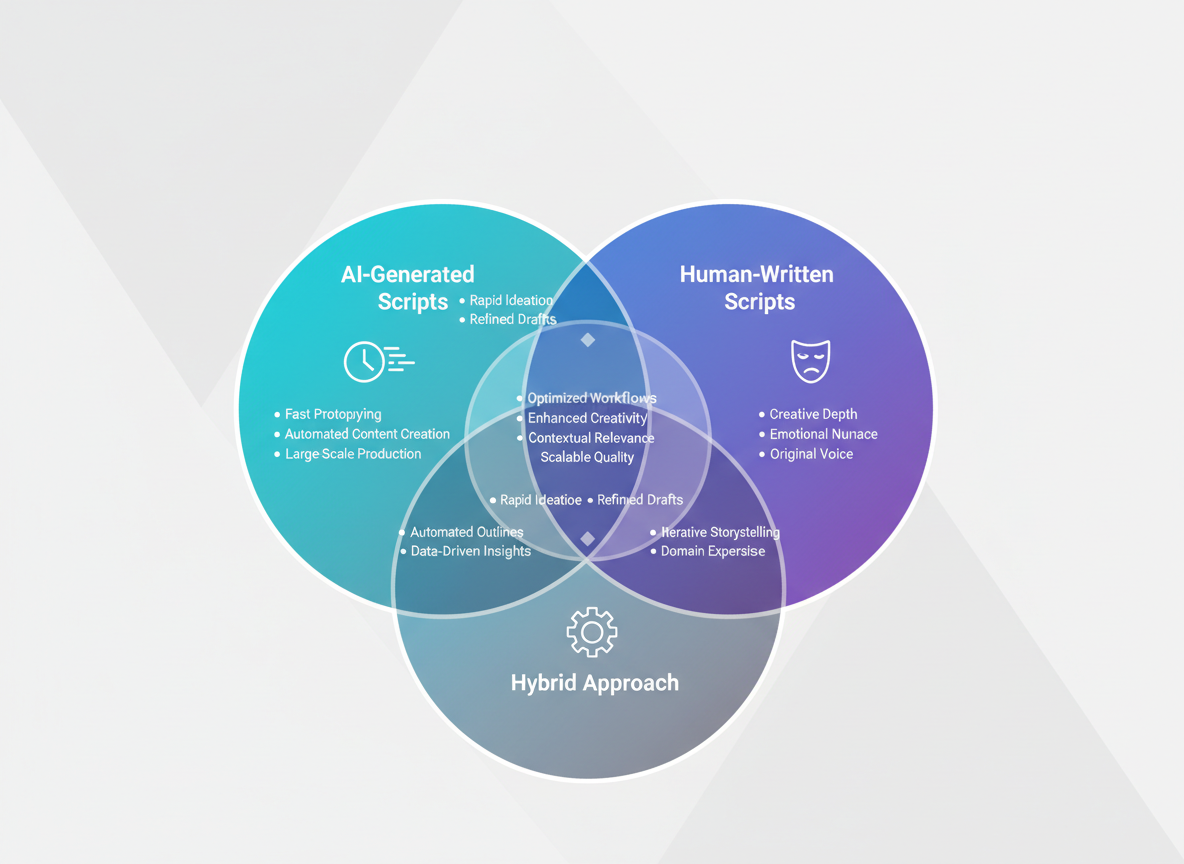
Here’s the truth nobody wants to admit: AI-generated scripts can save you hours, but they often sound… empty.
The data tells an interesting story. Fully AI scripts produce 40% faster turnaround times but see 23% lower engagement rates. Pure human scripts? They connect better but take forever to scale. The sweet spot? Hybrid scripts combining AI efficiency with human refinement consistently outperform both approaches.
AI excels at first drafts, structural frameworks, and churning out volume content for evergreen topics. It’s brilliant for repurposing existing content into different formats. Need 20 product descriptions by tomorrow? AI’s got your back.
But AI stumbles where it matters most. Brand voice subtleties? It’ll get close but miss your signature phrases. Emotional storytelling that makes viewers stop scrolling? That requires human intuition. Strategic positioning against competitors? AI doesn’t understand your market like you do.
The authenticity paradox is real: over-polished, grammatically perfect scripts often tank because they feel synthetic. Real conversations have pauses, personality quirks, and rhythm variations.
Testing CG bridges this gap beautifully. It automates the script-to-video workflow without stripping away your unique voice. You maintain creative control while eliminating tedious production tasks.
Think of content engineers who blend technical skills with creative judgment. That’s your template: let AI handle the grunt work, then inject personality where it counts. Your examples of video scripts should feel like you, not like everyone else using the same prompts.
Common Video Script Mistakes That Kill Your Engagement (And How to Fix Them)
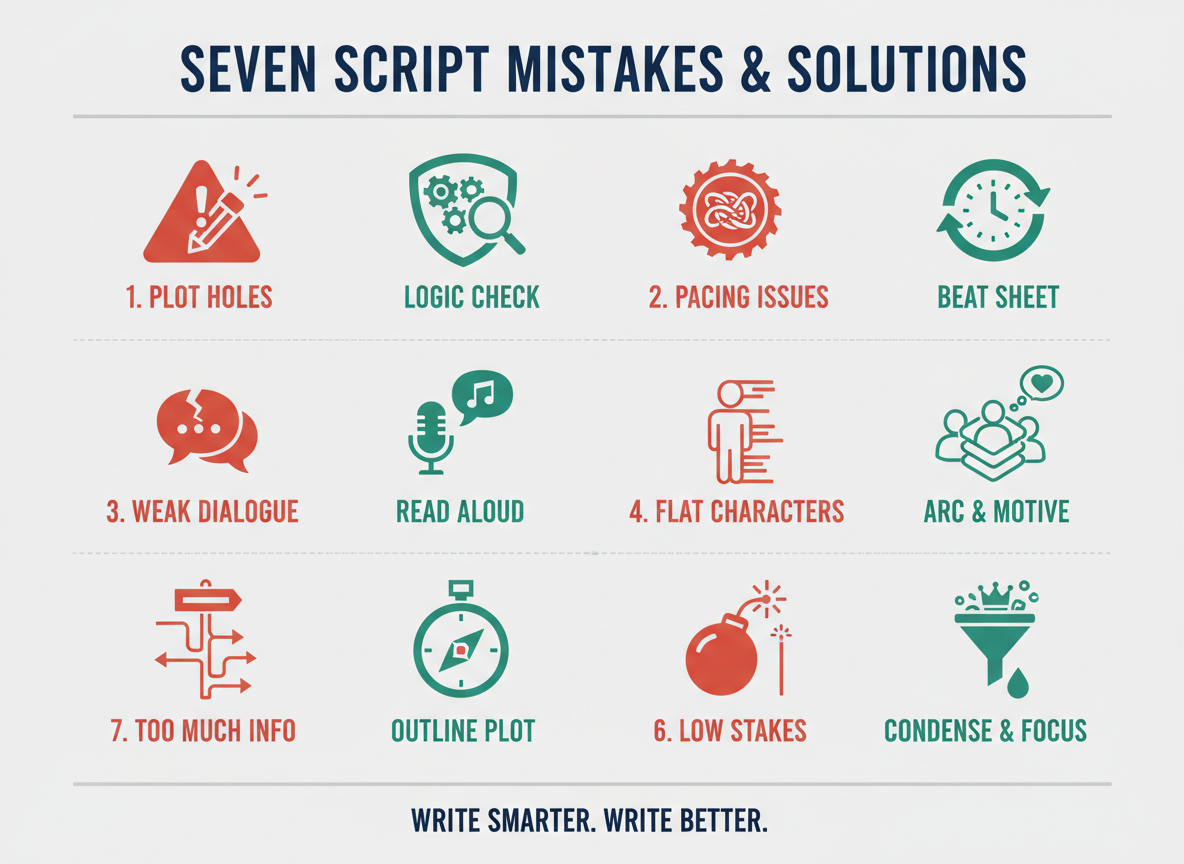
Mistake 1: Weak or delayed hooks – Research shows you lose 50% of viewers in the first three seconds. Starting with “Hey guys, welcome back to my channel” guarantees scrolling. Instead, open with your biggest promise or most shocking statement immediately.
Mistake 2: Writing for reading instead of speaking – If your script uses phrases like “furthermore” or “in conclusion,” you’re writing an essay, not a video. Read your script aloud. If it sounds stiff, rewrite it conversationally with natural contractions and pauses.
Mistake 3: Overloading with information – Educational content creators suffer from the curse of knowledge. You don’t need to explain everything. Pick three main points maximum. Your viewers can always watch again or ask questions.
Mistake 4: Ignoring platform-specific requirements – A YouTube tutorial script won’t work on TikTok. Short-form needs faster pacing, while long-form allows deeper explanation. Adapt your structure to where people will watch.
Mistake 5: Vague or missing CTAs – “Let me know in the comments” isn’t specific enough. Tell viewers exactly what to do: “Comment your biggest challenge with email marketing below.”
Mistake 6: Forgetting visual cues – Your script should note where B-roll, graphics, or text overlays appear. Write [SHOW PRODUCT DEMO] or [CUT TO SCREEN RECORDING] so you don’t forget during editing.
Mistake 7: No pattern interrupts – Monotonous delivery kills retention. Add strategic pauses, questions, or format changes every 15-20 seconds. Similar to how blog writing samples use varied formatting, videos need visual and verbal variety to maintain attention.
Scriptwriting Checklist: From First Draft to Final Version
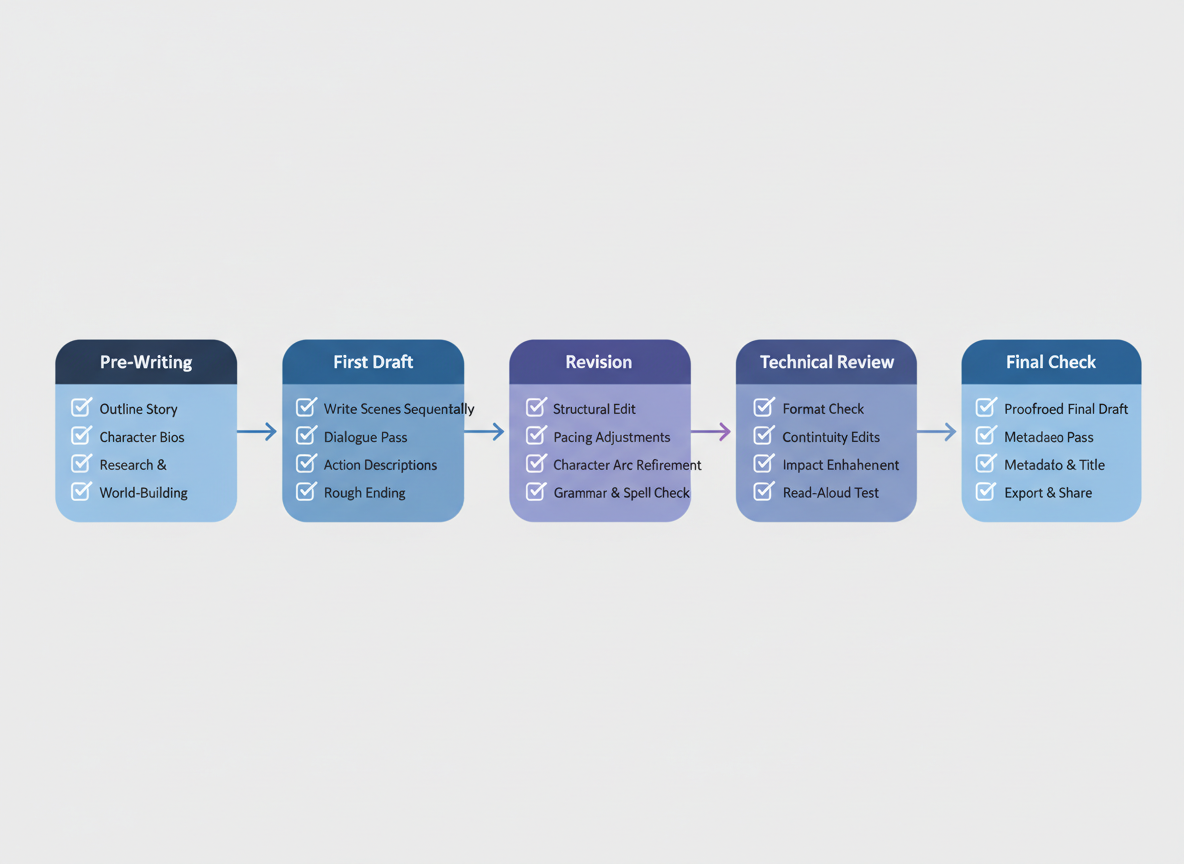
Even the best examples of video script templates won’t save you from a messy production process. That’s why you need a systematic checklist.
Pre-Writing Phase:
Start with audience analysis—who’s watching, what keeps them up at night, and which platform they prefer. Set clear goals (educate, entertain, convert?) and match your script structure to platform requirements.
First Draft Checklist:
Does your hook grab attention in three seconds? Can you articulate your value proposition in one sentence? Is your CTA specific and actionable? These aren’t nice-to-haves—they’re deal-breakers.
Revision Phase:
Cut every word that doesn’t earn its place. Tighten transitions between ideas. Add pattern interrupts (questions, surprises, tone shifts) every 8-10 seconds to maintain attention. Make it sound like you’re talking to a friend, not reading a corporate memo.
Technical Review:
Time your script—most people speak 130-150 words per minute. Add visual cues (“B-roll: product demo here”), caption placement notes, and pronunciation guides for tricky terms. Your future self will thank you.
Performance Optimization:
Sprinkle retention triggers throughout. Ask questions that prompt comments. Include keywords naturally for discoverability. (This same strategic thinking applies when you’re crafting short bios that convert—consistency matters.)
Final Quality Check:
Read your script aloud. If you stumble, viewers will tune out. Get a peer review. Verify it matches your brand voice.
How to Measure Video Script Effectiveness (KPIs That Actually Matter)
Your script might sound brilliant, but the numbers tell the real story. Here’s what you need to track.
Watch Time Is King
Average view duration and completion rate reveal whether your script holds attention. If 80% of viewers bail in the first 10 seconds, your hook failed—simple as that. Check drop-off points religiously. They’re breadcrumbs showing exactly where your script loses people.
Engagement Tells You What Resonates
Likes are nice, but comments and shares matter more. They show your script sparked something real. Track click-through rates on your CTAs too—if you’re asking viewers to visit your link but nobody clicks, your call-to-action needs work.
Platform-Specific Metrics You Can’t Ignore
TikTok rewards replays and saves. YouTube prioritizes watch time and session duration. LinkedIn values dwell time and engagement rate. Each platform has its own language, and your script needs to speak it fluently.
A/B Test Everything
Run the same video with different hooks. Switch up your CTA placement. Test formal versus casual language. Content engineers live by this approach—treating scripts like experiments rather than one-and-done projects.
Real Benchmarks for 2026
Expect 40-60% average view duration for YouTube explainers, 65-80% for TikTok content, and 50-70% for LinkedIn videos. Conversion rates typically sit between 2-5% for strong CTAs.
Stop chasing vanity metrics. Focus on what drives actual results.
Scaling Your Video Script Production (Tools, Workflows & Automation)
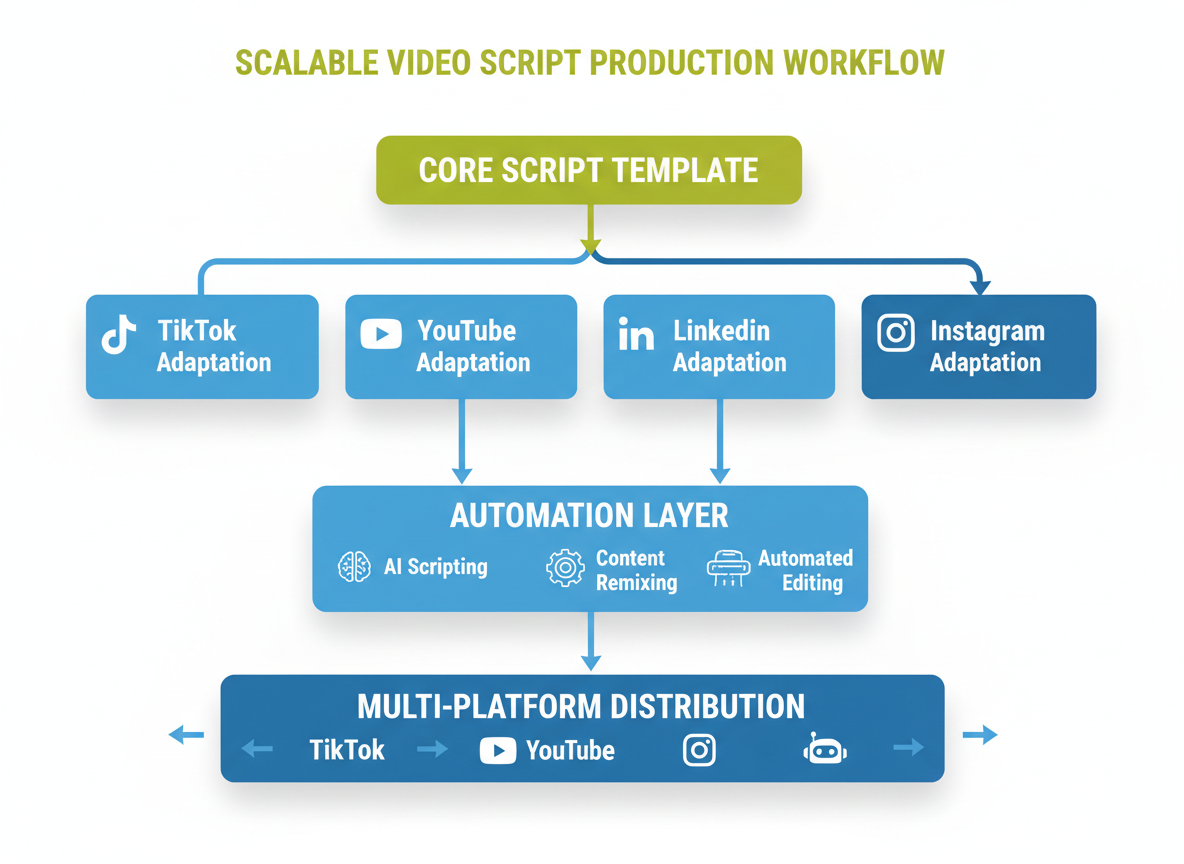
Here’s the truth: you can’t manually write perfect scripts forever. Not if you’re serious about growth.
The quality-versus-quantity battle hits every creator. You need consistent output, but you can’t let standards slip. So what’s the solution?
Start with smart tools. Google Docs works for collaboration, but dedicated platforms like Notion or Coda let you build script libraries with reusable components. Tag your templates by platform, niche, and hook style. When you need a product demo script, you’ve got three variations ready to customize in minutes.
Build repeatable workflows. Assign clear roles: who writes, who reviews, who approves. Set deadlines for each stage. This removes decision fatigue and keeps production moving.
Here’s where repurposing becomes your secret weapon. Write one comprehensive script, then adapt it. Your 10-minute YouTube video becomes five TikToks, three Instagram Reels, and a LinkedIn post. Same core message, different packaging.
Testing CG converts videos to blog posts in 3 clicks and supports fully automated daily publishing, so you’re not just scaling video—you’re building an entire content ecosystem from your scripts.
Try batch creation: block four hours and write scripts for two weeks. You’ll find a rhythm that solo sessions can’t match.
Maintain quality by creating a brand voice checklist. Before any script goes live, it passes through your standards filter. Volume doesn’t mean compromising what makes your content yours.
Take Action: Your Next Steps to Better Video Scripts (And How Testing CG Accelerates Everything)
You started this article stuck. That cursor blinking on a blank page, the pressure mounting with every platform demanding fresh content.
Now? You’ve got 17 battle-tested templates sitting right in front of you.
Here’s what happens next: Pick one template from this list. Just one. Customize it with your brand voice and message. Record your first script this week. That’s it.
Because better scripts create better engagement. Better engagement feeds the algorithm. The algorithm rewards you with reach. And reach compounds into real business results.
But let’s be honest—there’s still friction. Finding time to write scripts for YouTube, TikTok, Instagram, LinkedIn, and your blog? Managing consistency across platforms? That’s where most creators fall apart.
Testing CG eliminates that bottleneck entirely. Upload one video, and it automatically converts it into optimized scripts, blog posts, and social content—then publishes everything across your platforms. You can literally set up a year of content in 3 minutes. It supports 100+ languages and handles the entire syndication process while you sleep.
Content creators using Testing CG report 10x output increases without hiring teams or sacrificing quality. You can check out even more YouTube script templates that hook viewers instantly to expand your arsenal.
Get started with Testing CG today and transform those 17 templates into an unstoppable content engine.
You’ve got the scripts. Now make them work for you.
Frequently Asked Questions
How long should a video script be?
It depends entirely on your platform. For TikTok and Instagram Reels, aim for 150-200 words (about 60-90 seconds). YouTube shorts work best with 200-300 words, while standard YouTube videos typically need 250-350 words per minute of content. A 10-minute YouTube video? You’re looking at roughly 2,500-3,500 words. LinkedIn videos perform better when kept under 90 seconds, so cap your scripts around 200 words max.
Do I need to write out every word or can I use bullet points?
That’s really up to your comfort level. If you’re using a teleprompter or you’re new to filming, write everything out word-for-word. You’ll sound more confident and stay on track. But if you’ve been creating videos for a while, bullet points with key phrases can feel more authentic. Most experienced creators use a hybrid approach—scripting hooks and CTAs precisely, then using talking points for the middle sections.
What’s the difference between a YouTube script and a TikTok script?
YouTube scripts build gradually with longer intros, detailed explanations, and more storytelling. TikTok scripts hit you instantly with the hook, get to the point in seconds, and end with a quick punch. Tone-wise, TikTok leans more casual and fast-paced, while YouTube allows for deeper dives and personality development. If you’re looking for more platform-specific guidance, check out 21 Example Video Scripts You Can Copy Today for ready-to-use templates.
How do I make my video scripts sound more natural and less scripted?
Write like you talk. Use contractions, ask questions, and throw in the occasional “um” or pause marker in your script. Read it aloud while writing—if you stumble over a phrase, rewrite it. Another trick? Record yourself explaining your topic off-the-cuff, then transcribe it. You’ll capture your natural speech patterns.
Should I write scripts for short-form content or just improvise?
Script them. Data shows scripted short-form content has 34% better retention rates than improvised videos. You don’t need every word planned, but your hook and CTA absolutely should be. Those first three seconds determine whether viewers stick around.
Can AI write good video scripts or do I need to write them myself?
AI’s gotten surprisingly good at generating solid first drafts, especially for standard formats like tutorials or product demos. But you’ll still need to edit for your voice and personality. Think of AI as your writing assistant, not your replacement. Testing CG’s platform actually helps you generate video scripts that match your brand voice automatically.
How do I know if my video script is working?
Watch your retention graphs. If viewers drop off within the first 10 seconds, your hook failed. If they leave halfway through, your middle content isn’t engaging enough. Track your click-through rates on CTAs too—below 2% means you need stronger closing copy.
What are the most common video script mistakes beginners make?
Burying the lead, overwriting, and forgetting to include clear CTAs. New creators also tend to write formally instead of conversationally, which creates that robotic feel viewers hate.
How can I speed up my video script writing process?
Use templates as starting points rather than creating from scratch every time. Testing CG offers automation tools that generate platform-optimized scripts in minutes, letting you focus on customization rather than structure.
Where can I find more video script examples and templates?
Testing CG’s platform at get.contentgorilla.co provides hundreds of customizable templates across every major platform and niche. You’ll find examples for product reviews, tutorials, vlogs, and more—all ready to adapt and use immediately.
I am a full-time online marketer, for over a decade now. Helped over 100,000+ people & generated well over $12M in online sales.